His Yoke is Easy

Focal Passage: Matthew 11:28-30

There is a kind of weariness that sleep cannot fix. It settles not in the body but in the soul, where faith is meant to live and breathe. I have felt it at times. I bet you have, too.

Many Christians know this quiet exhaustion—the slow erosion of trust when prayers seem unanswered, obedience feels unnoticed, and God’s promises appear distant. It is not necessarily the weariness of doing too much or trying too hard, although that can happen. It can also manifest itself as we wonder if what we are doing still matters to God.

This spiritual fatigue often grows in the tension between what we believe and what we experience. We know God is good, attentive, and present, yet life can still feel heavy with silence, delay, and ambiguity.

Over time, the heart begins to carry burdens it was never meant to bear—managing outcomes, maintaining appearances of strength, and quietly questioning God’s involvement.

Jesus’ invitation in Matthew 11:28–30 speaks directly to this deep weariness. Christians grow weary sometimes not because faith is flawed, but because we often misunderstand its nature, turning trust into effort and surrender into striving.

Into that self-imposed exhaustion, Jesus offers not more to do, rather, he offers himself as someone to whom we can come.

That offer changes everything.

I think that’s why I gravitated this week to one of the greatest promises of New Testament scripture.

Come to me, all you who are weary and burdened, and I will give you rest. Take my yoke upon you and learn from me, for I am gentle and humble in heart, and you will find rest for your souls. For my yoke is easy and my burden is light. (Matthew 11:28-30)

I know this passage speaks first to a Jewish culture that demanded complete obedience to a wide-ranging system of Pharisaic rules, regulations and expectations. It is an invitation to those who felt the crushing weight of this legalistic religion and floundered in their inability to achieve righteousness through effort.

I also think it speaks to those of us today whose faith, once simple and confident, becomes strained under unmet expectations and prolonged uncertainty.

Jesus calls to those who are weary and burdened. The Greek words for “weary” and “burdened” carry distinct meanings that deepen the nature of Jesus’ invitation to come to him.

The word used for weary (kopiao) means to “grow tired from hard work, to toil to the point of exhaustion.” It is the strenuous effort that drains one physically, emotionally and even spiritually.

It is the same word used in John 5:5 when Jesus told Peter who had been fishing through the night to cast the nets again. Peter responded, “Master, we’ve worked hard all night and haven’t caught a thing.” They had worked and grown weary not only because it was hard work, but because it was all for nothing.

To be “burdened” (phortizo) or heavy ladened, depending on your translation, is to “load down.” Grammatically, it is a perfect passive participle. Literally, “having been loaded down” and remaining in that condition. It also suggests the burden has been placed upon them by an external source.

It speaks of carrying loads not chosen. Loads that cannot be removed without help–the expectations of others, guilt induced by others, obligations repeatedly thrust upon you by circumstances outside one’s control.

It’s the image of someone crushed under a load they didn’t pack and can’t put down. I picture the sway-backed horse or the small boat so fully loaded it sits low in the water with waves washing over its sides.

When Christ bids the weary and burdened to come to him, he promises rest. The Greek word used for “rest” (anapauso) means to find relief after toil, a refreshing that restores strength. So, it’s not ceasing to work as much as it is to be renewed or refreshed after growing weary. To be re-energized to continue the work before you.

You find the same idea in Psalm 23, “He leads me beside still waters…he restores my soul.”

For a people burdened by Jewish legalism like those in Jesus’ audience, Jesus promised an internal reset, not relief from a life of obedience, but freedom from the weight of that burden—a burden he took upon himself at the cross. The same applies to the exhausted Christians today who grow weary of all that life throws at them.

Jesus encourages us to silence all the internal noise that prevents us from seeing God’s hand at work in our lives or the walls that keep us from seeing or sensing God in the first place. We are urged to draw nearer to him to find the inner rest and restoration we need to continue the work to which he has called us.

Paul offers this reminder to the Galatian church.

Let us not become weary of doing good, for at the proper time we will reap a harvest if we do not give up. (Galatians 6:9)

Notice that the rest Jesus speaks about is not about no longer working. It’s about linking or yoking ourselves to him. Deepening our connection and our relationship to one willing to share our burden.

Take up my yoke and learn from me.

In Jewish culture in the first century, taking up one’s yoke meant submitting to authority–the “yoke of the law” or the teachings of a specific rabbi. It meant one would become attached to the teacher and live under his instruction or guidance.

When Jesus asks us to take up his yoke, he asks us to submit our lives to him, fully and completely. To learn from him. His way of life. Jesus is saying, “Come under my instruction. Let me define how you live. Quit trying to figure it all out by yourself. Quit doing things on your own and trust me.”

Jesus offers a different kind of yoke. One not tied to heavy burdens. One not imposed with strict, exhausting interpretations of rules and regulations. A yoke that is not oppressive, but is relational. Gentle. Life-giving.

However, Jesus’ yoke is still a yoke. He didn’t remove a yoke from us in order to send us out to pasture to frolic in the tall, green grass without care or concern. We remain tied to his authority in ways that still carry responsibilities. Ways that still require obedience.

He promises, though, that the labor, the yoke under which we work, will not be crushing or burdensome because he is gentle and humble in heart. Kind, not harsh. Understanding, not a taskmaster. Approachable and compassionate.

I like the Greek word for gentle (praus) used here. It means “strength under control.” The word described a warhorse–strong, powerful, but disciplined and held in check by the reins in the rider’s hands. It describes one who has power, but chooses restraint—not harsh, not domineering, not reactive.

Pair praus with the Greek word for humble (tapeinos) and you get a sweet nuance that testifies to who Jesus is.

Tapeinos usually held a negative tone in the first century. It could mean low status or brought low. Jesus claims the word and applies it to himself, not as a matter of shame, but as a virtue. Humbling himself, as the Son of God, to be like us. This was his inner disposition. This is who he was at the core.

Then, Jesus paints one more word picture for us. Go again to the Greek. The word used here for “easy” (chrestos) is a word that Jesus, as a first century carpenter, would clearly understand. It means “well-fitting.

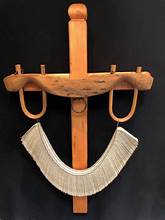
In that day, ox yokes were crafted by a carpenter from wood. The carpenter measured the ox, using those measurements to rough-cut the yoke. The yoke would be tried on, marked and sculpted to fit the shape and form of that ox so it would not rub and chafe. It was tailor-made for that ox.

Do you see that picture for followers of Christ like you and I? Jesus promises his yoke will fit us well. The life he gives us to live is not a burden that will rub and chafe us. Our lives, the work we have been called to do, are made and measured for each of us. Tailor-made by the master carpenter himself.

That thought ought to make the yoke easier to bear, but there is one last thing. Though it’s never explicitly said in this passage, I always picture a double yoke, shaped for a team of two oxen.

Farmers in Jesus’ day and farmers of our not-so-distant past, would often pair an older ox with a younger ox. A stronger ox with the weaker ox. The older, stronger ox would carry the greater burden as the younger, weaker ox learned and grew into its own yoke.

Even if not explicitly stated, the rest of scripture shows that Jesus carried the greater burden in our lives by his suffering and death on the cross for our sins and our mistakes. My burden is lighter because he has carried it and continues to carry it with me, bearing most of the weight of all that confronts me.

Paul, discussing the “thorn in his side,” reminds us that Jesus told him, “My grace is sufficient for you, for my power is made perfect in weakness. (2 Corinthians 12:9)

Jesus offered his invitation at a time when Jewish law, their yoke, had become so oppressive, it caused people to feel unable and incapable of being in right relationship with God. He offered a new yoke, a new way of living in relationship with him that provides rest and recovery from the burdens imposed by others.

That truth is no less relevant today.

There have been times in my life when the eyes staring back at me in the mirror showed signs of quiet exhaustion. Times when I grew tired of doing too much or trying too hard. I have felt the spiritual fatigue of unanswered prayers and distant promises.

I have looked into the eyes of family and friends over the past few weeks. I’ve heard the uncertainty and weariness in their voices. I’ve seen worry etched in their faces and heard it in the timbre of their voices. They carry burdens they were never meant to bear, feeling like they were alone in the middle of the struggle, questioning God’s presence, involvement and even his love.

I don’t know if that’s where you find yourself this week. Bone-weary and in need of rest and recovery. If that’s you, I know where you’ll find it because I found it, time and time again snug in the light and easy yoke of Christ.

The life he has called you to live is custom-made. Carved for your shoulders. The good news of Jesus is that you are yoked together with him and he’s pulling most of the load.

He reminds us in this passage that there is only one thing we need to do.

Come to me, all of you who are weary and burdened and I will give you rest.

Thinking Points

In what aspects of life do you most feel the “quiet exhaustion” your soul carries? What parts of your life feel like a yoke that rubs and chafes rather than one that fits well?

Think of the frustrations you’re experiencing. How much of that frustration comes from unintentionally turning trust into trying or surrender into striving?


Where do you sense Jesus inviting you to stop managing outcomes and simply come to Him?

How might your perspective shift if you pictured Jesus beside you in the yoke, carrying most of the weight?


Is God Calling?

Focal Passage: Mark 3:13-17

“God moves in mysterious ways.”

I found out today, after 72-years of my churchgoing, Sunday School teaching, Bible reading life, that those words cannot be found anywhere in the Bible.

You will find the words expressed, not in scripture, but in an old nineteenth century hymn by William Cowper. It is based on scriptures like the one in Isaiah 55 where God says, “My thoughts are not your thoughts, neither are your ways my ways.”

Whether from the old hymn or a passage of scripture, the way God moves in and through our lives is indeed mysterious. Often, however, when looking back over decades of life, the mysterious becomes a memory book of God’s grace in and calling for our lives.

The Sunday School lesson I taught this week included a passage in Mark 3 where God selected his 12 disciples. He called those men for a specific life and a specific purpose.

As a nine-year-old boy at First Baptist Church in Ropesville, TX, God called me to be one of his children. I made my profession of faith at that time and decided to follow Jesus.

God calls us to salvation, but the call does not end there. He also calls us to serve others in various ways, whether through our work, the church or in the everyday context of community.

The act of selection by Jesus is profound, underscoring his intention to empower ordinary people like you and me to carry his message and ministry to a lost and hurting world.

The passage in Mark seems such a straightforward verse about a specific event in Jesus’ ministry, but it is rich in nuance and meaning for the callings in our lives.

Jesus went up on a mountainside and called to him those he wanted and they came to him. He appointed twelve—designating them apostles—that he might send them out to preach and have authority to drive out demons. (Mark 3:13-15)

When scripture speaks of disciples, it can mean one of the 12 men closest to Jesus. It can also be any of the many followers of Jesus.

A disciple, by definition and practice of the first century, was a “student,” “a learner.” that’s pretty much how education worked in the Greco-Roman and Jewish worlds of the first century. A young man attached himself to a rabbi or teacher, with the intent of sitting at his feet, learning from him, walking beside him, listening to what he said and watching what he did. The idea was to think like, act like and become like the teacher.

Throughout his ministry, Jesus had dozens and dozens of disciples, people who were his students. Who learned from him. Who following his teachings. Who listened and watched what he did.

On that day on the mountainside described in Mark 3, Jesus called 12 men from among those many  disciples to be his apostles.

An apostle by definition is “one sent,” a representative with authority from the master. It was these 12 men, eyewitnesses to Jesus’ life, death and resurrection, who would go on to become foundational leaders of the Christian faith and of the early church.

There’s more to this passage than meets the eye, however. More than a simple list of those Jesus called to be his apostles. An idea, I think, that has deep implications for you and me about our calling.

Look back at verse 13.

Jesus “called to him those he wanted and they came to him.”

The Greek word “proskaleo” is the word Mark chose for “called.” It means “to be summoned.” “To be invited with intent and purpose.”

Jesus did not just look into the crowded of disciples and say with a wave of his hand, “I need 12 of you to come with me.” His choice wasn’t random. It was intentional. Purposeful. They choice of his apostles didn’t start with the disciples. It began with Jesus.

These men didn’t qualify themselves by anything they did. They didn’t fill out a job application.  They didn’t volunteer. Jesus chose them…specifically…individually.  This is consistent with the broader biblical theme found in John 15:16 where Jesus tells his followers,

“You did not choose me—but I chose you and appointed you to go and bear fruit…”

Jesus called those 12 men to be apostles, sent representatives on his behalf to preach the good news of Jesus. He gave them authority to do the same kinds of things he did throughout his ministry.

Here’s why I think that’s important to understand. When Jesus calls you and me, it is not random. He has a plan and a purpose behind the call, whatever it may be. Just as God takes the initiative in our salvation, he also takes the initiative in calling us to service. It is not random. It is intentional. It is purposeful. There is reason behind the call, even when it feels somewhat mysterious and out of character.

Note also that Jesus called them “to him.”

Again, this isn’t Jesus just being a coach and saying, “Okay, men, gather up. I’ve got something to say.” Think relationship before responsibility. Mark tells us earlier in this chapter that the crowds that followed Jesus, these many disciples, came because of “everything he was doing.” They were curious, in need or interested in what he was saying and doing.

As Jesus chose these 12 men, it was a call to move beyond interest to intimacy. From being a part of the crowd to being a part of the committed. Jesus called them to a deeper relationship with him. To know him more personally and intimately. To know his heart. To understand his way.

Jesus called them to know before they could be. Before they could be what Jesus needed them to be, they needed to know him, truly know him, in a deeper, more personal, daily fellowship with him.

Our call feels no different. When Jesus calls us to himself, it is for deeper fellowship. Deeper understanding. To know him and his heart. To become more like him as he equips and enables us to do the work to which he has called us.

You and I don’t have the privilege of literally walking in the footprints and shadow of Jesus like those first apostles did. They could hear his words. The tone of his voice. See the look on his face as he challenged the Pharisees or touched the eyes of the blind man. Those men could sit around a campfire late into the night, asking the Lord of the universe their burning questions as they probed for understanding. Can you imagine?

Yet, we really have the same access if you think about it. His spirit dwells within us. It gives us the same opportunity as we read through scripture to walk in his footprints and shadow. To hear his words and the tone of his voice. To see his face as he challenged the religious establishment and touched the blind.

We have the same chance to sit down with him in prayerful conversation and scripture reading to ask the Lord of the universe our burning questions as we probe for understanding. We don’t have to imagine it. We can live it.

God’s call in our lives is not only intentional and purposeful, it is a call to deeper fellowship and relationship with Jesus.

There is another phrase in this passage that I really love. It says Jesus called to him those he wanted. The Greek word for “wanted” used in this verse is “thelo.” It is an expression of his will, desire or preference. He wanted these particular men for a particular task.

Look at that list of men chosen. Peter, James, John, Andrew, Philip, Bartholomew, Matthew, Thomas, James, the son of Alphaeus, Thaddaeus, Simon, the Zealot, and Judas Iscariot.

Each disciple was chosen individually because of something Jesus saw in each of them. There was nothing outstanding about any of them. We know next to nothing about most of them. The things we know, we mostly infer. There were fishermen. A despised tax collector. One the Romans viewed as a terrorist. One who would eventually go off-rails and betray Jesus.

None of them were impressive by the standards of the world, but Jesus knew their hearts. They were teachable and willing. Open to the possibilities of what God, through Christ, might ask them to do. Jesus saw who they were deep inside and knew he could tap into their potential to accomplish and finish the task God had laid before him.

That’s what I want you to understand. God intentionally called you to be in relationship with him, to grow deeper in your relationship to him, based upon what he saw in your heart. He wanted you. Chose you. Intentionally and purposefully. He called you because he saw something in you that he could use to continue to accomplish and finish the task God has laid out before you.

The pairing of the words proskaleo and thelo…summoning and wanting…is important, I believe. Mark used these words to emphasize God’s personal invitation and his sovereign choice. He invites you. He chooses you. He has a point and a purpose for you.

If you have not yet responded to his salvation call, I pray you will. For that desire to accept Jesus for what he did for you on the cross comes before the call to serve.

I also don’t know what God has called you to do, but I believe he’s called you to a deeper relationship with him and an intentional and purposeful calling that extends well beyond a career. Pray that he will make clear that calling whatever it might be.

Until we meet him face to face, I don’t know if God ever stops calling us to serve. There is always a place for everyone called to God’s service. The call may change during the seasons of life, but it never ends.

God’s call is intentional. It is a call to relationship. In his sovereignty, he chose you. You can hear the call, but refuse to heed it. You can count the cost and abandon it. Joy comes, however, when you embrace it.

When Jesus called to him those he wanted, notice what comes next. Scripture says, “they came to him.”

I’m certain none of these 12 men fully understood what the call of Jesus really meant. I sometimes marvel in a disbelieving way how they so often failed to comprehend what Jesus was trying to teach them about who he was and what he came to do. It took his death and resurrection to drive the point home. That’s when they began to shine.

I’m equally sure there were times when the cost of discipleship seem too high a price to pay. They paid it anyway.

Reflecting on Mark 3:13, you and I are invited to consider our own responses to God’s divine call in our lives. Those times when we feel especially drawn to a purpose or mission. We need to be open and willing to follow where we are led. The verse challenges us to think about those decision points that determine our path through life.

That God chose these ordinary men as apostles should be a source of encouragement for you and me when we feel incapable or overlooked. Our unique gifts and experiences can work in concert with others to tell a broader story…to reach a wider community. We are called to demonstrate his love and compassion by embracing the roles we are meant to play.

The amazing act of Jesus calling his disciples invites us to reflect deeply on our ow lives and our willingness to respond to the beckoning finger that calls us with intention and purpose.

I don’t know what God has called you to do. What I believe for certain is that he called you to serve. He’s chosen you. He wants you. If that call is something unknown or something that seems outside your comfort zone, just know that God moves in mysterious way–but always beside those he calls.

That leaves us with one question. When Jesus calls you, will you come?

Thinking Points

Where in your own life’s story can you look back and now see God’s mysterious ways as moments of calling?


In what way is Jesus inviting you to move from interest to intimacy—moving you from the crowd to committed?


What aspect of the call you feel right now seems random right now? How might your feelings change if you trusted God’s call as intentional and purposeful?


What has God place within you—your temperament, experiences, gifts—that he may be choosing to use in this season of your life?

Build an Altar

Focal Passage: Genesis 12:7

I have some friends who are serious hikers. For several years, they head east to hike another leg of the Appalachian Trail. One hopes to complete the last 150 miles of his journey this year. The other still has 750 miles to go.

Robin and I are recreational hikers. Tackling such an ambitious goal is not in the cards or our legs, though we did hike about 15 feet of the Appalachian Trail when we visited the Great Smokey Mountains a couple of years ago. We have just short of 2,190 miles to go!

These hiker buddies tell me getting lost on the trail is a very real danger. To avoid losing the trail on rocky ground, they watch for cairns. A cairn is a pile of stones stacked carefully on top of one another, placed by rangers to guide hikers along the correct path.

We see something similar with altars. God’s people would gather stones to build an altar, not because the stones had significance, but because together they became a marker of an encounter with God—a memorial of faith, obedience or answered prayer. So, in one sense, these altars built of stone would keep them on the righteous path.

Altars are a common theme in the Old Testament, particularly in the story of Abraham’s life. God called him from a distant land, telling him to leave his country, his people and his family and go to a land that God would eventually show him and carrying a promise of blessing.

Eventually, Abraham reached a place called Shechem in Canaanite territory. When he arrived, God affirmed that this was the land he had promised to Abraham and his descendants. In Genesis 12:7 you find a small phrase showing Abraham’s response.

“…so he built an altar there…”

If you keep reading Abraham’s story, the phrase becomes a theme.

Time and time again in Genesis, Abraham builds an altar. Nothing dramatic (with one notable exception). No elaborate ritual. Just ordinary stones stacked in quiet response of God’s faithfulness. Those altars stand as markers along the trail of Abraham’s spiritual journey. In many ways, they show us how a believer grows through promise, identity, restoration, trust and obedience.

Promise

Go back to that passage in Genesis 12:7. Abraham entered Canaan, the land God promised him. Everything he owned he brought with him. The land belonged to others. God told him, “To your offspring I will give this land.”
Notice what Abraham doesn’t do. He doesn’t survey the land. He doesn’t secure its borders. He doesn’t call his men together to talk about conquest.

Instead, he worships in occupied territory. Bows before God in a place that does not yet reflect God’s reign. He stakes the ground spiritually before he ever possesses it physically. The altar at Shechem is built on promise alone. Abram has no deed. No visible guarantee. All he has is God’s word.

This is where faith begins, isn’t it? Before we see fulfillment, before we possess anything tangible, before circumstances shift in our favor, we build an altar on God’s promise alone.

Abraham’s altar is his way of saying, “God has spoken and that’s enough.”

There are seasons of life when God gives a promise, but not possession. In those moments, the question is simply this:

Will we build an altar anyway?

Identity

Afterward worshipping God in Shechem, Abraham moves his herd to a new place between Bethel and Ai. No new promise is given. No dramatic revelation follows. He is doing what a sheep herder does. He moves his flock to new grass. There, he pitches his tent and builds another altar. At this altar, scripture tells us he…

“called upon the name of the Lord.” (Genesis 12:8)

He is not worshiping this time in reaction to something new God has done. It establishes a pattern of worship for Abraham. It marks his identity. Among a people who worship pagan gods and a culture filled with competing loyalties, Abraham builds another altar establishing who he is and to whom he belongs.

You see, before faith is truly tested in the crucible of real life, it must be established, rooted in the fertile soil of God’s presence. The Bethel altar is Abraham declaring, “I belong to the Lord, not just in moments of revelation, but in daily life. It shifts the emphasis from event-driven faith to identity-driven faith.

Shechem is about what God said. Bethel is about who Abram is. There are seasons of life when we must firmly identify ourselves with God. When was the last time you built such an altar as a witness and testimony of the one to whom you belong?

Restoration

After these early steps of faith, Abraham falters. Famine sends him to Egypt where opposition feels formidable. Fear takes over. He misrepresents his relationship with Sarah. Now, the promise seems threatened by Abraham’s compromise.

When he finally returns to Canaan, he goes back to Bethel, the place where he declared his identity. I imagine the altar had fallen into disrepair during his time away. You can almost see Abraham rebuild the altar from fallen stones even as he rebuilt his identity with God. and he again…

“called upon the name of the Lord.” (Genesis 13:4)

This rebuilt altar is not about promises or identity. It is about restoration. Abraham returned to the place where faith burned brightest to rekindle what he had lost.

There is something profoundly hopeful here. The life of faith is not a straight upward climb, is it? The Father of Faith, as the writer of Hebrews describes him, stumbled just like we do. When he did, he repented. He didn’t hide in shame or construct a new path. He went back to first things. First love. First trust. First dependence. Picked up the stones and rebuilt the altar.

Abraham didn’t outgrow the altar. He returned to it. In that moment of worship Abraham found himself restored into fellowship with the God of the promise.

I don’t know about you. I’ve spent my time in Egypt—a time of fear-driven decisions or some other spiritual drift. The altar of restoration is a repentant desire to return. A desire to come back to the Lord.

The beauty of this part of Abraham’s story is there is no rebuke from God. No ending punishment. God simply receives his worship and opens his arms again to Abraham. If you need to reconnect with God today, if you need his restoration, pick up the stones. Rebuild the altar of your identity as a child of God.

Surrender

Just a few verses later, Abraham found himself at a crossroad with his nephew Lot. The land cannot sustain both families. As the elder, Abraham had the right of first choice. Instead, he let Lot decide where he wanted to settle his family and his herds.

Lot chose the lush Jordan Valley, leaving Abraham with the leftovers, land which appeared less desirable. After Lot departed, God reaffirmed his promise to Abraham and his children. Abraham then settled near Hebron and…

“…built an altar to the Lord…” (Genesis 13:18)

Maybe this altar represents surrender. Abraham had every right and reason to grasp what was his. Rather than claim his own, he yielded. He trusted that God’s promise didn’t depend on Abraham’s maneuvering or manipulation.

There is a deep spiritual maturity here. Early faith built an altar after hearing promise. Growing faith built an altar after losing its advantage.

Trust is not tested when everything aligns in our favor, but when we voluntarily relinquish control. The altar at Hebron said, “God’s blessing does not depend on my securing the best position.”

Surrendering means letting go of what looks better. Letting go of my assumed advantage to go where God has placed me. Faith means believing that what God assigns is better than what we could have chosen.

This altar was quieter than the first, but perhaps stronger. Abraham no longer needed visible superiority. He just needed to let go. Could you and I also need to let go of something we think we need in order to receive God’s fullest blessing? If so, let’s build an altar to God.

Obedience

The final altar was the most severe.

God commands Abraham to offer his son Isaac as a sacrifice—the very child through whom that original promise was to be fulfilled. This was no longer about land. It was about the promise itself.

When he arrived at Mt. Moriah, Abraham…

“…built an altar there…” (Gensis 22:9)

On Mt. Moriah, Abraham built another altar, one that would cost him everything. Earlier altars celebrated promise. This altar appeared to contradict it. Yet, Abraham obeyed. With each stone growing heavier in his hands and heart heaving in despair, Abraham’s faith grew deeper, even when he didn’t fully understand.

He didn’t argue. He didn’t delay. He built.

At the final critical moment, God provided a substitute. The altar became a place of revelation: “The Lord will provide.” Obedience revealed provision. Earlier altars revealed trust in God’s word. This one required trust in God’s character.

Faith ultimately laid everything on the altar before God, even everything that God himself had given.

When we step back and watch Abraham, we see a progression of faith.

Promise leads to worship.

Worship leads to identity.

Failure leads to restoration.

Restoration leads to surrender.

Surrender leads to obedience.

Altars mark the decisive moments in Abraham’s spiritual foundation. They are not monuments to achievement. Not even guideposts along the trail, at least not in the most important sense. They are testimonies to dependence on and connection with God.

The quiet message running beneath these passages is that faith is not defined by what we do, but by whom we worship. Abraham’s life was not secured by cleverness or control. It was shaped by repeated acts of worship. A lifestyle of worship.

We may no longer build literal altars of stone, but we need to erect our spiritual altars.

Build them in the place of promise before fulfillment.

Build them in the place where we chose to identify ourselves as children of God.

Build them where we return from wandering to a place of restoration.

Build them where we let go of our desires, surrendering to God’s control.

Build them where we obey without full understanding.

Perhaps the question for us is this simple: Where do you need to build your next altar?


A Life of Thanksgiving

Focal Passage: Colossians 3:12-17

In the middle of the United States Civil War on October 3, 1863, President Abraham Lincoln issued a proclamation declaring the last Thursday in November as a Day of Thanksgiving and Praise. Lincoln wrote in that proclamation that the year had been “filled with the blessings of fruitful fields and healthful skies,” blessings he called “gracious gifts of the Most High God.”

While merchants throughout our country blow off Thanksgiving for the more lucrative pursuit of Christmas, we, the people, as Lincoln liked to say, will all pause for a moment, gathered with family or friends, to enjoy a holiday centered on gratitude, generosity and togetherness. Hopefully, for those of us who try to live out our faith, Thanksgiving will grant us a chance for a little honest reflection on the gracious goodness of God.

Just as it is easy for us to get caught up in the trappings of Christmas and fail to sincerely remember God’s greatest gift, it is easy to get caught up in the toppings of Thanksgiving…the dressing, the cranberry sauce, the gravy. In my family, those toppings we focus on might include the cheese, the pico de gallo, the onions, and the guacamole we stuff into our non-traditional Thanksgiving fajitas.

We will quietly express our thanks to God, but I wonder if the words are that meaningful to him amid all the hustle and activity of the day. Let me explain.

I have lost both of my parents. At this ripe old age of 72, that’s not surprising, I suppose. Mom died 27 years ago of cancer at the too young age of 69. At the age of 98, Dad died two years ago of nothing more really than a life lived long and well.

Before they died, I got a chance to thank both of them in private for being the amazing parents they were. Given the sacrifices they made, the role models they were in my life, the life lessons they instilled, everything I said those days felt woefully inadequate. Though I struggled with the words, I think they understood my intent.

I got a similar response from both of them. Smiles shining through watery eyes and hugs they probably wished could be stronger.

My parents held expectations for me and my siblings, not so much on what we might do in life, but in how we chose to live life. As I think back on those precious moments with them, I pray I met those expectations.

As a parent of adult children now, I get it. You raise your children hoping they will be good people. That their lives will reflect the values you tried to instill in them. That they will live their lives with faith in God, love for family, compassion for others and integrity in all things. My sons have lived that life and more. Though they’ve both spoken their words of thanks at times, their lives lived well is all the gratitude I need.

Here’s the point I’m trying to make. We will gather around a table on Thanksgiving. At some point, we will pray and express our gratitude to God for all he’s done for us. I wonder, however, if this is the best way to say thanks to God.

While I’m quite sure our Lord appreciates the words of gratitude, how much more does he appreciate our lives lived as a reflection of his goodness and grace? How much more does he desire that we live our lives in ways that reflect the values he tries to instill in us?

I had the privilege of listening to an inspiring sermon this week delivered by the Rev. Robert Thomas, Jr., of Mt. Olivet Missionary Baptist Church in Houston. The Rev. Thomas spoke powerfully about holy living in a world filled with unholy actions.

In his text in Colossians 3:12, we find Paul saying that every believer in Christ should “clothe ourselves with compassion, kindness, humility, gentleness and patience.” We are to be forgiving because God forgave us, covering all our actions with love. Then, Paul added, “Let the peace of Christ rule in your hearts…and be thankful.”

I pulled out the verse again this week thinking about the upcoming Thanksgiving holiday, focusing on those last two words, “Be thankful.” If you continue reading in that chapter, you’ll find these words that sum up the previous verses. I think it has everything to do with how we express our gratitude to God. Paul said:

And whatever you do, whether in word or deed, do it all in the name of the Lord Jesus, giving thanks to God the Father through him. (Colossians 3:17)

Whatever you do in word or deed…give thanks.

Think about that for a second. I’m not sure Paul just wants us to thank God for giving us the word to say or the deed to do. I think he might mean that we should let our words and deeds be said and done in the name of Christ so well and so faithfully that our words and our deeds becomes an expression of our thanks to God.

When we act in compassion or kindness, when we live humbly, with gentleness toward others and patience in the face of the trouble, when we forgive, and let love drive our every thought or deed…that is an act of thanksgiving to God that means more to him, I believe, than simply saying a heartfelt thanks…as important as those words are to say at times.

When King Saul in the Old Testament disobeyed God but tried to cover it with yet another hastily thrown together sacrifice, God told him through Samuel, “To obey is better than sacrifice; to listen (is better) than the fat of rams.” (I Samuel 15:22)

That seems to be telling me that actions speak louder than words. If I want to thank God for his power, presence, protection and provision in my life, saying the words is important, but living in ways that honor him seems more important.

Let our obedience to his word be our thanksgiving for his goodness and grace. Jesus told his disciples in John 14:15 that if they truly loved him, they would keep his commandments. That we would live as he lived. Our surrender to his will and way then become acts of love and thankfulness.

Scripture teaches us, I think, that gratitude reaches its highest point when it moves beyond feelings and emotion and becomes faithful living. Being obedient to his commands and following his teachings in every aspect of life.

Living out God’s will by loving others, showing compassion toward those who are in need, forgiving those who hurt us, serving those around us—these actions, done in response to God’s redemptive and restorative work in our own lives, become the most sincere expressions of gratitude a believer can offer. A life surrendered to God’s will and way is a spiritual act of thanksgiving.

As he neared the end of his earthly ministry, Jesus consoled his disciples by urging them to stay connected to him. He drew upon a metaphor they would understand.

I am the vine; you are the branches. If a man remains in me and I in him, he will bear much fruit; apart from me you can do nothing…If you remain in me and my words remain in you, ask whatever you wish and it will be given you. This is to my father’s glory that you bear much fruit, showing yourselves to be my disciples. (John 15:5,7-8)

In other words, when we remain in Christ and do his will, we bear fruit. The fruit we bear brings glory to God. Our faithfulness and our work that impacts the lives of others and demonstrates that we are his children is an act of thanksgiving that glorifies God and makes him known to a world so desperately in need of him.

When we allow God’s spirit to shape our character with love, joy, peace, hope, patience, kindness, gentleness, we are expressing our deep gratitude for God’s saving work in our lives. When we, in a loving spirit, oppose actions in our world that run counter to the spirit and message of Christ, we are expressing our gratitude for God’s saving work in our lives.

When I see my sons living out the life God called them to live, when I see evidence of their faithfulness, compassion and Godly integrity, seeing the godly men they have become…that’s really all the gratitude I need. Of course, hearing that word of thanks, wrapped in the occasional hug, warms my heart.

I just feel God might be the same way. Watching you and me live out the lives we’ve been called to live for him, seeing evidence of our faith in our words and deeds, watching us bear fruit in ways that draw others to Christ, living godly lives, that’s what he most desires.

Hearing that word of thanks and giving him that spiritual hug, surely warms his heart.

Here’s my prayer for my life and yours this Thanksgiving holiday. May we recommit our lives to the one who redeemed us and called us to be his disciples, his fruit-bearers. May our lives and the words we speak and the work we do for him be a living expression of our gratitude for all he has done for us. Let’s say our thanks in prayer and live our thankfulness in practice.

I will praise you, O Lord my God, with all my heart; I will glorify your name forever. (Psalm 86:12)

Thinking Points

Who in my life has modeled grateful living? How can I follow their example in my walk with Christ?


In what ways can my everyday words and actions become a genuine expression of thankfulness to God?


Colossians 3 speaks to the qualities of compassion, kindness, humility, gentleness and patience, among others. Which of those traits do I need growth in my life if I want my life to shout my thanks to God for what he has done for me?


How might my life today change and want would it look like if obedience and faithfulness to God became my primary way of expressing gratitude to God?

Decisions, Decisions

Background Passages: Matthew 4:2-11; John 1:1,14; Matthew 22:37-40

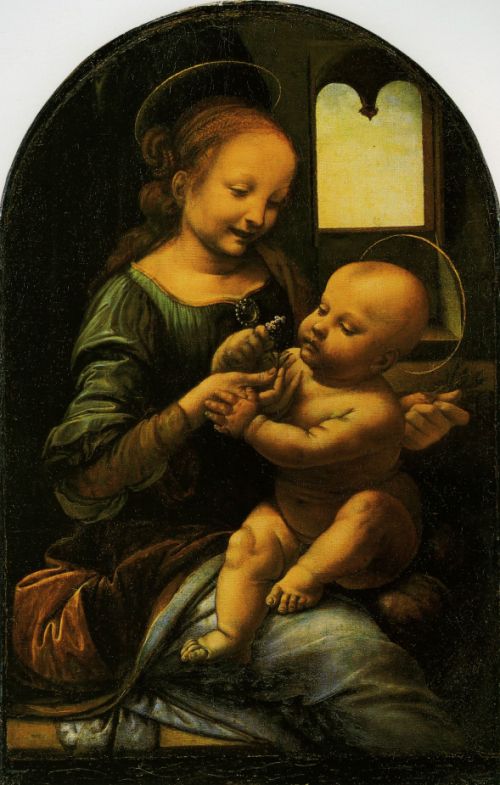
The Hermitage in St. Petersburg, Russia, once served as the palatial home of the tsars. The gilded palace is now an art museum. One of the works of art one can see at the Hermitage is The Benois Madonna, painted in 1478 by Leonardo Di Vinci.

Named after the family who once owned it, this portrait of Mary and the infant Jesus have them engrossed in play together, their gazes lifelike to a degree that only Di Vinci could achieve. Above both the Madonna and Jesus hover faint outlines of a halo.

The use of a halo to represent the deity of Jesus is a common theme in art. I remember thinking as I viewed that painting several years ago that Jesus might be embarrassed by the depiction. A halo just wasn’t his style. It’s difficult to see the halo when you read the astounding words in the Gospel of John.

In the beginning was the Word, and the Word was with God, and the Word was God…The word became flesh and made his dwelling among us. (John 1:1, 14)

As steeped in theology as those words might be, I find them so incredibly comforting. Think about that for a second. God’s son who existed in him and with him and was, in fact him, surrendered that divine existence to walk among the weeds with us. The very image of God living the same life I live.

Jesus’ early life is shrouded in mystery that matters only a little bit. From the infant unnaturally born in a natural way, to a 12-year-old with a mind that soaked up scripture like the desert soaks up a raindrop. To the carpenter with calloused hands who emerged from Jordan’s waters to hear his Father kickstart his ministry by declaring, “This is my beloved son in whom I am well pleased.”

Everything else in the years between those brief glimpses into his life remains a product of speculation and imagination. In my mind, he didn’t walk those 30 years with a halo on his head spouting the King James English. He lived those 30 years coming to grips with what it means to live as the image of God.

As he walked away from the Jordan that day, hair dripping with river water, with the words of his father echoing in his heart and soul, Jesus headed into the desert to face the options open to him in his ministry. To more clearly grasp his purpose.

Grady Nutt, in his book Being Me, wrote about Jesus’ time in the wilderness. “This remarkable young man with all his gifts and with his unique relationship to God—he even called God a word we would translate as Daddy—still had to decide who would rule his life and what he would do with his life.”

Scripture tells us that Jesus spent 40 days in prayer and fasting. It’s again speculation on my part, but I think this time spent talking to his father gave Jesus a clear understanding of the role he would play in God’s redemptive plan. Obedience to that plan would put him on a cross. It may not have been the first time the thought entered his mind, but his time in the desert, I believe, left no doubt as to his purpose.

I think the last time he got up from his knees with his stomach rumbling, it was with a sense of clarity and resolve. That’s probably why Satan began to put a bug in his ear, offering a few alternative choices.

You’ll find this account in both Matthew and Luke under a heading of “The Temptations of Christ.” The title gives a little too much credit to the tempter, it seems to me. Nutt calls the same passage, “The Decisions of Christ,” putting the emphasis on the response of the one who is tempted, not the challenge of the tempter.

I like that because when I’m being pulled to consider options other than what I know God demands of me, I have decisions to make. It’s less about the temptation and more about how I will respond to it. What I will decide to do. What choice I chose to make.

The good news is I only need to see Jesus, the image of God standing in a desert, to get a handle on the proper choice to any temptation. Take a look at a familiar story from the Bible.

After fasting forty days and forty nights, he was hungry. The tempter came to him and said, “If you are the Son of God, tell these stones to become bread.”

Jesus answered, “It is written: ‘Man does not live on bread alone, but on every word that comes from the mouth of God.’”

Then, the devil took him to the holy city and had him stand on the highest point of the temple. “If you are the Son of God,” he said, “throw yourself down. For it is written, ‘He will command his angels concerning you, and they will lift you up in their hands, so that you will not strike your foot against a stone.’”

Jesus answered, “It is also written: ‘Do not put the Lord your God to the test.’”

Again, the devil took him to a very high mountain and showed him all the kingdoms of the world and their splendor. “All this I will give you,” he said, “if you will bow down and worship me.”

Jesus said, “Away from me, Satan! For it is written: ‘Worship the Lord your God and serve him only.’” (Matthew 4:2-10)

In Christ, there is certainly the halo effect of God sending his son to become redemption for a sinful humanity. There is also the human effect of God sending his son, as Pastor Ray Stedman says, “to reveal man as God intended man to be.” In all Jesus did, in every aspect of his life as he lived among us as the image of God, we see a man acting as God desired us to act from the very onset of creation. The perfect example of God in human form.

From that perspective, suddenly life makes more sense. Throughout his ministry and certainly in this episode of his life, Jesus calls us to live faithfully by his words, his deeds and his decisions. He even summed it up in two simple statements to a scheming Pharisee.

You shall love the Lord your God with all your heart, and with all your soul and with all your mind. This is the first and greatest commandment. The second is like it. Love your neighbor as yourself. All the Law and the Prophets hang on these two commandments.” (Matthew 22:37-40)

You see how he internalized those commands in his response to the choices in front of him while in the wilderness.

Twice Satan challenged him, If you are the Son of God, then…” Notice the emphasis on the “if.” It isn’t an “if” in our English sense of the word, as though Satan was trying to make Jesus doubt his relationship to God. God affirmed when Jesus came up out of the Jordan.

Satan himself isn’t confused. He knew exactly who Jesus was.

The Greek text renders the word “if” more closely to our word “since.” “Since you are the Son of God, then”…why not do this instead of what you’ve been told you must do. This will be far less work. Far less pain. Far more glory and power.

What follows the “then” is a decision point where Jesus has to choose to be the one God called him to be. “Since you are the Son of God, then…”turn the stones to bread.” “…throw yourself down…” “…this can all be yours…”

Jesus’ entire life, his entire ministry, would be lived out against the backdrop of these decisions. The devil here is trying to get Jesus to move from the principle of dependence and trust in God. To do things his way.

It is the very essence of temptation for us as well. We face decision point after decision point attempting to get us to act on our own, independently of God and his indwelling spirit. “If you do this, Kirk, then…”

Let’s take a look at the decisions Jesus was asked to make.

You just think you’ve been hungry. Jesus had limited sustenance for almost six weeks. In one of the most understated bits of scripture the Bible tells us “…afterwards he was hungry.” The mere thought of turning a stone to a loaf of fresh baked bread makes me salivate right now. Imagine how Jesus felt when the temptation arose.

As miraculous as the temptation sounds, it rose out of a simple physical need. The temptation came because he was human and hungry, but that’s not really what the devil was saying. The implication is that God left him in the wilderness to starve. That God no longer cared.

That’s the way temptations come to us even today…through subtle suggestions that God could not possibly care for someone like me or you.

It’s the objection we hear to Christianity all the time. How could a loving God allow all this suffering in the world…war, famine, sickness. How could he let a child die? If there is a God, he must not care for us at all.

The devil suggested to Jesus that since God obviously didn’t care and since you are the Son of God, just take matters in your own hands. Meet your own needs independent of God.

It is the same decision you and I must make every day when faced with the choices laid out in front of us. Am I going to trust God or will I do my own thing. Answer my own questions. Make my own way.

Jesus’ response to temptation put life in its proper perspective. “Man shall not live on bread alone.” You see, our deepest need, my deepest need, is not physical. Not now, not ever.

My deepest need is to stay in right relationship with God. To trust. Making decisions based on my own will or by trusting in my own abilities comes at a cost to that relationship. Every single time.

If Satan can’t push you off one cliff, he’ll try to push you off another. After Jesus brushed off his attempt to use his physical needs against him, the devil targeted his soul. The devil couldn’t move Jesus away from this trust in the father, so he opted to put that trust to the test.

Taking Jesus to the highest rampart of the Temple, he said, “Throw yourself off.” Then, he quoted some scripture of his own suggesting that the angels would never let anything bad happen to him…not so much as a stubbed toe.

He said basically, “Do it and everyone will see how much you trust God and how you are willing to put yourself in danger for them. They’ll flock to you. What a spectacle it will be!”

As powerful as his miracles would prove to be, they were not enough to convince many of who he was. His greatest displays of faith came in the quiet trust of his heart that rested on what God had said and revealed to him time and time again. The things he did to stay the course. His trust and obedience to his Father’s will made the difference.

When Jesus spoke again, he chastised the devil. “Do not put the Lord your God to the test.” In other words, you can’t force God to act on your behalf. You can’t force him to change the conditions of life. That’s not the way faith works.

While it may not be as exciting as a swan dive from the top of the Temple, but a life lived obedient to God’s will, in his power and strength, provides the endurance and patience to deal with anything life throws your way…and to do it with joy.

As a last resort, the tempter took Jesus to a high mountain where he could see the world spread out below him in all its glory and beauty. Through subtle pretext and artful disguise, he said, “Worship me and I’ll give you authority over all of this.” The heart of the matter. “You will have power and will be exalted.”

Interestingly, Jesus came to win the world. To be Lord of all. To be exalted above all men so that “every knee would bow” and “every tongue confess that Jesus Christ is Lord…” as it says in Philippians. It was seemingly being handed to him on a silver platter without the agony of the cross. Yet, to grasp the heart of it you have to finish reading the verse. “…to the glory of God.”

That last part is the kicker, isn’t it? It sounds good until you realize the power, authority and the exaltation that come with the devil’s offer is fruitless unless God receives the glory.

Jesus chose again the appropriate response. “Worship the Lord your God and serve him only.”

There lies the basis of our decision to set aside all that glitters and draws us away from God. To keep ourselves from being caught up in the quest for power and glory all our own. The only right decision is to worship and serve the Lord.

It’s such a heart thing to understand, as Stedman says, “To worship is to serve. To serve is to worship.” Only God gives any real value to life. The world can never give it. It is a decision that speaks to the deepest desires of the heart. To have a life that is worthwhile. To worship God only and to serve mankind on his behalf.

So, it seems to me these are the most important decisions I can make in the face of any temptation. Will I trust him? Will I be obedient? Will I worship and serve him? As it was for Jesus, my entire life is lived against the backdrop of these decisions. So is yours.

I’m drawn back to the beginning.

The Word became flesh and made his dwelling among us.

Not with Di Vinci’s halo around his head, but wrapped in humanness to show us how to live as the men and woman God created men and women to be.

Temptations will come, but it’s less about the temptations than it is about the decisions we make when they come. Somewhere out in that desert above the Jordan River, Jesus set a pretty good example for all of us.

Check Your Plumb Line

Background Passages: Amos 7:7-9; Isaiah 28:16-17; Matthew 5:1-12

I have a vague recollection of my Dad building some kind of shed near the barn on our farm. The extent of my help on the project was dragging a 2 x 4 from a nearby pile, handing him a few nails, and picking up the hammer he dropped.

What I do have a memory of is watching him determine that the walls were absolutely vertical by using a plumb line.

A builder might use a plumb line as an alternative to a level to find a straight vertical line. In simplest form, a plumb line consists of a piece of string with a weight called a bob at the bottom.

When you hang the line downward, the weight, with an assist from gravity, pulls the string taut and creates a straight, vertical line. Measure your wall against that line and, if it’s equal top to bottom, your wall is plumb.

We know the ancient Egyptians used plumb lines thousands of years ago. I suspect they were used by others long before the Egyptians.

The prophet Amos, a sheepherder and farmer of figs from Tekoa, would have known how to use a plumb line. It’s natural that God would use a plumb line to reveal an important truth to his prophet.

Amos told the people of Israel that they were headed in the wrong direction. He said they “sold the righteous for silver and the poor a pair of sandals.” (Amos 2:6)

God was pronouncing judgment against Israel for its continued rebelliousness as they failed to live up to his standards and had failed to repent and return to God.

Twice as God declared his intent to punish his people, Amos begged him to relent. God then spoke to Amos a third time.

This is what he showed me. The Lord was standing by a wall that had been built true to plumb, with a plumb line in his hand. And the Lord asked me, “What do you see, Amos?”

“A plumb line,” I replied.

Then the Lord replied, “I am setting a plumb line against my people Israel. I will spare them no longer. The high places of Isaac will be destroyed, and the sanctuaries of Israel will be ruined. With my sword I will rise against the house of Jeroboam.” (Amos 7:7-9)

It’s not my intent to talk about the prophecies of Amos and how God followed through on his punishment. This passage intrigued me in what it says about God’s plumb line.

“I am setting a plumb line against my people Israel.”

I think it serves as a great reminder for us to make sure we measure up to God’s standard.

Rodney Johnson, pastor of New Light Christian Church in Kansas City, called God’s plumb line the standard by which God measures our faithfulness; our righteousness.

He said, “The kinds of instruments we use to measure our life will often determine what we uncover and how we face life in general.

“When we begin to examine our plumb lines, if they are faulty – based on the world’s standard of right and wrong – our assessments of where we are will be faulty. When our assessments are off – when they are different from God’s assessments – we cannot course correct to mirror our plumb lines to God’s.”

Years ago, I built a four-foot brick wall to shield my pool equipment from the pool. I used a plumb line. It only took a few rows of bricks to see that something was off. When I looked closer, the bob at the end of the plumb line was just barely resting on the ground. I was basing the uprightness of my wall on a faulty plumb line.

I think this is what Johnson was talking about. We too often measure our righteousness, our uprightness, if you will, by a faulty standard…parental expectations, cultural morality, friendships, legal requirements. In every one of those situations, the plumb bob is touching the ground, skewing the standard. Until and unless we use God’s plumb line, we will never measure up.

So, what’s the plumb line? What’s the standard?

In his prophetic message, Isaiah gave us a hint.

So this is what the Sovereign Lord says:

“See, I lay a stone in Zion, a tested stone, a precious cornerstone for a sure foundation; one that relies on it will never be stricken with panic.” (Isaiah 28:16)

“A tested stone,” one already measured against God’s plumb line, will become the “cornerstone for a sure foundation,” level and plumb. Isaiah is talking about the coming Messiah…Jesus Christ.

You see, if we’re trying to live by God’s standard, his plumb line, then we have to be able to see it. God revealed his plumb line through Jesus and through his word. To see Jesus as he lived, to hear God’s word as he preached and taught, to be able now to listen to the voice of God through the words of the Bible…that’s the plumb line against which our lives are measured.

Isaiah continues with the illustration.

I will make justice the measuring line and righteousness the plumb line…” (Isaiah 28:17)

Righteousness can be defined as “living in right relationship with God” or living “upright and obedient lives.” Letting our words and our deeds measure up to God’s plumb or standard.

It is a theme that runs throughout the New Testament. Paul told the Ephesians, “Therefore, be imitators of God, as beloved children; and walk in love, just as Christ also loved you and gave himself up for us… (Ephesians 5:1-2)

We live up to God’s standard when we imitate the life of Christ and walk in love for one another.

John’s first letter declares the same. “This is how we know we are in him: Whoever claims to live in him must live as Jesus did.” (I John 2:6)

The life of Jesus, his faithful obedience, his servant’s heart, make him the perfect plumb line against which we can test our own lives. We should strive to be like him.

“To this you were called, because Christ suffered for you, leaving you an example, that you should follow in his steps.” (I Peter 2:21)

Clearly Jesus is the standard for even Peter asks us to emulate Jesus as our perfect example of how to live our lives.

Jesus is not the only way God tests us against his plumb line. He uses his word to assess how well we are following his commands.

Look at 2 Timothy 3:16-17.  It says,

“All scripture is given by inspiration of God, and is profitable for doctrine, for reproof, for correction, for instruction in righteousness. That the man of God may be perfect, thoroughly furnished unto all good works.”

It is his word that tells us how we are to live our lives as his hands and feet in ministry.

You don’t need to read a lot of scripture to find this truth. It is there, at the turn of every page, a guide to tell us how to live, how to be measured against God’s standard and not found to be out of plumb.

It sounds so easy. Walk in Jesus’ footsteps.  Live in his image. Read the Bible. One of my favorite authors explained this in his book God’s Mirror Image:

“To live in the image of God seems to be such a deep theological concept. Yet, the promise of Jesus resonates in its simplicity. “If you have seen me, you have seen the Father.”

Once we get past the wonder of Emmanuel, “God with us,” and embrace the character and teachings of Christ, we can see exactly how we are to exist as God’s reflected image in the world. We mirror the image of God by imitating the character of Christ.”

What is the character of Christ? Look no further than the Beatitudes in Matthew 5. Look at this passage and then think about the life of Christ. He modeled every character trait described in those verses in his daily walk.

Every instance of Jesus’ life and ministry on earth recorded in the Bible is a blueprint on how we should live our lives. It’s up to us to live as he lived.

Here’s my thought. God has a plumb line and his message to Israel long ago and to us today is that he uses it as his standard to measure our faithfulness, our obedience and our righteousness.

God knows his will for us, where he wants us to be and how we should get there. The standard modeled in the life of Jesus and reflected in God’s word tells him if we’re in plumb. If not, his plumb line shows us how far we must go to get back on track.

When I read that passage this week, I had to think about that plumb line in my life. I had to make sure the plumb line I was using was not something other than the life of Jesus and God’s word.

If I’m honest, my plumb bob has been dragging the ground a bit and the what I’m trying to build of my life has been a little off vertical.

Let me go back to what the Rev. Johnson wrote. “When we begin to examine our plumb lines, if they are faulty – based on the world’s standard of right and wrong – our assessments of where we are will be faulty. When our assessments are off – when they are different from God’s assessments – we cannot course correct to mirror our plumb lines to God’s.”

I discovered I need a course correction. I need to make sure God’s plumb line is unobstructed, free to show me where I don’t measure up to his standard. In those areas of my life where I am off, I need to get back into proper alignment with his will and way for my life. That’s my commitment this week.

How about you? When’s the last time you checked the plumb line in your life? How well do you measure up to God’s standard?

It feels like a question all of us should ask every day.

Another Great Question

Background Passages: Luke 6:46-49; Romans 7:15-24

Some of the best teachers I ever had were those who challenged me with probing questions designed to pique my curiosity. It was a method championed by the ancient Greek philosopher Socrates. When teachers ask questions rather than simply provide information, they encourage students to dig more deeply and actively explore their own beliefs.

As good as Socrates might have been, Jesus, I think, used questions masterfully in his teaching to help his disciples see past the letter of the law into the heart of God. His questions almost always opened their eyes to a new way of understanding God’s purpose and plan.

In my last blog, I looked at a question Jesus asked his listeners. “What does it profit a man to gain the whole world and lose his soul?” After looking into that challenge, I began to look for other questions Jesus asked. I found one in Luke 6 that intrigued me.

“Why do you call me ‘Lord, Lord’ and do not do what I say?”

For years, one of my favorite shows on television was NCIS, starring Mark Harmon as Leroy Jethro Gibbs, the leader of a group of federal agents investigating crimes involving U. S. Navy personnel. When one of the agents under his command failed to grasp a key bit of information, Gibbs would often slap them on the back of the head as if to say, “Think!”

That’s what this scripture was to me this week…a slap on the back of my head. Why do I proclaim Jesus as my Lord and still do or not do what I know God’s word teaches me to do? It is a maddening tendency I expect I share with many other Christians.

It’s not a problem unique to me or to this time in history. You can hear the similar frustration in Paul’s words to the church in Rome.

“I do not understand what I do. For what I want to do, I do not do, but what I hate, I do…For I have the desire to do what is good, but I cannot carry it out. For I do not do the good I want to do, but the evil I do not want to do…this I keep on doing. Now if I do what I do not want to do, it is no longer I who do it, but it is the sin living in me that does it.” (Romans 7:15, 18-20)

It makes the question Jesus asked even more poignant. “Why do you call me “Lord, Lord’ and do not do what I say?”

Let’s set the context of Jesus’ question.

Throughout Luke 6, the gospel writer shares a series of teachings of Jesus. If you read through the chapter, you’ll find Jesus talking about the blessings that come from following him and the woes that befall those who go their own way. Luke relays to us Jesus’ thoughts on loving our enemies, turning the other cheek, giving them the shirt off your back and gives a taste of the Golden Rule, “Do to others what you would have them do to you.”

The questions continue to probe our hearts when Jesus asks, “If you love those who love you, what credit is that to you?” and “If you do good to those who are good to you, what credit is that to you? Even sinners do that.” “Be merciful, just as your Father is merciful.”

Luke continues with Jesus’ teaching on our desire to judge others. “Do not judge, and you will not be judged…Forgive and you will be forgiven…For with the measure you use, it will be measured to you.” In his message, Jesus warns us to remove the plank from our eyes before we complain about the speck in the eyes of another.

Finally, Luke shares a small parable from Jesus about a tree and its fruit, reminding us that “No good tree bears bad fruit, nor does a bad tree bear good fruit. People do not pick figs from thornbushes or grapes from briers. A good man brings good things out of the good stored up in his heart, and an evil man brings evil things out of the evil stored up in his heart. For the mouth speaks what the heart is full of.” (Luke 6:43-45)

After all of those words where Jesus calls us to a different way of life, Luke says Jesus asked our question of the day. “Why do you call me ‘Lord, Lord’ and do not do what I say?”

Given our proclivity toward sin, it may be best to come to grips with what it means to call Jesus “Lord?”

When we use the term “lord” today, it is typically a verb, not a noun. Someone who abuses their power and authority is said to “lord it over” those who serve under them. It’s a negative connotation.

“Lord” becomes a noun in the Christian context. It is the person to whom we have surrendered our lives, submitted our will to the will of Jesus, our Lord and Savior. Substitute “master” or “boss” if it is an easier concept to understand. One possessing absolute authority, power and control. It is a way of recognizing Jesus’ divine and holy position. Head of the church. Ruler of all creation. Lord of lords and King of kings.

When we make our faith commitment to Jesus as our Savior and Lord, we are turning our lives over to him. Surrendering complete control of our lives to his will and way. Submitting to his teaching and truth in all aspects of life. That means doing things, living life, his way…not my way.

When Jesus makes this statement, he is addressing those who have made that decision to put their trust in him. His followers. He’s not talking about the charlatans who pretend to be one of his disciples. He’s talking to those who made a genuine commitment to him but are struggling with living up to the standard he sets for us. He’s talking to me, and I suspect, he’s talking to you.

See what he says after asking his question?

“Why do you call me ‘Lord, Lord’ and do not do what I say? As for everyone who comes to me and hears my words and puts them in practice, I will show you what they are like. They are like a man building a house, who dug down deep and laid the foundation on rock. When a flood came, the torrent stuck that house but could not shake it, because it was well built. But the one who hears my words and does not put them into practice is like a man who built a house on the ground without a foundation. The moment the torrent struck it collapsed and its destruction was complete.” (Luke 6:46-49)

Jesus drew upon his experience as a carpenter and stone mason to drive home a point. In what has become a beloved children’s Bible story, we find a great truth for all ages. When we decide to place our trust in Jesus, it is the biggest and greatest decision we will ever make. Making that decision is just the first step in making Jesus Lord of our lives.

We must build upon that commitment by becoming Christ-like. Growing in our obedience to his teachings. Building upon the truth he taught. Not just hearing his words but putting them into practice every day.

Why do we call him Lord and still do what we want to do?

Because it’s not easy. The foolish builder in Jesus’ parable, didn’t want to put in the work required to dig into the rock. He was short-sighted. It was easier and much less trouble to build in the sand. It may be easier to keep living the way we’re living before Christ became our Lord, but it brings disaster upon us. It may be difficult to do things Jesus’ way, to be obedient in all things, but that brings unparalleled security in the face of life’s flashfloods.

Theologian William Barclay said, “In every decision in life there is a short view and a long view. Happy is the man who never barters future good for present pleasure. Happy is the man who sees things not in the light of the moment, but in the light of eternity.”

It’s far easier to say the right words than to live them out every day. Yet, that is exactly what we are called to do. So, it takes us back to what Jesus talked about before this remarkable question. We must love those who don’t love us back. Do good for those who do us harm. Put aside our judgmental attitudes. Forgive those who wrong us. Be merciful. In general, treat others as we would want them to treat us.

It’s not enough to give lip service to our faith. Every day must be a concerted, if occasionally flawed, effort to live as Jesus lived.

Here’s the good news. The grace of God does not require us to be perfect. His love and his mercy trump my inability to live as I should each day. His grace gives me another chance to rebuild the shattered walls on a firmer foundation of faith.

After Paul expressed his frustrations with his own inability to do what he knows he should, he praised God for his deliverance.

“What a wretched man I am! Who will rescue me from this body that is subject to death? Thanks be to God who delivers me through Jesus Christ, my Lord.” (Romans 7:24-25)

That pretty much sums it up for me. I don’t want to be one of those Jesus followers who never moves past that initial faith commitment. I want to be one of those hears his word and tries with all my heart and soul to put those words into practice.

Jesus’ question is a great one. “Why do you call me “Lord, Lord” and do not do what I say?”

What answer would you give today?

That’s a Good Question

Background Passages: Matthew 16:23-27

Though many kings and conquerors held such lofty ambitions, no one ever came close to ruling the whole world. A quick journey through history reveals a host of men who gave it their best shot. Sargon of Akkad. Julius Caesar, Cyrus the Great. Genghis Kahn. They and many others held stated goals of ruling the known world.

Alexander the Great of Macedonia carried similar ambitions and came close to seeing it through. Despite conquering most of the known world and gaining vast wealth and tremendous power, Alexander finally recognized the folly and hubris in his effort. Nearing the end of his life, he said, “When my casket is being carried to the grave, leave my hands hanging outside. For empty-handed, I came into this world and empty handed, I shall go! My whole life has been a hallow waste, a futile exercise, for no one at death can take anything with them!”

When I read that quote this week, I was reminded of two rhetorical questions Jesus asked his disciples as he neared the end of his earthly ministry.

“For what profit is it to a man to gain the whole world and lose his own soul? What can anyone give in exchange for his soul?” (Matthew 16:26)

It is an intriguing question that made me wonder why Jesus posed it to his closest followers. When something piques my interest, I’m usually curious enough to keep digging.

Jesus kept a frenetic pace while ministering to the multitudes in Galilee. Crowds of people followed him around seeking his teaching and his touch. Shortly after Jesus fed the 5,000, he took his closest disciples north to Caesarea Philippi.

Though the Bible doesn’t tell us why, the region around Caesarea Philippi was more sparsely populated. Jesus was now weeks away from the cross. Many biblical scholars speculate Jesus left the crowds behind in order to spend quiet and quality time with his disciples. He needed them to understand what was going to happen over the course of the next few weeks. He needed them to be ready for his death and to know what was expected of them.

In one quiet moment in Caesarea Philippi, surrounded by the temples to the various pagan gods, Jesus asked his disciples what the people were saying about him. They told him some people were calling him John the Baptist. Others thought him to be Elijah, Jeremiah or some other prophet of God.

“Who do you say that I am?” he asked his disciples. In typical fashion, Peter blurted out an answer for all of them,

“You are the Christ! The Messiah!”

The affirmation Peter spoke had to be both gratifying and troubling to Jesus. Gratifying, in that the disciples understood at some level of faith who Jesus was. Troubling, in that they didn’t fully understand what that meant.

As they began the journey toward Galilee and on to Jerusalem, Jesus began to teach them that he would suffer at the hands of the religious leaders…that he would be killed and would rise from the dead on the third day.

Peter took exception to what he considered morbid and fatalistic teaching. Pulling Jesus aside, scripture says that Peter “rebuked” him, saying essentially, “Stop talking like this. You’re frightening the others. This will never happen to you. Not on my watch! You are destined to rule.”

Jesus’ words to Peter cut to the quick, stunning the disciple to silence.

“Get behind me, Satan. You are a stumbling block to me. You do not have in mind the concerns of God, but merely human concerns.” (Matthew 16:23)

The terse exchange between Jesus and Peter opened the door to deeper teaching about God’s priorities. Read the words of Christ.

“Whoever wants to be my disciple must take up their cross and follow me. For whoever wants to save their life will lose it, but whoever loses their life for me will find it. For what does it profit a man if he gains the whole world, but loses his very soul? Or what can anyone give in exchange for their soul? For the Son of Man is going to come in his Father’s glory with his angels, and then he will reward each person for what he has done.” (Matthew 16:24-27)

Peter’s concerns about Jesus’ impending death were human concerns. It seems his understanding of Messiah, though tilted toward the miraculous power of Jesus’ teaching and miracles, most closely aligned with that of the rest of Israel as they looked to the Messiah to free them from the yoke of Roman oppression.

Peter had his mind and heart set on human things.

The question Jesus posed moves beyond rhetorical when we look into our own hearts. Are there concerns in our lives that take precedence over the things of God? Is our pursuit of those things putting us in danger of losing our very soul?

Let’s get the easy part out of the way. I believe God wants the very best for every one of his children. There is nothing wrong with gaining wealth, fame, success and power if those things are God’s plan for your life, if you’ve acknowledged that those blessings come only from God’s good grace and you use the blessings to meet the needs of others. However, to seek to tuck God in the corner of your life while you pursue earthly things runs counter to God’s will for his people. Jesus said doing so, will cost you.

The price for pursuing human concerns is our soul. Those who reject the call of Christ and chase after the things of this world, will face eternal condemnation as a result of their choice. Even if they rise to rule the world, the cost, says Jesus, is too high.

Believers who make that sincere, initial faith commitment then get bogged down in the things of the world, may not lose their eternal soul, but their lives will never experience the deep contentment, inner joy and peace God promises through our faith and trust in Jesus Christ. Their souls, their lives, are wasted potential in pursuit of things that ultimately don’t matter. The light God called them to be is hidden under a bushel of ambitions never fully realized.

Solomon, God’s anointed king of Israel, denied himself nothing, seeking greater pleasure and greater wealth. When he realized what it cost him in relationship to his God, he said in Proverbs 1 that everything he gained is “meaningless,” “vanity,” a “chasing after the wind.”

Solomon knew that by chasing after earthly blessings as the primary motive of our lives outside the will of God we compromise the very being of our souls. The fruit of our spirit rots on the vine. We inevitably lack the love, compassion, peace, gentleness, patience and self-control. Those things come our way only when we abide in Christ.

When Jesus responded to Peter’s rebuke, he outlined succinctly the cost of discipleship. This is the hard part of his statement. Simple in its concept. Difficult in its execution.

Pick up your cross and follow.

Give up your life for his sake.

Let go of your hold on the world.

We are called to die to the life we think we deserve and yield our lives to Jesus as boss of our lives. To surrender our will to the will of God. To go where he sends us. To make a difference in the lives of others in the place he sends us and the time he allots us.

When you really think about what Jesus said, he’s simply asking us to do what he did for us. No more. No less. The Rev. Charles Hoffacker put it this way. “This request shatters the life of every Christian like a rock thrown through glass. Echoing Peter’s refusal, we don’t want a suffering Messiah, one who calls us to no better place than his own, a cross with our name on it…The formation of Christian character over time then shows itself decisively. Jesus offers us a cross with insistence and we take hold of it, guided more by faith than fear.”

To be a disciple, a learner and follower of Christ, I must take up my cross and follow Jesus. It is a call to self-sacrifice. Absolute surrender to God. To die to self, as Paul declared, and live for Christ. Christ modeled the life we are called to live. You and I are called to live Christ-like lives. To follow in those remarkable footsteps. To love the lost as much as he did. To care for one another as much as he did. To mirror his compassion. To live faithfully even in the most demanding times. To declare as he did in the garden, “not my will, but yours be done.”

Given how much I struggle to pick up my cross, Jesus asked a really good question.

“What does it profit a man if he gains the whole world, but loses his soul?”

To those of us who know what he desires for us, the question begs an answer, doesn’t it?

Pushing the Right Buttons

Hebrews 10:22-25; I Corinthians 12: 12-26

My son Andrew has always been pretty good at pushing buttons. He had a way, particularly as a toddler, of getting under his older brother’s skin.

After one particularly troublesome morning where two-year-old Andrew repeatedly pestered four-year-old Adam, we heard a muffled scream from the playroom. Andrew came around the corner crying. He declared with righteous indignation through incredulous tears, “Adam hit me back.” It was the “hit me back” part of that statement that had Robin and I fighting back the laughter. Adam had finally had enough, and our toddler had implicated himself in his own words.

The episode didn’t cure him of being that annoying little brother at times. In the honesty of days gone by, they both were pretty good about stirring each other up, one action invariably leading to retaliation until they both were in trouble.

I guess all little brothers or little sisters have that tendency. I was a middle child. I’d like to think I was different, but I suspect my older brother would disagree.

The truth is the selfishness that is natural for a young child, tends to stay with us as adults. We’re all pretty good about pushing buttons when we’re feeling neglected, hurt or out of sorts.

The writer of Hebrews seemed to recognize that most of us are button pushers. He offered some affirming words on the subject.

The writer of Hebrews is unknown. For lack of any other name and in an effort to keep my word count low, rather than always referring to the writer of Hebrews, I’ll call him Syntakti. It means author in Greek.

Whomever Syntakti is, he is one who speaks with the authority of one who knows and understands the teachings of Jesus. The theology of his message throughout Hebrews lines up well with everything that Jesus and his disciples taught. His practical application rivals that of Paul.

One of the main theological themes of Hebrews is that Jesus is greater…the greater priest than Israel’s high priest and the greater sacrifice than any gift man might present as an atonement offering.

Shortly after making his case that Jesus is the greater priest and sacrifice, Syntaki states there is no longer a need for sacrifices offered under the law because of the price Jesus paid in blood upon the cross. Since the final sacrifice has been made and the Jesus now stands as the “great priest over the house of God” (Hebrews 10:21), the author, Syntaki, offers instruction on how to practically persevere in the faith. One of the keys, he says, is to “push somebody’s buttons” (my words, not his)

Let’s read what he says.

“Let us draw near to God with a pure heart and with the full assurance that faith brings, having our hearts sprinkled to cleanse us with a guilty conscience and our bodies washed with pure water. Let us hold unswervingly to the hope we possess, for he who promised is faithful.

“And, let us consider how we may spur one another on toward love and good deeds, not giving up meeting together as some are in the habit of doing, but encouraging one another—and all the more as you see the Day approaching. (Hebrews 10:22-25)

Did you see it in verse 25? “Spur one another on…” Another translation says we should “Stimulate one another to love…” The author tells us to figure out how we can poke, prod and push one another toward love and good deeds. To push each other’s buttons so we learn to love each other and do the good work to which we have been called.

Our present context for “pushing buttons” is a negative one, falling more in line with the annoying little brother. We push until it triggers the explosive reaction we hoped to provoke. Syntakti encourages us to push the right buttons that spur one another or stimulate one another to do the things our great priest desires us to do.

If you’re anything like me, you don’t like to be pushed or prodded to do anything…even if it’s good for me or beneficial in some way. When someone pushes my buttons…even the good buttons…I tend to push back and do nothing or worse, do the exact opposite. The author shows us how to push in the right way.

Syntakti says before we push anyone’s buttons we must “draw near to God” with a pure heart and the full assurance that faith brings. It’s an idea that speaks to our confidence and trust in the greatness and “graceness” of our Father in heaven. Because we have in Jesus direct access to the Father, because we are beneficiaries of his amazing grace, we can go directly to him with our joys, concerns, sorrows and fears in absolute confidence and trust. We have that privilege because what we find in his word and what we see in his character is true. He is the same “yesterday, today and tomorrow.” Our life experiences prove it time and time again.

Drawing near to God speaks to our personal interaction with him. While we certainly draw near to him in corporate worship, we must also find intimacy with God through our private time with him. Bible study. Prayer. Listening. Walking with him every day. Paying attention to the Spirit’s leading. Such commitment cannot be a one-time thing.

The author also tells us to “hold unswervingly to the hope we possess” in Christ. Never let go of the hope we have in Christ. Why? Because he has proven himself faithful time and time again. Keep trusting in his faithfulness. Keeping a tight grip on the promises he has kept to us. His word reminds us of his constant, undivided love.

Holding without fail to our hope presents the idea of extreme focus on the things of God to the exclusion of the ways of the world. Unwavering trust when things are going well, knowing he will never ignore us. Unwavering trust in the most difficult times of life, knowing that he will never abandon us.

So, before we can push each other to do what God wants us to do, we have to have our hearts and mind in the right place. Only then can we “consider how to spur one another toward love and good deeds.” Without that foundation of faith governing our words and actions, we will almost invariably push the wrong buttons. At the very least, it will come across as a holier-than-thou attitude.

The word “consider” used in this passage means to “think carefully about…” “To figure things out…” “To be intentional” in thinking about new ways to encourage each other to live as we should. We are to light a fire under each other and push the buttons that will trigger the love within us and move toward doing good.

Syntakti knew his audience well. In the hindsight provided by the Spirit, I think he knew us pretty well, too.

Life was not easy for those first century readers. In many ways, it is no easier for us to live for Christ in our world today. The hardships they faced tempted them to drift away from the fellowship of believers. As the world discounts so much of what we hold dear, are we not also tempted to drift away?

Since the pandemic, the exodus from the church has had staggering implications on church attendance and ministry. Like those first century Christians, it seems we find it safer and easier to worship in isolation or not at all.

The author of Hebrews knows the danger of separating ourselves from the body of believers. He wants us to spur each other to love one another and to do the good work and ministry of the church. We can’t push the right buttons if we’re isolated at home. We can only encourage one another if we meet regularly together. If we join in corporate worship. If stand by each other in ministry.

Look again at verse 25.

“And, let us consider how we may spur one another on toward love and good deeds, not giving up meeting together as some are in the habit of doing, but encouraging one another.”

Here’s what I’ve found to be true in my personal experience. My best days of worship happen when someone pushes my buttons. The congregational and choral music inspires. The preaching challenges. The teaching makes me think. Someone uses the gifts God gave them to encourage me to keep living for Christ. To spur me on to love others more deeply. To push me to keep serving him. To prod me to keep meeting the needs of others.

I need that encouragement in my life as I suspect you do. I need them to push my buttons. It’s true that one can practice faith in isolation, but others miss out on your testimony and witness. If you are not “meeting together,” you’re depriving others of the gifts you bring to the table. You’re depriving them of the blessings you have to offer. If I’m not present, I’m depriving you of the blessings I have to offer.

In I Corinthian’s 12, Paul plants his tongue in his cheek and tells us how much we need each other.

Now if the foot should say, “Because I am not a foot, I don’t belong to the body,” it would not be a reason to not belong to the body. And if the ear should say, “Because I am not an eye, I do not belong to the body,” it would not for that reason stop being a part of the body. If the whole body were an eye, where would the sense of hearing be? If the whole body were an ear, where would the sense of smell be?…Now you are the body of Christ, and each one of you is part of it. ” (I Corinthians 12:15-17, 27)

The point of that humorous illustration is that God gifts us in unique ways to be a part of the body of believers. The kingdom of God only flourishes when every part of that body is present and working together.

If you’re an ear, I need you to be a great ear. If you’re a foot, put your best foot forward. By being who God called you to be, I am encouraged to use my God-given gifts in service to God and others. I am encouraged to love and do good deeds. And, maybe, just maybe, as I do those things, I am an encouragement to you.

My boys pushed a lot of buttons in their childhood and, especially during their teenage years. Even in those times, we knew they cared for each other. They did enjoy pushing those buttons, though.

However, in the years since, they’ve pushed the right buttons for each other. The deep love and friendship they have for one another stands in remarkable juxtaposition to the arguments of youth. They have been there for each other in some incredibly difficult times over and over again, encouraging one another, much to the delight of their parents.

I am grateful for all the people God placed in my life to push all the right buttons in me. You have spurred me to love more deeply and serve more intentionally.

Let me encourage you to draw nearer to God. To hold unswervingly to the hope in Christ that you possess. Then, let’s consider together ways that we can together push each other’s buttons so we can love with the love of Christ and do the good work he has called us to do.

Seems to be a good prayer for today.

Amen!

Why Mary? Why Joseph?

Background Passages: Luke 1; Matthew 1:18-24; 2 Timothy 1:9-10a; Galatians 4:4-5

Because I grew up in church, the Christmas story is a familiar one. It never ceases to amaze me how the story never grows stale or repetitive when I let God speak through his word. After Thanksgiving, my study and thoughts turned to Christmas. When I read again the familiar story, I thought “Why Bethlehem?”

God used Bethlehem to remind me that he can use the most insignificant among us to point the world to Jesus. He used Bethlehem to remind me that I cannot be caught sleeping and miss the opportunity to see God at work through Christ. To be Christ at work.

I read the passage in Luke again this week. A new thought jumped out at me. God could have chosen anyone to give birth to his son. Why Mary? He could have chosen any man to step in as Jesus’ earthly father. Why Joseph?

While I’ll never presume to fully understand the mind of God, think with me.

The birth of Jesus Christ was not a plan thrown together at the last minute when God suddenly realized his people had abandoned him. While the primordial ooze was still solidifying throughout his universe, the omniscient Creator set in motion a plan to redeem his creation, destined by his gift of free will to go its own way. The baby in a manger, who would be the savior on a cross, was always the centerpiece of that pre-existent plan.

Paul proclaimed it in his second letter to his protégé Timothy.

He has saved us and called us to a holy life, not because of anything we have done, but because of his own purpose and grace. This grace was given us in Christ Jesus before the beginning of time, but it has now been revealed through the appearing of our savior, Christ Jesus… (2 Timothy 1:9-10a)

God knew when to hatch his plan. He knew he had to wait until just enough of the world was ready to listen with open hearts and minds; ready to receive the gift he would send at that perfect moment in time to redeem those who recognized what he was doing through Jesus Christ.

When the set time had fully come, God sent his Son, born of a woman, born under the law, to redeem those under the law, that we might receive adoption to sonship. (Galatians 4:4-5)

I can almost see the Creator staring into the future in search of the woman who would bear the part of himself that would become the salvation of the world. There must have been thousands upon thousands of suitable women to consider as the mother of God’s son.

One might expect his eyes to fall on a woman like Elizabeth with impeccable credentials from a line of ancestors descending from one of Israel’s patriarchs. A woman married to a prominent rabbi, a man of wealth and influence. Scripture tells us Elizabeth was “righteous in the sight of God, walking blamelessly in all the commandments and requirements of the Lord.” (Luke 1:6) He didn’t choose Elizabeth…or anyone like her for that matter.

Instead, his scrutiny extended beyond the time of the law and prophets, into the time of the Roman occupation until it settled on Mary, Elizabeth’s cousin, a young woman without prominence…from a town with no consequence…in a country of little significance.

So, why Mary?

Certainly, the plan had been laid out for centuries as Paul tells us in Galatians. God pegged her from the beginning. To let us know who he had chosen, God’s prophecies described her in detail. The mother of the Messiah would be a virgin living in Nazareth with a reason to give birth in Bethlehem. She would be descended from David and married to someone from the same Davidic line.

Mary checked off all the boxes laid out in scripture for the mother of Christ, but Luke tells us the real reason she was chosen. When God scanned the future and his eyes settled on Mary, she simply found “favor with God.” The prophecies stood only as the backstory he created to validate his choice.

In the sixth month of Elizabeth’s pregnancy, God sent the angel Gabriel to Nazareth, a town in Galilee, to a virgin pledged to be married to a man named Joseph, a descendant of David. The virgin’s name was Mary. The angel went to her and said, “Greetings, you who are highly favored! The Lord is with you.” Mary was greatly troubled at his words and wondered what kind of greeting this might be. But the angel said to her, “Do not be afraid, Mary; you have found favor with God.” (Luke 1:26-30)

Did you hear it? Did you hear the reason? Before the world began, the Creator’s all-knowing eyes and heart scanned the future and he saw Mary and he liked what he saw in her. He favored her. The Greek word for favor found in these verses is charin. It can also mean favored for this cause, for a purpose.

When God saw Mary, he saw her as someone he could call to serve for the specific purpose he had in mind. He chose to extend his favor to Mary by being with her. (The Lord is with you.) Making his presence known. Standing with her throughout the difficult life to which he called her as the mother of God’s son.

Why Mary? What did God see in her that made him want to extend his favor to her. I think you find it in her response after hearing the news shared by the angel. After the angel told her of her Holy Spirit induced pregnancy and that the child born would be the Son of God, the Messiah, and that his kingdom would know no end, Mary’s response revealed her heart.

After the initial shock wore off and with the soothing reassurance offered by the angel, hear the obedience and trust in her response.

“I am the Lord’s servant,” Mary answered. “May your word to me be fulfilled.” (Luke 1:38)

The Creator God who sees the end from the beginning chose Mary long before the prophecies were uttered because of the depth of her faith and her willing heart. She was the right woman in the right place at the right time with enough faith to be open to God’s call…willing to let him be at work in her life.

Hang on to that thought. We’ll come back to Mary in a moment. Now, consider this.

Why Joseph?

When God first found Mary in his search through the future of humanity, he found her pledged to be married to Joseph. Like Mary, Joseph held no position of power or wealth. He lived an ordinary life, devoid of the prestige one would expect as the father of the Messiah.

Watch how he responds to Mary’s unexpected news.

Mary tried to explain the unexplainable when she shared the shocking news of her pregnancy with Joseph. When he could not imagine the unimaginable, Joseph could have subjected her to public disgrace and even had her stoned to death. However, he never seemed to seriously consider those options.

A righteous and honorable man, Joseph instead decided to handle things privately. Desiring to avoid making Mary an option of ridicule, humiliation and gossip, he chose a quiet divorce.

In Joseph’s private intentions, spoken only in his heart before his head hit his pillow that night, God saw in this simple carpenter the strength of character and unmeasured grace he needed in the one he would choose to be the earthly father of the Son of God. God saw in Joseph a man of compassion, humility, faithfulness and mercy. Characteristics Jesus would see modeled by his earthly father as he grew in wisdom and stature and in favor with God and man. (Luke 2:52)

While scripture doesn’t say it this way, I think Joseph found favor with God…just as Mary did…just as Jesus would someday experience. That’s why God sent his angel to ease Joseph’s mind.

But after he considered this, an angel of the Lord appeared to him in a dream and said, “Joseph son of David, do not be afraid to take Mary home as your wife, because what is conceived in her is from the Holy Spirit. She will give birth to a son, and you are to give him the name Jesus, because he will save his people from their sins”…When Joseph woke up, he did what the angel of the Lord had commanded him and took Mary as his wife. (Matthew 1:20-21, 24)

I hope you see the same obedience, faith and willing heart that I see in Joseph when he woke up the next morning. He no longer doubted Mary’s experience. He heard the same words of comfort she heard, telling him to have no fear of what the future holds. No second-guessing God’s purpose. No second-guessing God’s plan. He just willingly accepted in faith and obedience the role God asked him to play.

So, we look at this couple and ask why?

Why Mary?

Why Joseph?

Mary and Joseph go down in history as simple, ordinary, everyday people through whom God chose to do an extraordinary thing. He chose them because he saw something in them that let him know they were strong enough to handle the difficult role of being the parents of his only son. They had the choice to say yes or no to the call. He chose them because they made themselves available to the will of God in their lives. Willingly and without reservation.

He did the same for all of us. Before time began, he looked into the 21st century and identified me and you and set aside the work he wanted us to do.

We aren’t called to raise the Messiah from the cradle to the cross, but we are called to raise him up through the power of the testimony of what he has done in our lives. To do the things he has called us to do with the same faith, obedience and willing heart demonstrated and modeled by Mary and Joseph.

So, the question is less about why Mary or why Joseph? Here’s the question that matters.

Why you?

Why me?

Whatever he’s called us to do, it was important enough for God to set it before us. Let’s be faithful in the doing. Willingly and without reservation.