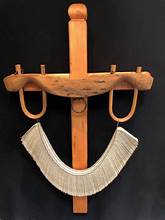
Focal Passage: Matthew 11:28-30
There is a kind of weariness that sleep cannot fix. It settles not in the body but in the soul, where faith is meant to live and breathe. I have felt it at times. I bet you have, too.
Many Christians know this quiet exhaustion—the slow erosion of trust when prayers seem unanswered, obedience feels unnoticed, and God’s promises appear distant. It is not necessarily the weariness of doing too much or trying too hard, although that can happen. It can also manifest itself as we wonder if what we are doing still matters to God.
This spiritual fatigue often grows in the tension between what we believe and what we experience. We know God is good, attentive, and present, yet life can still feel heavy with silence, delay, and ambiguity.
Over time, the heart begins to carry burdens it was never meant to bear—managing outcomes, maintaining appearances of strength, and quietly questioning God’s involvement.
Jesus’ invitation in Matthew 11:28–30 speaks directly to this deep weariness. Christians grow weary sometimes not because faith is flawed, but because we often misunderstand its nature, turning trust into effort and surrender into striving.
Into that self-imposed exhaustion, Jesus offers not more to do, rather, he offers himself as someone to whom we can come.
That offer changes everything.
I think that’s why I gravitated this week to one of the greatest promises of New Testament scripture.
Come to me, all you who are weary and burdened, and I will give you rest. Take my yoke upon you and learn from me, for I am gentle and humble in heart, and you will find rest for your souls. For my yoke is easy and my burden is light. (Matthew 11:28-30)
I know this passage speaks first to a Jewish culture that demanded complete obedience to a wide-ranging system of Pharisaic rules, regulations and expectations. It is an invitation to those who felt the crushing weight of this legalistic religion and floundered in their inability to achieve righteousness through effort.
I also think it speaks to those of us today whose faith, once simple and confident, becomes strained under unmet expectations and prolonged uncertainty.
Jesus calls to those who are weary and burdened. The Greek words for “weary” and “burdened” carry distinct meanings that deepen the nature of Jesus’ invitation to come to him.
The word used for weary (kopiao) means to “grow tired from hard work, to toil to the point of exhaustion.” It is the strenuous effort that drains one physically, emotionally and even spiritually.
It is the same word used in John 5:5 when Jesus told Peter who had been fishing through the night to cast the nets again. Peter responded, “Master, we’ve worked hard all night and haven’t caught a thing.” They had worked and grown weary not only because it was hard work, but because it was all for nothing.
To be “burdened” (phortizo) or heavy ladened, depending on your translation, is to “load down.” Grammatically, it is a perfect passive participle. Literally, “having been loaded down” and remaining in that condition. It also suggests the burden has been placed upon them by an external source.
It speaks of carrying loads not chosen. Loads that cannot be removed without help–the expectations of others, guilt induced by others, obligations repeatedly thrust upon you by circumstances outside one’s control.
It’s the image of someone crushed under a load they didn’t pack and can’t put down. I picture the sway-backed horse or the small boat so fully loaded it sits low in the water with waves washing over its sides.
When Christ bids the weary and burdened to come to him, he promises rest. The Greek word used for “rest” (anapauso) means to find relief after toil, a refreshing that restores strength. So, it’s not ceasing to work as much as it is to be renewed or refreshed after growing weary. To be re-energized to continue the work before you.
You find the same idea in Psalm 23, “He leads me beside still waters…he restores my soul.”
For a people burdened by Jewish legalism like those in Jesus’ audience, Jesus promised an internal reset, not relief from a life of obedience, but freedom from the weight of that burden—a burden he took upon himself at the cross. The same applies to the exhausted Christians today who grow weary of all that life throws at them.
Jesus encourages us to silence all the internal noise that prevents us from seeing God’s hand at work in our lives or the walls that keep us from seeing or sensing God in the first place. We are urged to draw nearer to him to find the inner rest and restoration we need to continue the work to which he has called us.
Paul offers this reminder to the Galatian church.
Let us not become weary of doing good, for at the proper time we will reap a harvest if we do not give up. (Galatians 6:9)
Notice that the rest Jesus speaks about is not about no longer working. It’s about linking or yoking ourselves to him. Deepening our connection and our relationship to one willing to share our burden.
Take up my yoke and learn from me.
In Jewish culture in the first century, taking up one’s yoke meant submitting to authority–the “yoke of the law” or the teachings of a specific rabbi. It meant one would become attached to the teacher and live under his instruction or guidance.
When Jesus asks us to take up his yoke, he asks us to submit our lives to him, fully and completely. To learn from him. His way of life. Jesus is saying, “Come under my instruction. Let me define how you live. Quit trying to figure it all out by yourself. Quit doing things on your own and trust me.”
Jesus offers a different kind of yoke. One not tied to heavy burdens. One not imposed with strict, exhausting interpretations of rules and regulations. A yoke that is not oppressive, but is relational. Gentle. Life-giving.
However, Jesus’ yoke is still a yoke. He didn’t remove a yoke from us in order to send us out to pasture to frolic in the tall, green grass without care or concern. We remain tied to his authority in ways that still carry responsibilities. Ways that still require obedience.
He promises, though, that the labor, the yoke under which we work, will not be crushing or burdensome because he is gentle and humble in heart. Kind, not harsh. Understanding, not a taskmaster. Approachable and compassionate.
I like the Greek word for gentle (praus) used here. It means “strength under control.” The word described a warhorse–strong, powerful, but disciplined and held in check by the reins in the rider’s hands. It describes one who has power, but chooses restraint—not harsh, not domineering, not reactive.
Pair praus with the Greek word for humble (tapeinos) and you get a sweet nuance that testifies to who Jesus is.
Tapeinos usually held a negative tone in the first century. It could mean low status or brought low. Jesus claims the word and applies it to himself, not as a matter of shame, but as a virtue. Humbling himself, as the Son of God, to be like us. This was his inner disposition. This is who he was at the core.
Then, Jesus paints one more word picture for us. Go again to the Greek. The word used here for “easy” (chrestos) is a word that Jesus, as a first century carpenter, would clearly understand. It means “well-fitting.”
In that day, ox yokes were crafted by a carpenter from wood. The carpenter measured the ox, using those measurements to rough-cut the yoke. The yoke would be tried on, marked and sculpted to fit the shape and form of that ox so it would not rub and chafe. It was tailor-made for that ox.
Do you see that picture for followers of Christ like you and I? Jesus promises his yoke will fit us well. The life he gives us to live is not a burden that will rub and chafe us. Our lives, the work we have been called to do, are made and measured for each of us. Tailor-made by the master carpenter himself.
That thought ought to make the yoke easier to bear, but there is one last thing. Though it’s never explicitly said in this passage, I always picture a double yoke, shaped for a team of two oxen.
Farmers in Jesus’ day and farmers of our not-so-distant past, would often pair an older ox with a younger ox. A stronger ox with the weaker ox. The older, stronger ox would carry the greater burden as the younger, weaker ox learned and grew into its own yoke.
Even if not explicitly stated, the rest of scripture shows that Jesus carried the greater burden in our lives by his suffering and death on the cross for our sins and our mistakes. My burden is lighter because he has carried it and continues to carry it with me, bearing most of the weight of all that confronts me.
Paul, discussing the “thorn in his side,” reminds us that Jesus told him, “My grace is sufficient for you, for my power is made perfect in weakness. (2 Corinthians 12:9)
Jesus offered his invitation at a time when Jewish law, their yoke, had become so oppressive, it caused people to feel unable and incapable of being in right relationship with God. He offered a new yoke, a new way of living in relationship with him that provides rest and recovery from the burdens imposed by others.
That truth is no less relevant today.
There have been times in my life when the eyes staring back at me in the mirror showed signs of quiet exhaustion. Times when I grew tired of doing too much or trying too hard. I have felt the spiritual fatigue of unanswered prayers and distant promises.
I have looked into the eyes of family and friends over the past few weeks. I’ve heard the uncertainty and weariness in their voices. I’ve seen worry etched in their faces and heard it in the timbre of their voices. They carry burdens they were never meant to bear, feeling like they were alone in the middle of the struggle, questioning God’s presence, involvement and even his love.
I don’t know if that’s where you find yourself this week. Bone-weary and in need of rest and recovery. If that’s you, I know where you’ll find it because I found it, time and time again snug in the light and easy yoke of Christ.
The life he has called you to live is custom-made. Carved for your shoulders. The good news of Jesus is that you are yoked together with him and he’s pulling most of the load.
He reminds us in this passage that there is only one thing we need to do.
Come to me, all of you who are weary and burdened and I will give you rest.
Thinking Points
In what aspects of life do you most feel the “quiet exhaustion” your soul carries? What parts of your life feel like a yoke that rubs and chafes rather than one that fits well?
Think of the frustrations you’re experiencing. How much of that frustration comes from unintentionally turning trust into trying or surrender into striving?
Where do you sense Jesus inviting you to stop managing outcomes and simply come to Him?
How might your perspective shift if you pictured Jesus beside you in the yoke, carrying most of the weight?