Follow the Trail

Focal Passages: Jeremiah 31:31-34; Luke 22:20

Daniel Boone is probably my pioneer hero thanks to Fess Parker and the glory days of NBC. While the television show that aired from 1964 to 1970 was more fiction than fact, Boone did play a significant role in the western expansion of the United States in the late-1700s.

In 1775, Daniel Boone and a team of about 30 axmen hacked their way from Tennessee through the Cumberland Gap into Kentucky and the Ohio River Valley, cutting the Wilderness Road. Along the way, they widened and connected a series of existing Native America paths, opening the door for American settlement on the western side of the Appalachian Mountains.

As he carved this new road, Boone “blazed a trail.” While we use that phrase today as an idiom to mean pioneering a movement or innovating in some new field, to Daniel Boone, “blazing a trail” meant to cut notches (blazes) into trees to point travelers in the right direction.

Historians estimate that roughly 200,000-300,000 people used the Wilderness Road, following Boone’s blaze marks, to reach Kentucky and beyond.

I’ve been reading the gospels in the last week as we approach Easter and found a new way to look at God’s redemptive work, following a trail God blazed long ago. Follow it with me.

This trail began before creation. Paul tells us this much in 2 Timothy 1:9.

He has saved us and called us to a holy life—not because of anything we have done but because of his own purpose and grace. This grace was given us in Christ Jesus before the beginning of time.

There’s our first blaze. We can follow the trail to the Old Testament. The prophet Jeremiah came at a time when the people of God had again fallen away from God. They broke again the old covenant with God and faced a future in captivity and exile. Hopelessly lost in their sin.

What Jeremiah proclaimed was the high point of his prophecies. A deep blaze in the trail of God’s salvation, pointing us toward Jesus and the cross.

The time is coming, declares the Lord, when I will make a new covenant with the house of Israel and with the house of Judah. It will not be like the covenant I made with their forefathers when I took them out of Egypt, because they broke my covenant though I was a husband to them. (Jeremiah 31:31-32)

Jeremiah declares that a new covenant is coming. This new covenant will be different by recognizing that God’s people would never on their own be able to keep the old covenant. God would provide a new way to restore his bride to himself.

Listen to the words of God that Jeremiah proclaims.

This is the covenant I will make with the house of Israel after that time, declares the Lord. I will put my law in their minds and write it on their hearts. I will be their God and they will be my people. No longer will a man teach his neighbor or a man his brother, saying, “Know the Lord,” because they will all know me from the least of them to the greatest. For I will forgive their wickedness and will remember their sins no more. (Jeremiah 31:33-34)

Can you see the promise of Easter in his words?

This new covenant, sealed with the blood of Christ, says that rather than laws written in stone, God will write his law in their hearts and in their minds. Faithfulness will become less an outward demonstration, but an inward transformation…a change of heart.

When God declares that he will be their God and they will be his people he is encouraging intimacy and belonging. They will have a restored relationship that is not based on compliance, but on connection and grace.

God promised that they will no longer be dependent on priests or intermediaries to know him. The relationship with him in the new covenant will be personal and direct. He will speak to them and they will speak to him. The new covenant will be available to anyone…from the least to the greatest.

The promise of something new has been made. Put a notch on this tree and let it lead us further down the trail.

The thought of this new covenant crossed my mind during a sermon my pastor preached several weeks ago in his series from the Gospel of Mark. Follow me on this path of discovery.

Jesus, confronted by some folks who were upset that Jesus’ disciples didn’t always fast like the really holy people of the day (Mark 2:22), broke into a parable about wineskins. It’s a story that would have left all who heard nodding in agreement. “You don’t pour new wine into old wineskins.”

You see Jesus had come to do, as the prophet said in Isaiah 43:19, “a new thing.” One simply could not pour Jesus’ teachings into a tired, old religious system that led to ruin. Jesus was doing a new thing. Once restricted to the Jewish people, God was prepared to do a new thing. His “new wine” would not only break out of the rigid trap of the Law that limited salvation to a select few, it would be available to all people, both Jew and Gentile. God is doing a new thing.

Cut a notch into that tree and keep blazing the trail.

Later, in Luke 22, Jesus gathered his closest disciples in a non-descript upper room in the heart of Jerusalem to share the Passover meal, hours before his betrayal, arrest and crucifixion. Thick with emotion and meaning, it was unlike any other Passover they had ever experienced.

Jesus shared the bread with those around him, urging them to take and always remember what he had done and what he was about to do.

This is my body given for you. Do this in remembrance of me. (Luke 22:19)

Then, Jesus shared the cup. Listen closely to what he said and watch him cut another notch in the trail.

This cup is the new covenant in my blood which is poured out for you. (Luke 22:20)

The wineskin story ultimately led me to Isaiah’s promise that God is doing a new thing, which in turn led to Jesus’ promise of a new covenant. It is a statement so rich in meaning.

In a biblical sense, a covenant is a promise between God and humanity. The old covenant, set out in Exodus 24, was that God would take Israel as his people. Israel promised to obey the laws God set before them. God upheld his end of the bargain. Israel could not consistently obey the law, thereby breaching the covenant time and time again with their sinfulness. All of the Jewish sacrificial system was established to atone for that sin through blood sacrifice.

Before we get too high on the horse with Israel, we would do no better than they in keeping the law. We would get just as lost in our attempt to follow the old covenant.

So in this teachable moment, Jesus tells his disciples that his death, his blood, will create a new relationship between God and humanity. His sacrifice on the cross replaced the old covenant system based on obedience to the Mosaic law with a new covenant based on forgiveness and grace.

Jesus and his work on the cross lies at the end of the trail this trail. Jeremiah’s beautiful description of what that new covenant would mean to you and me is another blaze along the path. Let’s follow it toward Easter as we look again at the prophecy of Jeremiah through New Testament eyes.

I will put my law in their minds and write it on their hearts. I will be their God and they will be my people. No longer will a man teach his neighbor or a man his brother, saying, “Know the Lord,” because they will all know me from the least of them to the greatest. For I will forgive their wickedness and will remember their sins no more. (Jeremiah 31:33-34)

The old covenant with its laws, sacrifices and temple system required repeated offerings. The new covenant in Jesus is sufficient, final and personal…offered to you and me through his sacrifice on the cross and sealed by his resurrection.

The new covenant offered through Christ will not be some externally driven creed or code. It is a a life lived by the teachings of Christ, written on our hearts and burned in to our minds. It is our turning point. It isn’t an attempt to modify our behavior, but a way of transforming out hearts to be like the heart of Christ. In this new covenant, we don’t conform to the law, we are changed inside to be like Christ.

As a result, we know God in a different more intensely personal way. He is our God and we are uniquely and securely his. No dependence on intermediaries. No barriers beyond those we create through our waywardness. He is not someone we cannot reach. We have this direct relationship with God through Jesus.

Because of Christ’s death for our sins and his resurrection that promises new life, our sins are forgiven and forgotten. God chooses not to remember. Jesus paid the price of atonement on the cross, so we don’t have to suffer the penalty.

That’s the promise of the new covenant and the hope and joy of Easter, isn’t it? Easter is Jesus saying, “By my life and my death, I have opened the door to a new relationship between you and God. I am the forever sacrifice that atones or covers every sin. The trail has been blazed. All you have to do is follow it.”

The Jeremiah passage may be the clearest Old Testament prophecy of what Christians understand as the new covenant fulfilled in Christ.

It shifts the focus from external law to internal change; from a national covenant to a personal relationship; from repeated sacrifice to complete forgiveness.

God planned his redemptive work and set it in motion long before time began, blazing a trail through human history, to bring us to that first Easter morning and the resurrection of the one who died to mark the pathway for us. Jesus is our trailblazer.

I am the way, the truth and the life. No one comes to the Father except through me. (John 14:6)

These are the questions we all must answer. Have you seen the blaze marks he cut for you? Have you followed the trail that leads to this new covenant and to the eternal life he promised you?

I hope you have, but if not, it’s never too late to start walking.

If the trail has already led you to Jesus, have you honored the new covenant he made with you? Are you living your life following Christ as your example?

I hope you have, but if not, that next blaze mark could bring you back to the path he needs you to walk.

Thinking Points

How does this new covenant change the way I view my relationship with God?


How is my faith different when it comes from inner transformation rather than external rules or traditions?


What does it mean for me personally that Jesus’ sacrifice on the cross is sufficient and final?


How can I live out the hope and freedom of the new covenant starting this Easter?


How can I share the reality of God’s personal relationship with others in my life?

 

Build an Altar

Focal Passage: Genesis 12:7

I have some friends who are serious hikers. For several years, they head east to hike another leg of the Appalachian Trail. One hopes to complete the last 150 miles of his journey this year. The other still has 750 miles to go.

Robin and I are recreational hikers. Tackling such an ambitious goal is not in the cards or our legs, though we did hike about 15 feet of the Appalachian Trail when we visited the Great Smokey Mountains a couple of years ago. We have just short of 2,190 miles to go!

These hiker buddies tell me getting lost on the trail is a very real danger. To avoid losing the trail on rocky ground, they watch for cairns. A cairn is a pile of stones stacked carefully on top of one another, placed by rangers to guide hikers along the correct path.

We see something similar with altars. God’s people would gather stones to build an altar, not because the stones had significance, but because together they became a marker of an encounter with God—a memorial of faith, obedience or answered prayer. So, in one sense, these altars built of stone would keep them on the righteous path.

Altars are a common theme in the Old Testament, particularly in the story of Abraham’s life. God called him from a distant land, telling him to leave his country, his people and his family and go to a land that God would eventually show him and carrying a promise of blessing.

Eventually, Abraham reached a place called Shechem in Canaanite territory. When he arrived, God affirmed that this was the land he had promised to Abraham and his descendants. In Genesis 12:7 you find a small phrase showing Abraham’s response.

“…so he built an altar there…”

If you keep reading Abraham’s story, the phrase becomes a theme.

Time and time again in Genesis, Abraham builds an altar. Nothing dramatic (with one notable exception). No elaborate ritual. Just ordinary stones stacked in quiet response of God’s faithfulness. Those altars stand as markers along the trail of Abraham’s spiritual journey. In many ways, they show us how a believer grows through promise, identity, restoration, trust and obedience.

Promise

Go back to that passage in Genesis 12:7. Abraham entered Canaan, the land God promised him. Everything he owned he brought with him. The land belonged to others. God told him, “To your offspring I will give this land.”
Notice what Abraham doesn’t do. He doesn’t survey the land. He doesn’t secure its borders. He doesn’t call his men together to talk about conquest.

Instead, he worships in occupied territory. Bows before God in a place that does not yet reflect God’s reign. He stakes the ground spiritually before he ever possesses it physically. The altar at Shechem is built on promise alone. Abram has no deed. No visible guarantee. All he has is God’s word.

This is where faith begins, isn’t it? Before we see fulfillment, before we possess anything tangible, before circumstances shift in our favor, we build an altar on God’s promise alone.

Abraham’s altar is his way of saying, “God has spoken and that’s enough.”

There are seasons of life when God gives a promise, but not possession. In those moments, the question is simply this:

Will we build an altar anyway?

Identity

Afterward worshipping God in Shechem, Abraham moves his herd to a new place between Bethel and Ai. No new promise is given. No dramatic revelation follows. He is doing what a sheep herder does. He moves his flock to new grass. There, he pitches his tent and builds another altar. At this altar, scripture tells us he…

“called upon the name of the Lord.” (Genesis 12:8)

He is not worshiping this time in reaction to something new God has done. It establishes a pattern of worship for Abraham. It marks his identity. Among a people who worship pagan gods and a culture filled with competing loyalties, Abraham builds another altar establishing who he is and to whom he belongs.

You see, before faith is truly tested in the crucible of real life, it must be established, rooted in the fertile soil of God’s presence. The Bethel altar is Abraham declaring, “I belong to the Lord, not just in moments of revelation, but in daily life. It shifts the emphasis from event-driven faith to identity-driven faith.

Shechem is about what God said. Bethel is about who Abram is. There are seasons of life when we must firmly identify ourselves with God. When was the last time you built such an altar as a witness and testimony of the one to whom you belong?

Restoration

After these early steps of faith, Abraham falters. Famine sends him to Egypt where opposition feels formidable. Fear takes over. He misrepresents his relationship with Sarah. Now, the promise seems threatened by Abraham’s compromise.

When he finally returns to Canaan, he goes back to Bethel, the place where he declared his identity. I imagine the altar had fallen into disrepair during his time away. You can almost see Abraham rebuild the altar from fallen stones even as he rebuilt his identity with God. and he again…

“called upon the name of the Lord.” (Genesis 13:4)

This rebuilt altar is not about promises or identity. It is about restoration. Abraham returned to the place where faith burned brightest to rekindle what he had lost.

There is something profoundly hopeful here. The life of faith is not a straight upward climb, is it? The Father of Faith, as the writer of Hebrews describes him, stumbled just like we do. When he did, he repented. He didn’t hide in shame or construct a new path. He went back to first things. First love. First trust. First dependence. Picked up the stones and rebuilt the altar.

Abraham didn’t outgrow the altar. He returned to it. In that moment of worship Abraham found himself restored into fellowship with the God of the promise.

I don’t know about you. I’ve spent my time in Egypt—a time of fear-driven decisions or some other spiritual drift. The altar of restoration is a repentant desire to return. A desire to come back to the Lord.

The beauty of this part of Abraham’s story is there is no rebuke from God. No ending punishment. God simply receives his worship and opens his arms again to Abraham. If you need to reconnect with God today, if you need his restoration, pick up the stones. Rebuild the altar of your identity as a child of God.

Surrender

Just a few verses later, Abraham found himself at a crossroad with his nephew Lot. The land cannot sustain both families. As the elder, Abraham had the right of first choice. Instead, he let Lot decide where he wanted to settle his family and his herds.

Lot chose the lush Jordan Valley, leaving Abraham with the leftovers, land which appeared less desirable. After Lot departed, God reaffirmed his promise to Abraham and his children. Abraham then settled near Hebron and…

“…built an altar to the Lord…” (Genesis 13:18)

Maybe this altar represents surrender. Abraham had every right and reason to grasp what was his. Rather than claim his own, he yielded. He trusted that God’s promise didn’t depend on Abraham’s maneuvering or manipulation.

There is a deep spiritual maturity here. Early faith built an altar after hearing promise. Growing faith built an altar after losing its advantage.

Trust is not tested when everything aligns in our favor, but when we voluntarily relinquish control. The altar at Hebron said, “God’s blessing does not depend on my securing the best position.”

Surrendering means letting go of what looks better. Letting go of my assumed advantage to go where God has placed me. Faith means believing that what God assigns is better than what we could have chosen.

This altar was quieter than the first, but perhaps stronger. Abraham no longer needed visible superiority. He just needed to let go. Could you and I also need to let go of something we think we need in order to receive God’s fullest blessing? If so, let’s build an altar to God.

Obedience

The final altar was the most severe.

God commands Abraham to offer his son Isaac as a sacrifice—the very child through whom that original promise was to be fulfilled. This was no longer about land. It was about the promise itself.

When he arrived at Mt. Moriah, Abraham…

“…built an altar there…” (Gensis 22:9)

On Mt. Moriah, Abraham built another altar, one that would cost him everything. Earlier altars celebrated promise. This altar appeared to contradict it. Yet, Abraham obeyed. With each stone growing heavier in his hands and heart heaving in despair, Abraham’s faith grew deeper, even when he didn’t fully understand.

He didn’t argue. He didn’t delay. He built.

At the final critical moment, God provided a substitute. The altar became a place of revelation: “The Lord will provide.” Obedience revealed provision. Earlier altars revealed trust in God’s word. This one required trust in God’s character.

Faith ultimately laid everything on the altar before God, even everything that God himself had given.

When we step back and watch Abraham, we see a progression of faith.

Promise leads to worship.

Worship leads to identity.

Failure leads to restoration.

Restoration leads to surrender.

Surrender leads to obedience.

Altars mark the decisive moments in Abraham’s spiritual foundation. They are not monuments to achievement. Not even guideposts along the trail, at least not in the most important sense. They are testimonies to dependence on and connection with God.

The quiet message running beneath these passages is that faith is not defined by what we do, but by whom we worship. Abraham’s life was not secured by cleverness or control. It was shaped by repeated acts of worship. A lifestyle of worship.

We may no longer build literal altars of stone, but we need to erect our spiritual altars.

Build them in the place of promise before fulfillment.

Build them in the place where we chose to identify ourselves as children of God.

Build them where we return from wandering to a place of restoration.

Build them where we let go of our desires, surrendering to God’s control.

Build them where we obey without full understanding.

Perhaps the question for us is this simple: Where do you need to build your next altar?


Life After Birth

Focal Passage: John 3:1-17

Every time I pull into my drive way and look at the roof above my garage, I see the flashing that has come loose. The glue and nails that once held it in place have weakened and broken free. The sealant intended to keep water from leaking into the frame of the house has visible gaps.

It wouldn’t be hard to fix if it were within easier reach of my 12-foot ladder and my 72-year-old body. Just when I think I can make that repair, I look again at the pitch of that roof and decide that discretion is the better part of valor. Back goes the ladder on its hooks.

I drove into the driveway this week, the flashing laughing again at my cowardice. I had enough. I picked up my phone and called Willie. Willie has done a fair amount of restoration work in my neighborhood. My neighbors tell me his competency comes at a reasonable price.

Every home, regardless of how well it was originally built, will need restoration after a time. This week, weather permitting, Willie will come out and restore the broken pieces of my house. I’ll be grateful.

Restoration.

It sort of became the theme of my thoughts this week. I read a snippet from a book I have in my library called Dancing at My Funeral, written by Maxie Dunnam back in 1973. I bought the book during my sophomore year at Texas Tech University with the discount I got for working part-time as a clerk at the Baptist Bookstore in Lubbock.

The book is Dunnam’s reflection upon the choices that shaped his life…some for the good and some, well, no so much. Dunnam looked back at his life with the freedom of grace that God gave him, finding he could “dance at the funeral of the past that haunted him.”

He comes out of that life reflection able to rejoice because he understands that the Bible is all about restoration. It is a theme that courses through the heart of all scripture. Cover to cover. From “In the beginning” to John’s last “Amen,..” and everything in between.

Dunnam wrote, “All the years since my youth I had been demanding a chance to start over. But, that’s impossible! And unimportant. The fact that you can’t start over is only part of the essential truth. The encouraging and redeeming part is that you don’t need to start over. The need is to start today…right now…living the new life God offers.

“The past,” said Dunnam, “can’t be blotted out, but we don’t have to be shackled by it. And, that is the essence of the gospel.”

Restoration.

You may remember our friend Nicodemus. He’s the Pharisee who first got to hear Jesus say, “For God so loved the world…” Nicodemus heard Jesus teach and preach. His colleagues in the priesthood felt threatened by Jesus’ surprising teachings and his rising popularity. Nicodemus, on the other hand, felt his carefully constructed faith begin to unravel at the seams every time he hear Jesus speak.

The faith Jesus spoke about seemed firmly anchored in concepts of love and grace that transforms ritual into righteousness. Everything Jesus said burrowed in the emptiness of Nicodemus’ religion, cutting away the last remaining strings that held it together.

When he could not rid himself of the drabness of his faith, Nicodemus tiptoed into Jesus’ campsite in the dead of night for a private conversation that would probe his heart at its deepest.

“Rabbi, we know you are a teacher who has come from God. For no one could perform the miraculous signs you are doing if God were not with him.” (John 3:2)

Far more than a polite conversation starter, these opening lines were a veiled plea of a man for whom life and faith had grown stale. To borrow the words of Dunnam’s own experience, the past haunted him.

In reply, Jesus declared, “I tell you the truth; no one can know the kingdom of God unless he is born again.” (John 3:3)

Jesus’ cryptic statement only served to deepen Nicodemus’ despair and increase his anguish. Nicodemus argued the point by incredulously stating that being born again is a physical impossibility. A red-herring of an argument that Nicodemus hoped would buy him time to think.

Maybe it buys us some time as well. Think about it.

Yes, new life comes at birth, but after you’ve made of mess of life, when nothing about your past makes sense, when we can’t break the chains of the past, life just gets hard. It’s not easy climbing out of the ruts cut by our deliberate decision to live life on our terms.

I think deep down Nicodemus wanted this new life Jesus talked about, but didn’t know where or how to find it. This desire to find life after birth brought him to Jesus when every fiber of his being told him to stay away.

Jesus answered, “I tell you the truth, no one can enter the kingdom of God unless he is born of water and the spirit. Flesh gives birth to flesh but the spirit gives birth to spirit…for God so loved the world that he gave his one and only son that whoever believes in him shall not perish but have eternal life. For God did not send his son into the world to condemn the world, but to save the world through him.” (John 3:5-6, 16-17)

Nicodemus wasn’t questioning the desire for restoration. That he wanted more than anything. He was questioning the possibility of restoration.

I understand where Nicodemus is coming from. Like me staring at that ladder, he knew something needed repair, but the risk felt too high and the outcome too uncertain. Yet, he came anyway—quietly and cautiously—because he knew he needed someone else to do the restoration. Jesus was his Willie, the one who could make it new again.

Restoration often begins right there. Where fear and hope meet and hope takes that one small step forward.

Jesus laid it all out there for Nicodemus as he does for us. God loves enough to offer restoration through Christ. He didn’t come to condemn us for our failures to live up to God’s standard, he just wants us to open our hearts to the possibilities that life can be more…that restoration to new life is not only possible, it is powerful.

Paul practically shouts it out in his letter to the Colossian church.

When you were dead in your sins…God made you alive in Christ. He forgave all our sins…he took it away, nailing it to the cross. (Col 2:13-14)

With sins forgiven and nailed to the cross with Christ, we find ourselves restored to new life. We see that message clearly written in 2 Corinthians.

Therefore, if anyone is in Christ, he is a new creation, the old has gone. The new has come. (2 Corinthians 5:17)

I could finish this up with my own thoughts, but I doubt they would be as profound as those penned by Dunnam himself. So, with respect to copyright laws, allow me to quote him.

“I’ve discovered there is a beginning which is common to every experience, no matter what has gone before. This beginning is the point of decisiveness where we turn to God with a new attentiveness, a new openness to his possibilities…To say “yes” to God is the ultimate act of will. To say “yes” is to surrender. Surrender is the pivotal point for becoming a whole person.”

Restoration.

Surrender leads to restoration and restoration is built into ever fiber of God’s word. It found its deepest expression in the death of Jesus on the cross in sacrifice for the mistakes of our past, present and future. For those open to the possibility of restoration…life after birth…it is all the answer we need.

The past need not define or haunt us. The present need not overwhelm us. The future need not frighten us. Every bit of flashing can be resealed. Every nail re-driven. I can…you can…be restored to new life in Christ. All it takes is the courage to tiptoe into Jesus’ campsite…even in the middle of the night when nothing else makes sense.

When we surrender to his will, there is always life after new birth and it is always more.

I have come that they might have life and have it to the full. (John 10:10)

Jesus offers me abundant life beginning now. Regardless of my past mistakes. Regardless of my stubborn desire to live life on my terms. He stands by offering a life overflowing with joy, purpose, peace, and communion with God and others.

Here’s my chance and yours today. Find restoration in God’s grace. Bury the guilt of the past. Toss a flower on its grave. Dance at its funeral.

Let’s express our gratitude to Christ for restoration even as we discover that there is indeed life after birth.

Create in me a pure heart, O God and renew a steadfast spirit within me…Restore to me the joy of your salvation and grant me a willing spirit to sustain me. (Psalm 51:10,12)

Thinking Points

What “loose flashing” in my life have I noticed but avoided addressing because the climb feels risky or uncomfortable?


In what ways might my faith—like Nicodemus’s—be carefully constructed but quietly unraveling at the seams?


Do I believe restoration is something God desires for me, but struggle to believe it is truly possible? Why?


What parts of my past still feel like they haunt me rather than instruct me—and what would it mean to “dance at their funeral?”


What would it look like for me to say a decisive “yes” to God today—not starting over (because I can’t), but starting now?


The Begin Againers

Focal Passage: Joel 2:12-13

Of all the jobs on the farm, I hated to hoe more than any other. Those endless, quarter-mile rows of cotton stretched forever into the horizon, especially in the July heat. The mindless hours of swiping that blade through that red West Texas dirt sure made going to college more appealing.

“Chopping cotton” was the first job most of us farm kids were compelled to do. We were too young to drive the tractor, but Dad could always shorten the hoe handle to fit our short stature. I learned how to sharpen the edge of my hoe with a file long before I mastered long division.

My Dad and older brother flanked each side of me the day I hoed my first row of cotton. I was not amused. I reached the age where I had to trade play for hard work…at least some of the time. My attitude reflected my half-hearted effort. Chopping just beneath the sandy surface to slice the stem of the weeds, took less effort than digging them out by the roots. So, that’s what I did…for hours.

Dad tried to get me to do it right. He showed me. He scolded me. He finally just took care of his business and left me alone.

About 10 days later, Dad took me to the same field and told me to tell him what I saw. Clearly, every third row, the rows I hoed, were fresh with regrown weeds while the other two were still pristine. The weeds I sliced seemed to grow back faster and stronger, nature’s way of thumbing its nose at me.

Dad pulled my hoe out of the bed of the pick-up truck, handed it to me, and said simply, “Begin again.”

I spent the rest of that day, miserable in a field, fixing my mistake. Lesson learned.

That distant life lesson resurfaced this week after years buried in the background of my mind. A passage in the Old Testament book of Joel reminded me that when God points out our sins, he also calls us to return to him, to begin again living within the framework of his will. To be what singer/songwriter Scott Mulvahill calls in one of his songs a “begin againer.”

Look at the message God shares through the prophet Joel in his call for repentance and starting over in restored relationship with the father.

Even now,” declares the Lord, “return to me with all your heart—with fasting and weeping and mourning. Rend your heart and not your garments. Return to the Lord your God for his is gracious and compassionate, abounding in love… (Joel 2:12-13)

You see, my Dad, rather than get angry, let my mistake run its course. Despite his instruction, he gave me my free-will choice to stubbornly do things my way. When that didn’t work well, he pointed out how my half-hearted effort didn’t achieve the desired results. He wanted me to understand that doing things the right way may be harder, but it is always better. Then, with a pat on the back, he just told me to begin again. Start over. Return to the field and do it right.

Does that not sound like how God deals with his own children? We grip the handle of our free-will choices and dig just beneath the surface of obedience, with an insincere effort. Then, just a few days later the sin, the weeds, return.

God walks us out to that weed-infested life and shows us the difference in doing things his way or doing them our way. With a pat on the back, he hands us the hoe and says get after it. “Do it again, please, but this time, do it my way.” God is a God of second and third chances… and thankfully so many more. In our rebellion, even now, he calls us to return to him. To be a begin againer.

Look again at this beautiful passage.

Return to me. Three words of incredible and incomprehensible hope that speak directly to those moments when we feel it’s too late. Those days when we feel we’ve strayed too far from the Lord to find our way back. Unintended mistakes. Deliberate rebellion. Spiritual apathy. God says, even now despite all you’ve done or failed to do, you can return. It’s never too late. Begin again.

The call to return must be answered with all your heart, God says. With fasting, weeping and mourning. Beginning again isn’t just a surface level change. God desires our complete and utter surrender. Not religious gestures or rituals. Not going through the motions. Just a sincere turning away from our stubborn desires to do life our way. He wants us to return to him with all that is within us. Our thoughts. Our affections. Our desires. Our souls. Our hearts. Our strength.

Fasting, weeping and mourning capture our deepest expressions of repentance. These acts and emotions are not expressions of sorrow over being called out or regret for the consequences we face, but sincere grief over the sin itself. In these things we recognize deeply our failure for what it is and how far it has taken us from God’s way and will.

Then Joel takes it a step further. Rend your heart, not your clothes. The ancient Hebrew would tear his clothes as a symbol of repentance or being repentant. God wants to make sure we understand that the transformation must be real. Don’t just look or sound repentant on the outside while stubbornly holding on to our old self on the inside. Perfection is not required. Humility is. Be transformed and renewed. Begin again.

God’s call to return to him or to begin living again for him rests in the very character of God. Our sincere regret opens the possibility of restoration. God’s grace confirms it. He welcomes us back, not because we earned it, but because of his goodness. His patience. His mercy. His grace. His never ending and all-encompassing love. It is who he is.

After his moral failure with Bathsheba and his scheme to claim her as his own, David, the psalmist, painted a vivid picture of how to begin again. Listen to the pleading in his words.

Create in me a clean heart, Oh God, and renew a right spirit in me. Cast me not away from your presence and take not your holy spirit from me. Restore to me the joy of my salvation and uphold me with a willing spirit. (Psalm 51:10-12)

Here’s what I find interesting in his passage as I think about my need at times to begin again.

David does not ask God to fix his heart—he asks Him to create a new one. The Hebrew word for “create” (bara) is the same used in Genesis 1:1 when God creates, well, everything. It suggests that David knows he needs a fresh start—something only God can accomplish. It is a cry for transformation, not just forgiveness. Let me say that again because it’s important. It is a cry for transformation, not just forgiveness.

It’s not just that we made a mistake when we sinned. We must recognize our hearts as fundamentally broken. David doesn’t minimize his sin. He’s asking for a radical inner change. He’s asking to begin again with the right spirit within him…steadfast, faithful, true…in touch with God’s spirit within. It is an urgent desire to draw near to the God he abandoned for a time. It’s David’s desire to begin again, living in the nurturing presence of his father in heaven.

Just recognizing my mistake in that field years ago, did not relieve me of the consequences. I got to hoe it all again, but I wasn’t by myself. Dad walked three rows over. Hoeing weeds that were mine to hoe.

What a marvelous picture of God’s sacrifice and abiding presence! When we sincerely begin again, we will never walk alone. For anyone needing to begin again, to start living for Christ again tomorrow, you need to know that God’s mercy is stronger than our failure. His presence is the reassurance of his sacrificial and everlasting presence.

That passage in Joel calls us to return to God. In its context, though, the call to return comes after a long period of rebellion. Our seasons of rebellion may seem just as long. Wouldn’t it be great, however, if we returned to God each morning. Start the day with a clean slate…a pure heart and a right spirit…a chance to set aside yesterday’s failure for a fresh start within the will of father in heaven?

God’s ready to walk with us every day, hoe in hand, helping us do it right.

The every day begin againers.

Thinking Points

In what areas of your life have you been giving a half-hearted effort? How might God be calling you to dig deeper?


How does the image of my father walking alongside me while I fix my mistakes help you understand God’s presence when you face the consequences of your own sin?


Why is transformation more important to God than just seeking forgiveness? What must we do to move past regret and really change the way we live?


What would it look like for you to “return to God” every morning as an “every day begin againer?”

No Longer Bent

Background Passages: Luke 13:10-17 and I John 1:8-9

I like to think I’m related to him. After all, we all would like to be related to someone famous.

C.S. Lewis, one of the 20th century’s most dynamic apologists of the Christian faith, is best known in the modern world as the author of The Chronicles of Narnia, a story rich in Christian symbolism. I first encountered his writings when I read The Screwtape Letters and Mere Christianity in college. The former an intriguing look at how Satan manipulates us; the latter a deep presentation of the validity of Christianity and what the life of a Christian is like.

He penned a lesser known book called Out of the Silent Planet. Similar to Narnia, it is a science fiction book written in the 1930s in which his protagonist journeys to another world. Like Narnia, he weaves Christian symbolism through the pages of Silent Planet. I admit I’ve only read snippets of this book, but within its pages Lewis uses his space traveler to explain sin to a people who never heard the concept.

After searching for a definition that would make sense to these aliens, the hero settled on the words “bent” and “bound.” Lewis defined sin as “misshapen.” “Not the way we were made to be.” “Not fit for our intended purpose.”

It is as good a definition as any. When a nail is bent, it cannot be hammered unless it is straightened. When an arrow is bent, it cannot fly straight. When we are bent, we are not shaped in the way God intended us to be. Lewis speaks of the sinner as one bound. Tied up. Unable to shake free. Trapped.

To paraphrase Romans, “For all are bent, and fall short of God’s glory.”

I’m writing today, recognizing my “bentness.” Okay, I made up that word, but you get the point. Sin makes us uncomfortable. We don’t like to think about our failings. While we know we sin, we also know that we don’t sin constantly. That we do some things right. We want to focus on that to make ourselves feel a bit better.

Here’s the truth about sin, however. When we break our arm, the rest of our body still functions as designed. We are not capable of doing everything we want to do until the arm is healed. Sin works the same way. While we can still do some good things, as long as sin is in our lives, we aren’t everything God needs us to be. We are not fit for our intended purpose.

Thank God his forgiveness is not just a heavenly thing that comes at the end of our time. Forgiveness is a daily gift for those who seek it.

Luke may not have written this story with that in mind, but it made me think again that God doesn’t wish for us to live bent and bound by sin. Look at Luke 13.

Jesus sat among the people in a local synagogue on the Sabbath, likely at the invitation of the local church officials who were somewhat excited to have this popular rabbi passing through their village. Chances are Jesus had never taught in this synagogue. He probably didn’t know too many people in the crowd. Teaching in the synagogue was simply his practice during his earthly ministry. Something he wanted to do. Something he enjoyed.

In the middle of his dialogue with the people about some passage of scripture, a woman captured Jesus’ attention, stopping him in mid-sentence. In those seconds of silence, you can hear the rustle of robes as the crowd turns to follow Jesus’ gaze.

What Jesus saw broke his heart. He swallowed a wave of overwhelming, God-inspired empathy. A lump of emotion filled his throat and the tears well up in his eyes.

“…a woman was there, crippled by a spirit for 18 years. She was bent over and could not straighten up at all.” (Luke 13:11)

When you picture this woman, you have to picture a posture more than stooped. The curvature of her spine forced her shoulders forward and downward. Bent at the waist, hobbling on unsteady legs and a knobby walking stick. Unable to lift her head above her horizon. The woman lived with a stark debilitation that left her crippled and unable to function.

As Jesus’ voice trailed off, he watched as the woman shuffled for her seat along the wall. She didn’t approach Jesus. Made no request of him. She didn’t proclaim her faith in him as a miracle worker. She just wanted to sit to take the burden off her feet and her back.

The rustle of robes returns as the crowd turns back to Jesus, as if to say, “It’s just Miriam. She’s been like that forever.” They know her. They have seen her around the village. Some of them probably even checked on her from time to time.

“Miriam,” my name for her, does today what she has probably done every Sabbath for the past 18 years. There is no indication in scripture that this was an unusual event. No indication that today the spirit moved her to get out of bed and make the difficult journey to the synagogue.

She came, as she always did, to be taught. To worship and learn. Today was no different. She probably didn’t even now there would be a guest teacher in the pulpit. This was just her place on the Sabbath. Jesus called her a “daughter of Abraham” in verse 16, possibly recognizing that this was her faithful pattern on the Sabbath, the place she needed and wanted to be on any Lord’s day.

In the midst of the ordinary, something extraordinary happened in this synagogue on this day.

Jesus swallowed the lump in his throat, choking back his emotion. He stood and called to her before she sat down, asking her to come forward. With difficulty she tilted her head to see who called out to her. As she looked sidelong at Jesus, she sidled slowly, and probably a bit suspiciously, his direction until she stood, hunched over in front of him.

Jesus dropped to a knee with his hand lightly on her shoulder, the tilt of his head matching hers until he looks her in the eyes.

His word is simple. His intent clear.

“Woman, you are set free from you infirmity. He put his hands upon her; and immediately she straightened up and praised God.”

The woman came to God’s house bent and broken, bound by her affliction. Jesus set her free. The root word in Greek for “set free” is to “loosen” or “untie.” She was no longer bent by or bound to her ailment. She had been released from almost two decades of physical torment.

Jesus set her free, released her from her bonds, not because she begged him to, but because he wanted to. He set her free because he wanted her to be free. To be what God intended her to be. It was, after all, the reason he came.

I find that an excellent illustration of our sin and God’s forgiveness. C. S. Lewis says sin misshapes us. Leaves us bent and broken. Paul talks about being bound in sin. Tied up and shackled by it. A slave to it.

I think when Jesus sees us bound in our sin, he still gets that same lump in his throat. That same overwhelming sense of empathy that he learned while hanging on a cross. It is what compelled him to die for us…an empathic love that says, “I can’t stand to see you this way.”

It is what keeps him reminding us, through his spirit, that God stands ready to forgive our sins.

God does not wait for us to come to grips with our bent and misshapen selves. Through Jesus Christ, he called us to himself, looked us in the eye, and took the full burden of our “bentness” all the way to Calvary. In doing so, he said to us, “Straighten up. You are set free.”

Once set free, we can respond as this woman did and praise God who loves us.

But, there is another character in this story. The administrator of the synagogue, the one responsible for proper protocol, objected indignantly to the healing. He quieted the crowd with a stern, “holier-than-thou” stare and a thunderous exclamation.

Rather than challenge this upstart rabbi directly, he turned his back to Jesus and admonished the astonished crowd for getting excited about a breach in protocol, putting Jesus in his place and indirectly chastising the woman whom Jesus healed.

In the arrogant tone of the righteously misguided, he said, “There are six days for work. So come and be healed on those days, not on the Sabbath.”

Protocol over people. Ritual over right.

Jesus would have none of it.

“You hypocrites! Doesn’t each of you on the Sabbath untie his ox or donkey from the stall and lead it out to give it water?” (Luke 13:15)

There’s that word again. The word Jesus used when he told the woman she had been “set free” from her disability, is the same word translated “untie” in this passage. He’s saying, “You willing set your donkey free on the Sabbath to give him a drink. Yet, you balk at setting this woman free from an 18-year trauma.”

Jesus said it better than I did. He said,

“Then should not this woman, this daughter of Abraham, whom Satan has kept bound for 18 long years, be set free (untied, released) on the Sabbath day from what bound her?” (Luke 13:16)

Here’s the kicker in this part of the story. We see clearly that the woman was set free, but what of the church official. His strict adherence to a distorted interpretation of scripture and church tradition, left him criticizing when he ought to be celebrating. His objection revealed just how bent out of shape he was. Revealed the sin in his life.

You have to wonder about the administrator. I wonder how many times this poor woman sought his prayers for healing over 18 years. I wonder if seeing her every Sabbath and now seeing her healed shamed him for his failure to invoke God’s healing.

This poor church official fell victim to a distorted spiritual view that at times inflicts all of us. C. S. Lewis said, “Those of us who do not think about our own sins make up for it by thinking incessantly about the sins of others.” It was and is a myopic view.

This church official, like me at times, got so busy “doing church” that he “did no good.” He could not recognize that his reliance on ritual blinded him to his own “bentness.” Bound to sin he didn’t know he had. Thinking that his body was functioning at 100 percent efficiency without acknowledging that his arm was broken.

When faced with our own sin, we have two choices.

We can fail to recognize that we are as bent spiritually as this woman was physically. Without recognizing our hypocrisy and seeking God’s forgiveness, we remain tied and bound to the sin.

“If we say we have no sin, we deceive ourselves, and the truth is not in us…” (I John 1:8)

Or…

We can recognize our misshapen selves. That we are living in a way that is not what God intended. A burdened, but repentant heart that stands hunched over before God seeking his forgiveness and willing to accept the grace gift of his forgiveness.

“If we confess our sins, he is faithful and just to forgive us our sins and to cleanse us from all unrighteousness.” (I John 1:9)

The attitude of the contrite gives God the chance to put his hand lightly on our shoulder and tell us to straighten up. It is a moment for praising God and celebrating our new freedom in him.

When we have been untied from the sin in our lives, Jesus gives us the opportunity to be “surprised by joy,” to use again the words of C. S. Lewis. The woman in our story praised the one who set her free.

I’m grateful for my God who is relentless in his desire to forgive.

A New Thing

Background Passage: Isaiah 43:18-21; Philippians 1:4-6

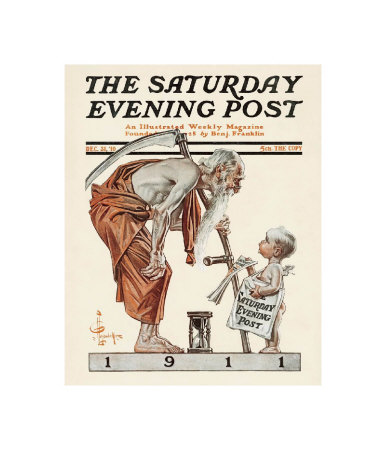
The passing of the annual torch from Father Time to Baby New Year has its roots in America in the fanciful illustrations of Joseph Christian Leyendecker, an early 20th century mentor of Norman Rockwell. Beginning with the December 29, 1906 edition of the Saturday Evening Post, Leyendecker started a 36-year publishing tradition by drawing an innocent, cherubic baby on the cover of the magazine’s last issue of each year in celebration of the arrival of the New Year. Each illustration suggested, “Out with the old. In with the new.”

Out with the old. In with the new. The New Year gives us the opportunity to forget the past and start with a new set of resolutions designed to make us better. I don’t suppose it’s ever a bad thing to reflect on the old year and then make the inevitable inner promises to reinvent ourselves. If you’re anything like me, however, a promise made in January’s daybreak rarely survives its sunset.

Coming so closing after the celebration of Christmas, I also find the New Year serves as a great reminder of the new work God has done in our lives through the birth of his son. A reminder to set aside the sins of the past and to recommit ourselves to the life God desires for us.

Isaiah, preaching to the people of Israel in exile, shared an encouraging word from God to his weary people. This is what he said,

“Forget the former things: do not dwell on the past. See! I am doing a new thing! Now it springs up; do you not perceive it?”

What is done is done. What is past is past. Despite a world of remorse or regret, we can do nothing to change a single moment of this past year. God reminds us through Isaiah, “Put your mistakes behind you. Don’t let them eat at your soul.” That’s always easier said than done. However, the continuous redemptive work of God tells a remorseful heart that the price of our sin has already been paid. Let it go. Look ahead.

When we finally turn our eyes from the failures of our past, when we finally let go of the baggage, we can look forward to the new work of God in our lives.

I love the words God shared with Isaiah. Hear the excitement in God’s voice as he tries to revive the broken hearts of his people. “See! I am doing a new thing!” It’s as if he is saying, “Look! Wake up! Don’t hang your heads! Look at the exciting things in store for you in the year ahead! I’m getting ready to rock your world! Can’t you see it?”

Was 2018 what you hoped it would be? I hope so, but maybe you found the past 12 months filled with pain, uncertainty, heartbreak and grief. Maybe you felt disconnected and alone. Maybe you realize you walked a path of your own choosing that took you too far from God. Maybe you just feel…off somehow. Just not quite right. Hear God’s word of encouragement. “See! I am doing a new thing!”

God’s word to the people of Israel promised restoration. He offers the same to us, especially when we are wandering in our personal wasteland and wilderness. He tells us with genuine excitement in his voice, “Have I got plans for you!”

Don’t make this New Year about resolutions. Make it about re-commitment. Focus on the new thing God is doing in your life. Open your heart to the possibility that this new thing he is doing will be the absolute best thing for your heart.

If you doubt this promise for a minute, consider Paul’s greeting to the Philippian church.

“In all my prayers for all of you, I always pray with joy because of your partnership in the gospel from the first day until now, being confident in this, that he who began a good work in you will carry it to completion until the day of Christ Jesus.”

The one who began this good work, this new thing, in your life will stay with you until it is finished. He will never stop working in our lives. Not in 2019. Not ever. So as we look to this New Year, it’s out with the old and in with this new thing God is doing.

I don’t know about you, but that makes me look forward to what this New Year will bring.

Rest for the Weary

Background Passages: Mark 11:27-33: Mark 12:28-34; Matthew 11: 28-30

I wonder if Jesus ever walked into the temple in Jerusalem desiring only to offer his own prayers to the Father in the privacy of his heart. Did he ever just get to sit in the shade of the portico and listen to the well-versed teaching of the rabbi? If it happened, it did not happen often. His presence seemed always to elicit a response either from the people, begging for his words of truth, or from his persecutors, probing for a weakness in his teaching.

Hours before his arrest, Jesus might have entered the temple just to pray…to clear his mind for what was to come. Instead, he found himself surrounded by hate in a rustle of flowing and elegant robes. No pleasantries exchanged. No effort to pull him from the crowd that gathered that morning for a private talk. Jesus turned full circle studying the 15 or so men who hemmed him in…the chief priests, the most learned scholars of scripture and the temple leadership…each shouting an indignant challenge to the Galilean teacher they viewed as a substantial threat to their way of life.

“By what authority are you doing these things?” they asked. “And who gave you authority to do this?”

Those entering the temple turned on their heels not wishing to be dragged into the confrontation. Others trapped inside retreated to the walls or peaked from behind the broad columns lining the courtyard.

Jesus pursed his lips. Took a deep breath. Looked down at his sandaled feet, sensing the anger in their murmuring. He raised his head, stared intently into the face of the first one to utter the challenge. In a voice as soft as a sprinkle that threatened a downpour, Jesus said, “Let me ask you one question…” When he finished probing for a response, they huddled in confusion, knowing they had stepped into a trap of their own making.

After a minute of deliberation, the best response they came up with was, “We don’t know.”

Jesus turned again full circle with eyes that burned into their souls to see if any of the others could offer a better answer. When no one spoke, Jesus took a step forward, turned sideways and squeezed past the first row of robes as the others parted to give him room, and whispered to no one in particular, “Neither will I tell you by what authority I am doing these things.”

Delightfully cloaked in a religion of rule and regulation, the religious leaders of the day could not fathom the wonder of his miracles or the simplicity of Jesus’ teaching. It ran counter to all in which they believe. Counter to that which elevated them above the ordinary man struggling to comply with the multitude of laws the priests and teachers found so comforting.

These same men, or men just like them, constantly hovered on the fringe of the crowd as Jesus taught. One parable–about a vineyard and the workers who killed the master’s son when he came to collect what was owed–caught their attention. They gnashed their teeth when it became clear to them that Jesus viewed them as the unfaithful tenants.

As their anger grew they threw rapid fire questions at Jesus. “Should we pay taxes to Caesar?” “Will there be marriage after the resurrection?” Jesus answered and avoided their traps with a voice as strong as his accusers.

At one drawn out pause in the cancerous debate, a Pharisee stepped forward, arms stretched in front of him, palms up… a plea, a peace offering. The man looked back at the huddled Sadducees and smiled as if to say, “That was fun to watch.”

Jesus looked at him, puffed out his cheeks and exhaled audibly in relief, willing his heart to slow its beat. “Please. Sit.”

After a brief introduction, the Pharisee spoke with Jesus, intent upon understanding. “Of all the commandments in all the law, which is the most important?”

Jesus, who had spent the last three years trying to break down the wall the law had erected between God and his creation, smiled for the first time all day. Tears welled up in his eyes. At last, here was a question that merited his attention…an arrow that pierced the heart of the matter.

“The most important one,” answered Jesus, “is this: ‘Hear, O Israel, The Lord our God, the Lord is one. Love the Lord your God with all your heart and with all your soul and with all your mind and with all your strength.’ The second is this: ‘Love your neighbor as yourself.’ There is no commandment greater than these. All the Law and the Prophets hang on these two commandments.”

This conversation continued as Jesus and his new friend exchanged similar thoughts and ideas. It ended with a warm embrace and a word of encouragement. Jesus held the Pharisee at arms’ length and said, “You are not far from the kingdom of God.”

Life for the Sadducees and the Pharisees consisted of a set of rigorous rules and regulations no man could reasonably follow. Because their obsessive compulsive minds did it better than most, they held the ordinary man in contempt. Over time, arrogance led them to establish a hierarchy of goodness that carefully and permanently cemented them at the top of the pious pyramid, looking down upon and taking advantage of those failing to meet the stringent requirements the religious leaders imposed.

By the time Jesus arrived on earth, God’s original law and covenant lie buried under hundreds of rules of behavior almost impossible for anyone to obey. The burden of obedience drove people away from God rather than drawing them in. Jesus challenged this distortion of the law.

Noted psychologist Abraham Maslow explained the natural human tendency to be overly dependent on a narrow set of skills and resources when resolving issues in life. Maslow is generally quoted as saying, “I suppose it is tempting, if the only tool you have is a hammer, to treat everything as if it were a nail.”

Rule, ritual and regulation became religion’s hammer in an attempt to beat God’s people into submission. It was all they understood. Jesus addressed the issue as he met constant rejection from the religious leaders and people of Galilee throughout his ministry.

In a similar episode early in Jesus’ ministry, he mourned for the cities of Chorazin, Bethsaida and Capernaum saying that their absolute dependence on rule and ritual blinded them to the new truth of the good news he offered. Trying to help the people get past the legal barrier, Jesus said,

“Come to me, all you who are weary and burdened, and I will give you rest. Take my yoke upon you and learn from me, for I am gentle and humble in heart, and you will find rest for your souls. For my yoke is easy and my burden is light.”

As I read through the scripture I can see the thoughts as they developed in Jesus’ heart and mind. Trying to find a way to make his point, Jesus focused his eyes on a farmer in the distance, walking behind an ox pulling a plow through the rocky hillside. He heard the farmer shout and the animal bellow as they labored to cut through the sunbaked earth.

Jesus thought back to that carpentry shop in Nazareth. Remembered the farmer who came to him in need of a new yoke for his ox. A perfectionist in his craft, Jesus followed the farmer to his field where he sized up the animal, visualizing how he wanted this new yoke to fit upon those muscled shoulders.

He went back to his shop. Jesus took his plane from a shelf and began to shape a piece of oak to match the vision in his head. He sanded it smooth and attached the harness points in perfect balance to keep the reins from pulling the yoke to one side or the other.

I can see him as he hefted the yoke on his shoulder and took it to the farmer, carefully fitting it upon the ox, adjusting it to his shape. He gave the reins to the farmer and watched for a minute as the ox pulled the plow through the field. The yoke made the burden less onerous for both man and beast.

That memory spurred the words. “Come to me, all you who are weary and burdened…For my yoke is easy and my burden is light.”

Jesus spoke every day to people whose shoulders sagged under the remorseless pressure of compliance to a bulky set of rules. The Pharisees lived in a world of “do this…don’t do that,” of “yes to this…and no to that.” The people lived in a world, condemned by arbitrary rule, and ridiculed by the religious leaders for their personal failings.

Religion…faith…became a burden.

He faced the rebuke of the Pharisees when his disciples picked a little grain on the Sabbath to satisfy their hunger. He faced the challenge of religious leaders who chastised him for healing a man with a crippled hand on the Sabbath. Ultimately, in those last days, he battled with an entrenched enemy whose questions never addressed the heart of the matter.

Jesus tried time and time again to tell them. “It doesn’t have to be this hard. Love your God with your whole being. Love those around you as you love yourself.”

I read again this week of a man who said that being a Christian was just a bunch of rules designed to “suck the fun right out of life.” That statement always troubles me. Do we as Christians act like the religious leaders of the day forcing compliance to a set of “laws” we created to separate ourselves from others?

The joy of life is not conditioned by rules and regulations that tell you what you can or cannot do. Joy comes through relationships…first and foremost with God and then with others. If those two things fall into place, that which “sucks the joy out of life” disappears.

Walking with God need not be complicated. It need not be burdensome. When the master carpenter carves out your yoke and places it upon your shoulders, it fits like a glove, the burdens so much lighter.

Jesus countered the prevailing burden with a simple invitation to accept the salvation he offered…the life he offered. “Come to me…” It’s that simple. “…all who are wearied and burdened…” It’s that inclusive. “…I will give you rest…” It’s that rewarding.

Jesus extends a personal invitation to the lost who have not found him and to the found who have lost their way. Come to him. Erase the weariness from your heart. Then, love your God with all your being. Love your neighbor with the love God extends to you. Once done, life becomes joy.

Come, Let Us Reason Together

Background Passage Isaiah 1:11-18

He was the coolest guy in town, wearing his jeans, a white t-shirt and leather jacket. A snap of his fingers called six attractive girls to his side. A tap of his fist or a quick kick turned on the jukebox. If a kid from another high school was threatening his friends, his mere presence sent the bully running for the exit of the malt shop.

Arthur Fonzarelli. He was the Fonz. As a leading character of the popular 1970s sitcom Happy Days, the Fonz, played by Henry Winkler, dispensed his brand of street wisdom to his group of wide-eye followers, Richie Cunningham, Ralph, “the Mouth”, and Potsie. In their eyes, Fonzie could do no wrong.

The Fonz rarely made a mistake so sitcom writers gave him an endearing quirk. He had a hard time admitting he was wrong. He would start to confess his mistake to Richie or Ralph and invariably stumble over the word. “I was wwwrr…” After a pause to collect himself, he would again stutter, “I was wroonn…” Trying again and again to communicate his mistake, he would change his approach and finally admit, “I wasn’t exactly right.”

Nothing stings as much as the sudden realization that we are wrong. I suspect it happens in our lives more often than we’d like to admit. I know it does in mine. Like the Fonz, we struggle to admit we are wrong. The words catch in our throats.

At no time is that fault more evident than when we sin against God. In our attempts to live our lives in our own strength, we fail miserably at times to live up to the standard of Jesus Christ, making a mess of our days. Even when confronted with our sin, we use every excuse, every reason to justify our behavior. Only when the earth gives way beneath us and our world starts to crumble, do we admit that we were “wwwrr…,” “,,,Wroonn.” “…Not exactly right.”

God knows this struggle within us and stands ready to talk it out.

The people of Israel in the days of Isaiah gave lip service to worship of the One God. They went through the motions of honoring their God. Offering their sacrifices. Singing their praises. Conducting their religious festivals. Spreading out their arms in prayer. Because God knew the insincerity of their hearts, he called them to task for their sin.

“The multitude of your sacrifices, what are they to me?” says the Lord. “I have more than enough of burnt offerings.” God called their offerings “meaningless” and their assemblies “unbearable.” He said, “I will hide my eyes from you. I will not listen to your prayers.” God, their Father, challenged them. “ Stop doing wrong, learn to do right! Seek justice, encourage the oppressed. Defend the cause of the fatherless, plead the case for the widow.”

Then, he offered something that only a loving Father would offer. An offer he still makes to us today. He said,

“Come, let us reason together.”

Imagine that. Our God, our Creator, the Almighty, wants to sit down with us to talk it out. Another translation of this passage says, “Come, let us argue it out.” God’s word here is not an offer to negotiate our decisions and choices. It is so much more. God extends an invitation to us to talk about our lives, the things with which we struggle, the things that break our hearts, the things we do to try and control our lives on our own. He calls us to engage in thoughtful and honest conversation.

Why would a sovereign Lord seek time with us about the things we do that run counter to his teaching and his will for our lives? When we make an argument before God in an attempt to justify our sin, and when we sincerely listen to his counter arguments, God knows that at some point in that conversation we’re going to open our eyes and our hearts and realize he was right and we were wrong. In an honest dialogue with God, that outcome is inevitable.

Within that debate, if we’re honest with ourselves, God’s logic, his evidence, his arguments against our chosen lifestyle will simply be too convincing and compelling. We will have no choice but to admit our guilt. Oh, we’ll struggle to say it out loud. We will pussyfoot around it. We’ll admit, “I wasn’t quite right,” before we finally bow down before him and say it. “I was wrong.” “I have sinned.”

God doesn’t just want us to admit our mistakes, he wants us to turn away from them. To repent and reclaim his promises. And, he offered restoration. He told the people of Israel,

“Though your sins are as scarlet, they shall be as white as snow. Though they are red like crimson, they shall be like wool.”

The conversation God invites us to enter with him, the dialogue that ensues, doesn’t leave us begging for forgiveness that will never come. It always leads to redemption and restoration. Admitting our guilt is step one. Turning from our ways to full obedience and trust sets us back on the proper path of God’s will for our lives. And, it all starts with the conversation. “Come, let us reason together,” says the Lord.

Understand clearly, in the balance between our God-given freedom and his divine sovereignty, our obedience does not force God to forgive. If it did, we would control his forgiveness. God forgives, not because our obedience requires him to, but because he wants to forgive. It is the desire of his heart. Just ask David or Jonah or a host of others throughout the Bible. God is the God of do overs and second chances.

I saw a poster recently. Paraphrased, it said, “Nothing stinks more than that moment during an argument when you realize you’re wrong.”

There may be an element of truth in that statement as it pertains to our worldly relationships. We just don’t like to be wrong. But, in our relationship to God, there is nothing sweeter than that moment when our conversation with the Father convinces us of our mistakes and draws us back under his will and way.

“Come, let us reason together.” What a life changing conversation that can be!

***

Dr. Kirk Lewis is author of two unique devotional books–Put Away Childish Things and The Chase: Our Passionate Pursuit of Life Worth Living. Learn more about author and his books at www.drkirklewis.com.