No Better Advocates

Focal Passages: Romans 8:26-34 and Hebrews 7:25

Isn’t it funny the things we remember and what brings them to the surface.

I declared public relations as my major at Texas Tech over 50 years ago without knowing much about the field. I sat in the back of the lecture hall, as was my custom, wearing my cloak of invisibility, hoping to never be called upon to share my limited understanding of the discipline I had chosen for my career.

The professor ambled slowly into class that first day wearing what I soon realized was his daily uniform–a rumpled, gray suit, that I suspect he had worn every day for the past 15 years. He opened his lecture by telling the class, “There is an old joke that defines public relations as the art of putting your best foot forward while lying about the other.” He laughed so we laughed with him.

I learned over the course of that morning and for the next four years that nothing could be further from the truth. A good public relations practitioner or spokesperson will not lie. The role as taught frames the message in a way that reflects the organization’s intentions, values and strengths, even when acknowledging mistakes that may have been made. The spokesperson speaks when the leadership team the pr professional represents is unable or hesitant to speak.

In his explanation, the professor said, “It is the pr practitioner who intercedes with the public on behalf of his or her client or organization.” It was the first time I had heard the word “intercession” outside of the church.

This week, in preparation for a Bible study class I’m teaching at my church on the Nicene Creed, I read these verses in Romans 8.

In the same way the spirit helps us in our weakness. We do not know what we ought to pray for but the spirit himself intercedes for us with wordless groans. And he who searches our hearts knows the mind of the spirit because the spirit intercedes for God’s people in accordance to the will of God. (Romans 8:26-27)

This passage about the spirit’s intercession was familiar to me. However, in my head, I never linked it to the far more familiar verse that followed.

And we know that in all things God works for the good of those who love him, who are called according to his purpose. (Romans 8:28)

I kept reading. Paul continues to talk about believers being called and justified by God, secured in relationship to the father.

Who will bring a charge against those God has chosen? It is God who justifies. Who then is the one who condemns? No one! Christ Jesus who died—more than that, who was raised to life—is at the right hand of God and is interceding for us. (Romans 8:33-34)

Again, this passage feels overshadowed in my head by more familiar verses that followed.

Who then shall separate us from the love of Christ? Shall trouble or hardship or persecution or famine or nakedness or danger or sword?…No, in all these things we are more than conquerors through him who loved us. (Romans 8:35, 37)

It’s that word interceding that intrigued me this week. The Holy Spirit’s interceding is familiar to me. His indwelling presence allows him to speak to God on behalf of his client…me…and you…when we don’t know exactly what to say or how to say it. My divine public relations specialist.

The Greek word Paul used to describe or define the Holy Spirit’s intercession is a word I cannot begin to pronounce…hyperentygchanei. Hyperentygchanei looks like it needs to buy another vowel or two. A few more consonants wouldn’t hurt.

Its root entygchano means to appeal or petition. Its prefix, hyper, can mean on behalf of or as a substitute for.

Paul says, in effect, the Holy Spirit petitions or appeals to the one who knows our hearts (God, the Father) in a strong or urgent way. Literally, to intercede for us with intense pleading, substituting his divine understanding and language for my feeble human insight and futile and ineffective words.

By adding hyper to the root, Paul stacks intensity into the word. This is not casual prayer language. It shows the Holy Spirit stepping into human weakness, translating the inarticulate into divine communication, pleading on our behalf the language of our hearts that we may not even fully understand.

It’s not that the spirit helps us pray better. The spirit carries our weakness into the presence of God and personally advocates on our behalf with divine depth and purpose which is to ensure that the desires we may not fully know or that we can’t fully express align more perfectly with the will of God (vs. 27).

The spirit intercedes for us even when we don’t know what to say or when we can’t see what’s next. Despite not understanding it all and because of the Spirit’s intercession, we can rest in the assurance that in all things God works for the good of those who love him, who are called according to his purpose. (Vs. 28)

I find this connection between the intercession of the spirit and God working for the good most comforting.

Still, here’s the twist that I never saw coming. Jesus also intercedes on my behalf…not just the Holy Spirit.

When Jesus took his place on the right hand of God, I always thought of it as a vindication of his death, a declaration of his victory. God honored him and gave him a name above all names. His presence at the throne of God demonstrated his exalted status as Lord and Savior. I assumed it meant his work was finished…and to a point, that’s correct. His work on the cross is done. The salvation for those who believe in his name has been bought by his blood.

However, Paul opens up a new perspective in verse 34. I’m sure I read the passage in the past, but I’m not sure I ever truly saw it. Jesus, my savior is sitting next to God the Father, speaking words on my behalf. Interceding on my behalf.

The word Paul uses in verse 34 about the intercession of Jesus uses the same word without the hyper prefix used to describe the intercessory work of the Holy Spirit. Here Paul uses just entygchaneito speak on behalf of another, to appeal or petition for another.

Jesus is still at work on my behalf and yours. He sits at the right hand of God, but not with his feet on a ottoman, sipping a glass of iced tea, while some angel waves a feathered fan in his face. He is interceding on my behalf and on your behalf…still.

The writer of Hebrews paints a picture of Jesus as our High Priest, whose job in the Old Testament was to offer atonement for the sins of the people. To serve as an intermediary between God and those who belonged to him.

Jesus is our great High Priest who sympathizes with our weaknesses and gives us confident access to God’s throne of grace. (Hebrew 4:14-16)

His access to God is our access to God through him.

Hebrews emphasizes how Jesus actively intercedes for believers, every time for the purpose and process of salvation. Here’s where the theology gets deep for me. Jesus’ work on the cross, his death and resurrection, made salvation possible for anyone who would confess his name and believe that God raised him from the dead. (Romans 10:9).

Hebrews tells us that for every believer, that work of Christ is done.

He offered one sacrifice for our sins forever and now sits on God’s right hand, his intercession flows from a finished atonement. (Hebrews 10:12-13)

…Intercession flows from a finished atonement…

Here’s what I think that means in a simplistic way. When the spirit convicted me of my sin and I turned to Jesus, the one who offered his life in payment for my sin, I gave my life to him. The finished work of Jesus’ atonement was that moment when he Jesus, sitting at the right hand of God, whispered in the Father’s ear, “Yes, I died for Kirk. His debt has been paid.” Because Jesus interceded on my behalf, God’s poured out his grace on me.

Christ’s intercession for salvation seems pretty straightforward to me. This next part takes me deeper.

Jesus’ intercession on my behalf doesn’t end at that moment of salvation. It continues through sanctification, that beautiful church word that means the process of being made holy…the ongoing, Spirit-enabled transformation of a believer into Christlikeness.

It is that work for which Christ continuously intercedes on our behalf. Hear this word from Hebrews.

Therefore, he is able to save completely (literally, to the uttermost, to the end) those who come to God through him because he always lives to intercede for them. (Hebrews 7:25)

Did you hear that?

…he always lives to intercede…

Christ intercedes to sustain our life in Christ to ensure we don’t collapse under pressure. To guarantee that repentance remains possible even after our failure to live up to his calling. To ensure our continued spiritual growth even amid our own weaknesses. Simply put, Christ intercedes to ensure that our standing with God remains intact while we are being transformed.

This is not a second or recurring atonement. It is a picture of Jesus remaining our advocate, presenting his finished work on our behalf, ensuring that our access to the Father never ends. After I am saved, I still sin. I still need forgiveness in real time. I still live in a broken world. Jesus stands in my corner as my advocate before God, pleading my case.

Hebrews 7:24 is a clear statement of Jesus’ continuous intercession. His work covers the full scope of salvation, not just our initial forgiveness and our becoming more like Christ, but our ongoing security and relationship to God for all eternity.

Maybe the concept is more simple than I first thought. The Holy Spirit’s intercession is experiential. He is at work within us, helping us in our weaknesses in prayer and aligning our hearts with the heart of God. Jesus’ intercession is positional. He represents us before God, securing our standing with him based upon his finished work.

As a former public relations practitioner, I understand the intercession of the spirit and of Christ a little more clearly than I once did. The spirit is my spokesperson who speaks on my behalf when I am unable or unwilling to speak for myself, even when I’m not sure what to say.

Christ speaks for us both when we fail to do things right and when we manage by God’s grace to follow him. He frames our lives in a way that reflects the intentions, values and strengths of Christ himself, even while acknowledging before God the mistakes we’ve made. Both the spirit and Christ, intercede to help us grow in our relationship to God as they transform us into the image of Christ.

We could ask for no better advocates.

Thinking Points

Most of us have found ourselves unable to pray because we did not know what to say or what we should ask for? What has happened once, will happen again. How does Romans 8:26-27 bring comfort in those moments?

How does the Holy Spirit’s intercession help you trust that God is working for your good, even when circumstances feel unclear or painful?

What difference does it make to know that Jesus is not only risen and exalted, but also actively interceding for you?

How does Christ’s ongoing intercession shape your understanding of forgiveness, sanctification, and your secure relationship with God?

In what ways does the image of the Spirit and Christ as advocates deepen your confidence as you approach God in prayer?

Walk This Way

Focal Passages: Matthew 4:19, Romans 8-29, I John 2:5b-6

Marty Feldman, the bugged-eyed comic of the 1970s, acted in the role of Igor in the cut comedy classic Young Frankenstein, released in 1974. He and Gene Wilder, starring as Dr. Frederick Frankenstein, played off of each other to perfection.

In one timeless scene, Frankenstein, arrived at the castle to begin his experiments. Igor, the scientist’s assistant with the ever-shifting hump on his back, picked up the doctor’s suitcase and began hobbling away. Hunched over and dragging his right leg behind him. As he led the doctor to his room, Igor said, “Walk this way.”

Wilder, looked a little bemused, but followed Igor, hunched over and dragging his own right leg. Comedy gold, in my book.

Some 50 years later, I still play that scene with my grandkids. “Walk this way,” as I mimic Igor. They just look at me like I’m a crazy man.

I don’t know if Feldman and Wilder realized the biblical truth they accidentally modeled, but in some ways, it matches the familiar call of Jesus to discipleship.

Walk this way becomes an echo of Jesus calling the seeker to “follow me.”

As he called his disciples, Jesus would utter some form of those two words. We see it first in Matthew 4:19. Peter and Andrew were casting their nets in pursuit of the day’s catch. Jesus called to them from shore…

“Follow me. I will make you fishers of men.”

The call to follow promising a new work, a new mission focused on spreading the good news of Christ.

Later in Matthew 8, a man came to Jesus with the desire to become a disciple, but wanted to first take care of some family business. When Jesus said to him, “Follow me…,” the man prioritized his family concerns and walked away. The change required by those words cost too much.

Later, Jesus called Matthew himself from a lucrative job as tax collector. Jesus walked up to the tax booth and said simply, “Follow me.” Matthew left it all behind to follow Jesus.

Commentaries tell me the word Matthew uses for follow in these passages is akoloutheo. It doesn’t mean “just tag along with me.” It means…

“To move in the same way as.”

“To occupy the same road.”

“Not trailing behind, but walking the same path the other walks.”

These first century men, living in the Jewish rabbinic tradition, would understand this word as a call to discipleship. It certainly meant to learn under the tutelage of a master teacher. Still, the word conveys more than the idea of learning from someone. It speaks about total life imitation.

A true disciple watched his rabbi constantly…the way he interpreted scripture, the way he prayed, the way he treated others, the way he dealt with opposition and struggle.

The goal of following was to so completely understand the rabbi’s conduct and character that the rabbi’s way of living in and seeing the world became the disciple’s way of living and seeing the world.

Jesus wasn’t just on the recruiting trail, looking for people who might agree with his theology, he was looking for people willing to walk the same road he walked in the way he walked it. He called people to imitate his obedience to the Father and demonstrate his love for the broken, the hurting and the outcast. He called folks to absolute surrender to the will and way of God. He called his followers to lay everything down, even life itself, for the truth of God’s kingdom.

You see that clearly displayed just weeks prior to the cross and the end of Jesus’ earthly ministry. Jesus began to tell his disciples that he “must go to Jerusalem and suffer many things…that he must be killed and on the third day be raised to life.”

Peter, bless his heart, pulled Jesus aside and–scripture uses a harsh word here–“rebuked” Jesus. In essence, Peter sternly cautioned Jesus, “Quit saying such things! We’ll never let that happen! We’ll walk with you and they wouldn’t dare touch you!”

Jesus fired right back at Peter with a harsh rebuke of his own. “Get behind me, Satan!”

Then, Jesus, turning to all his disciples in another call to continued discipleship, laid out the conditions of discipleship in no uncertain terms.

“If anyone would come after me, he must deny himself, take up his cross and follow me.” (Matthew 16:24)

There it is again, according to the commentaries, akoloutheo,

Follow me.

The word here deepens the meaning of what “following” actually requires. Now, he talks about the cost of following.

Self-denial. Yielding control of life. …all of life… to a sovereign Lord.

Taking up your cross. Investing one’s life…all of one’s life…to the work of God’s kingdom, regardless of the cost.

Follow. Giving your life…all of life…not just in a moment of trust that brings salvation, but in a continuous desire to become more like Christ every day.

Romans 8:29 says that God calls us to be conformed to the likeness of his Son. Paul isn’t just asking us to agree in principle with the teachings of Christ. He isn’t asking us to fall in line in some sort of superficial imitation of Jesus.

Discipleship and the call to follow is to work toward an inward, essential transformation into the same nature, conduct and character of Christ. A lifelong process of living each day just a little more like him.

Theologically, we call that sanctification…the ongoing process of salvation that has as its goal being transformed into the image of Christ. Being Christlike.

Many Christians today think of following Jesus as a belief system to maintain or a set of values by which to live. Thom Rainer, former president and CEO of Lifeway Christian Resources, bemoans this kind of consumer Christianity, a term he used to describe a faith that expects spiritual goods and services rather than sacrificial discipleship.

Following Jesus has never been a position to hold or a label to attach to our resume. Nor is it a political masthead. The call of Christian discipleship is a call to transformation, obedience and service.

The Apostle John answered Jesus’ call to follow. It changed his life forever. In his first letter, John encouraged his readers to live this transformed life of obedience.

We know that we have come to know him if we obey his commands. The man who says, “I know him,” but does not do what he commands is a liar, the truth is not in him. But if anyone obeys his word, God’s love is truly made complete in him. (I John 2:5a)

Then John hits the nail on the head.

This is how we know we are in him: Whoever claims to live in him must walk as Jesus did. (I John 2:5b-6)

So, the question this call begs me to answer…and the question it poses for you, too…is not how deep is my belief in Jesus, but how much does my daily walk look like his?

Now can you see that Feldman/Wilder skit finding its way into the gospel?

Akoloutheo.

Follow me.

Walk this way.

Thinking Points

Where in my daily life am I simply “agreeing with Jesus” rather than actually walking in His ways?

What part of self denial or surrender is Jesus calling me to embrace more fully right now?

How does my response to inconvenience, conflict, or suffering reveal whether I am walking the same road Jesus walked?

What habits, attitudes, or priorities need to be reshaped so that my life increasingly reflects the character of Christ?

Who in my life is watching my walk, and what picture of Jesus are they seeing through me?

Dip Your Toe in the Jordan

Author’s Note: I wrote this article 10 years ago in the months after my retirement as superintendent in Pasadena ISD. As our church shared its baccalaureate ceremony last Sunday, I was reminded again of what it felt like long ago to have all my life ahead of me as today’s graduates now have. It seemed again a good message to share with them. Feel free to send it to the graduates in your life. KL

Focal Passage: Joshua 1:1-9

I walked on stage this year again as a part of yet another high school graduation. After a 30-year career in public education, I’ve participated in one form or another in more than 120 commencement exercises and watched roughly 65,000 young people end their high school careers. That means I’ve seen my share of beach balls. Heard my share of air horns. Watched my share of impromptu dances across the stage.

The faces of these graduates as they received that cherished piece of parchment paper reflected a mixture of joy and excitement, tinged with an underlying sense of dread. Each of them undoubtedly realized in the hours after they walked the stage that they faced a future that remained largely unknown despite all their plans and dreams.

As I watched the evenings unfold each year, the ceremony always reminded me of my own graduation from high school. The scope and venue were certainly different–NRG Stadium in Houston compared to my high school auditorium in Ropesville, Texas. Standing among classes ranging in size from 450 to 1,000 students compared to my class of 33.

The graduation ceremonies, regardless of time, place and size, meant the same today as they did in our yesterday. Each graduate ends that which is familiar to begin a future that will unfold before them in unexpected ways, taking them down paths beyond anything they can truly imagine. It will be confusing and chaotic. Exciting and exhilarating. Filled with joy and pain. Some will thrive amid the challenges of life. Others will wither under its pressure.

So, we watch these young people graduate from high school with a prayer on our lips and hope in our hearts that God will lead, guide and protect them through each day of their lives. I am certain, whether they know it or not, they will need his presence every step of the way.

Our culture calls it commencement. A beginning. I like to think of it as a commissioning. A challenge set before them to be all God needs them to be in whatever call of life he sets before them.

He faithfully served his God under the leadership of Moses. Chosen among the leaders of his tribe to sit among Moses’ council of advisors, Joshua played a significant role in leading the Hebrew people into the promised land. As a spy, Joshua refused to see the land of Canaan as a place of unconquerable giants and impenetrable fortress cities as others did. Rather, Joshua saw the land God promised as a land of milk and honey.

Because of his trust and faith in God, Joshua was given the task originally assigned to Moses. I picture him dipping is toe in the slow current of the River Jordan, staring across the value in the direction of Jericho. It is three days before he would give the command to his people to cross the river and enter the land of promise.

If he was anything like most of us, and I suspect he was, he fought an internal battle with his doubts and fears, voicing a prayer for strength and wisdom he felt he lacked. Joshua surely understood his future would be at times confusing and chaotic. Exciting and exhilarating. Filled with joy and pain. A future in which he could thrive amid the challenges and stumble under the pressure. Like our graduates today, I suspect the butterflies in Joshua’s stomach seem as large as eagles.

God chose that moment as his commencement. His commissioning. The Old Testament tells us that God gave his charge to the leader of his people as he stood with his toes in the Jordan. As a commission to those he calls to serve, it can encourage our graduates equally well as they prepare to encounter life after high school. And, it is good news indeed.

God said to Joshua…

“Be strong and very courageous. Obey the laws Moses gave you. Do not turn away from them and you will be successful in everything you do. Study this book of the Law continually. Meditate on it day and night so you may be sure to obey all that is written in it. Only then will you succeed. I command you…be strong and courageous! Do not be afraid or discouraged. For the Lord you God is with you wherever you go.” (Joshua 1:7-9)

To those graduating from high school or college, know that God has a purpose for your life, just as he did when he told Joshua, “You will lead me people to possess all the land I promised to give their ancestors.” His plan is unique to you. To the heart he has given you. The skill sets you have learned and the talents you acquired along the way. I can almost guarantee you the plan will take you places you never thought you’d go. Watch for the doors that open and don’t hesitate to walk through them.

Following God’s path will not always be easy. Life will hit with cold reality that will lead to disappointment and discouragement. Yet it will also bless in glorious ways. God encouraged Joshua to “be strong and very courageous.” The door he opens may not be a threshold you wanted to cross. Step across it anyway with courage, conviction and confidence in the Father. A door may appear at times to be blocked. Overcome. Persevere. Rest on the promises of God.

God reminds us in this passage that success is contingent on our understanding of and obedience to the word of God. We leave high school and home desiring to exert our personal independence, to make our own choices and chart our own course in life. That’s the whole point of growing up.

Free of someone who wakes you on Sunday morning for church, it will be easy to sleep in…to set aside your faith. A word of caution. Now is not the time to express your independence from God. As you enter college or head into the work force to establish a home of your own, you will choose whether to abandon the relationship you have with Christ or to draw more deeply upon it. You have that choice.

God reminded Joshua not to stray from the teachings of God. To hold the word of God close to his heart. To mediate upon it. To study it. To draw from scripture the wisdom of God that enables us to deal with both the good and difficult times of life. This is the key to success.

Be careful also to recognize success through the eyes of God and not the eyes of the world. Success hinges upon your ability to stay focused and obedient to the plan God has for you. When we walk in his steps we walk on firm ground, able to experience joy and contentment in a life of service to the Father and to others.

As you can imagine and as the scripture tells us, Joshua and his people had to fight for all that God promised. The path God chose for Joshua as not easy. The hardships and heartaches were real. The difficulties must have seemed insurmountable at times where Joshua struggled with which way to turn and what he should do. He must have felt terribly alone at times.

You will almost certainly face hardships and heartaches throughout your life, hopefully in the measured grace of God’s blessings. You will face some of life’s hardest decisions, uncertain about which way to turn and what you should do.

Know this. God promised his presence. “…the Lord your God is with you wherever you go.” It is a promise as true today as it was when Joshua stood with his toes in the Jordan River. Trust the promise. Trust in the one who made it. God will be with you wherever you go.

So the message of Joshua speaks these four things as clearly to me today as it should to you as a high school graduate.

God has a plan and purpose for each of us…in every phase of life.

He calls us to walk with strength and courage in obedience to his plan and purpose regardless of where it leads us.

We find that strength and courage and discover his will and wisdom only when seek him and immerse ourselves in his word.

Despite the difficulties that will most assuredly come, we can rest each day knowing that he will be with us wherever we go.

Here’s the thing I’ve learned and the one of which I am reminded with every graduation I attend. The challenge of graduation isn’t a one-time event. After you’ve tossed the cap and hung the tassel from the mirror of your car, you will take the next step in the life God has planned for you. You will dip your toes in the Jordan and step into the land his has promised. From that day forward, you will find another Jordan to cross. And another. And another. And another.

To every graduate out there, whether with the Class of 2026 or any class back through time, celebrate this special day. When it is over, dip your toes in the Jordan. You can’t imagine what God has planned for you!

Thinking Points

The following reflections are applicable to graduates as well as those of us who crossed that stage long ago. God is still asking all of us to dip our toes in the next Jordan. 

Where do I sense God opening a door in front of me, and what step of courage is He asking me to take as I cross my own “Jordan?”


How will I stay rooted in God’s Word as I step into independence, so that my success is shaped by His wisdom rather than the world’s expectations?


What current season of transition in my life feels like standing at the riverbank, and how is God calling me to be strong and courageous in it?


In what ways have I seen God’s faithfulness in past crossings, and how might remembering those moments strengthen my trust for the next one?

Choose Life

Focal Passage: Deuteronomy 30:19-20 and Romans 12:1-2

Baseball entered my bloodstream during the 1961 World Series when the New York Yankees defeated the Cincinnati Reds in five games. The New York dynasty bothered my Dad. He detested the Yankees, and, quite naturally, so did I.

While we grudgingly accepted the greatness of Mickey Mantle and Whitey Ford, both of us had a soft spot for Yogi Berra. Catchers in the Major Leagues are generally among the more intelligent players on the team. Berra sounded like the exception.

“You can observe a lot just by watching.”

“It’s like deja vu all over again.”

Smart in practical, real-world ways, especially about baseball, teamwork, and reading situations quickly, Berra built a reputation for goofy sayings that made him a media darling.

I thought of one of my favorite Yogi quotes this week as I was doing my Bible study. He once said, “When you come to the fork in the road, take it.”

Psychologists say that people make as many as 35,000 decisions or choices of one kind or another every, single day. Rice Krispies or Cheerios? Sensodyne or Crest? Paper clips or staples?

Out of the millions of choices made over our lifetimes, those same psychologists say we make only a few hundred life-altering decisions. Buy or Rent? This job or that one? “I do” or I don’t?

Back in my college days, I asked a friend to tell me whom I should ask out on a date. He suggested one of two girls we knew who happened to be roommates. When I asked him which one, he said, “Just call. Ask the one who answers the phone.” The girl who answered the phone on that February night in 1973 has been my wife for over 50 years now.

Thankfully, sometimes God guides those all-important choices for us.

I might be wrong, but on most days, I’m not sure God cares if I go with the paper clips or staples. In the grand scheme of his plan for my life he’s probably less concerned about whether I use a brand recommended by dentists for sensitive teeth or a brand where I can cheerfully report, “Look, Ma! No cavities.”

There are, however, many choices we face that do matter in God’s will for our lives. Those are the ones to which we must pay attention. There is one choice more important than any other.

The Hebrew people didn’t always make the right choice. No one knew this better than Moses. He has seen Israel long for captivity in Egypt again after God had set them free. He had heard them grumble when they wanted something other than the manna God provided to sustain them in the desert. He stared in disbelief at a golden calf they created when they grew tired of waiting on God.

Moses watched them stand at the point of deliverance in Kadesh Barnea ready to enter the promised land only to back away in fear. Moses witnessed the death of an entire generation in the wilderness because of the choices they made.

This godly leader felt the consequences of poor decisions as he stood a second time on the precipice of the promised land, knowing he would not be allowed to enter because of his own disobedience.

Moses understood that life is full of consequential choices. After all of that history—after rebellion, regret, judgment, and mercy—Moses gathered this new generation of Israelites on the banks of the Jordan telling them they had a choice to make.

Read what he said.

This day I call on heaven and earth as witnesses against you that I have set before you life and death, blessings and curses. Now, choose life… (Deuteronomy 30:19)

When Moses urges them to “choose life,” it is not a poetic flourish. He pleads with a people who have repeatedly chosen a path of destruction, even when another more blessed option was clearly offered.

At first glance it seems a simple choice. Who among us, even today, would not choose life and blessing over death and curses? Most scholars say that’s not really the choice we’re called to make. Life and blessing or death and curses are the results of what we choose.

Moses goes on to explain to the Hebrew people and to us what it looks like to choose life. Read further in the passage.

Choose life…that you may love the Lord your God, listen to his voice and hold fast to him. For the Lord is your life… (Deuteronomy 30:20)

Notice that God does not force the outcome. He invites a response.

Choose life.

The Hebrew word for choose used in this passage means “to select or decide after careful consideration. It is not a casual choice, nor is it an emotional one. It is intentional, suggesting loyal commitment. It is the same word used in covenant language when God “chooses” Israel.

Moses tells the people essentially, “Choose God the way God has chosen you.”

Interestingly, according to one commentary, the Hebrew word translated “life” in this passage is plural. It conveys the idea of life to its fullest; life in every dimension. Spiritual. Relational. Emotional. It mirrors the language of Jesus’ desire when he calls us to experience “abundant life.” Life as it was meant to be in God’s creation.

The people of Israel hear Moses tell them to carefully and deliberately commit to a path that leads to a true, full, God-centered life.

Moses doesn’t stop there. He tells them how to do it. It’s less about 10 commandments etched in stone and more about their relationship to God. Did you see it?

To love him.

To listen to his voice.

To hold fast to him.

There is a passage in Genesis where God declares, “Jacob I loved; Esau I hated.” The Hebrew words for love and hate are not about emotion. They are about choice. God chose Jacob as the one who would receive God’s promises. He did not choose Esau.

We are to choose God. To give him our devotion. Our adoration. Our loyalty. Our worship. Our trust. That’s what it means to love God.

We are to go past hearing God’s voice and deeply listening to his words. God stands ready to teach and guide those who chose him. His word is true and never fails. It is, as the Psalmist says, a “light unto my feet,” intended to guide our daily walk, even when we are surrounded by darkness. We are to listen to his voice.

As we live in relationship with God, we are to hold fast to him. The verb tense of the word suggests that holding on to God is not something done only once or only in difficult times. It means literally to keep on clinging to God. Hold on tightly. Don’t ever let go.

Think about that. Moses said, choose life by loving God, listening to his voice and clinging to him. The reason, he added, is simple. God is life. See it? Choose life. God is life. Therefore, choose God.

For a people about to enter a land where God was neither known nor worshipped, the choice Moses laid out was the only choice that would bring them the life God promised.

Every day, in a thousand small and large ways, you and I stand at Yogi’s fork in the road. Now, we have a choice between good or bad. Good or better. Better or best. Life or death. Blessing or curses.

When you get right down to it, we face the same choice the Hebrew people made long ago.

Will I love and trust God or will I depend on myself?

Will I listen to the voice of God and the whispers of his Holy Spirit or will I ignore what I hear?

Will I cling to Christ despite the circumstances or will I let myself drift away?

The good news is that God not only gives the command to choose—He gives the desire behind it. “Choose life” is not harsh; it is deeply compassionate and reveals the heart of God. Choose life is not an ultimatum, it is his expressed desire for all of us. It is as if God is saying, “This is the path that leads to joy, peace, and purpose. Walk in it, please! Come to me!”

It’s not just an Old Testament concept. Paul urged the Christian believers in Rome to choose life by offering themselves to God.

Therefore, I urge you, brothers, in view of God’s mercy, to offer yourselves as living sacrifices, holy and pleasing to God—this is your spiritual act of worship. Do not conform any longer to the pattern of this world, but be transformed by the renewing of your mind. Then you will be able to test and approve what God’s will is—his good, pleasing and perfect will. (Romans 12:1-2)

In other words, give yourself to God in every way. Choose life.

Today, life will be set before you and I again and again. Not in one dramatic moment, but in a hundred quiet decisions…a hundred forks in the road.

Choose to love Him.

Choose to listen.

Choose to hold fast.

Because He is life.

Thinking Points

What choices have I made recently that indicate what I truly value and trust?

Where am I tempted to choose comfort, familiarity, or self reliance instead of choosing God?

What would it look like today for me to love God intentionally — with loyalty, devotion, and commitment?


How well am I listening for God’s voice rather than merely hearing His words?


In what circumstances do I need to cling to God more tightly instead of drifting or loosening my grip?

Walk and Be Blameless

Focal Passage: Genesis 17:1

It was one of those Facebook posts you see all the time. Boldface words on a solid yellow background. The post was a single passage of scripture from Genesis. I don’t remember who posted it originally. I only saw the post that one time, but for some reason, the passage kept skipping through my mind like a smooth stone flung across a calm lake.

When Abram was 99 years old, God appeared to him and said, “I am God Almighty; walk before me and be blameless.” (Genesis 17:1)

It is a verse that gets lost in the personal, covenant language that follows as God promises a new relationship with Abram and his people. Like any covenant or promise, it lays out the responsibilities of both parties. God explains in the following verses what he will do. Yet this first verse captures in a nutshell what God expects of Abram.

I heard it all week every time the stone skipped over that water. I am God Almighty. (Skip) Walk before me. (Skip) Be blameless. (Skip)

The words pushed me to slow down and look more carefully at the language itself. The more I looked at the verse the deeper and richer it became. Let me show you what I mean.

The Hebrew word for walk used in the passage is halakh. It’s not like God is telling Abram, “March! Get moving!” Rather, halakh, in one sense, speaks of wandering. Not walking in a straight line. Roaming back and forth.

If that sounds like the aimless meandering of someone who doesn’t know where they’re going, it’s not. It suggests the idea of consistent, purposeful movement. In other words, make a habit of… Develop a pattern of life

When God tells Abram to walk, he’s saying, “As you go about your life…” or “Wherever life takes you…” “In everything you do, no matter where you are…” For one whose life took more than one unexpected turn, that resonates with me. “In the daily routine of life…”

This idea of walking doesn’t end with Abram. The New Testament picks it up and deepens it. Our walk becomes one of the primary ways Paul and John describe our life in Christ.

Paul writes in Ephesians:

I urge you to walk in a manner worthy of the calling you have received. (Ephesians 4:1)

Our walk, according to Paul, is our daily conduct. Our moral direction. It is all about aligning our relationship with Christ with everything we do. Paul encouraged the followers of Christ in the Ephesian church to make sure their life reflected the life and love of Jesus everywhere they went and in all they did.

John also used walk to describe authentic faith.

If we say we have fellowship with him and yet walk in darkness, we lie and do not live by the truth…but if we walk in the light, as he is in the light, we have fellowship with one another… (I John 1:6-7)

What does that walk look like? Genesis 17 offers another word to guide us. Be Blameless. It’s another skip of that rock we’ve tossed across the pond.

The Hebrew word of blameless is tamim. We can relax a bit because it doesn’t mean sinless or morally perfect. Thank goodness!

Tamim means complete. Whole. Undivided. Think faithful, not flawless. David was called a “man after God’s own heart,” yet he sinned. Even so, he was tamim. A man with undivided loyalty to God.

God tells Abram so we can also hear him. “Live your life consistently with an undivided heart, whole and complete. Don’t withhold any part of your life from me. Give me your all. Live it all before me.”

Pause with me here.

Have you ever studied a passage of scripture, thinking you had it nailed down tightly only to have the nagging sense that you were missing something important? That was me last night. Walk. Be blameless. What was I missing?

Here’s what I noticed. God tells Abram to walk or live out his life, but he says walk before me. The phrase before me expresses a nuance I had not considered. The most literal translation from Hebrew translates before me as before my face.

Before whose face?

I am God Almighty. Walk before me…

At first glance in feels like a foreboding call to obedience because God always has his eye on us, just waiting for us to trip up so he can punish us.

I was a good kid, I think. If I’m honest, I was probably better when I knew my parents were watching. That’s human nature, I suppose, but I just don’t think that’s what God is saying here. It makes obedience a fear response. I’ll walk the straight and narrow because I don’t want to get in trouble.

When you look deeper, God Almighty is calling Abram into a covenant relationship with him. A call to personal relationship. God tells Abram wherever you go in life, whatever you do, do it in my presence. “Be with me. Let me be with you.”

There it is. That’s the amazing thing I missed at first glance. God Almighty wants a personal relationship with me. He wants to walk with me wherever I go. I find that far more comforting than uncomfortable.

Jesus made a similar connection in his last intimate message to his disciples before his arrest and crucifixion

Remain in me and I will remain in you. No branch can bear fruit by itself; it must remain in the vine. Neither can you bear fruit unless you remain in me. I am the vine; you are the branches. If a man remains in me and I in him, he will bear much fruit. Apart from me, you can do nothing. (John 15:4-5)

Can you see how this ties so well to Genesis 17? God tells Abram to walk before him. Jesus tells us to remain or abide in him. To dwell in his presence. To live in him. It’s relational. It’s mutual. It’s Jesus’ way of saying live your life continuously and consistently in the presence of God.

Doing so, allows me to not only be in fellowship with God and others, but to bear fruit…to reflect the life of Christ so others can catch a glimpse of who he is and what he promises.

I am God Almighty.

Walk.

Before me.

Be Blameless.

It is a call to live a Christ-like life in every area of life wherever that life takes us. And always in the strength of our God Almighty.

Not perfect. Just present.

Not flawless. Just faithful.

Not alone. Just alongside.

Maybe that’s where this new covenant takes root. Not in the grand spiritual moments, but in our daily walks with undivided hearts in relationship with an almighty God who delights in walking with us.

Maybe that’s why I still keep hearing it, like a stone skipping across the water again and again and again.

Thinking Points

When you hear God’s words, “Walk before me,” do you experience them more as an invitation to a relationship or as a call to performance? Why?


What areas of your life you tend to keep compartmentalized—places where your heart may not feel completely “undivided” before God?


How does understanding blameless as “whole” or “complete” change the way you think about faithfulness?


What might it look like for you this week to live more consciously before God’s face—reveling in His presence rather than fearful of His scrutiny?

Man in the Mirror

Focal Passage: James 1:22-25

Like many World War II veterans, Dwight Eisenhower was one of my Dad’s heroes, both as a general and a president. The more I read about Eisenhower’s leadership during the war and his time as president and his compassion for people, the more I admire the man.

Eisenhower was not a man of impulse, but rather a man who gathered information, listened to the advice of others and then acted decisively. He knew there was a time to plan and a time to do.

In his book, An Army at Dawn, Rick Atkinson related this story about Eisenhower. American troops had landed in North Africa in 1942 in an effort to liberate Europe from Hitler’s Nazi Germany. In the earliest days of that invasion, the U. S. Army struggled to gain ground. Eisenhower grew frustrated with what many of his commanders were doing…or more accurately…not doing in the field.

In his notes, Eisenhower wrote, “There is a lot of big talk and desk hammering around this place, but very few doers.”

Don’t you wonder sometimes if God feels the same way when he watches his people today. Surely, he hears a lot of “big talk and desk hammering” from those who profess a love for him, but how many of us are “doers.”

God actually warned us of that tendency when he inspired James to write a letter to the persecution-scattered Christians of the first century. Look at what he says after encouraging his fellow Christians to humbly accept the word planted in you.

Do not merely listen to the word and so deceive yourselves. Do what it says. Anyone who listens to the word but does not do what it says is like a man who looks at his face in the mirror and, after looking at himself, goes away and immediately forgets what he looks like. But the man who looks intently into the perfect law that gives freedom, and continues to do this, not forgetting what he has heard, but doing it—he will be blessed in what he does. (James 1:22-25)

James warns us against lulling ourselves into a false sense of complacency by thinking we’re getting this faith thing right for the Lord when we aren’t really doing the things he teaches us to do.

I love the illustration James uses to drive home his point when he talks about the man who, in his daily routine, sees himself in the mirror, but forgets what he looks like when he walks way. James compares the physical man with the spiritual man who “looks intently” into the “perfect law,” and not forgetting what it reveals, but rather doing what it commands.

James sees God’s word as a perfect mirror, one into which we can look to see the truth as God reveals it to us. The godly man, James says, remembers what God’s law or word says and then does what it commands him to do.

The first man observes, goes away and forgets. The second man studies, perseveres and acts. The first man goes through the motions without meaning and the second man looks with intent at the word of God, continually concentrating on its meaning.

What he learns changes his behavior and compels him to act upon it. Both men listen…which is a good place to start…only the latter ultimately acts.

In Matthew’s account of the Sermon on the Mount, Jesus makes the same point.

Therefore, anyone who hears these words of mine and puts them into practice is like the wise man who built his house on the rock. The rain came down, the streams rose, and the winds blew and beat against the house; yet it did not fall because it had its foundation on the rock. But everyone who hears these words of mine and does not put them into practice is like a foolish man who built his house upon the sand. The rain came down, the streams rose and the winds blew and beat upon the house, and it fell with a great crash. (Matthew 7: 24-27)

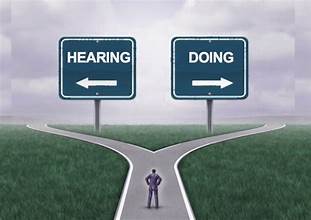
The difference between hearing and doing is huge!

Jesus’ illustration is borne out of his life experiences as a carpenter and craftsman. It is believable that he spent a portion of his life building homes, knowing the critical importance of a good foundation.

Theologian William Barclay wrote, “Only a house whose foundations are firm can withstand the storm; and only a life whose foundations are sure can stand the tests.”

Jesus tells us how to build that foundation…on hearing and on doing.

Jesus places value in the hearing. We cannot act upon what we do not know. Therefore, we must listen to God’s word. It is looking into the mirror of his word and seeing it for what it is. Again, it’s a great first step. Listening with intent takes us deeper than just hearing. The latter acknowledges God’s teaching. The former internalizes it.

Listening with intent to the word of God prepares for Jesus’ next command. Jesus wants us to be doers of his word. Knowledge only becomes relevant when we put it into action. Theory must be applied. Again, as Barclay writes, “Theology must become life.”

My cardiologist today told me to exercise more and lose weight. It does little good to go to the doctor in the first place if I’m not going to at least try to do what she instructs me to do. The same holds with my faith. It does little good to study God’s word if I don’t allow it to change my lifestyle and compel me to act.

It boils down to obedience, doesn’t it? For both my physical and spiritual health.

I have been guilty too many times of not hearing with intent. I suspect you have as well. Many people hear the word of God, but they don’t do anything with it. There are a lot of people who just enjoy listening to good preaching and teaching. That’s as far as it goes. They never really do anything with it. Call them “hearers of the word.” They listen, and listen, and listen — but it never leads them to DO what they’ve heard.

Again, hearing God’s word is a good thing, but it is not the end that God desires for us. James tells us that the one who hears with intent, never forgetting God’s word, the one will be blessed in what he does. This means the obedient person who does what God commands will find favor through a changed life. Will find blessings in the doing itself. Blessings in a life aligned with God’s will.

The blessing received by hearing and doing carries the biblical idea of shalom—being right with God and others. It is relational and spiritual. It also hints at blessings derived from an active and obedient faith that bears fruit in the life of the one who does and the lives of those he or she touches.

There’s the challenge James presents us. If all you and I are doing is hearing or reading or even studying God’s word, we might think we’re being a good follower of Christ, but we’re only deceiving ourselves, looking at ourselves in a mirror and walking away (vs. 22). Maybe it’s time we took the next step to become doers of the word!

Like Michael Jackson sang back in 1987 when he recorded Man in the Mirror:

I’m starting with the man in the mirror.
I’m asking him to change his ways.
And no message could have been any clearer.
If you want to make the world a better place
Just look at yourself then make a change.

May my life and yours be a reflection of Jesus and not a lot of “big talk and desk hammering.”

Thinking Points

When I read or hear God’s word, where do I most often stop short of actually doing what it calls me to do?


In what ways might I be mistaking familiarity with scripture for obedience to scripture?


How does Jesus’ picture of building on rock versus sand challenge the foundation upon which I’m currently building my life?


What is one concrete step I can take this week to move from “hearing” to “doing?”

Treasuring and Pondering

Focal Passage: Luke 2:19

Mary, did you know
that your baby boy would one day walk on water?
Mary, did you know
that your baby boy would save our sons and daughters?
Did you know
that your baby boy has come to make you new?
This child that you delivered
would soon deliver you.

Those words written by Mark Lowry, a comedian, singer and songwriter long associated with the Gaither Family, are the first stanza of what has become my favorite Christmas song. Many artists have recorded it since it was written, but Lowry sings it with unequaled passion.

In the bridge, Lowry’s words to Mary speak of the work of Christ in a building crescendo.

The blind will see.
The deaf will hear.
The dead shall live again.
The lame will leap.
The dumb will speak.
The praises of the lamb.

The as the song closes, the words ask Mary one last question before providing the resounding answer.

Did you know that your baby boy
Is heaven’s perfect lamb?
The sleeping child you’re holding is the great I AM!

Mary, did you know?

*****

The young mother listened to the hearty giggles of her toddler as the boy’s father tossed him playfully into the air, catching him with calloused hands. She laughed to herself as this manly carpenter cooed in baby-speak. She shook her head in awe and returned to the preparation of the evening meal.

The routine task of grinding the wheat into flour for the evening bread freed her mind once again to reflect on the life God had given her.

Luke, the Bible’s historian, put it this way.

But Mary treasured up all these things and pondered them in her heart. (Luke 2:19)

Mary, did you know?

That one little verse, often overlooked, comes at the end of the beloved Christmas narrative. Long after Jesus’ birth, long after the shepherds returned to their fields and flocks, Mary treasured and pondered.

Mary, did you know?

Long after Jesus’ dedication when Simeon praised God for allowing him to see God’s salvation, Mary treasured and pondered.

Mary, did you know?

Long after Anna, a prophetess who served in the temple, took one look at Jesus and told everyone who would listen that this was the child who would bring redemption to Jerusalem, Mary treasured and pondered.

Long after the wise men found a new route home, Mary treasured and pondered.

Mary, did you know?

On that day I imagined, as Mary kneaded the dough and Joseph and Jesus played, what did she treasure? What did she ponder?

Think back to the night the angel told Mary what God planned for her. She would bear a son who would be the Son of the Most High; a son who would reign over the House of David forever. Later, her aunt Elizabeth, filled with the Holy Spirit, reaffirmed the miraculous birth as she called Mary blessed among all women.

Through an immaculate pregnancy and an ordinary birth, Mary saw it all come true, just as God promised. In those first few years, surely the whole experience seemed surreal, almost beyond belief. Mary took it all in. Tried to make sense of the inexplicable. She treasured and she pondered.

The Greek verb translated treasured in this passage doesn’t mean to just remember. It means to carefully preserve, to guard or keep something alive for future understanding.

You and I have had 2,000 years of history. We can hold God’s word in our hand and read the unfolding of his redemptive plan that began its climactic work in a Bethlehem manger.

Two or three years after that day, Mary was still trying to wrap her arms around it. So much of what happened must have seemed to her a mystery. So, she kept the experience in her heart as she watched her child grow, keeping her experience real and alive, hoping to one day understand the how and why?

Mary not only treasured, but she pondered.

Thinking is a broad, general process that tends to be quick and practical. I think about what I’m about to do. Pondering takes thinking to a completely different level. Most of us are thinkers. We don’t ponder enough.

Pondering implies lingering thought. Unhurried. Contemplative. Reflective. Inward. When one ponders one weighs significance. Turning something over and over in your heart and mind, It implies a sense of awe and wonder, seeking to find personal meaning.

The Greek word Luke uses in this passage translated as ponder means to actively bring things together. To compare and contrast. To wrestle with a thought toward understanding. That’s different from daydreaming or passively reflecting on something.

You see, Mary, like any mother, carried fond memories of her child’s birth. The journey from Nazareth. The discomfort of a donkey ride. The worry about finding a place to stay in a crowded city. The pain of childbirth. The pure joy of holding her son in those first magical moments. That’s the precious memory of motherhood.

When Mary pondered, she intentionally reflected on all that was said and all that happened, trying to fit the pieces together. Wrestling with its meaning. Mary wanted to make sense of what felt unexplainable. Mary looked at everything she had experienced to that point…everything we understand as our Christmas story…and treasured and pondered what it all meant.

Mary, did you know?

To her credit, Mary never demanded immediate understanding. Never insisted that if God wanted her participation, he needed to read her in fully on the plan. Mary thought about it…a lot…I imagine. Despite not fully grasping the significance or the how and why, Mary accepted her role in God’s plan with such deep faith and trust.

There it is! In the middle of Mary’s treasuring and pondering lies the lesson I needed as the Advent candles are snuffed out and we pack away the manger for another year.

On this side of Christmas, what do we know? What must we treasure? What must we ponder?

God is at work in my life. He has been at work, is now at work, and will be at work in my life until the day he calls me home. I truly believe that. I have a tendency, though I suspect most of us do, to demand from God an immediate explanation for the things happening in my life…good or bad. I tend to pray for answers before I am willing to act.

I test. I don’t always treasure.

I think. I don’t always ponder.

Mary trusted that God was at work in and through her life, even if she didn’t always know why or how things were going to work out. Her faith held on to and accepted the mystery rather than disregarding it, or worse still, trying to change it. Most importantly, Mary trusted that understanding would come with time and obedience. Her role was to keep listening and waiting…as long as necessary.

I need to learn that faith often means actively treasuring and guarding God’s promises that have not yet been resolved with clarity. To hang on to his word. To keep it viable and constantly in my thoughts for future understanding. To be obedient to it without trying to bend it to my will. To trust that the day will come when he opens my eyes to see with reverence and wonder how he has moved throughout my life.

Mary understood that God’s work in her life required spiritual attentiveness…a whole lot of pondering if you will. Most of the life’s lessons God teaches me require me to wrestle with them until what he is trying to teach me starts making sense. He asks me to dig deeper. To seek his truth. The water of life rarely comes from a shallow well.

Treasuring and pondering take time. What God begins in our lives one day will unfold, but it will unfold in his time, not instantly, but when the time is right. He asks us to wait faithfully on his timing. That’s never easy to do.

When God’s work surpasses our understanding, we are invited…like Mary…to treasure and ponder his work in our lives.

That seems to be the perfect message for the coming New Year.

I will mediate on your precepts and will fix my eyes on your ways. (Psalm 119:15)

Thinking (Pondering) Points

What has God done in my life recently that I need to slow down and ponder?


What practices in my faith walk help me treasure God’s work instead of casually dismissing it?


In what ways does Mary’s quiet, reflective faith challenge my tendency to seek quick answers?


How might God be shaping me during times when he asks me to wait and reflect rather than act?

A Life of Thanksgiving

Focal Passage: Colossians 3:12-17

In the middle of the United States Civil War on October 3, 1863, President Abraham Lincoln issued a proclamation declaring the last Thursday in November as a Day of Thanksgiving and Praise. Lincoln wrote in that proclamation that the year had been “filled with the blessings of fruitful fields and healthful skies,” blessings he called “gracious gifts of the Most High God.”

While merchants throughout our country blow off Thanksgiving for the more lucrative pursuit of Christmas, we, the people, as Lincoln liked to say, will all pause for a moment, gathered with family or friends, to enjoy a holiday centered on gratitude, generosity and togetherness. Hopefully, for those of us who try to live out our faith, Thanksgiving will grant us a chance for a little honest reflection on the gracious goodness of God.

Just as it is easy for us to get caught up in the trappings of Christmas and fail to sincerely remember God’s greatest gift, it is easy to get caught up in the toppings of Thanksgiving…the dressing, the cranberry sauce, the gravy. In my family, those toppings we focus on might include the cheese, the pico de gallo, the onions, and the guacamole we stuff into our non-traditional Thanksgiving fajitas.

We will quietly express our thanks to God, but I wonder if the words are that meaningful to him amid all the hustle and activity of the day. Let me explain.

I have lost both of my parents. At this ripe old age of 72, that’s not surprising, I suppose. Mom died 27 years ago of cancer at the too young age of 69. At the age of 98, Dad died two years ago of nothing more really than a life lived long and well.

Before they died, I got a chance to thank both of them in private for being the amazing parents they were. Given the sacrifices they made, the role models they were in my life, the life lessons they instilled, everything I said those days felt woefully inadequate. Though I struggled with the words, I think they understood my intent.

I got a similar response from both of them. Smiles shining through watery eyes and hugs they probably wished could be stronger.

My parents held expectations for me and my siblings, not so much on what we might do in life, but in how we chose to live life. As I think back on those precious moments with them, I pray I met those expectations.

As a parent of adult children now, I get it. You raise your children hoping they will be good people. That their lives will reflect the values you tried to instill in them. That they will live their lives with faith in God, love for family, compassion for others and integrity in all things. My sons have lived that life and more. Though they’ve both spoken their words of thanks at times, their lives lived well is all the gratitude I need.

Here’s the point I’m trying to make. We will gather around a table on Thanksgiving. At some point, we will pray and express our gratitude to God for all he’s done for us. I wonder, however, if this is the best way to say thanks to God.

While I’m quite sure our Lord appreciates the words of gratitude, how much more does he appreciate our lives lived as a reflection of his goodness and grace? How much more does he desire that we live our lives in ways that reflect the values he tries to instill in us?

I had the privilege of listening to an inspiring sermon this week delivered by the Rev. Robert Thomas, Jr., of Mt. Olivet Missionary Baptist Church in Houston. The Rev. Thomas spoke powerfully about holy living in a world filled with unholy actions.

In his text in Colossians 3:12, we find Paul saying that every believer in Christ should “clothe ourselves with compassion, kindness, humility, gentleness and patience.” We are to be forgiving because God forgave us, covering all our actions with love. Then, Paul added, “Let the peace of Christ rule in your hearts…and be thankful.”

I pulled out the verse again this week thinking about the upcoming Thanksgiving holiday, focusing on those last two words, “Be thankful.” If you continue reading in that chapter, you’ll find these words that sum up the previous verses. I think it has everything to do with how we express our gratitude to God. Paul said:

And whatever you do, whether in word or deed, do it all in the name of the Lord Jesus, giving thanks to God the Father through him. (Colossians 3:17)

Whatever you do in word or deed…give thanks.

Think about that for a second. I’m not sure Paul just wants us to thank God for giving us the word to say or the deed to do. I think he might mean that we should let our words and deeds be said and done in the name of Christ so well and so faithfully that our words and our deeds becomes an expression of our thanks to God.

When we act in compassion or kindness, when we live humbly, with gentleness toward others and patience in the face of the trouble, when we forgive, and let love drive our every thought or deed…that is an act of thanksgiving to God that means more to him, I believe, than simply saying a heartfelt thanks…as important as those words are to say at times.

When King Saul in the Old Testament disobeyed God but tried to cover it with yet another hastily thrown together sacrifice, God told him through Samuel, “To obey is better than sacrifice; to listen (is better) than the fat of rams.” (I Samuel 15:22)

That seems to be telling me that actions speak louder than words. If I want to thank God for his power, presence, protection and provision in my life, saying the words is important, but living in ways that honor him seems more important.

Let our obedience to his word be our thanksgiving for his goodness and grace. Jesus told his disciples in John 14:15 that if they truly loved him, they would keep his commandments. That we would live as he lived. Our surrender to his will and way then become acts of love and thankfulness.

Scripture teaches us, I think, that gratitude reaches its highest point when it moves beyond feelings and emotion and becomes faithful living. Being obedient to his commands and following his teachings in every aspect of life.

Living out God’s will by loving others, showing compassion toward those who are in need, forgiving those who hurt us, serving those around us—these actions, done in response to God’s redemptive and restorative work in our own lives, become the most sincere expressions of gratitude a believer can offer. A life surrendered to God’s will and way is a spiritual act of thanksgiving.

As he neared the end of his earthly ministry, Jesus consoled his disciples by urging them to stay connected to him. He drew upon a metaphor they would understand.

I am the vine; you are the branches. If a man remains in me and I in him, he will bear much fruit; apart from me you can do nothing…If you remain in me and my words remain in you, ask whatever you wish and it will be given you. This is to my father’s glory that you bear much fruit, showing yourselves to be my disciples. (John 15:5,7-8)

In other words, when we remain in Christ and do his will, we bear fruit. The fruit we bear brings glory to God. Our faithfulness and our work that impacts the lives of others and demonstrates that we are his children is an act of thanksgiving that glorifies God and makes him known to a world so desperately in need of him.

When we allow God’s spirit to shape our character with love, joy, peace, hope, patience, kindness, gentleness, we are expressing our deep gratitude for God’s saving work in our lives. When we, in a loving spirit, oppose actions in our world that run counter to the spirit and message of Christ, we are expressing our gratitude for God’s saving work in our lives.

When I see my sons living out the life God called them to live, when I see evidence of their faithfulness, compassion and Godly integrity, seeing the godly men they have become…that’s really all the gratitude I need. Of course, hearing that word of thanks, wrapped in the occasional hug, warms my heart.

I just feel God might be the same way. Watching you and me live out the lives we’ve been called to live for him, seeing evidence of our faith in our words and deeds, watching us bear fruit in ways that draw others to Christ, living godly lives, that’s what he most desires.

Hearing that word of thanks and giving him that spiritual hug, surely warms his heart.

Here’s my prayer for my life and yours this Thanksgiving holiday. May we recommit our lives to the one who redeemed us and called us to be his disciples, his fruit-bearers. May our lives and the words we speak and the work we do for him be a living expression of our gratitude for all he has done for us. Let’s say our thanks in prayer and live our thankfulness in practice.

I will praise you, O Lord my God, with all my heart; I will glorify your name forever. (Psalm 86:12)

Thinking Points

Who in my life has modeled grateful living? How can I follow their example in my walk with Christ?


In what ways can my everyday words and actions become a genuine expression of thankfulness to God?


Colossians 3 speaks to the qualities of compassion, kindness, humility, gentleness and patience, among others. Which of those traits do I need growth in my life if I want my life to shout my thanks to God for what he has done for me?


How might my life today change and want would it look like if obedience and faithfulness to God became my primary way of expressing gratitude to God?

A Case for Compassion

Focal Passages: Hebrews 13:1-3; and Matthew 25:37-40

When my two boys were young, my wife and I bought all 40 books in Gordon Osborne’s Value Tales series. Using stories of famous historical figures, each book focused on a desirable character trait, traits we wanted to instill in our kids.

There were books about the courage of Harriett Tubman. The determination of Helen Keller. The perseverance of Thomas Edison. The initiative of Frederick Douglass. The books taught children honesty, patience, kindness, responsibility, truth and fair play, humor, love, confidence, and imagination, for instance.

One of the books I remember taught a lesson on compassion using the life of Florence Nightingale, the British nurse who revolutionized nursing care and medical hygiene during the Crimean War.

I was drawn to this book initially because my Mom, whose first name was Florence, was also a nurse with a compassionate heart. (In full disclosure Mom was not fond of the name, preferring to go by Earline.) I found it compelling, also, because it taught compassion, that ability to sense another’s need or suffering, combined with a genuine desire to address the need or suffering. It was a trait I wanted my sons to cultivate.

I thought of that book specifically this week, when I read a summary of a 2025 study on compassion in the United States released by the Muhammad Ali Center in Louisville, KY.

The center surveyed more than 5,000 people from 12 metropolitan areas across the country. According to the survey, Americans believe the country is less compassionate today than it was four years ago. In fact, only 29 percent of those surveyed said they personally feel compassion toward those in need. More than two-thirds of those surveyed acknowledged gaps in their compassion for and empathy toward certain groups of people, including the poor or those of differing ethnic backgrounds.

If that doesn’t disturb you as a believer in Christ, it should. The very nature of Jesus, the one in whom we believe, was compassion.

The writer of Hebrews closed out his letter to the churches by making a case for compassion. Look at what is written.

Keep on loving each other as brothers and sisters. Do not forget to entertain strangers for by doing so some people have entertained angels without knowing it. Remember those in prison as if you were their fellow prisoners, and those who are mistreated as if you yourselves were suffering. (Hebrews 13:1-3)

Compassion demonstrates our faith in practical, relational ways. It is not abstract, rather it is expressed in love, hospitality and solidarity with folks who are struggle with life. Compassion provides ongoing care for a people in need. Acts of kindness and expressions of empathy are sacred acts, commissioned by God and modeled for us in every way by Christ himself.

Keep loving each other isn’t just a casual thought inserted by the writer. It stands as a steadfast, continuing commitment to care for others, reminding us that expressions of God’s love to others are central to our faith.

The writer speaks of a bond, a love shared among siblings or family. It is not sporadic nor conditional. Rather, it flows freely and consistently, an outpouring of God’s love through us because his love is in us.

It involves genuine kindness and support for others within the fellowship of believers and extending into our community at large. This loving expression of compassion means celebrating their joys and mourning losses. Too many people today feel isolated and out of options. As Christians, we ought to commit ourselves to be emotionally and physically available in ways that create opportunities for active grace as a true reflection of the heart of Christ.

Compassion also demonstrates itself in hospitality toward those we may not know. We are challenged by the writer to see every person as valuable and worthy of respect, care and generosity…not just those we broadly consider “family.”

In New Testament times, the practice of welcoming strangers was not just a form of ancient welfare. It was a matter of survival for many. Everything we have is a gift from God to be shared with those in need.

The reference to “entertaining angels unaware” recalls a couple of Old Testament stories, but I think it suggests a deeper sense of reverence today. You and I never know fully the stories of those we encounter along the way. Every person we meet, every person we help, holds significance in God’s eyes beyond our understanding. By being open and generous, we align ourselves with Gd’s heart and his purpose.

As the writer of Hebrews ends his call for compassion, he encourages Christians today, even as he encourages his readers in the first century church, to think of the men, women and children who suffer adversity as if the suffering was also ours to bear. Think empathy in practice. To walk a mile in the shoes of another. To coax us into practical action. To put hands and feet to our prayers.

Someone once said when any one of us suffers, it affects all of us in one way or another. The writer wants us to respond to the hardships of others with compassion and kindness. To see the struggles of others as intimately connected to our shared humanity as a shared sense of what it means to be God’s children.

I find solid truth in what Hebrews tells us as I suspect many who might read this do as well. Yet, in less than five minutes of the nightly news or on an equal time on any social media platform, and you find a society that devalues compassion as a cultural weakness. Too many Christians are at best indifferent and at worst insensitive to the struggles of others.

All we need to do is look to scripture for answers in the life of Christ.

Over five thousand people followed him into the wilderness, listening to him preach and teach. Matthew 14 tells us when Jesus saw the crowd, “he had compassion on them and healed their sick.” Later, they grew hungry. Out of compassion, he fed them.

Early in his gospel, Mark tells the story of Jesus healing a leper, a man ostracized and shunned because of his illness. Mark writes that Jesus, “filled with compassion, reached out his hand and touched the man.” This merciful act set aside the cultural taboo of the day that demanded Jesus stay away. In this tender touch, Jesus restored dignity and a sense of belonging to a man whom society tossed aside as unworthy of their help.

Jesus commands us to love as he loved. To be compassionate as he was compassionate. In his last hours with his disciples, Jesus told a parable about the judgment that awaits all of us. In this parable the king invites some to accept their inheritance and walk into the kingdom. As the reason for their good fortune, he said,

For I was hungry and you gave me something to eat. I was thirsty and you gave me something to drink. I was a stranger, and you invited me in. I needed clothes and you clothed me. I was sick and you looked after me. I was in prison, and you came to visit me.” (Matthew 25:35-36)

The king’s guests said they could not honestly remember every doing any of those things for the king. The king’s reply makes the point for us.

I tell you the truth. Whatever you did for one of the least of these brothers of mine, you did to me.” (Matthew 25:40)

Clearly, the message is that compassion means something. It means something not only to the hungry, the thirsty, the alien (legal or not), the sick, the poor and the prisoner. It means something to God.

Here is what you and I need to recognize in that story, however. The righteous whom God invited into the kingdom received God’s praise, not because they meet God’s needs, but because compassion for the marginalized people was so natural they didn’t notice they were doing something extraordinary for the “least of these.”

Second-nature.

Authentic humility.

Grace-motivated.

Heart-driven.

That kind of compassion.

I think that’s the message the writer of Hebrews was teaching me this week. It is the message Jesus demonstrated every day of his life on earth. In a world where compassion is undervalued and left undone, live it anyway. When the culture seeks to oppress rather than uplift, set aside the taboos and love them anyway.

Make compassion second nature…so much a part of you that you don’t realize you’re doing something extraordinary. The reason is clear. When you do it for the least of his children…

For all the compassion God has shown you and me, that ought to be reason enough.

Thinking Points

When was the last time I showed compassion to someone without realizing it, simply as a natural expression of Christ’s love?

In what ways have I allowed today’s culture or bias to limit my compassion toward certain groups or individuals?


How can I make compassion a second nature response, rather than something I feel forced or obligated to do?


What does Hebrews 13:1-3 teach me about the kind of empathy that honors God?


If Jesus were to evaluate my compassion today as God did those in the parable in Matthew 25, what might he find in my words, actions and attitudes?

You Are God’s Workmanship

Publishers note: Due to a glitch in the technology or my own lack of technical skill, it is possible that this post was not sent to my email subscribers two weeks ago. Now that the system has been fixed, I am reposting upon request. –KL

Focal Passage: Ephesians 2:10

Antonio Stradivari began crafting violins, cellos and violas in the late 1660s in Cremona, Italy. His techniques and varnishes produced instruments known for their powerful, resonant and balanced tones. Musicians since the early 18th century consider the Stradivarius (or Strad) as masterpieces of musical craftsmanship, the gold standard of stringed instruments.

While several hundred of these remarkable instruments exist today in the hands of collectors and museums and top performers, they are worth millions.

Polish-born Roman Totenberg, a Polish-born child prodigy, emigrated to the United States in 1937, where he built his career as a celebrated violinist, teacher and performer. In 1980, while a teacher at the Longy School of Music in Cambridge, MA, Totenberg’s prized Stradivarius, crafted by the master in 1734, was stolen from his office. It remained “lost” for over 30 years. Never played. Never heard. Its music lost for a time.

Totenberg’s Strad was recovered in 2015. Despite its years of disuse, once restored, the violin’s sound was revived. Mira Wang, a former pupil of Totenberg played the instrument in its first public concert following its restoration.  Concert reviews noted that Wang struggled to find the musical “fit” with the instrument. One article quoted a familiar idea among musicians that great instruments have distinct personalities and can be “tricky” until a player and instrument are perfectly matched.

That concept of musical fit runs parallel, I think, with faith and good works.  Many Christians, myself included at various times of my life, feel a disconnect with our faith and our actions. It’s not that we’re doing bad things necessarily. It’s just that we’re not doing much good either. We’re comfortable accepting God’s grace and doing little or nothing with it.

We’re either comfortable being a lost violin or we feel like the ill-matched musician, struggling to find where we fit in God’s work.

Let me explain what I mean from one of my favorite passages in Ephesians. Paul spent a great deal of time in Ephesians 2 talking about God’s gift of grace. For it is by grace you have been saved, through faith—and this not from yourselves, it is the gift of God—not by works so that no one can boast.

Salvation comes by grace through faith. We’ve done nothing to earn it. Theologian William Barclay said, “All the good works in the world cannot put us right with God.”

Once we have been made right with God, Barclay said, “there is something radically wrong with the Christianity which does not issue in good works.” In other words, this unmerited act of grace should propel us to do good works as a natural outgrowth of our relationship with Christ.

Paul said as much in his next breath and it’s this passage that spoke again to me this week.

For we are God’s workmanship, created in Christ Jesus to do good works, which God prepared in advance for us to do.” (Ephesians 2:10)

Let’s break this down a bit.

We are God’s handiwork. His masterpiece. Created with purpose and design.

What a remarkable thing to understand! The Greek work translated “workmanship” comes from the Greek “poiema,” rich in its definition. Though it literally means, “a thing made,” you can find a hint of its intent in a beautiful poem, an artistic masterpiece, or even a Stradivarius.

Think about that. A poet, composer or master craftsman doesn’t just haphazardly slap words or notes on a page or glue strips of wood together. Instead, ever detail is deliberately designed and crafted with care and purpose. Each poem, each song, each instrument unique in form and function.

So, it is with you and me. Every aspect of our lives, our personalities, talents, circumstances, our growth as spiritual beings, stands as a testimony of God’s divine composition. His craftsmanship. When the Psalmist declares that we are “fearfully and wonderfully made,” he’s not just talking about the intricacies of our physical bodies. He’s talking about the totality of us. Everything we are now or have the potential of being is crafted within us, just waiting to be released.

As inspiring as that ought to be, think beyond God’s workmanship in us. The next phrase in our passage adds a deep layer of meaning to our personal and spiritual identity. When we are saved by faith, God creates us once more in Christ Jesus.

Our physical creation is of God and by God, but we are remade spiritually in Christ…his life, death and resurrection. We become a new creation through the grace of God and our faith and trust in his son. This isn’t just a refinement or improvement. It is a new spiritual reality. The limitations of the past give way to godly potential.

Therefore, if anyone is in Christ, he is a new creation, the old has gone, the new has come! (2 Corinthians 5:17)

Being God’s workmanship in Christ Jesus transforms our ordinary human potential into purpose-driven alignment with God’s will and plan for our lives. It isn’t about existing; it’s about fulfilling a calling. If and when we tap into that source in Christ, we are empowered to do the work of Christ.

So, what are we called to do? Paul said it:

…to do good works which God prepared in advance for us to do.

This is where we find the “fit.” We will never be fully content and satisfied in life until we are being obedient to this purpose for us.  Until we are doing the good works he ordained us to do from the very beginning of time.

God’s plan for you and me to do good works existed before he put the first stars in place. He created us to reflect his purpose and his will as adopted sons and daughters through Jesus Christ. He planned from the beginning for each of us to do good works simply as a part of who we are and whose we are. It is not a prerequisite for salvation, but a result of it.

If our lives do not serve others nor serve the cause of Christ, we’re like the poem never read, the painting never seen or the priceless violin never played.

The value of a masterpiece lies in its uniqueness. If the musicians are to be believed, every Stradivarius has a distinct character that must be paired with the right musician to find its tone or voice.

Though a virtuoso in her own right, Wang struggled to make her style and approach fit with Totenberg’s violin. Later, the same violin was placed on loan with Juilliard violinist Nathan Metzler. Commentators and dealers noted the violin’s strong voice, praising its “amazing power and sweetness” once in the hands of a player who could draw that sound out.

Each us of has been uniquely gifted with talents and abilities to serve his kingdom. Finding purpose doesn’t always mean making grand plans or taking bold actions. It means something as simple as living faithfully every day. Ensuring that our actions and words reflect God’s love whether at home, work, in our families and our neighborhoods. Whether among friends or those we hardly know.

If you’re struggling with what “good works” you’re supposed to do, you’re probably being too technical. Good works are less about the act and more about the attitude that generates the act.

Scripture tells us that good works are outward actions that flow from an inward faith and relationship with God. Don’t think specifically of feeding the hungry or helping the sick, though our good works may manifest themselves in exactly that. Think kindness, patience, love, gentleness, peace, joy and self-control motivating the things we do for others. Think Jesus.

True good works are done in obedience to God’s word, through the power of the Holy Spirit, and for the glory of God rather than self. Every act points toward God.

Let your light so shine before men that they may see your good works and glorify the Father in Heaven. (Matthew 5:16)

That’s not all. Our good works, our acts of mercy, justice and compassion, equate to obedience to the teachings of Christ born out of our love for him and gratitude for his atoning sacrifice. John 14:15 tells us we obey his teachings that lead to good works because we love him.

The good news about good works is that in the goodness of God, his spirit empowers us to act. We don’t have to do any of it in our own power. It is God working through us. We just need to make ourselves available to be used and get out of his way.

For it is God who works in you to will and to act in order to fulfill his good purpose. (Philippians 2:13)

My uncle Les Lewis posted his daily devotional last week about faith, but he said something that I think applies here, too. He wrote, “When faith is God behaving in me, my potential is as great as God is great.” God behaving in me. That seems the very definition of “good works,” granting us the potential to make a real difference in the lives of those we encounter.

While our gifts are unique and God fits our gifts with his purpose, working to do good is most effective when done together. When our unique gifts blend in service. In his letter to Titus, Paul encouraged this young minister to ensure that he and those he served worked together to help others.

And I want you to stress these things, so that those who have trusted in God may be careful to devote themselves to doing what is good. These things are excellent and profitable for everyone. (Titus 3:8)

Our good works get magnified when we work in concert with other believers. As Christians we are meant to help each other grow in love and in the work we do for Christ. Walking alongside one another we learn to love better, forgive more, serve selflessly, each using the unique gifts God grants us. Every good deed encourages another.

The writer of Hebrews said almost the same thing.

Let us consider how we may spur one another on toward love and good deeds, not giving up meeting together, as some are in the habit of doing, but encouraging one another… (Hebrews 10:24-25)

Like the Totenberg Stradivarius, our lives and our faith may at times fall silent or out of tune with the purposes of God and the work he calls us to do. God is not only the craftsman that designed us with purpose, he is the virtuoso who plays with “amazing power and sweetness” when we allow him to work in and through us.

If you or I are not yet demonstrating the good work for which he created us, know this. Each one of us, every believer, can be restored, renewed, and brought back to life in him. God, the divine craftsman, not only created us as His workmanship but continues to shape and refine us through His Spirit so that His melody of grace can resonate through our lives, demonstrating his love through our good works.

In the end, we are not meant to sit unused or hidden away. He made us to be instruments of His grace in a life of good works. Now, we just have to let him draw the bow across our strings.

Thinking Points

In what ways might you feel like an “unplayed violin” in your faith journey—and what would it take to let God bring your purpose to life again?


How does understanding yourself as God’s workmanship change the way you see your daily actions and choices?


What “good works” has God already placed before you that may simply require your willingness to act?


How can you better align your unique gifts and temperament with God’s purposes so that his “music” flows naturally through you?