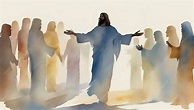
Walk This Way

Focal Passages: Matthew 4:19, Romans 8-29, I John 2:5b-6

Marty Feldman, the bugged-eyed comic of the 1970s, acted in the role of Igor in the cut comedy classic Young Frankenstein, released in 1974. He and Gene Wilder, starring as Dr. Frederick Frankenstein, played off of each other to perfection.

In one timeless scene, Frankenstein, arrived at the castle to begin his experiments. Igor, the scientist’s assistant with the ever-shifting hump on his back, picked up the doctor’s suitcase and began hobbling away. Hunched over and dragging his right leg behind him. As he led the doctor to his room, Igor said, “Walk this way.”

Wilder, looked a little bemused, but followed Igor, hunched over and dragging his own right leg. Comedy gold, in my book.

Some 50 years later, I still play that scene with my grandkids. “Walk this way,” as I mimic Igor. They just look at me like I’m a crazy man.

I don’t know if Feldman and Wilder realized the biblical truth they accidentally modeled, but in some ways, it matches the familiar call of Jesus to discipleship.

Walk this way becomes an echo of Jesus calling the seeker to “follow me.”

As he called his disciples, Jesus would utter some form of those two words. We see it first in Matthew 4:19. Peter and Andrew were casting their nets in pursuit of the day’s catch. Jesus called to them from shore…

“Follow me. I will make you fishers of men.”

The call to follow promising a new work, a new mission focused on spreading the good news of Christ.

Later in Matthew 8, a man came to Jesus with the desire to become a disciple, but wanted to first take care of some family business. When Jesus said to him, “Follow me…,” the man prioritized his family concerns and walked away. The change required by those words cost too much.

Later, Jesus called Matthew himself from a lucrative job as tax collector. Jesus walked up to the tax booth and said simply, “Follow me.” Matthew left it all behind to follow Jesus.

Commentaries tell me the word Matthew uses for follow in these passages is akoloutheo. It doesn’t mean “just tag along with me.” It means…

“To move in the same way as.”

“To occupy the same road.”

“Not trailing behind, but walking the same path the other walks.”

These first century men, living in the Jewish rabbinic tradition, would understand this word as a call to discipleship. It certainly meant to learn under the tutelage of a master teacher. Still, the word conveys more than the idea of learning from someone. It speaks about total life imitation.

A true disciple watched his rabbi constantly…the way he interpreted scripture, the way he prayed, the way he treated others, the way he dealt with opposition and struggle.

The goal of following was to so completely understand the rabbi’s conduct and character that the rabbi’s way of living in and seeing the world became the disciple’s way of living and seeing the world.

Jesus wasn’t just on the recruiting trail, looking for people who might agree with his theology, he was looking for people willing to walk the same road he walked in the way he walked it. He called people to imitate his obedience to the Father and demonstrate his love for the broken, the hurting and the outcast. He called folks to absolute surrender to the will and way of God. He called his followers to lay everything down, even life itself, for the truth of God’s kingdom.

You see that clearly displayed just weeks prior to the cross and the end of Jesus’ earthly ministry. Jesus began to tell his disciples that he “must go to Jerusalem and suffer many things…that he must be killed and on the third day be raised to life.”

Peter, bless his heart, pulled Jesus aside and–scripture uses a harsh word here–“rebuked” Jesus. In essence, Peter sternly cautioned Jesus, “Quit saying such things! We’ll never let that happen! We’ll walk with you and they wouldn’t dare touch you!”

Jesus fired right back at Peter with a harsh rebuke of his own. “Get behind me, Satan!”

Then, Jesus, turning to all his disciples in another call to continued discipleship, laid out the conditions of discipleship in no uncertain terms.

“If anyone would come after me, he must deny himself, take up his cross and follow me.” (Matthew 16:24)

There it is again, according to the commentaries, akoloutheo,

Follow me.

The word here deepens the meaning of what “following” actually requires. Now, he talks about the cost of following.

Self-denial. Yielding control of life. …all of life… to a sovereign Lord.

Taking up your cross. Investing one’s life…all of one’s life…to the work of God’s kingdom, regardless of the cost.

Follow. Giving your life…all of life…not just in a moment of trust that brings salvation, but in a continuous desire to become more like Christ every day.

Romans 8:29 says that God calls us to be conformed to the likeness of his Son. Paul isn’t just asking us to agree in principle with the teachings of Christ. He isn’t asking us to fall in line in some sort of superficial imitation of Jesus.

Discipleship and the call to follow is to work toward an inward, essential transformation into the same nature, conduct and character of Christ. A lifelong process of living each day just a little more like him.

Theologically, we call that sanctification…the ongoing process of salvation that has as its goal being transformed into the image of Christ. Being Christlike.

Many Christians today think of following Jesus as a belief system to maintain or a set of values by which to live. Thom Rainer, former president and CEO of Lifeway Christian Resources, bemoans this kind of consumer Christianity, a term he used to describe a faith that expects spiritual goods and services rather than sacrificial discipleship.

Following Jesus has never been a position to hold or a label to attach to our resume. Nor is it a political masthead. The call of Christian discipleship is a call to transformation, obedience and service.

The Apostle John answered Jesus’ call to follow. It changed his life forever. In his first letter, John encouraged his readers to live this transformed life of obedience.

We know that we have come to know him if we obey his commands. The man who says, “I know him,” but does not do what he commands is a liar, the truth is not in him. But if anyone obeys his word, God’s love is truly made complete in him. (I John 2:5a)

Then John hits the nail on the head.

This is how we know we are in him: Whoever claims to live in him must walk as Jesus did. (I John 2:5b-6)

So, the question this call begs me to answer…and the question it poses for you, too…is not how deep is my belief in Jesus, but how much does my daily walk look like his?

Now can you see that Feldman/Wilder skit finding its way into the gospel?

Akoloutheo.

Follow me.

Walk this way.

Thinking Points

Where in my daily life am I simply “agreeing with Jesus” rather than actually walking in His ways?

What part of self denial or surrender is Jesus calling me to embrace more fully right now?

How does my response to inconvenience, conflict, or suffering reveal whether I am walking the same road Jesus walked?

What habits, attitudes, or priorities need to be reshaped so that my life increasingly reflects the character of Christ?

Who in my life is watching my walk, and what picture of Jesus are they seeing through me?
Waiting for What’s Next

Background Passages: John 21:1-19; Luke 5:1-11

Easter has come and gone. For many of us, the act of remembering Jesus death and the celebration of his resurrection represents the pinnacle of God’s redemptive work. The Bible goes to great lengths in Old Testament prophecy and in New Testament teaching about the miraculous saving work of Jesus Christ. He lived. He died for the sins of the world. He rose again, entering the lives of those who believe as a living Savior. Powerful stuff!

However, it would be a big mistake, I think, for us to live in the resurrection. As necessary as that moment was for our spiritual destiny, God calls us for so much more. Look no farther than one of my favorite episodes in the Bible. It took place just a few weeks after the resurrection on the shore of the Sea of Tiberias.

Peter.
James.
John.
Nathaniel.
Thomas.
Two unnamed disciples.

Seven men
sat around a campfire
smoldering on the shore of the
Sea of Tiberias.
“Go to Galilee and wait for me,”
Jesus told them after his resurrection.
So they sat.
They waited.
Waited some more.

The longer they waited,
the less they talked to one another.
The longer they waited,
the more anxious they became.
Fidgeting.
Uncomfortable.
Mindlessly skipping stones
across the placid water.

Unable to contain himself,
Peter stood.
Balled his fists into the stiff muscles of his lower back.
Looked blankly into the distance.
“I’m going fishing,”
He muttered.

Without another word he walked to his boat,
pebbles crunching under his feet.
Six men with nothing else to do
looked at one another…
“Wait up!
We’ll go with you.”

Even Nathaniel and Thomas,
the only non-fishermen in the group,
raced after him,
eager to do anything but sit.
Anything to break up the endless hours of waiting.

As the sun set,
they set out in their boat,
doing what most of them had done
for years before they met Jesus.

All night they toiled.
Cast and pull.
Cast and pull.

Like fisherman who knew their water,
They moved from one favored spot to another
looking for the schools of fish where they always were.
Yet, they caught nothing.

All night they toiled.
Cast and pull.
Cast and pull.

As the sun broke over the mountains
And the morning haze began to lift,
Peter spread the empty net one last time across boat.
Cupped the solitary, squiggling minnow in his hand.
The first “fish” they caught all night.
He tossed the minnow back into the water
with a sigh deeper than the sea itself.
“Let’s go in.”

As they worked to fold the net and stash their gear,
a voice called to them from the beach.
A man stood ankle deep in the water,
waving at them.
“Friends, have you had any luck?”
He asked.
“Did you catch any fish?”

Their reply simple and terse.
“No.”
Without another word,
they returned to the job at hand.

“Throw your net on the right side of the boat
and you’ll find some,”
the voice on shore suggested.

John’s face flushed with weary anger.
His brother James rolled his eyes.
They knew these waters.
They fished all night.
Sometimes, the fish just weren’t there.

“To the right,”
the voice said again.

Peter, John and James
stopped what they were doing.
Something oddly familiar in the challenge.
A look passed between them.
A memory.

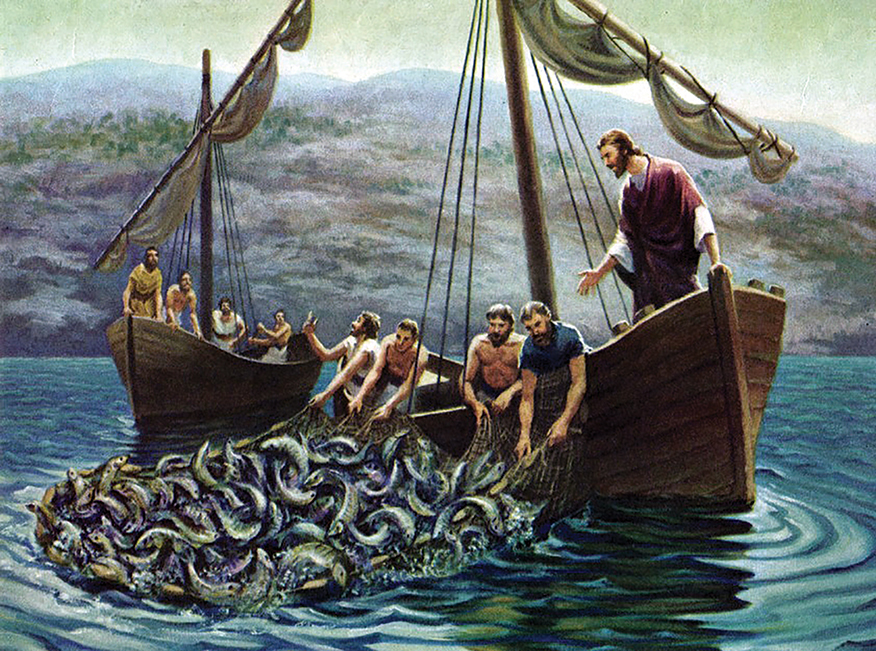
A similar night three years earlier.
A fishing outing.
No fish in the nets.
A voice telling them to cast the nets…
one more time.
A haul so large it threatened to
burst their nets.

A smile passed between the three men
as they remembered the day
Jesus called them to be his disciples.
The day he said,
“Follow me.
I will make you fishers of men.”

Without another thought,
they picked up the folded net.
Tossed it again into the sea…
This time on the right side as instructed.

Together they watched the net sink into the dark water.
Waited a moment.
Pulled the net,
Expecting nothing.

“Must have snagged a rock,”
Peter suggested.
Pulled again with all their strength.
With some effort,
the net reached the surface.
Astounded looks.
Excited shouts.

Peter looked at the teeming net.
Looked to the shore.
The man stood laughing,
clapping his hands in delight.

Peter looked back at the fish
thrashing in the net.
Caught the bewildered eyes of James and John.
Looked back again at the laughing man on the beach.
“It’s Jesus,”
He whispered.

“It’s Jesus,”
He shouted!

Peter turned to Thomas,
giving him his corner of the net.
“Here.
Take this.”

Thomas grabbed the net,
nearly pulled overboard
by the unexpected weight of the catch.

Peter pulled on his tunic.
Dove into the water,
swimming to meet Jesus.
His friends rowed the boat toward shore,
dragging a full net behind them.

By the time they arrived,
Jesus had rekindled the fire.
A couple of fish on the grill.
A loaf of bread baking on the heated stone.
The aroma heavenly.

“Bring some of the fish you just caught,”
Jesus called, ready to prepare a feast for his friends.
With a smile warmer than the sun,
he welcomed them.
Boisterous words.
Bear hugs.
“Come and have some breakfast.”

Such a heartwarming story of friendship and belonging. Jesus’ love for his disciples so evident in the tenor of this scene. Their love for him, equally touching. The man for whom they had waited for these difficult days, sat among them, gutted a few fish, tossed them onto the fire, and prepared a meal for them. He offered a prayer of gratitude for God’s provision. They reconnected in the joy of familiar fellowship.

It’s a wonderful story, but…it doesn’t end there. John tells us they finished eating and strolled down the beach together. Their festive breakfast reunion yielding to a quiet conversation of critical importance.

Jesus kicked over a smooth stone with the toe of his sandal.
Bent over.
Picked it up.
Tossed it absently into the water.
Watched the ripples spread from its splash.
A private metaphor for the broadening reach
of his good news.

“Peter,”
he said quietly,
drawing the disciple closer.
“Do you love me more than these?”

Without hesitation.
“Yes, Lord,”
he answered,
“You know that I love you.”

“Feed my lambs.”

Peter shook his head in wonder.
His forehead wrinkled in thought.
“What brought that on?”

A minute later.
“Peter,”
Jesus said again.
The strength of his voice
drew the attention of the other
disciples walking nearby.
“Do you love me?”

Peter stood his ground.
Confused, but determined.
“Yes, Lord!
You know that I love you!”

Jesus’ eyes bore into his soul.
“Take care of my sheep.”

Moments passed.
Everyone lost in thought.
Jesus stopped walking.
The disciples in a semi-circle around him.
He looked at all of them.
Then, looked Peter in the eye.

“Peter,
do you love me?”

Tears filled the disciple’s eyes.
His heart hurt.
Thoughts swirled in his head.
“Does he not believe me?”
“Why does he keep asking?”
“Surely he knows what I feel.”

Peter could not hold the intensity of Jesus’ gaze.
He turned. Stared at a distant fishing boat.
Thinking of the life he once loved.
His mind racing through the last three years.
A montage of images.

He took a deep breath.
Turned back to stare into the
eyes of his Christ.
Emphatic.
“Lord, you know all things.
You know that I love you.”

Two men.
Eyes locked on one another.
Jesus stepped forward.
Draped his arms across Peter’s broad shoulders.
Touched forehead to forehead.
“Feed my sheep.”

Then,
Jesus held Peter at arm’s length.
Flashed a trademark smile
at Peter and the men surrounding them.
He turned Peter around.
Draped his arm around his shoulder.
Grabbed John and did the same.
Walking between them,
He echoed the exact words
he used three years earlier.
To these same men.
On this same beach.

“Follow me.”

Inevitably, we study these two stories—the casting of the net…Jesus’ poignant questioning of Peter…as separate events. Separate truths. Reading through these verses again this week, I view them as one story. As a significant and necessary reminder that we have been called, not just to believe, but to serve.

It is hard to wait on God. It’s hard to wait on Jesus. It’s hard to wait on the Spirit. Think of the time in your life where you wondered, “God, I’m at a crossroad. What comes next?” What do we do when we’re unsure of what to do next?

The disciples were at a crossroad of eternal importance. Their world had been turned upside down. The horror of the cross. Feeling lost and alone. The euphoria of the resurrection. The ground beneath them must have felt like quicksand.

In the days immediately after his resurrection, Jesus sent his disciples to Galilee, promising that he would meet them there. They filtered out of Jerusalem. Headed north. They waited. Days passed and Jesus had not shown up. They had to be wondering, “What’s next for us?”

The disciples went to Galilee facing an uncertain future. Christian writer Elizabeth Elliot suggested in one of her books, “When you don’t know what to do next, do the next thing.” In this moment of waiting, the disciples didn’t know what to do next, so they did what they knew. They climbed into a boat, pushed out to sea and went fishing. Cast and pull. Cast and pull.

Here’s the beauty of how God works in our lives. He uses the familiar to remind us of our connection to him. Every one of us who has committed our lives to Christ can remember that moment with clarity. It is a precious memory. Like us, I imagine each of the disciples could recall the exact moment when Jesus extended his call to them. What they were doing. What he said. How they felt. For most of the disciples on the boat on this particular day, the teeming net served as the trigger that reminded them of Jesus’ call. Reminded them of what they were called to do.

In the middle of their “What’s next?” moment, Jesus used the teeming net to repaint a picture of God’s call to service that had been so vividly etched into their hearts. In doing so, he reminded them of their purpose in life…a purpose muddled by the events in Jerusalem. “I will make you fishers of men.”

Lesson one. When you don’t know what to do next, go back to your beginning with Christ. Remember the joy of your salvation and the purpose to which God called you. Put yourself in the right position…the right attitude…to be receptive to a gentle reminder from God. When that disembodied voice from your past tells you cast your net on the other side, it’s okay to roll your eyes if it makes no sense under the circumstance. But, cast it anyway. You never know what you will catch.

Lesson two. If the disciples didn’t fully grasp the metaphor, Jesus took the opportunity to explain it in words. In John’s follow up to this heartwarming moment in the lives of Jesus and his disciples, we see the men walking along the shore after a hearty breakfast and wonderful fellowship. Jesus posed a question to Peter. “Do you love me?” Three times asked. Three times answered. “You know I love you.”

Now, the questions probably served as an act of redemption for Peter who had denied Christ three times. I can accept that as an ancillary motive for the questioning, but I don’t think it was Jesus’ main purpose.

Casting the net and pulling in that amazing catch allowed the disciples to bask in the warmth of their relationship with a resurrected Christ, but that’s not why they were called. They were called to minister. To serve. To do the work of God. As they walked the shoreline, Jesus refocused them…pointed them outward.

“Feed my lambs.”

“Take care of my sheep.”

“Feed my sheep.”

You see, it’s not enough to live in the glow of the resurrection morning. It’s not enough to celebrate Easter.

After reminding Peter and the other disciples to “feed my sheep,” Jesus said simply. “Follow me.” It’s not enough to love God. If our love doesn’t change the way we live every day…if it doesn’t compel us to serve…if it doesn’t encourage us to live each day as Jesus lived…we’re just going fishing

…and catching nothing.

So, let’s cast our nets. Let’s remember a Christ who died and rose again. Then, let’s find a few sheep to feed.