Man in the Mirror

Focal Passage: James 1:22-25

Like many World War II veterans, Dwight Eisenhower was one of my Dad’s heroes, both as a general and a president. The more I read about Eisenhower’s leadership during the war and his time as president and his compassion for people, the more I admire the man.

Eisenhower was not a man of impulse, but rather a man who gathered information, listened to the advice of others and then acted decisively. He knew there was a time to plan and a time to do.

In his book, An Army at Dawn, Rick Atkinson related this story about Eisenhower. American troops had landed in North Africa in 1942 in an effort to liberate Europe from Hitler’s Nazi Germany. In the earliest days of that invasion, the U. S. Army struggled to gain ground. Eisenhower grew frustrated with what many of his commanders were doing…or more accurately…not doing in the field.

In his notes, Eisenhower wrote, “There is a lot of big talk and desk hammering around this place, but very few doers.”

Don’t you wonder sometimes if God feels the same way when he watches his people today. Surely, he hears a lot of “big talk and desk hammering” from those who profess a love for him, but how many of us are “doers.”

God actually warned us of that tendency when he inspired James to write a letter to the persecution-scattered Christians of the first century. Look at what he says after encouraging his fellow Christians to humbly accept the word planted in you.

Do not merely listen to the word and so deceive yourselves. Do what it says. Anyone who listens to the word but does not do what it says is like a man who looks at his face in the mirror and, after looking at himself, goes away and immediately forgets what he looks like. But the man who looks intently into the perfect law that gives freedom, and continues to do this, not forgetting what he has heard, but doing it—he will be blessed in what he does. (James 1:22-25)

James warns us against lulling ourselves into a false sense of complacency by thinking we’re getting this faith thing right for the Lord when we aren’t really doing the things he teaches us to do.

I love the illustration James uses to drive home his point when he talks about the man who, in his daily routine, sees himself in the mirror, but forgets what he looks like when he walks way. James compares the physical man with the spiritual man who “looks intently” into the “perfect law,” and not forgetting what it reveals, but rather doing what it commands.

James sees God’s word as a perfect mirror, one into which we can look to see the truth as God reveals it to us. The godly man, James says, remembers what God’s law or word says and then does what it commands him to do.

The first man observes, goes away and forgets. The second man studies, perseveres and acts. The first man goes through the motions without meaning and the second man looks with intent at the word of God, continually concentrating on its meaning.

What he learns changes his behavior and compels him to act upon it. Both men listen…which is a good place to start…only the latter ultimately acts.

In Matthew’s account of the Sermon on the Mount, Jesus makes the same point.

Therefore, anyone who hears these words of mine and puts them into practice is like the wise man who built his house on the rock. The rain came down, the streams rose, and the winds blew and beat against the house; yet it did not fall because it had its foundation on the rock. But everyone who hears these words of mine and does not put them into practice is like a foolish man who built his house upon the sand. The rain came down, the streams rose and the winds blew and beat upon the house, and it fell with a great crash. (Matthew 7: 24-27)

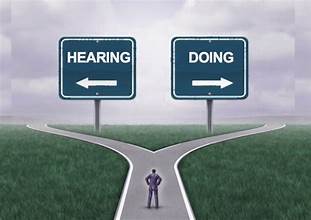
The difference between hearing and doing is huge!

Jesus’ illustration is borne out of his life experiences as a carpenter and craftsman. It is believable that he spent a portion of his life building homes, knowing the critical importance of a good foundation.

Theologian William Barclay wrote, “Only a house whose foundations are firm can withstand the storm; and only a life whose foundations are sure can stand the tests.”

Jesus tells us how to build that foundation…on hearing and on doing.

Jesus places value in the hearing. We cannot act upon what we do not know. Therefore, we must listen to God’s word. It is looking into the mirror of his word and seeing it for what it is. Again, it’s a great first step. Listening with intent takes us deeper than just hearing. The latter acknowledges God’s teaching. The former internalizes it.

Listening with intent to the word of God prepares for Jesus’ next command. Jesus wants us to be doers of his word. Knowledge only becomes relevant when we put it into action. Theory must be applied. Again, as Barclay writes, “Theology must become life.”

My cardiologist today told me to exercise more and lose weight. It does little good to go to the doctor in the first place if I’m not going to at least try to do what she instructs me to do. The same holds with my faith. It does little good to study God’s word if I don’t allow it to change my lifestyle and compel me to act.

It boils down to obedience, doesn’t it? For both my physical and spiritual health.

I have been guilty too many times of not hearing with intent. I suspect you have as well. Many people hear the word of God, but they don’t do anything with it. There are a lot of people who just enjoy listening to good preaching and teaching. That’s as far as it goes. They never really do anything with it. Call them “hearers of the word.” They listen, and listen, and listen — but it never leads them to DO what they’ve heard.

Again, hearing God’s word is a good thing, but it is not the end that God desires for us. James tells us that the one who hears with intent, never forgetting God’s word, the one will be blessed in what he does. This means the obedient person who does what God commands will find favor through a changed life. Will find blessings in the doing itself. Blessings in a life aligned with God’s will.

The blessing received by hearing and doing carries the biblical idea of shalom—being right with God and others. It is relational and spiritual. It also hints at blessings derived from an active and obedient faith that bears fruit in the life of the one who does and the lives of those he or she touches.

There’s the challenge James presents us. If all you and I are doing is hearing or reading or even studying God’s word, we might think we’re being a good follower of Christ, but we’re only deceiving ourselves, looking at ourselves in a mirror and walking away (vs. 22). Maybe it’s time we took the next step to become doers of the word!

Like Michael Jackson sang back in 1987 when he recorded Man in the Mirror:

I’m starting with the man in the mirror.
I’m asking him to change his ways.
And no message could have been any clearer.
If you want to make the world a better place
Just look at yourself then make a change.

May my life and yours be a reflection of Jesus and not a lot of “big talk and desk hammering.”

Thinking Points

When I read or hear God’s word, where do I most often stop short of actually doing what it calls me to do?


In what ways might I be mistaking familiarity with scripture for obedience to scripture?


How does Jesus’ picture of building on rock versus sand challenge the foundation upon which I’m currently building my life?


What is one concrete step I can take this week to move from “hearing” to “doing?”

Treasuring and Pondering

Focal Passage: Luke 2:19

Mary, did you know
that your baby boy would one day walk on water?
Mary, did you know
that your baby boy would save our sons and daughters?
Did you know
that your baby boy has come to make you new?
This child that you delivered
would soon deliver you.

Those words written by Mark Lowry, a comedian, singer and songwriter long associated with the Gaither Family, are the first stanza of what has become my favorite Christmas song. Many artists have recorded it since it was written, but Lowry sings it with unequaled passion.

In the bridge, Lowry’s words to Mary speak of the work of Christ in a building crescendo.

The blind will see.
The deaf will hear.
The dead shall live again.
The lame will leap.
The dumb will speak.
The praises of the lamb.

The as the song closes, the words ask Mary one last question before providing the resounding answer.

Did you know that your baby boy
Is heaven’s perfect lamb?
The sleeping child you’re holding is the great I AM!

Mary, did you know?

*****

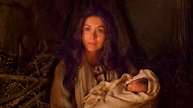
The young mother listened to the hearty giggles of her toddler as the boy’s father tossed him playfully into the air, catching him with calloused hands. She laughed to herself as this manly carpenter cooed in baby-speak. She shook her head in awe and returned to the preparation of the evening meal.

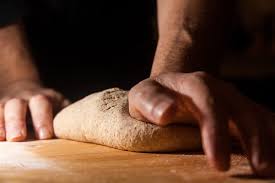
The routine task of grinding the wheat into flour for the evening bread freed her mind once again to reflect on the life God had given her.

Luke, the Bible’s historian, put it this way.

But Mary treasured up all these things and pondered them in her heart. (Luke 2:19)

Mary, did you know?

That one little verse, often overlooked, comes at the end of the beloved Christmas narrative. Long after Jesus’ birth, long after the shepherds returned to their fields and flocks, Mary treasured and pondered.

Mary, did you know?

Long after Jesus’ dedication when Simeon praised God for allowing him to see God’s salvation, Mary treasured and pondered.

Mary, did you know?

Long after Anna, a prophetess who served in the temple, took one look at Jesus and told everyone who would listen that this was the child who would bring redemption to Jerusalem, Mary treasured and pondered.

Long after the wise men found a new route home, Mary treasured and pondered.

Mary, did you know?

On that day I imagined, as Mary kneaded the dough and Joseph and Jesus played, what did she treasure? What did she ponder?

Think back to the night the angel told Mary what God planned for her. She would bear a son who would be the Son of the Most High; a son who would reign over the House of David forever. Later, her aunt Elizabeth, filled with the Holy Spirit, reaffirmed the miraculous birth as she called Mary blessed among all women.

Through an immaculate pregnancy and an ordinary birth, Mary saw it all come true, just as God promised. In those first few years, surely the whole experience seemed surreal, almost beyond belief. Mary took it all in. Tried to make sense of the inexplicable. She treasured and she pondered.

The Greek verb translated treasured in this passage doesn’t mean to just remember. It means to carefully preserve, to guard or keep something alive for future understanding.

You and I have had 2,000 years of history. We can hold God’s word in our hand and read the unfolding of his redemptive plan that began its climactic work in a Bethlehem manger.

Two or three years after that day, Mary was still trying to wrap her arms around it. So much of what happened must have seemed to her a mystery. So, she kept the experience in her heart as she watched her child grow, keeping her experience real and alive, hoping to one day understand the how and why?

Mary not only treasured, but she pondered.

Thinking is a broad, general process that tends to be quick and practical. I think about what I’m about to do. Pondering takes thinking to a completely different level. Most of us are thinkers. We don’t ponder enough.

Pondering implies lingering thought. Unhurried. Contemplative. Reflective. Inward. When one ponders one weighs significance. Turning something over and over in your heart and mind, It implies a sense of awe and wonder, seeking to find personal meaning.

The Greek word Luke uses in this passage translated as ponder means to actively bring things together. To compare and contrast. To wrestle with a thought toward understanding. That’s different from daydreaming or passively reflecting on something.

You see, Mary, like any mother, carried fond memories of her child’s birth. The journey from Nazareth. The discomfort of a donkey ride. The worry about finding a place to stay in a crowded city. The pain of childbirth. The pure joy of holding her son in those first magical moments. That’s the precious memory of motherhood.

When Mary pondered, she intentionally reflected on all that was said and all that happened, trying to fit the pieces together. Wrestling with its meaning. Mary wanted to make sense of what felt unexplainable. Mary looked at everything she had experienced to that point…everything we understand as our Christmas story…and treasured and pondered what it all meant.

Mary, did you know?

To her credit, Mary never demanded immediate understanding. Never insisted that if God wanted her participation, he needed to read her in fully on the plan. Mary thought about it…a lot…I imagine. Despite not fully grasping the significance or the how and why, Mary accepted her role in God’s plan with such deep faith and trust.

There it is! In the middle of Mary’s treasuring and pondering lies the lesson I needed as the Advent candles are snuffed out and we pack away the manger for another year.

On this side of Christmas, what do we know? What must we treasure? What must we ponder?

God is at work in my life. He has been at work, is now at work, and will be at work in my life until the day he calls me home. I truly believe that. I have a tendency, though I suspect most of us do, to demand from God an immediate explanation for the things happening in my life…good or bad. I tend to pray for answers before I am willing to act.

I test. I don’t always treasure.

I think. I don’t always ponder.

Mary trusted that God was at work in and through her life, even if she didn’t always know why or how things were going to work out. Her faith held on to and accepted the mystery rather than disregarding it, or worse still, trying to change it. Most importantly, Mary trusted that understanding would come with time and obedience. Her role was to keep listening and waiting…as long as necessary.

I need to learn that faith often means actively treasuring and guarding God’s promises that have not yet been resolved with clarity. To hang on to his word. To keep it viable and constantly in my thoughts for future understanding. To be obedient to it without trying to bend it to my will. To trust that the day will come when he opens my eyes to see with reverence and wonder how he has moved throughout my life.

Mary understood that God’s work in her life required spiritual attentiveness…a whole lot of pondering if you will. Most of the life’s lessons God teaches me require me to wrestle with them until what he is trying to teach me starts making sense. He asks me to dig deeper. To seek his truth. The water of life rarely comes from a shallow well.

Treasuring and pondering take time. What God begins in our lives one day will unfold, but it will unfold in his time, not instantly, but when the time is right. He asks us to wait faithfully on his timing. That’s never easy to do.

When God’s work surpasses our understanding, we are invited…like Mary…to treasure and ponder his work in our lives.

That seems to be the perfect message for the coming New Year.

I will mediate on your precepts and will fix my eyes on your ways. (Psalm 119:15)

Thinking (Pondering) Points

What has God done in my life recently that I need to slow down and ponder?


What practices in my faith walk help me treasure God’s work instead of casually dismissing it?


In what ways does Mary’s quiet, reflective faith challenge my tendency to seek quick answers?


How might God be shaping me during times when he asks me to wait and reflect rather than act?

A Life of Thanksgiving

Focal Passage: Colossians 3:12-17

In the middle of the United States Civil War on October 3, 1863, President Abraham Lincoln issued a proclamation declaring the last Thursday in November as a Day of Thanksgiving and Praise. Lincoln wrote in that proclamation that the year had been “filled with the blessings of fruitful fields and healthful skies,” blessings he called “gracious gifts of the Most High God.”

While merchants throughout our country blow off Thanksgiving for the more lucrative pursuit of Christmas, we, the people, as Lincoln liked to say, will all pause for a moment, gathered with family or friends, to enjoy a holiday centered on gratitude, generosity and togetherness. Hopefully, for those of us who try to live out our faith, Thanksgiving will grant us a chance for a little honest reflection on the gracious goodness of God.

Just as it is easy for us to get caught up in the trappings of Christmas and fail to sincerely remember God’s greatest gift, it is easy to get caught up in the toppings of Thanksgiving…the dressing, the cranberry sauce, the gravy. In my family, those toppings we focus on might include the cheese, the pico de gallo, the onions, and the guacamole we stuff into our non-traditional Thanksgiving fajitas.

We will quietly express our thanks to God, but I wonder if the words are that meaningful to him amid all the hustle and activity of the day. Let me explain.

I have lost both of my parents. At this ripe old age of 72, that’s not surprising, I suppose. Mom died 27 years ago of cancer at the too young age of 69. At the age of 98, Dad died two years ago of nothing more really than a life lived long and well.

Before they died, I got a chance to thank both of them in private for being the amazing parents they were. Given the sacrifices they made, the role models they were in my life, the life lessons they instilled, everything I said those days felt woefully inadequate. Though I struggled with the words, I think they understood my intent.

I got a similar response from both of them. Smiles shining through watery eyes and hugs they probably wished could be stronger.

My parents held expectations for me and my siblings, not so much on what we might do in life, but in how we chose to live life. As I think back on those precious moments with them, I pray I met those expectations.

As a parent of adult children now, I get it. You raise your children hoping they will be good people. That their lives will reflect the values you tried to instill in them. That they will live their lives with faith in God, love for family, compassion for others and integrity in all things. My sons have lived that life and more. Though they’ve both spoken their words of thanks at times, their lives lived well is all the gratitude I need.

Here’s the point I’m trying to make. We will gather around a table on Thanksgiving. At some point, we will pray and express our gratitude to God for all he’s done for us. I wonder, however, if this is the best way to say thanks to God.

While I’m quite sure our Lord appreciates the words of gratitude, how much more does he appreciate our lives lived as a reflection of his goodness and grace? How much more does he desire that we live our lives in ways that reflect the values he tries to instill in us?

I had the privilege of listening to an inspiring sermon this week delivered by the Rev. Robert Thomas, Jr., of Mt. Olivet Missionary Baptist Church in Houston. The Rev. Thomas spoke powerfully about holy living in a world filled with unholy actions.

In his text in Colossians 3:12, we find Paul saying that every believer in Christ should “clothe ourselves with compassion, kindness, humility, gentleness and patience.” We are to be forgiving because God forgave us, covering all our actions with love. Then, Paul added, “Let the peace of Christ rule in your hearts…and be thankful.”

I pulled out the verse again this week thinking about the upcoming Thanksgiving holiday, focusing on those last two words, “Be thankful.” If you continue reading in that chapter, you’ll find these words that sum up the previous verses. I think it has everything to do with how we express our gratitude to God. Paul said:

And whatever you do, whether in word or deed, do it all in the name of the Lord Jesus, giving thanks to God the Father through him. (Colossians 3:17)

Whatever you do in word or deed…give thanks.

Think about that for a second. I’m not sure Paul just wants us to thank God for giving us the word to say or the deed to do. I think he might mean that we should let our words and deeds be said and done in the name of Christ so well and so faithfully that our words and our deeds becomes an expression of our thanks to God.

When we act in compassion or kindness, when we live humbly, with gentleness toward others and patience in the face of the trouble, when we forgive, and let love drive our every thought or deed…that is an act of thanksgiving to God that means more to him, I believe, than simply saying a heartfelt thanks…as important as those words are to say at times.

When King Saul in the Old Testament disobeyed God but tried to cover it with yet another hastily thrown together sacrifice, God told him through Samuel, “To obey is better than sacrifice; to listen (is better) than the fat of rams.” (I Samuel 15:22)

That seems to be telling me that actions speak louder than words. If I want to thank God for his power, presence, protection and provision in my life, saying the words is important, but living in ways that honor him seems more important.

Let our obedience to his word be our thanksgiving for his goodness and grace. Jesus told his disciples in John 14:15 that if they truly loved him, they would keep his commandments. That we would live as he lived. Our surrender to his will and way then become acts of love and thankfulness.

Scripture teaches us, I think, that gratitude reaches its highest point when it moves beyond feelings and emotion and becomes faithful living. Being obedient to his commands and following his teachings in every aspect of life.

Living out God’s will by loving others, showing compassion toward those who are in need, forgiving those who hurt us, serving those around us—these actions, done in response to God’s redemptive and restorative work in our own lives, become the most sincere expressions of gratitude a believer can offer. A life surrendered to God’s will and way is a spiritual act of thanksgiving.

As he neared the end of his earthly ministry, Jesus consoled his disciples by urging them to stay connected to him. He drew upon a metaphor they would understand.

I am the vine; you are the branches. If a man remains in me and I in him, he will bear much fruit; apart from me you can do nothing…If you remain in me and my words remain in you, ask whatever you wish and it will be given you. This is to my father’s glory that you bear much fruit, showing yourselves to be my disciples. (John 15:5,7-8)

In other words, when we remain in Christ and do his will, we bear fruit. The fruit we bear brings glory to God. Our faithfulness and our work that impacts the lives of others and demonstrates that we are his children is an act of thanksgiving that glorifies God and makes him known to a world so desperately in need of him.

When we allow God’s spirit to shape our character with love, joy, peace, hope, patience, kindness, gentleness, we are expressing our deep gratitude for God’s saving work in our lives. When we, in a loving spirit, oppose actions in our world that run counter to the spirit and message of Christ, we are expressing our gratitude for God’s saving work in our lives.

When I see my sons living out the life God called them to live, when I see evidence of their faithfulness, compassion and Godly integrity, seeing the godly men they have become…that’s really all the gratitude I need. Of course, hearing that word of thanks, wrapped in the occasional hug, warms my heart.

I just feel God might be the same way. Watching you and me live out the lives we’ve been called to live for him, seeing evidence of our faith in our words and deeds, watching us bear fruit in ways that draw others to Christ, living godly lives, that’s what he most desires.

Hearing that word of thanks and giving him that spiritual hug, surely warms his heart.

Here’s my prayer for my life and yours this Thanksgiving holiday. May we recommit our lives to the one who redeemed us and called us to be his disciples, his fruit-bearers. May our lives and the words we speak and the work we do for him be a living expression of our gratitude for all he has done for us. Let’s say our thanks in prayer and live our thankfulness in practice.

I will praise you, O Lord my God, with all my heart; I will glorify your name forever. (Psalm 86:12)

Thinking Points

Who in my life has modeled grateful living? How can I follow their example in my walk with Christ?


In what ways can my everyday words and actions become a genuine expression of thankfulness to God?


Colossians 3 speaks to the qualities of compassion, kindness, humility, gentleness and patience, among others. Which of those traits do I need growth in my life if I want my life to shout my thanks to God for what he has done for me?


How might my life today change and want would it look like if obedience and faithfulness to God became my primary way of expressing gratitude to God?

You Are God’s Workmanship

Publishers note: Due to a glitch in the technology or my own lack of technical skill, it is possible that this post was not sent to my email subscribers two weeks ago. Now that the system has been fixed, I am reposting upon request. –KL

Focal Passage: Ephesians 2:10

Antonio Stradivari began crafting violins, cellos and violas in the late 1660s in Cremona, Italy. His techniques and varnishes produced instruments known for their powerful, resonant and balanced tones. Musicians since the early 18th century consider the Stradivarius (or Strad) as masterpieces of musical craftsmanship, the gold standard of stringed instruments.

While several hundred of these remarkable instruments exist today in the hands of collectors and museums and top performers, they are worth millions.

Polish-born Roman Totenberg, a Polish-born child prodigy, emigrated to the United States in 1937, where he built his career as a celebrated violinist, teacher and performer. In 1980, while a teacher at the Longy School of Music in Cambridge, MA, Totenberg’s prized Stradivarius, crafted by the master in 1734, was stolen from his office. It remained “lost” for over 30 years. Never played. Never heard. Its music lost for a time.

Totenberg’s Strad was recovered in 2015. Despite its years of disuse, once restored, the violin’s sound was revived. Mira Wang, a former pupil of Totenberg played the instrument in its first public concert following its restoration.  Concert reviews noted that Wang struggled to find the musical “fit” with the instrument. One article quoted a familiar idea among musicians that great instruments have distinct personalities and can be “tricky” until a player and instrument are perfectly matched.

That concept of musical fit runs parallel, I think, with faith and good works.  Many Christians, myself included at various times of my life, feel a disconnect with our faith and our actions. It’s not that we’re doing bad things necessarily. It’s just that we’re not doing much good either. We’re comfortable accepting God’s grace and doing little or nothing with it.

We’re either comfortable being a lost violin or we feel like the ill-matched musician, struggling to find where we fit in God’s work.

Let me explain what I mean from one of my favorite passages in Ephesians. Paul spent a great deal of time in Ephesians 2 talking about God’s gift of grace. For it is by grace you have been saved, through faith—and this not from yourselves, it is the gift of God—not by works so that no one can boast.

Salvation comes by grace through faith. We’ve done nothing to earn it. Theologian William Barclay said, “All the good works in the world cannot put us right with God.”

Once we have been made right with God, Barclay said, “there is something radically wrong with the Christianity which does not issue in good works.” In other words, this unmerited act of grace should propel us to do good works as a natural outgrowth of our relationship with Christ.

Paul said as much in his next breath and it’s this passage that spoke again to me this week.

For we are God’s workmanship, created in Christ Jesus to do good works, which God prepared in advance for us to do.” (Ephesians 2:10)

Let’s break this down a bit.

We are God’s handiwork. His masterpiece. Created with purpose and design.

What a remarkable thing to understand! The Greek work translated “workmanship” comes from the Greek “poiema,” rich in its definition. Though it literally means, “a thing made,” you can find a hint of its intent in a beautiful poem, an artistic masterpiece, or even a Stradivarius.

Think about that. A poet, composer or master craftsman doesn’t just haphazardly slap words or notes on a page or glue strips of wood together. Instead, ever detail is deliberately designed and crafted with care and purpose. Each poem, each song, each instrument unique in form and function.

So, it is with you and me. Every aspect of our lives, our personalities, talents, circumstances, our growth as spiritual beings, stands as a testimony of God’s divine composition. His craftsmanship. When the Psalmist declares that we are “fearfully and wonderfully made,” he’s not just talking about the intricacies of our physical bodies. He’s talking about the totality of us. Everything we are now or have the potential of being is crafted within us, just waiting to be released.

As inspiring as that ought to be, think beyond God’s workmanship in us. The next phrase in our passage adds a deep layer of meaning to our personal and spiritual identity. When we are saved by faith, God creates us once more in Christ Jesus.

Our physical creation is of God and by God, but we are remade spiritually in Christ…his life, death and resurrection. We become a new creation through the grace of God and our faith and trust in his son. This isn’t just a refinement or improvement. It is a new spiritual reality. The limitations of the past give way to godly potential.

Therefore, if anyone is in Christ, he is a new creation, the old has gone, the new has come! (2 Corinthians 5:17)

Being God’s workmanship in Christ Jesus transforms our ordinary human potential into purpose-driven alignment with God’s will and plan for our lives. It isn’t about existing; it’s about fulfilling a calling. If and when we tap into that source in Christ, we are empowered to do the work of Christ.

So, what are we called to do? Paul said it:

…to do good works which God prepared in advance for us to do.

This is where we find the “fit.” We will never be fully content and satisfied in life until we are being obedient to this purpose for us.  Until we are doing the good works he ordained us to do from the very beginning of time.

God’s plan for you and me to do good works existed before he put the first stars in place. He created us to reflect his purpose and his will as adopted sons and daughters through Jesus Christ. He planned from the beginning for each of us to do good works simply as a part of who we are and whose we are. It is not a prerequisite for salvation, but a result of it.

If our lives do not serve others nor serve the cause of Christ, we’re like the poem never read, the painting never seen or the priceless violin never played.

The value of a masterpiece lies in its uniqueness. If the musicians are to be believed, every Stradivarius has a distinct character that must be paired with the right musician to find its tone or voice.

Though a virtuoso in her own right, Wang struggled to make her style and approach fit with Totenberg’s violin. Later, the same violin was placed on loan with Juilliard violinist Nathan Metzler. Commentators and dealers noted the violin’s strong voice, praising its “amazing power and sweetness” once in the hands of a player who could draw that sound out.

Each us of has been uniquely gifted with talents and abilities to serve his kingdom. Finding purpose doesn’t always mean making grand plans or taking bold actions. It means something as simple as living faithfully every day. Ensuring that our actions and words reflect God’s love whether at home, work, in our families and our neighborhoods. Whether among friends or those we hardly know.

If you’re struggling with what “good works” you’re supposed to do, you’re probably being too technical. Good works are less about the act and more about the attitude that generates the act.

Scripture tells us that good works are outward actions that flow from an inward faith and relationship with God. Don’t think specifically of feeding the hungry or helping the sick, though our good works may manifest themselves in exactly that. Think kindness, patience, love, gentleness, peace, joy and self-control motivating the things we do for others. Think Jesus.

True good works are done in obedience to God’s word, through the power of the Holy Spirit, and for the glory of God rather than self. Every act points toward God.

Let your light so shine before men that they may see your good works and glorify the Father in Heaven. (Matthew 5:16)

That’s not all. Our good works, our acts of mercy, justice and compassion, equate to obedience to the teachings of Christ born out of our love for him and gratitude for his atoning sacrifice. John 14:15 tells us we obey his teachings that lead to good works because we love him.

The good news about good works is that in the goodness of God, his spirit empowers us to act. We don’t have to do any of it in our own power. It is God working through us. We just need to make ourselves available to be used and get out of his way.

For it is God who works in you to will and to act in order to fulfill his good purpose. (Philippians 2:13)

My uncle Les Lewis posted his daily devotional last week about faith, but he said something that I think applies here, too. He wrote, “When faith is God behaving in me, my potential is as great as God is great.” God behaving in me. That seems the very definition of “good works,” granting us the potential to make a real difference in the lives of those we encounter.

While our gifts are unique and God fits our gifts with his purpose, working to do good is most effective when done together. When our unique gifts blend in service. In his letter to Titus, Paul encouraged this young minister to ensure that he and those he served worked together to help others.

And I want you to stress these things, so that those who have trusted in God may be careful to devote themselves to doing what is good. These things are excellent and profitable for everyone. (Titus 3:8)

Our good works get magnified when we work in concert with other believers. As Christians we are meant to help each other grow in love and in the work we do for Christ. Walking alongside one another we learn to love better, forgive more, serve selflessly, each using the unique gifts God grants us. Every good deed encourages another.

The writer of Hebrews said almost the same thing.

Let us consider how we may spur one another on toward love and good deeds, not giving up meeting together, as some are in the habit of doing, but encouraging one another… (Hebrews 10:24-25)

Like the Totenberg Stradivarius, our lives and our faith may at times fall silent or out of tune with the purposes of God and the work he calls us to do. God is not only the craftsman that designed us with purpose, he is the virtuoso who plays with “amazing power and sweetness” when we allow him to work in and through us.

If you or I are not yet demonstrating the good work for which he created us, know this. Each one of us, every believer, can be restored, renewed, and brought back to life in him. God, the divine craftsman, not only created us as His workmanship but continues to shape and refine us through His Spirit so that His melody of grace can resonate through our lives, demonstrating his love through our good works.

In the end, we are not meant to sit unused or hidden away. He made us to be instruments of His grace in a life of good works. Now, we just have to let him draw the bow across our strings.

Thinking Points

In what ways might you feel like an “unplayed violin” in your faith journey—and what would it take to let God bring your purpose to life again?


How does understanding yourself as God’s workmanship change the way you see your daily actions and choices?


What “good works” has God already placed before you that may simply require your willingness to act?


How can you better align your unique gifts and temperament with God’s purposes so that his “music” flows naturally through you?

Transforming Grace

Author’s Note

“If you can’t think of anything to say, maybe it’s time to listen.”

This unattributed quote sums up what I felt a year ago as I was struggling to pull together another post for my Bible study blog The Searcher. At that time, I had been publishing my personal Bible study reflections for over a decade and, frankly, I felt like I was running out of things to say. I continued my personal Bible studies, but I quit writing about them. Instead, I chose to listen.

I like to think God gifted me with the ability to string a few cogent words together to communicate a thought or two, particularly as it relates to things I’m learning in scripture. I believe when we study his word, God, through his spirit, honors the time and teaches us things we need to know in whatever season of life we might be experiencing. I trusted that I would feel it when, or if, God wanted me to begin again sharing what he was teaching me.

One year has rolled around and it feels like it is time to start once more. So, for those who wondered why I quit writing, now you know. It was simply time for me to listen with fresh ears and an open heart.

Thanks for your patience.

Transforming Grace

Titus 2:11-14

As the days lead up to Easter, I’ve been reminded through my pastor’s sermon series of God’s wondrous grace offered to each of us through Jesus’ death and resurrection. The price of redemption for our sins has been paid in full. A gift freely given. Undeserved and unmerited.

For it is by grace you have been saved, through faith—and this not from yourselves, but it is the gift of God—not by works so that no one can boast.” (Ephesians 2:8)

This saving nature of grace, I clearly understand and value, but it’s really a gift that keeps on giving.

Paul penned a quick note to Titus, a young pastor he left behind in Crete to carry on the work Paul started. It would not be an easy assignment for Titus. Cretans enjoyed a nasty reputation in the ancient world. Epimenides, a philosopher from Crete who lived in the 6th century B.C., called his fellow Cretans “liars, evil brutes and gluttons.”

Paul spent time in his letter instructing Titus on general themes he needed to teach to the new believers under in care. Sound doctrine. Temperance. Self-Control. Love. Patience. Integrity. Then, he talked about grace. Look at what he said in Titus 2:11-14

For the grace of God that brings salvation has appeared to all men. It teaches us to say “no” to ungodliness and worldly passions, and to live self-controlled, upright and godly lives in this present age, while we wait for the blessed hope—the glorious appearing of our great God and Savior Jesus Christ, who gave himself for us to redeem us from all wickedness and to purify for himself a people that are his very own, eager to do what is good.

That first sentence speaks to saving grace through Christ. Notice, though, that grace doesn’t just save, it teaches. We spend a lot of time singing about his amazing grace that forgives and saves, but we rarely think of grace beyond the cross.

Pastor and author John Piper said, “Grace is not simply leniency when we have sinned. Grace is the enabling gift of God not to sin. Grace is power, not just pardon.”

Look again at what Paul tells Titus. Grace teaches us to say “no” to ungodliness and sin. Such teaching goes beyond simple instruction. The Greek word for teach suggests the entire process of instruction, encouragement, correction and discipline. In essence, grace empowers us to live the abundant life Christ promised through its constant work in our lives. Helping us say no to impulses and desires that run counter to God’s will and yes to obedience to his will, to living in right relationship with God and others and imitating Christ in our attitudes and our actions.

Just as a personal trainer helps us adopt a healthier lifestyle, grace acts as our personal spiritual trainer leading us toward a life that pleases God. Grace doesn’t just save, it transforms.

Do not conform any longer to the pattern of this world, but be transformed by the renewing of your mind. Then, you will be able to test and approve what God’s will is—his good, pleasing and perfect will. (Romans 12:2)

God’s grace purifies and cleanses us, setting us apart as God’s people who are eager to do good.

When his Christian mother died in 1733, six-year-old John Newton lived under the strict and forbidding thumb of his unbelieving, sea captain father whose discipline lacked nurturing and any outward show of love.

As a young man, Newton joined the British Navy. He sailed headlong into a life of depravity and rebellion that led to his deep involvement in the African slave trade. His life sullied by violence and blatant disregard for any moral compass. By his own admission, Newton’s actions were horrific, nothing short of cruel and inhumane.

Caught in a particularly dangerous storm in 1748, Newton found himself in a floundering ship with little hope of rescue, praying in desperation to the God his mother worshipped. That moment, according to Newton, marked the beginning of his transformation into a man of God.

Once safe on land, Newton gave his life to Christ. He immediately abandoned the slave trade to become an Anglican minister, preaching about God’s grace and advocating for the abolition of slavery.

In his autobiography, Newton acknowledged the change that took place in his life when he accepted Christ as savior. He said, “I am not what I ought to be, I am not what I want to be, I am not what I hope to be in another world; but still I am not what I once used to be, and by the grace of God I am what I am.”

Understanding the transforming nature of forgiveness and grace, Newton penned the words of one of the world’s most beloved hymns. Originally written as a poem with 13 verse, Amazing Grace tells the story of how God changed his life.

I have sung that song so many times in my life that I don’t always hear the words. Reading it as the poem written by a transformed soul adds to its meaning. One particular verse caught my attention.

Through many dangers, toils and snares
I have already come.
‘Tis grace that brought me safe this far
And grace will lead me home.

Newton may have penned that last line thinking about grace that provides his way to heaven, but I wonder if the relevant word here might be “lead.” Paul shares that once we receive God’s saving grace, it is the power of grace that leads (guides, teaches, encourages) us to live for Christ. He told the Philippian church,

He who began a good work in you will carry it on to completion. (Philippians 1:6)

The transforming grace of God leads us from that moment forward by reshaping our hearts, making us a new creation, by changing the way we think about life and our responsibility to God as we live it. Creating within us such purified and clean hearts that are eager to do good.

So, here’s the challenge you and I face this week. Let’s thank God not only for grace that pardons, but equally for grace that transforms and empowers us to live Christ-like lives, eager to do good just as he did.

Thinking Points

How does grace differ from mercy and justice?

Why do you think grace is more powerful than guilt for changing behavior?

What area(s) of life is grace currently transforming in you?

You Are What You Think

Background Passages: Psalm 1:1-4, Jeremiah 17:7-8, Philippians 4:8, and 2 Corinthians 10:3-5

The route we typically took to my parents’ house from Pasadena to Ropesville was honestly not the most scenic drive. While there is something to be said for the stark beauty of the endless highway and cotton fields, the trip that we took countless times was little more than the occasional mesa, a random Dairy Queen and a lot of flat, empty space.

I recall making that drive early in our marriage before children as we sat in silence while the country droned by. I felt Robin’s eyes on me long before she asked the question every husband dreads.

“What are you thinking?”

Every husband knows my response. “Nothing.” Also, as every husband knows, that’s exactly what I was thinking in that exact moment and in most moments of solitude. Absolutely nothing.

Comedian Mark Gungor would say, “I was in my Nothing Box.” (If you’ve never seen that YouTube video about how the brains of men and women work, it’s worth the view.)

The Bible talks a lot about our thought life. Though it’s slightly out of context, Solomon lets us know in Proverbs 23:7 that “As a man thinks, so he is.”

In other words, you are what you think. Whatever we choose to concentrate on, spend our time thinking about, will impact the way we choose to live.

Hear the instructive word of the Psalmist.

Blessed is the one who does not walk in step with the wicked or stand in the way sinners take or sit in the company of mockers, but whose delight is in the law of the Lord, and who meditates on his law day and night. That person is like a tree planted by streams of water which yields its fruit in season and whose leaf does not wither—whatever they do prospers. Not so the wicked. They are like chaff that the wind blows away. (Psalm 1:1-4)

As the opening hymn of the Psalm, the passage answers some amazingly deep questions about life. Who am I going to be? Who is God? Where can I find true contentment and happiness? What road should I take in life? What is my purpose?

It is a call to be blessed. To find contentment and joy, regardless of life’s circumstances. The passage puts us squarely in the middle of the fork in the road. The first path is walked by the wicked, the sinners and the mockers of all that is holy.

Jesus might have called it Broadway. He said in Matthew 7:13, “…For wide is the gate and broad is the road that leads to destruction, and many enter through it.”

That first step down the path of the wicked and the way of the sinner always begin with a thought, an idea, a desire that pops in our head that entices and seduces us. We begin to think walking that path would be so much more fun, so much more profitable, so much more popular, that we can’t help but start the journey. As we think, so we are. It doesn’t take long for our thoughts to take hold in our hearts. Now, instead of just thinking about things we shouldn’t, we’re doing them.

Sadly, Paul and I have much in common on this point. I suspect most of us do.

I do not understand what I do. For what I want to do I do not do, but what I hate I do…For I know that good itself does not dwell in me, that is, in my sinful nature. I have the desire to do what is good, but I cannot carry it out. For I do not do the good I want to do, but the evil I do not want to do–this I keep doing. (Romans 7:15,18-19)

We won’t find contentment on the broad road described by Jesus or the way of the wicked described by the Psalmist. Rather, we’ll end up feeling more and more like Paul. We don’t intend to walk that path, but the world makes it look easy and appealing.

Blessedness (joy and contentment) comes, according to Psalm 1, when we don’t follow in the footsteps of those who do evil or take the path sinners take or travel among the scoffers who know nothing of God and his grace or goodness. It is the road to destruction…to chaff. An existence in which we are blown in whatever direction the wind blows. Never truly grounded. Always acting on a whim.

The Psalmist said the one who is blessed will find a different road to travel. In that same passage in Matthew, Jesus tells us to use the narrow gate and the “narrow road that leads to life and only a few find it.” As Robert Frost said, “…the road less traveled.”

Blessedness flows to the one whose “delight is in the law of the Lord, and who meditates on his law day and night.” Delight is a heart response to something or someone of beauty and value, in this case, God’s word and its truth. The word “delight” is used typically in scripture to describe the life in which God’s purpose and choice are in view.

It is joy, pleasure and satisfaction that comes when we abide in his word and will. Such delight comes only from delving deeply into scripture, finding its relevance for our lives and acting daily upon it.

The one who thinks only about the truths and promises of God found in his word is the one who walks in the path of the righteous and stands in the way of the faithful or sits in the company of those who trust in God’s word. You see, as a man thinks, so he is.

If we think of the things of God, those will be the attributes ingrained in us. It is an immutable truth repeated time and time again in scripture.

Since, then, you have been raised with Christ, set your hearts on things above, where Christ is, seated at the right hand of God. Set your minds on things above, not on earthy things. (Colossians 3:1-2)

Then, look at what Paul tells the Philippian church about the way we ought to think.

He begins the passage by exhorting his readers to “rejoice.” To find joy. To find contentment. To find a peace that “transcends all understanding…” Then, he tells them how.

Finally, brothers and sisters, whatever is true, whatever is noble, whatever is right, whatever is pure, whatever is lovely, whatever is admirable—if anything is excellent or praiseworthy—think about such things. Whatever you have learned or received or heard from me, or seen in me—put it into practice. And the God of peace will be with you. (Philippians 4:4-8)

Paul expresses in such a beautiful and poetic way how our thoughts ought to be directed.

Jesus even alludes to it in his Beatitudes when he says, “Blessed are the pure in heart, for they will see God.”

Given that the heart was viewed in the Jewish culture as the center of thought and will, Jesus says those whose thoughts are pure, whose motives for every decision are aligned with God’s word and will—these are the souls who will see God at work in their lives. These are the folks who find God in every circumstance of life—good or bad.

You are what you think.

Paul shared one more thought in his second letter to the Corinthian church which feels applicable here.

Though we live in the world, we do not wage war as the world does. The weapons we fight with are not the weapons of the world. On the contrary, they have divine power to demolish strongholds. We demolish arguments and every pretension that sets itself up against the knowledge of God, and we take captive every thought to make it obedient to Christ. (2 Corinthians 10:3-5)

Don’t you love that last phrase?

…take captive every thought to make it obedient to Christ…

The Greek word used for “take captive” means “to control, to conquer, to bring into submission.” We bring into submission every thought so that it conforms to the teachings of Christ. We conquer our tendency to dwell on things we shouldn’t be thinking about. We control those wicked thoughts by not letting them take root in our heart and soul.

The good news is that the Psalmist tells us how to do this.

We take captive our thoughts ”by meditating on the law day and night.”

Our hearts desire must be to embed ourselves so deeply in God’s word and all that it teaches us that we have little time to think of anything else. To be so grounded in scripture, that every temptation is answered by the Spirit’s whispered reminder of what has been taught us through God’s word…just as Jesus refuted every temptation from Satan with a word from scripture.

It’s not enough to just hear scripture read to you in Sunday School or from the pulpit. We need to spend time during the week studying God’s word, especially when the pervasive garbage of the world tries so hard to infiltrate our every thought.

The Rev. Charles Spurgeon said, “A Bible that is falling apart usually belongs to someone who isn’t.”

I’ll revert to the Proverbs, an ancient equivalent to the modern day “garbage in, garbage out.” Proverbs 15:14 says that “A wise person is hungry for knowledge, while the fool feeds on trash.”

You are what you think.

I like the idea the Psalmist conveys when he says what it is like to be one who immerses himself in God’s word.

That person is like a tree planted by streams of water which yields its fruit in season and whose leaf does not wither—whatever they do prospers.

Jeremiah shares a similar thought.

Bless is the one who trusts in the Lord, whose confidence is in him. They will be like a tree planted by the water that sends out its roots by the stream. It does not fear when heat comes; its leaves are always green. It has no worries in a year of drought and never fails to bear fruit. (Jeremiah 17:7-8)

You must love this tree metaphor as much as I do.

Notice that the tree is planted by the stream. It didn’t grow up there on its own accord. It was planted. Planted means to cause to take root. The Hebrew word used here more closely translates as “transplanted.” To cause to take root after moving from one environment to another more suited for growth.

I love that idea in the context of this Psalm that talks about the way of the wicked opposed to the way of the righteous seen in the one who dwells in God’s word. That person is transplanted from the path of wicked, the sinner and the scoffer to live and grow next to the living water found in God’s word through Christ Jesus.

A tree’s roots run deep, searching always for the moisture and nutrients that fuel its growth. The deeper its roots go, the more sturdy and stable it becomes , more capable of withstanding any wind that blows. (In contrast, it takes very little wind to blow away the chaff.)

That’s how it is with one grounded deeply in scripture. She finds the spiritual water and nutrients to grow and mature in Christ. And, like the tree, that kind of growth takes time. We live in a time of instant gratification, but the Christian life is a process of growing and learning. Each minute we stop looking to the Bible for our strength is a lost moment in our spiritual lives.

Notice also that the tree yields fruit. Our time spend in studying God’s word will always point us to ministry and service. It is the understanding of what God requires of us that propels us to care for and serve others.

The message of this Psalm hit me squarely between the eyes this week.

You are what you think.

As we walk through each day, let’s meditate on God’s word…day and night. Think about the things of God. When we do, it’s so much easier to…

Be the tree.

Better Than Biscuits

Background Passages: Ecclesiastes 3:11, Isaiah 40:29-31 and Colossians 1:15-20

I saw this floating story around the social network this week in a Facebook post shared by my friend Kim Pressly. It’s a story about a visiting pastor who attended a men’s breakfast in the middle of a rural farming community, not unlike the one in which I was raised.

An older, sun-baked farmer, decked out in faded bib overalls was asked to say grace for the morning breakfast.

“Lord, I hate buttermilk”, the farmer began. The visiting pastor opened one eye to glance at the farmer and wondered where this was going. The farmer loudly proclaimed, “Lord, I hate lard.” Without missing a beat, the farmer continued, “And Lord, you know I don’t much care for raw, white flour.”

The pastor once again opened an eye to glance around the room and saw that he wasn’t the only one feeling a bit uncomfortable with the farmer’s prayer.

Then the farmer added, “But Lord, when you mix them all together and bake them, I do love fresh, warm biscuits.

“Lord, when things come up that we don’t like, when life gets hard, when we don’t understand what you’re saying to us, help us to just relax and wait until you are done mixing. It’ll probably be even better than biscuits.

“Amen.”

I suspect that little anecdote spoke to me when I first read it this week because there is a lot going on in this world that I don’t like. Current realities make life difficult. I suppose we own much of it. We’ve let those difficulties divide us as a people more deeply than I ever thought possible. The parts we don’t own, those things beyond our control, we sure don’t understand.

I hate what is happening to our country, our world, our churches, our lives. It is too often unattractive, unhealthy and unChristian. I don’t know about you, but I find myself growing tired of the buttermilk and the lard and the raw, white flour.

So maybe that old farmer is right. “God, help us wait until you are done mixing.”

I suppose the first Bible verse that comes to my mind is this:

“He has made everything beautiful in its time. He has also set eternity in the human heart; yet no one can fathom what God has done from beginning to end.” (Ecclesiastics 3:11)

We can’t always see what God has done, nor can we always see what he is doing right now. We do know there is beauty in everything God has created. He orders all things. When we make our mistakes, he is constantly realigning our path with his will. When our world ventures off course, he is there to hold it together until his time is right.

We may not always understand why God allows for things to happen in our lives that cause pain, fear, and worry. However, we can trust that he is constantly at work to reveal his goodness and love amid the troubles of the day.

So, when I don’t like the buttermilk, I just need to realize the Master Baker is still in the kitchen.

If I can accept that God is in control and working through the mess on our behalf, then I can turn to Isaiah 40:29-31 and rest from the struggle and draw strength from his presence.

“He gives strength to the weary and increases the power of the weak. Even youths grow tired and weary and young men will stumble and fall; but those who wait upon the Lord will renew their strength. They will soar on wings like eagles, they will run and not grow weary. They will walk and not grow faint.”

What does it mean to “wait upon the Lord?”

Because we’ve spent so much time in the waiting room of a doctor’s office or in the line at the Department of Motor Vehicles to get our license renewed, we tend to think “waiting” is a passive experience. That we must somehow sit on our hands until God chooses to do something to fix the situation in which we find ourselves. In scripture, however, waiting on the Lord is a call for action.

When these words were spoken by God through Isaiah, the Israelites were in exile in Babylon and Jerusalem lay in ruins, it’s walls and buildings mere rubble. Their hopes and dreams shattered. Tired of their situation, they complained that God no longer seemed interested in their well-being; that he was disinclined to seek justice on their behalf.

Isaiah paints a different picture of God the Creator. He speaks of God giving power to those who are fainthearted and weary. He counters their complaint that God is too small of the situation. Isaiah reminds them, “Have you not known? Have you not heard? The Lord is the everlasting God, the Creator of the ends of the earth.”

God, Isaiah proclaims, “gives power to the faint and strengthens the powerless.” God is ready to share his power with those who call upon his name. All that is required of them is to “wait on the Lord.”

They were not to sit idly by twiddling their thumbs until God acted on their behalf. They were to wait upon him in confident trust and expectation that he was at work to restore them to the place he called them to be. To wait on the Lord is to actively put our hope and trust in him.

Hope, in a biblical sense, is not desperation. It is living out each day in the image of Christ as his hands, heart and voice. It is taking all we know of Christ and his teachings and doing our part to influence a world that’s trending in the wrong direction. It is actively serving and ministering to the hearts of those we encounter along the way.

Despite the turmoil that surrounds us, we are called to a hopeful expectation that God is still in the kitchen mixing together all the ingredients of the life he has called us to live in Him.

If we do our part in the waiting time, God promises to renew our strength. One commentary I read explained that the word used for “renew” in this passage is closer in translation to the word “exchange.” I like that mental picture.

Those who wait on the Lord do more than renew their strength, they exchange, instead, their faint or faltering strength for the unfailing power of God. Our weakness is replaced by his strength…our frailty with the power of the Creator God who never grows tired.

The beautiful imagery that Isaiah used gives perfect illustration to the uplifting power of God.

“They will soar on wings like eagles.”

An eagle soars to great heights not on the power of his own wings, but on the rising air currents that lift it higher and higher. The eagle’s own power gets him airborne, but to soar he needs the wind. Once he finds the current, soaring is effortless.

Our waiting on the Lord, our confident hope, is the personal action that gets us airborne. We soar when we find the Spirit’s wind that lifts us to new heights. When we find God’s spirit with us, soaring is effortless. We will not grow weary of the task laid before us.

Scripture reminds us that God is always mixing things together, working to bring good from every circumstance for those who love him and are called for his purpose. It is God who holds it all together.

The world is in a mess right now. I don’t like what I see and hear. It seems everything we hold dear is falling apart at the seams.

There is still a big part of me, however, that believes God is at work in the chaos.

Paul indicated as much to his letter to the Colossian church.

“He is the image of the invisible God, the firstborn of all creation. For by him all things were created, in heaven and on earth, visible and invisible, whether thrones or dominions or rulers or authorities — all things were created through him and for him. And he is before all things, and in him all things hold together…For in him all the fullness of God was pleased to dwell, and through him to reconcile to himself all things, whether on earth or in heaven, making peace by the blood of his cross.” (Colossians 1:15-20)

Those who wait on the Lord put our confident trust in Christ, the image of the invisible God. That means in times of trouble we can fall back on his teachings to guide us because he has preeminence or authority over all things.

And, here is the part of this passage that speaks to the farmer’s prayer: “…in him all things hold together…and through him to reconcile to himself all things…making peace by the blood of his cross.”

The farmer got it right. All the things in life that I hate, the things I fear are tearing us apart, God knows about all of them. He is in preeminent and is holding life together. Keeping it all in the mix until the time when he can reconcile or bring everything back together to himself. Until we find the peace available through his sacrifice on the cross.

Here’s the deal though. Those things in the mix require one more ingredient. For God to turn those things I hate into something worth tasting, those who wait upon the Lord must be folded into the batter. Confidently expecting God to work in and through us to accomplish his plan and purpose, not only in our lives, but in the world around us. His work through us.

So, don’t grow weary as you look upon the complicated world around you. Our Lord is mixing and holding it all together. Wait upon the Lord. His work…our work…is not done.

I confident when he’s finished, whatever he’s cooked up will be better than biscuits.

Freedom and Responsibility

Background Passages: John 8:31-36, Romans 8:3-4, I Peter 2:16, Galatians 5:13-23, James 2:14-18 and James 1:25

Early in my public relations career, I attended my first out of state business trip. How novel to travel half way across the country on someone else’s dime.

Robin and I drop the boys off with my parents in Ropesville, Texas, and boarded a plane for Pennsylvania. I wasn’t that excited about the conference, but I jumped at the chance to go to Philadelphia over the July 4th holiday.

I attended the obligatory meetings, but as soon as I could shake free, Robin and I walked the historic parts of the city. The Liberty Bell. Independence Hall. Parades. Fireworks. All the trappings of the Fourth of July in an historic city.

Standing behind the rope and staring at the 56 desks in that sweltering room in Independence Hall, I could almost see and hear those men debating their grievances against England and its king.

Samuel and John Adams. Benjamin Franklin. Thomas Jefferson. John Hancock.

Hancock, the president of the Second Continental Congress and governor of Massachusetts, is remembered more for his large and flamboyant signature than his role in leading the Congress.

Though the story is anecdotal, Hancock signed the document with a flourish and remarked, “The British ministry can read that name without spectacles. Let them double their reward.”

He probably didn’t really utter that line, but as they said at the end of the 1962 film, The Man Who Shot Liberty Valence, “When the legend becomes fact, print the legend.”

Though the 56 men representing the 13 colonies agreed in principle to the words of the Declaration on July 4, they didn’t actually sign it until August 2. Still, the significance of the declaration is a call for freedom that we celebrate as a nation today.

I love the words first learned in school.

“…We hold these truths to be self-evident; that all men are created equal, that they are endowed by their Creator with certain unalienable rights, that among these are life, liberty and the pursuit of happiness…”

I sit here today knowing we as a nation have not always lived up to that standard of those words. I sit here knowing that we too often fail to grasp the full weight of the responsibilities that go with freedom and liberty.

I sit here today knowing they may be the most significant words of freedom ever written in a secular, political context. They represent ideals worth celebrating. Ideals worth pursuing with vigor. Ideals worth our best efforts to achieve for all people.

Freedom. Liberty. Rich blessings far too many on earth do not have. Blessings far too easily taken for granted by those who enjoy them.

In the middle of the family and community celebrations this week, let’s remember the true significance of those words.

We ought also to remember God-inspired words which speak to our spiritual liberty and freedom so central to our faith as Christians.

Martin Luther penned a treatise in 1520 called On the Freedom of a Christian. I remember reading parts of his paper in my one year of seminary. He declared in his work that “A Christian is a perfectly free lord of all, subject to none. A Christian is a perfectly dutiful servant, subject to all.”

The statements seemed contradictory, but not to Luther. Our faith and trust in Jesus frees us from being slaves to a salvation doctrine that requires good works.

Luther taught that salvation cannot be earned by doing good things. It is a grace gift, freely given by a loving God to anyone who believes in Jesus Christ. Therefore, Luther says, Christians are completely free, not bound by any law, rule or commandment that we must keep in order to earn salvation.

But, Luther also said there is a flip side to the coin. Though set free in this way from salvation dependent upon good works, we are not set free from doing good works.

With the freedom that exists under Christ, there is great responsibility. Let’s think quickly about both of these ideas.

Jesus sat down with a group of Jews who had believed in him. He began to teach them what it means to be one of his followers. As he taught, he uttered what may be the most significant words of freedom ever written in a spiritual context.

“To the Jews who believed in him, Jesus said, ‘If you hold to my teachings, you are really my disciples. Then, you will know the truth, and the truth shall set you free.” (John 8:31-32)

The Jewish believers struggled with the concept, proud of their national identity and proud of the fact that though they were subjected to foreign occupation throughout their history, they refused to call themselves slaves. Freedom, you see, was trapped within their political reality. It took but a moment for Jesus to drive home his point.

“Everyone who sins is a slave to sin. Now a slave has no permanent place in the family, but a son belongs to it forever. So, if the Son sets you free, you are free indeed.” (John 8:34-36)

Jesus is talking about a reality of life. If we were required to be 100 percent obedient to God’s law in order to obtain salvation, none of us would gain an entry pass to heaven. Paul said it clearly, “For all have sinned and fallen short of the glory of God.”

In the good news of the gospel God made provision for our weakness. We are freed from both the eternal consequences and control of sin.

You see, the truth Jesus spoke about to all who would listen, the truth that sets us free from the burden of perfect compliance, is the grace gift of salvation in Jesus Christ.

“You shall know the truth and the truth shall set you free.” is our spiritual declaration of independence.

Paul told the believers in Rome, “What the law of Moses could not do, God did by sending his own son as an offering for sin, bearing man’s punishment for him so he could be set free from sin and enjoy the fellowship of God.” (Romans 8:3-4)

God through Jesus Christ and our faith in him, bore the consequences of our failure to live up to the standard he set before us. Because of that, we should live differently, trying harder each day to avoid the control of sin in our lives.

Peter encouraged those early Christians with these words.

“Act as free men and do not use your freedom as a covering to do evil, but use it as bondslaves to God. (I Peter 2:16)

In her book, You Learn By Living: Eleven Keys to a More Fulfilling Life,” Eleanor Roosevelt wrote that freedom places its own requirements on all who live under its blanket.

“With freedom comes responsibility. For the person who is unwilling to grow up, the person who does not want to carry his own weight, this is a frightening prospect.”

The liberty we enjoy as a nation sets us free to live pretty much as we choose, but it carries the great responsibility of citizenship. We bear the responsibility protecting our freedoms, respecting the rights of others and ensuring those freedoms extend to all of us. For freedom to work well in society, those who enjoy the freedom must live well. Do right. Care for one another.

Paul said something similar applies to Christ followers. He told a group of struggling Christians in Galatia,

“You, my brothers and sisters, were called to be free. But do not use your freedom to indulge the flesh, rather serve one another humbly in love. For the entire law is fulfilled in this one command, ‘Love your neighbor as yourself.’ If you bite and devour one another, watch out or you will be destroyed by one another.” (Galatians 5:13-15)

Paul urges his fellow believers to “walk in the spirit,” calling them to produce fruit, or evidence of their faith in their daily lives. Things such as “love, joy, peace, forbearance, kindness, goodness, faithfulness, gentleness, and self-control. There is no law against such things.” (Galatians 5:22-23)

Unlike Ms. Roosevelt’s political context, the Bible teaches that with spiritual freedom comes even greater responsibility. To the person unwilling to grow spiritually, the person who does not carry the cross of his testimony in Christ, this is a frightening prospect.

For spiritual freedom to work well, those who enjoy the freedom in Christ must live well. Do right. Care for one another. We must feel compelled by conscience and conviction to do good works.

Jesus taught us all we need to know about living well. His life was the open textbook. Building relationships. Healing the hurting. Feeding the hungry. Caring for the helpless. Opening the doors for an eternal relationship with God to all with eyes to see and ears to hear. His life, full to the brim with faith in his father, was a life spent doing good works.

My Mom was a woman of practical faith. Her faith was not a “Sunday go to meeting with white gloves on” kind of faith where one professed a trust in Christ yet whose deeds showed little evidence of it. She got her hands dirty in God’s good work caring for the elderly in the Lubbock community.

In my favorite passage from James, the writer refutes the idea that faith frees us to do what we please; that we are under no obligation to do good to others.

“What good is it my brothers if someone claims they have faith, but has no deeds? Can such faith save them? Suppose a brother or sister is without clothes and daily food. If one of you says to them, ‘Go in peace, keep warm and well fed,’ but does nothing about their physical needs, what good is it? In the same way, faith by itself, if it is not accompanied by action, it is dead.

“But someone will say, ‘You have faith. I have deeds.’ Show me your faith without deeds and I will show you my faith by my deeds.” (James 2:14-18)

Every good deed, every act of mercy, every act of love extended to another ought to be a natural outgrowth of the freedom we have in Christ. It is within the living of a Christ-like life of love that we find our blessings.

“But anyone who looks intently into the perfect law that gives freedom and continues in it, not forgetting what they heard, but doing it, they will be blessed in what they do.” (James 1:25)

Though I am far from perfect, I am keenly aware of the responsibility my faith carries to live well and do good.

I am grateful today for the freedom I have as an American. I do not take it lightly. I recognize the responsibility that comes with it.

I am, however, far more grateful today for the freedom granted me by the grace of God through my belief in Jesus as my savior.

It is a self-evident truth. “You shall know the truth and the truth shall set you free.”

On this July 4th weekend, that is my spiritual declaration of independence.

The Race Marked Out for Us

Background Passage: Hebrews 12:1-2; Matthew 13:1-23

The passage below falls easily into my list of 10 favorite Bible verses. Born with an athlete’s mind, if not an athlete’s talent, I find I can relate to the imagery suggested by the writer of Hebrews. Hebrews was written to a group of Christian believers who faced the temptation to abandon their faith in the face of fierce opposition and outright persecution.

“Therefore, since we are surrounded by
so great a cloud of witnesses,
let us throw off everything that hinders
and the sin that so easily entangles,
and let us run with perseverance
the race marked out for us.
Let us fix our eyes on Jesus,
the author and perfecter of our faith…”

The astute writer drew upon the life testimonies of men and women we might place in our Hall of Honor for the faith they demonstrated when God called them to serve. He wanted these struggling brothers and sisters to think of these great people as spectators in the crowd, encouraging them in their Christian walk.

Each of us can come up with a list of our personal heroes of faith whose lives inspire, encourage and strengthen our own. When life gets tough, thinking about those who lived through their own share of disappointments, despair and defeat can keep us pressing forward in our own spiritual journey.

To get to where I want to go with this devotional thought, let’s first hit a couple of quick points.

First, we must cast off all that slows us down or trips us up. The language of the passage talks about being weighed down, burdened, or carrying a bulging, heavy load. Using the writer’s imagery, we think about it in terms of a race or athletic contest.

There is a reason why runners take off their warm-up suits before the start their race. There is a reason their track shoes are all sole and little substance. Everything they wear is lightweight. To gain a runner’s edge, they wish to get rid of anything that would slow them down.

I remember my high school football coach putting lead weights around my ankles during practice and making me run the drills. Every move felt like I was slogging through mud. I don’t know if I actually moved faster when the weight was removed, but it sure felt like it.

That is the mental picture the writer of Hebrews is painting. Get rid of what might keep you from running the race God calls us to run. It is easy to see times in my Christian life when I carried weight I didn’t need to carry. Bad habits. Bitterness. Irritation. Regret. Poor choices. Lost focus. Selfishness. Arrogance. It is sin that wraps itself around our hearts and our feet until it causes us to stumble. Sin that trips us up.

Living the kind of life God desires for us requires us to be agile and quick in our response to his call and his will. We simply can’t do that when we carry around our burdens or try to walk with weights on our feet. We can’t move when our feet are trapped in a tangle of sin.

Scripture tells us to throw it off, untangle our feet, and get back in the race.

Secondly, we must be in spiritual shape to stay in the race. It’s easy to stay committed to Christ for a time. It’s much hard to have staying power. The writer of Hebrews says,

“…run with perseverance…”

Depending on your Bible translation, this admonition may read, “…run with patience…” or “run with endurance.”

Those early Christians lived during a time when calling oneself a Christian was dangerous. When faced with economic sanctions and life or death choices, many turned away from the faith to which they were called. Before we get too high on our horse and claim superior faith, we need to think about those times when we set aside our own faith for the convenience of the day. A commitment made to God that we failed to keep. A promise made that we broke. A holy fire within that we let smolder.

Jesus talked about those moments in life when he shared the parable of the sower. He spoke of the farmer’s seed that fell on the thin soil. It sprouted quickly and withered just as fast. He told his disciples later that the plant is like a person who receives God’s word gladly and sets it aside when life gets tough. The faith which grew so promisingly, withered in the heat of the day.

When we give our lives to God and accept his gift of grace, it is not a commitment of convenience that allows us to walk away when challenges come. Salvation does not vaccinate us against a pandemic of problems. Sometimes the best lessons we learn come when we look back on our spiritual walk and see how God worked in our lives during times we struggled most to see him and sense his will.

The writer of Hebrews encourages us, “be patient.” “Persevere.” “Endure.” “Finish what we started.”

Here’s the third point…the idea that caught my attention when reading this passage this time. The writer of Hebrews talked about the “race marked out for us.”

“…the race marked out for us…”

In one sense, we are all running the same race…our spiritual journey is all about following God’s call. Being obedient to his will for our lives. In another sense, we each have our own race to run. You can’t run mine and I can’t run yours. It is my unique call. God, in his wisdom, laid out the track that he asked me to run.

There are some believers in the world who must run a race of real persecution, living out their faith beset by those who would punish them for believing in Jesus. Their race is more difficult than the race I run.

There are some believers who daily face abuse, rejection, poverty, sickness, loneliness. There are Christians who face heartbreak, unimaginable loss and financial ruin. It is not the race they wished for, but it is the race they must run.

God has given me a race to run. He asks me to stay in my lane because that’s where the things I need to learn and his best blessings will be found.

When we were all younger, three of us would meet each evening after our kids were put to bed for a nightly jog. After several months of running three miles a night, one of us, I don’t remember who, had the brilliant idea to run a half-marathon…13 miles and change. That meant some nights we were running five miles and some Saturdays much longer in preparation.

Though all of us were a bit more slender in those days, I didn’t have the runner’s mindset nor the runner’s body. I was forever falling behind. When we began to stretch out those nightly runs, I usually fell behind quite a bit.

At some point, I found a shortcut. About midway through our routine route, we entered a neighborhood that circled around and found the same road on which we had been running. I discovered if I took a left when they went straight, I would meet them coming back, knocking several blocks off my run.

It seemed to be a brilliant strategy as long as I could withstand their less than gentle ribbing. It seemed a good idea until we began our official half-marathon race in the hills of Huntsville, Texas. All those days taking a shortcut took their toll. By they time I finished the race that day, exhausted and spent, they were sipping lemonade and eating bananas in the shade with their feet up. I just wasn’t in as good a physical condition as my friends because I took months of shortcuts.

God, in his infinite will and wisdom, has our life’s course laid out. Every shortcut, every detour we take because it’s easier, erodes our spiritual condition. In “…the race marked out for us” there are no shortcuts that honor God’s purpose and play for our lives.

The good news is that whatever race we have been given to run, and whatever shortcuts we took that put us on the wrong path, the writer of Hebrews gives us the key to finishing well.

“Let us fix our eyes upon Jesus…”

The best runners in the world leave the starting blocks with their eyes on the tape at the finish line. They don’t look at the other runners. They don’t glance into the stands. They run with their eyes on the tape.

The world dangles a lot of attractive philosophies and practices in front of our eyes. We hear the cheers of those who would encourage us to run a different race. The only counter to the siren call of others is to keep our eyes fixed on Jesus.

He is faithful. He is trustworthy. He will never forsake you. This is exactly what the writer of Hebrews is telling his persecuted brothers and sisters. It is the message they needed to hear.

Run the race you’ve been given. Throw off anything that keeps you from running well. Run with patience and endurance. Stay in your lane. Take no shortcuts. Keep your eyes on Jesus.

It is the message I needed to hear.

What’s In Your Hand?

Background Passages Exodus 4:1-5; Romans 12:6-8; Ecclesiastes 9:10

The bedouin stood on calloused, bare feet with his sandals in his hand, trembling in the glow of the burning bush. Seeing its light. Feeling its heat. Listening to the voice from its flame.

The 80-year-old shepherd heard these words and more…

“I am the God of Abraham, Isaac and Jacob…I’ve heard the cries of my people…I am sending you to Pharaoh to bring my people out of Egypt.”

Moses hid in the desert for 40 years after an unceremonious exit from Egypt. Face to face with the oppression of the people of his birth, he reacted in the heat of the moment, killing the offending Egyptian. Once the son of the Pharaoh’s daughter. Now a old man, tending sheep that didn’t even belong to him. O, how the mighty had fallen.

God spoke to Moses on the slopes of Mount Horeb from a burning bush that was not consumed. The God of his fathers called him to a mission of eternal importance. It was the next phase of God’s redemptive plan. To make it happen, he needed to get his people out of Egypt and back to the land he had promised them. He needed Moses.

This unbelievable experience in the wilderness should have lifted his spirits and emboldened Moses to act. Instead, the miracle on the mountain left him filled with anxiety, offering one excuse after another.

“Who am I? I am no one. Pharaoh will not listen. I know the man.”

God said, “Go!”

“To the Hebrew people, I’m nothing. When they ask who sent me…and they will ask…what do I tell them”

“Tell them I am who I am! Now, go!”

“They’re not going to believe this…not the Hebrew people and certainly not Pharaoh.”

God chose this moment to ask Moses a critical question.

“What is in your hand, Moses?”

Moses looked at his right hand. Fingers wrapped around the thick shepherd’s staff, worn smooth by years of use. His mind raced. This was the tool of his trade. A staff for protection. A staff for balance. A staff for herding. Just a stick.

I wonder at that moment if Moses saw a flash of something more ominous in the staff he held. He was once a prince of Egypt. Perhaps, in that moment, the staff served as a symbol of all that had gone wrong in his life. The perfect manifestation of his failure. He had traded a scepter for a shepherd’s crook so he could herd a flock of sheep that weren’t even his. As he heard God ask his question, “What is in your hand?” Perhaps Moses felt unworthy, certain that God could choose a better man.

Moses swallowed the lump in his throat and said simply…

“A staff.”

Nothing more. Nothing less. An old tree branch whittled and shaped to serve his needs. God knew it could represent something new and different. He just needed Moses to see it, too.

“Throw it on the ground, Moses.”

Moses let it drop. As it bounced on the rocky soil, the staff transformed into a snake. Startled, he took two steps back and stared.

“Now, pick it up.”

As soon as Moses lifted the snake from the ground, it turned back into a staff.

Moses looked in awe at the bush.

“This,” said the Lord, “is so that they may believe that the Lord, the God of their fathers…the God of Abraham, the God of Isaac and the God of Jacob has appeared to you.”

What is in your hand?

What a great question!

I wonder how many of us have starred at the burning bush and heard the voice of God telling us, “I’ve got something I need you to do for me. It’s important. I need you to go….”

I wonder how often you have done what I’ve done and responded immediately with every excuse in the book to avoid doing what God needs us to do. My excuses sound remarkably similar to the ones Moses muttered into the face of a burning bush.

Who am I that you would ask this of me?

  • I’m not capable.
  • I’ve made too many mistakes.
  • I am no longer the man I once was.
  • I’m too old.
  • No one would listen to me.
  • They’re just going to laugh in my face.
  • Find someone else…please.

How like Moses I am at times. Too comfortable in my place. Too embarrassed of my failures. Too willing to believe my mistakes trump my potential. Too unwilling to open myself to God’s transformative power.

Then, the question comes to me just as it came to Moses.

“What’s in your hand?”

When you get down to it, that’s an intriguing question. If we’re honest with ourselves, it’s a question we’ve all heard at some point in our lives. When God asks the question, it deserves an honest look.

Scripture is filled with stories of individuals who possessed no extraordinary gifts. That which they held in their hands was ordinary. Yet, God called. When they quit making excuses, God began to use them. Consider these examples.

Gideon defeated the Midianites with trumpets and lanterns.
Samson slaughtered the Philistines with the jawbone of a donkey.
David took down Goliath with a sling and a stone.
A child with a small basket of bread and fish fed a multitude.

So I ask again, the burning bush question.

What is in your hand?

One of the greatest mistakes we make as believers in Christ is to underestimate who we are and what we have. We hold an old whittled stick…an ability to carry a tune, the skill to bake a cake, the temperament for a kind word, the sensitivity to encourage a troubled soul. Yet, we deem it insufficient, weak, small in comparison to abilities we see in others.

Then, the excuses flow. Maybe, it doesn’t matter as much exactly what is in our hand. Maybe all that really matters is, as one writer said, “how much God is in your stick.”

And, there’s the lesson Moses learned. As long as you hold on to your stick, God can’t demonstrate his power. You’ve got to throw it down. Let it go. Surrender it to God. Once God is in it, his power flows through it.

Then, your ability to carry a tune inspires. Your skill in baking brings comfort. Your kind word changes another person’s outlook on the day. Your encouragement lifts a burden from a neighbor’s shoulders. There is nothing insufficient, weak or small about that.

Whatever is in your hands, when surrendered to God, gets infused with his power that makes a difference. And, people will see what is in your hand and know that God is present in your life.

So, what is in your hand?

The truth is, I can’t tell you. It is a matter between you and God. But, know this. There is something there. God has put something in your hand. It may look ordinary to you, but it was given to you for a purpose. He has gifted all of us, placed something in our hand, to use toward the glory of his kingdom.

Whatever God has placed in our hands we are to use it. Paul wrote about it extensively.

“We have different gifts, according to the grace given to each of us. If your gift is prophesying, then prophesy in accordance to your faith. If it is serving, then serve. If it is teaching, then teach. If it is to encourage, then give encouragement. If it is in giving, then give generously. If it is to lead, do it diligently. If it is to show mercy, do it cheerfully.” (Romans 12:6-8)

I don’t know what your gift may be, but it does no one any good if you never use it. Each of us has been gifted by God so he can send us wherever he needs us to go. To do what he needs us to do. When we surrender that gift to God, when we throw it down, God’s power is alive through us.

Whatever your hand finds to do; do it with all your might. (Ecclesiastes 9:10)

An unknown poet penned a bit of prose a few years ago entitled, “It Depends Whose Hands It’s In.” It’s not Shakespeare or Byron, but it holds a pretty good message. This is how it starts off.

“A basketball in my hands is worth about $19
A basketball in Michael Jordan’s hands is worth about $33 million.
It depends whose hands it’s in.”

As one who has missed his share of lay-ups, I ask you…

What is in your hand?