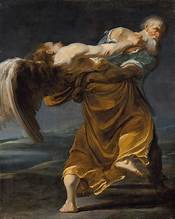
Wrestling With God

Focal Passage: Genesis 32:24-32

When a Bible passage becomes a mirror into your own life, it’s time to sit up and pay attention. I read the story of Jacob in Genesis 32 this week, finding that I identified all too well with him.

How often have I tried to cling to control or run away when facing some hard truth? How often have I simply trusted in my own cleverness more than I trusted in God’s providential care?

Jacob’s story tells me there comes a time when God no longer lets us keep doing things our way. There comes a time when we find ourselves wrestling with a loving God who refuses to let us stay the same.

I wonder if, like me, you can see yourself mirrored in Jacob’s life. Think about it.

*****

Jacob stood alone on the bank of the Jabbok River on a night that probably felt darker than any he had known.

Over the course of the day, he had sent out three separate caravans loaded with lavish gifts, sending them across the river on a march toward his estranged twin brother Esau. Jacob hoped to placate Esau’s anger for his callous and selfish acts of betrayal some 20 years earlier.

Then, just before sunset, Jacob sent his two wives, his children and the remainder of his possessions to set up camp across the river in expectation of Esau’s arrival the next day.

As his family faded into the night Jacob stayed behind in the darkness trying to devise some novel scheme to get out of the mess he created of his life. One good scheme deserved another in Jacob’s eyes.

As a young man, Jacob tricked a desperately hungry Esau into giving away his birthright as the first-born son in exchange for a bowl of stew. With his financial future secure and with the help of their mother Rebecca, Jacob later duped his blind father Isaac into extending to Jacob the family blessing, which again, rightfully belonged to Esau.

Cheated twice out of his heritage, Esau pledged to kill Jacob as soon as their father died. Rebecca, afraid for Jacob’s life, sent him back to Haran to stay with her brother Laban until things in Canaan cooled down a bit. Rather than deal with the consequences of his actions, Jacob ran.

This escape to Haran began a long, difficult 20-year journey of love, labor and deceit. Laban manipulated Jacob’s love for his daughter Rachel, turning it into 20 years of indentured servanthood. Every time Jacob wanted to return home, Laban found another way of keeping him there.

When it finally appeared that Laban might never let him go, Jacob gathered together his family, his servants and his livestock. In the dead of night, he ran.

Jacob spent his whole life manipulating the circumstances of his life in his favor. Trying to take advantage of every situation to gain the upper hand.

So, that night he stood on the bank of the river…con artist who had been conned, a manipulator who had been manipulated…calculating outcomes that might happen if Esau rejected his gifts. I suspect running away rose to the top of the list. It had been his go-to solution every other time circumstances got the better of him.

Jacob was still scheming with one eye looking toward Esau and the other looking for the best escape route. God had other plans. Before Jacob could face Esau, he had to face God. Before he could run away again, he had a run in with God.

You’ll find the passage in Genesis 32.

So Jacob was left alone, and a man wrestled with him till daybreak. When the man saw that he could not overpower him, he touched the socket of Jacob’s hip so his hip was wrenched as he wrestled with the man.

Then the man said, “Let me go, for it is daybreak.”

But Jacob replied, “I will not let you go unless you bless me.”

The man said, “What is your name?”

“Jacob,” he answered.

Then the man said, “Your name will no longer be Jacob, but Israel, because you have struggled with God and with humans and have overcome.”

Jacob said, “Please tell me your name.”

But he replied, “Why do you ask my name?” Then he blessed him there. (Genesis 32:24-29)

I don’t want to make it sound like Jacob was a horrible individual. He wasn’t. While he crossed more than one ethical line, there was something inside him that longed for God.

Go back a few chapters in Genesis. Jacob is running as fast as he can to Laban at his mother’s insistence. He’s tired and worn out. The man with a stolen estate has no home in which to sleep. He pulls a flat rock for a pillow and dreams of a stairway to heaven. It’s as if God is saying, “Home may be out of reach right now, but heaven is not. I am here.”

Through his dream God renews with Jacob the covenant he made with his father Isaac and his grandfather Abraham. The land upon which his head rests will be his land and the land for all his descendants. Through his lineage, scripture says, “the people of the world shall be blessed.” Jacob holds on to that promise for two decades.

As Jacob’s wealth increases during his time with Laban, Jacob gives God the glory for every success.

Jacob recognized God’s presence in his life, he just didn’t always trust him. Jacob always felt that if anything good was going to happen, he had to make it happen. He lived up to his name every step of the way… “the heel grabber,” “the grasper,” “the striver.”

God commands Jacob to “return to the land of your fathers” (Genesis 31:3), telling him, “I will be with you.” The closer Jacob gets to the border of Esau’s land, he grows more anxious, worrying about Esau’s retribution.

Jacob didn’t think God was capable on his own of working things out, so he rolled out the gifts. He divided his family and his flock, hoping that one group might escape if Esau attacked the other. He searched through the night for any other advantage that might give him the upper hand.

Jacob left God no other choice. In one of the most understated verses in scripture, a “man wrestled with him until daybreak.”

It’s almost as if Jacob turned to run away again only to be tackled by a man ready to rumble. Theologians debate whether this man was an angel, the pre-incarnate Christ or God himself. As far as Jacob was concerned, “I saw God face to face, and yet my life was spared.” (Gensis 32:30)

It’s almost laughable when you think about it: God wrestling a man. Yet, God and I have gone more than a few rounds over the years. I suspect you have, too. Each of us at one time or another has wrestled with what we know God is calling us to do.

In addition to his more manipulative traits, Jacob was also clever, resourceful, determined and strong-willed. He was all those things, but he was not yet surrendered. God knew it was time for Jacob to stop conniving, to stop running, so they fought it out in a match that lasted all night.

I don’t know about you, but some of my wrestling matches with God last a lot longer. I can put up a quite the fight when I don’t want to do what God wants me to do. I can find excuses or what I think are pretty valid reasons why I’m right and God is wrong. My ideas always seem better.

Notice this, however. Jacob’s bout with God didn’t last until daybreak because he and God were evenly matched. The prolonged struggle lasted as long as it did because God was exposing Jacob’s stubborn independence.

When we are wrestling God for control of our lives, that fight goes on until we recognize our own stubbornness. It will last until we surrender and call him Lord.

The scripture declares clearly the moment Jacob gave in. As the morning approached, I think he still wanted to run away…to do things his way. At that point, with a touch intended to put an end to Jacob’s resistance, God dislocated his hip. Running was no longer an option. Pastor Adrian Rogers put it this way, “God crippled him to conquer him.”

When Jacob realized he had no choice, he surrendered, wrapping his arms around the ankles of the only one who could make things right.

Here’s the interesting thing to me. One moment Jacob is wrestling against God; the next moment he is clinging to God. Jacob, the man who had stolen the blessing of his father, was now begging for the blessing of the Father God.

When Jacob said, “I will not let you go unless you bless me,” it is not defiance, it’s desperation. Jacob quit fighting to win and started depending. Wrestling became an embrace.

In a culture that prizes self-sufficiency and self-reliance, surrender seems a coward’s option. It may well be one’s greatest act of courage. God’s work in us flows best through surrender.

Jacob’s story reflects our own tendency to run from God’s call, conviction or presence. Like Jacob, we are met by God, through circumstances, reflection or divine confrontation. Sometimes, he stops us in our tracks so we can no longer run from him.

Surrender brings transformation.

Your name will no longer be Jacob, but Israel, because you have struggled with God and with men and have overcome. (Genesis 32:28)

It’s not saying he outwrestled God. Jacob overcame his own stubbornness, his own self-reliance.

Theologian Frederick Buechner called Jacob’s divine encounter at the Jabbok River the “magnificent defeat of the human soul at the hands of God.” In Jacob’s story we can easily see our own struggles with our desire to take control of our lives. Our failed efforts to find escape from our own fears and vulnerabilities.

Out of these experiences God offers blessing.

In the end, God did what he had to do. He confronted Esau. He grappled all night for what was truly important. When Jacob could wrestle no longer, he surrendered. He clung to God with greater strength than he resisted, realizing that he could not go on without him.

Jacob’s story invites us to ask simple but searching questions: Why am I still wrestling? Where am I still wrestling with God? The blessing came only when Jacob stopped resisting and held on in surrender. The same is true for us.

God meets us in the places we fear most, not to destroy us, but to reshape us. And though surrender may leave us limping, it also leaves us blessed.

Next time you see me, I hope you see me limping.

Thinking Points

Where in my life am I still trying to manage outcomes instead of trusting God?


What fear or unresolved situation keeps me looking for an escape route?


What would it look like for me to stop wrestling with God and start clinging to him?


What new identity or new way of walking might God want me to embrace when I surrender control to him?

Don’t Squander Your Inheritance

Background Passages: Genesis 25:27-34 and Romans 8:15b-17

Using some borrowed cash and his personal savings, Frank Winfield Woolworth bought some discounted merchandise to sell to the general public at reduced cost. He opened his first Woolworth’s Great Five Cent Store in Utica, NY, in 1879. Though that first store went out of business, he kept working and reopened again in Pennsylvania to greater success.

Eventually, Woolworth built his business into a retail corporation worth $25.9 billion in its heyday. Over the years, the company was handed down through the family until the last Woolworth’s closed its doors in 1997. Though the company lives on with a smaller, more targeted product line under the name of Foot Locker, Woolworth’s, as a corporation, no longer exists.

At one point, Woolworth’s granddaughter Barbara Hutton assumed leadership in the corporation. Many people point fingers at Hutton as the first of the Woolworths to start squandering her inheritance. Even though they were the biggest name in business, patriarch F. W Woolworth’s granddaughter knew nothing about making money, and instead vowed never to work a day in her life. By the time she was on her seventh husband, she had lost almost her entire fortune.

All of us would like to leave something of substantial value for our children. If we’re blessed enough to do so, we hope we’ have raised them well enough that they do not misuse the gift they have been given.

Sadly, it is not uncommon to see the second or third generation squander in a season all of the hard work, value, and wealth created by the first generation. When the sons or daughters spend away all which they’ve been given, it’s usually because they take for granted what they have, possessing a sense of entitlement.

What is true in this temporal and material world takes on even greater important in the eternal and spiritual realm. As the beneficiary of a spiritual inheritance of immense value, I know how easy it can be to squander all that God has given us. When I read the Woolworth story this week and wrapped it in spiritual terms, I had to ask myself as I’m asking you, “Are we squandering our God-gifted inheritance?”

It is, I think, a viable question.

*****

He dragged himself back home, weary and filthy after days hunting wild game. He comes empty-handed. Other than one scrawny rabbit, he killed nothing. The long trek home was nothing short of miserable. His quiver empty of arrows and his stomach roiling with hunger as he crested the ridge overlooking his father’s encampment.

The hunter caught the aroma of a rich lentil stew carried on the smoke from the open pit near his father’s tent. Hunger drove him forward.

Young. Impetuous. Famished. Esau rushed to the tent where his brother Jacob sat stirring the pot, sampling from his ladle the tasty broth.

As Jacob sampled the stew, he saw his twin brother making a beeline for the fire pit. Normally quiet and reserved, Jacob did not enjoy confrontation, but something about Esau always set Jacob’s teeth on edge. Seeing the ravenous look on his brother’s face, Jacob’s devious streak flashed.

“Mmmmmm,” Jacob overplayed the taste of the stew, adding a pinch more salt, a look of rapture on his face. “This is soooo good,” he said to himself, knowing that Esau would hear.

Esau plopped to the ground beside the boiling pot, his mouth watering in anticipation. “Quick, let me have some of that red stew! I’m famished!”

Jacob sat back on his heels, giving Esau a sad look. “I don’t know,” he said. “I made this for Father. Maybe you can have the leftovers.”

“There were no deer anywhere,” complained Esau. “I’ve not eaten in days. Give me some stew!”

“I tell you what,” said Jacob, pouring some of the stew into a wooden bowl and wafting it under Esau’s nose. “First, sell me your birthright.”

“Look, I’m about to die,” Esau said. “What good is a birthright to me?”

“Swear to me first,” insisted Jacob. Grudgingly uttering an oath, Esau surrendered his birthright to Jacob.

“Then, Jacob gave Esau some bread and some lentil stew. He ate and drank and then got up and left. So Esau despised his birthright.”

One has to wonder how often Esau regretted his impetuous disregard of his inheritance. He was hungry, but not starving. For a morsel of food and the temporary satisfaction of a full belly, he gave up that to which he was legally entitled.

I suspect as the years passed, he forgot about it most days, perhaps thinking that Jacob would regard the transaction as a joke between brothers. I doubt either son ever told Isaac of the deal they had made. For his part, Jacob kept the oath in his robe pocket, ready to pull it out when the time was right.

Let’s talk first about this birthright. Thought it is an inheritance, there is no strong 21st century equivalent to the ancient birthright. Our culture is not wired the same way.

In the Hebrew culture, the birthright was a matter of wealth and status. Upon his death, the father’s possessions were divided equally among all the male children, except the firstborn son received a double portion. Under ordinary circumstances when Isaac died, Esau, as the oldest son, would be entitled to two-thirds of Isaac’s wealth. Jacob would receive the final one-third.

This whole situation seems deceitful and completely unfair. Jacob took advantage of his brother in a weak moment to strip him of his inheritance. It makes us cringe a little. However, God knows the heart. When Rebekah became pregnant with the twins, God revealed to Isaac and his wife that the younger son would be the prominent son.

“Two nations are in your womb, and two peoples from within you will be separated. one people will be stronger than the other and the older will serve the younger.” (Genesis 25:23)

We tend to look down on Jacob for his duplicity, but God’s plan depended on the man Jacob would become, not the man he was at the time. He knew how Esau would disregard is birthright.

It is an intriguing story, but how does it answer our initial question? Are we squandering our God-gifted inheritance? Are we doing something that would strip us of God’s blessing?

Let’s first establish our right to a godly inheritance.

In the New Testament, believers in Christ are called the “children of God.” Look at John 1:12-13.

“Yet to all who receive him, to those who believed in his name, he gave the right to become children of God—children born not of natural descent, nor or human decision or a husband’s will, but born of God.”

Being born again through our faith in Jesus Christ and the grace of God, we become his heirs, worthy of our inheritance.

“…but you received the spirit of sonship. And by Him we cry, ‘Abba. Father.’ And the Spirit himself testifies with our spirit that we are God’s children. Now if we are children, then we are heirs—-heirs of God and co-heirs with Christ.” (Romans 8:15b-17)

Clearly, scripture teaches that all believers in Christ receive an inheritance by virtue of being a child of God. It is an inheritance with benefits in the here and now as well as in the eternal. We are asked to honor that inheritance with our lives.

“Whatever you do, work at it with all your heart, as working for the Lord, not for men, since you know that you will receive an inheritance from the Lord as a reward.” (Colossians 3:23)

Hebrew culture allowed the father to strip the eldest son of his first-born rights if the father felt him unworthy.

With our spiritual inheritance guaranteed by Christ, we are still asked to live lives worthy of the gift. How might we squander that which we’ve been given? One of the keys is that almost parenthetical sentence in Genesis 25:34.

“So Esau despised his birthright.”

Culture and tradition all but guaranteed Esau a double portion of his father’s inheritance, yet we’re told he “despised his birthright.” It is not that Esau hated the whole idea of getting a double portion. In Hebrew, to despise something, to hate something, is a matter of choice. To despise your inheritance means you put other things ahead of it. To choose something else. In the heat of the moment, Esau chose a single bowl of bean soup over that to which he was entitled.

Other translations say that Esau “profaned his birthright.” That word takes on a different connotation in the 21st century, speaking primarily to crude and vulgar language. In Scripture the term suggests a broader scope. The idea conveys a lack of holiness. To take something that is righteous and good and treat it with contempt.

Esau profaned his God-given and special birthright by trading it for something cheap and ordinary…as if it meant nothing to him.

I wonder how many times I’ve approached my birthright as a child of God with the same level of disregard as Esau demonstrated. How often have I taken my spiritual inheritance for granted? How often have I treated my spiritual birthright too casually? Trading it in for something so inconsequential as a bowl of stew…satisfying in the moment, but with no lasting value.

Paul told the Colossians, “Whatever you do, work at it with all your heart, as working for the Lord…” I will not do that if I value a bowl of stew more than I value God’s provision, plan and purpose for my life.

Consider the writer of Hebrews as he posed a rhetorical question to his readers. If the world becomes more important to us that the inheritance God provides then “how shall we escape (God’s judgment) if we ignore such a great salvation?”

The world promises us that the stew is going to taste so good that everything else pales in comparison. It’s going to promise us that if we just eat the stew the hunger will never return. It’s going to promise that the stew…the wealth, the fame, the power, the position will mean more to us that anything God offers.

Here’s the deal though. Stew is not salvation. It’s just stew.

We squander our God-given inheritance when the stew is more important than the salvation. We squander our inheritance when we give too little thought to God and his purpose and will for our lives. We squander our inheritance when we fail to give God’s grace gift the value it deserves. We squander our inheritance when we fail to live as if it matters more than anything else in this world.

This is the lesson I learn from Esau. I can never forget, not for a minute, that God and his promises are holy. I am his and he is mine. When I forget that simple fact, or when I give that relationship anything less than the highest priority in my life, I squander the chance to experience the blessings he promises me.

Claim that inheritance offered through Jesus Christ. Through your witness and your work, increase its value. Frank Woolworth’s daughter squandered her inheritance. Don’t squander the inheritance God gave you no matter how tasty the stew looks.

Amen?

Amen!