Don’t Squander Your Inheritance

Background Passages: Genesis 25:27-34 and Romans 8:15b-17

Using some borrowed cash and his personal savings, Frank Winfield Woolworth bought some discounted merchandise to sell to the general public at reduced cost. He opened his first Woolworth’s Great Five Cent Store in Utica, NY, in 1879. Though that first store went out of business, he kept working and reopened again in Pennsylvania to greater success.

Eventually, Woolworth built his business into a retail corporation worth $25.9 billion in its heyday. Over the years, the company was handed down through the family until the last Woolworth’s closed its doors in 1997. Though the company lives on with a smaller, more targeted product line under the name of Foot Locker, Woolworth’s, as a corporation, no longer exists.

At one point, Woolworth’s granddaughter Barbara Hutton assumed leadership in the corporation. Many people point fingers at Hutton as the first of the Woolworths to start squandering her inheritance. Even though they were the biggest name in business, patriarch F. W Woolworth’s granddaughter knew nothing about making money, and instead vowed never to work a day in her life. By the time she was on her seventh husband, she had lost almost her entire fortune.

All of us would like to leave something of substantial value for our children. If we’re blessed enough to do so, we hope we’ have raised them well enough that they do not misuse the gift they have been given.

Sadly, it is not uncommon to see the second or third generation squander in a season all of the hard work, value, and wealth created by the first generation. When the sons or daughters spend away all which they’ve been given, it’s usually because they take for granted what they have, possessing a sense of entitlement.

What is true in this temporal and material world takes on even greater important in the eternal and spiritual realm. As the beneficiary of a spiritual inheritance of immense value, I know how easy it can be to squander all that God has given us. When I read the Woolworth story this week and wrapped it in spiritual terms, I had to ask myself as I’m asking you, “Are we squandering our God-gifted inheritance?”

It is, I think, a viable question.

*****

He dragged himself back home, weary and filthy after days hunting wild game. He comes empty-handed. Other than one scrawny rabbit, he killed nothing. The long trek home was nothing short of miserable. His quiver empty of arrows and his stomach roiling with hunger as he crested the ridge overlooking his father’s encampment.

The hunter caught the aroma of a rich lentil stew carried on the smoke from the open pit near his father’s tent. Hunger drove him forward.

Young. Impetuous. Famished. Esau rushed to the tent where his brother Jacob sat stirring the pot, sampling from his ladle the tasty broth.

As Jacob sampled the stew, he saw his twin brother making a beeline for the fire pit. Normally quiet and reserved, Jacob did not enjoy confrontation, but something about Esau always set Jacob’s teeth on edge. Seeing the ravenous look on his brother’s face, Jacob’s devious streak flashed.

“Mmmmmm,” Jacob overplayed the taste of the stew, adding a pinch more salt, a look of rapture on his face. “This is soooo good,” he said to himself, knowing that Esau would hear.

Esau plopped to the ground beside the boiling pot, his mouth watering in anticipation. “Quick, let me have some of that red stew! I’m famished!”

Jacob sat back on his heels, giving Esau a sad look. “I don’t know,” he said. “I made this for Father. Maybe you can have the leftovers.”

“There were no deer anywhere,” complained Esau. “I’ve not eaten in days. Give me some stew!”

“I tell you what,” said Jacob, pouring some of the stew into a wooden bowl and wafting it under Esau’s nose. “First, sell me your birthright.”

“Look, I’m about to die,” Esau said. “What good is a birthright to me?”

“Swear to me first,” insisted Jacob. Grudgingly uttering an oath, Esau surrendered his birthright to Jacob.

“Then, Jacob gave Esau some bread and some lentil stew. He ate and drank and then got up and left. So Esau despised his birthright.”

One has to wonder how often Esau regretted his impetuous disregard of his inheritance. He was hungry, but not starving. For a morsel of food and the temporary satisfaction of a full belly, he gave up that to which he was legally entitled.

I suspect as the years passed, he forgot about it most days, perhaps thinking that Jacob would regard the transaction as a joke between brothers. I doubt either son ever told Isaac of the deal they had made. For his part, Jacob kept the oath in his robe pocket, ready to pull it out when the time was right.

Let’s talk first about this birthright. Thought it is an inheritance, there is no strong 21st century equivalent to the ancient birthright. Our culture is not wired the same way.

In the Hebrew culture, the birthright was a matter of wealth and status. Upon his death, the father’s possessions were divided equally among all the male children, except the firstborn son received a double portion. Under ordinary circumstances when Isaac died, Esau, as the oldest son, would be entitled to two-thirds of Isaac’s wealth. Jacob would receive the final one-third.

This whole situation seems deceitful and completely unfair. Jacob took advantage of his brother in a weak moment to strip him of his inheritance. It makes us cringe a little. However, God knows the heart. When Rebekah became pregnant with the twins, God revealed to Isaac and his wife that the younger son would be the prominent son.

“Two nations are in your womb, and two peoples from within you will be separated. one people will be stronger than the other and the older will serve the younger.” (Genesis 25:23)

We tend to look down on Jacob for his duplicity, but God’s plan depended on the man Jacob would become, not the man he was at the time. He knew how Esau would disregard is birthright.

It is an intriguing story, but how does it answer our initial question? Are we squandering our God-gifted inheritance? Are we doing something that would strip us of God’s blessing?

Let’s first establish our right to a godly inheritance.

In the New Testament, believers in Christ are called the “children of God.” Look at John 1:12-13.

“Yet to all who receive him, to those who believed in his name, he gave the right to become children of God—children born not of natural descent, nor or human decision or a husband’s will, but born of God.”

Being born again through our faith in Jesus Christ and the grace of God, we become his heirs, worthy of our inheritance.

“…but you received the spirit of sonship. And by Him we cry, ‘Abba. Father.’ And the Spirit himself testifies with our spirit that we are God’s children. Now if we are children, then we are heirs—-heirs of God and co-heirs with Christ.” (Romans 8:15b-17)

Clearly, scripture teaches that all believers in Christ receive an inheritance by virtue of being a child of God. It is an inheritance with benefits in the here and now as well as in the eternal. We are asked to honor that inheritance with our lives.

“Whatever you do, work at it with all your heart, as working for the Lord, not for men, since you know that you will receive an inheritance from the Lord as a reward.” (Colossians 3:23)

Hebrew culture allowed the father to strip the eldest son of his first-born rights if the father felt him unworthy.

With our spiritual inheritance guaranteed by Christ, we are still asked to live lives worthy of the gift. How might we squander that which we’ve been given? One of the keys is that almost parenthetical sentence in Genesis 25:34.

“So Esau despised his birthright.”

Culture and tradition all but guaranteed Esau a double portion of his father’s inheritance, yet we’re told he “despised his birthright.” It is not that Esau hated the whole idea of getting a double portion. In Hebrew, to despise something, to hate something, is a matter of choice. To despise your inheritance means you put other things ahead of it. To choose something else. In the heat of the moment, Esau chose a single bowl of bean soup over that to which he was entitled.

Other translations say that Esau “profaned his birthright.” That word takes on a different connotation in the 21st century, speaking primarily to crude and vulgar language. In Scripture the term suggests a broader scope. The idea conveys a lack of holiness. To take something that is righteous and good and treat it with contempt.

Esau profaned his God-given and special birthright by trading it for something cheap and ordinary…as if it meant nothing to him.

I wonder how many times I’ve approached my birthright as a child of God with the same level of disregard as Esau demonstrated. How often have I taken my spiritual inheritance for granted? How often have I treated my spiritual birthright too casually? Trading it in for something so inconsequential as a bowl of stew…satisfying in the moment, but with no lasting value.

Paul told the Colossians, “Whatever you do, work at it with all your heart, as working for the Lord…” I will not do that if I value a bowl of stew more than I value God’s provision, plan and purpose for my life.

Consider the writer of Hebrews as he posed a rhetorical question to his readers. If the world becomes more important to us that the inheritance God provides then “how shall we escape (God’s judgment) if we ignore such a great salvation?”

The world promises us that the stew is going to taste so good that everything else pales in comparison. It’s going to promise us that if we just eat the stew the hunger will never return. It’s going to promise that the stew…the wealth, the fame, the power, the position will mean more to us that anything God offers.

Here’s the deal though. Stew is not salvation. It’s just stew.

We squander our God-given inheritance when the stew is more important than the salvation. We squander our inheritance when we give too little thought to God and his purpose and will for our lives. We squander our inheritance when we fail to give God’s grace gift the value it deserves. We squander our inheritance when we fail to live as if it matters more than anything else in this world.

This is the lesson I learn from Esau. I can never forget, not for a minute, that God and his promises are holy. I am his and he is mine. When I forget that simple fact, or when I give that relationship anything less than the highest priority in my life, I squander the chance to experience the blessings he promises me.

Claim that inheritance offered through Jesus Christ. Through your witness and your work, increase its value. Frank Woolworth’s daughter squandered her inheritance. Don’t squander the inheritance God gave you no matter how tasty the stew looks.

Amen?

Amen!

A Seat at His Table

Background Passages: I Samuel 30:1-6; 2 Samuel 9:1-12; I Peter 1:4; and Romans 1:17

I was probably 12 years old when it happened. During our extended family gatherings, the children piled their plates with food and sat around folding tables in my grandmother’s living room, listening surreptitiously to the adult conversations in the dining room next door, longing for the day when we could sit at the big table.

There was something maturing about sitting among the adults. The teasing among cousins in the “kid’s room” gave way to the easy listening to life lessons and good-natured banter among my parents and my uncles and aunts. I found it riveting. I also found it much easier to reach the ham and coconut cream pie.

I thought of that today when in my Bible study I came across I story I read long ago and forgot. It’s a great reminder today about why we get to sit at the big table.

Bad news travels fast.
Israel’s army routed.
Saul and Jonathan slain in battle.
As the news breaks,
panic ran rampant throughout the encampment.

We’ll call her “Eglah.”
A nursemaid for Jonathan’s son,
Mephibosheth.
The young maiden scooped the frightened five-year-old
into her arms,
raced passed the tents,
pushed through the throng of terrified people.

Into the hills they escaped,
as far from the battlefield as possible.
As she climbed the rocky path carrying the young child,
Eglah tripped on a tree root.
Stumbled and fell to the ground,
crushing the child between her and the unyielding rocks.

He shrieked in pain.
Both ankles broken,
twisted at unnatural angles.

Alone and scared,
Eglah wrapped the shattered bones as best she could,
lifted the sobbing child again into her arms
and continued her flight to the east.
Five days later, the two refugees crossed the Jordan River
Finding a safe haven in the home of a friend in Lo Debar.
A nothing place.
Off the beaten path.
A great place to hide.

Eglah.
A simple maiden.
Knew enough of the world to know
that a new king
would seek out all descendants of the old ruler
to eliminate every threat to his reign.

In terror they hid in Lo Debar
Fearful of every stranger
who chanced upon their village.
In hiding for 15 years.
Mephibosheth’s feet never healed properly,
Leaving him a cripple both in body and spirit.

Meanwhile, across the Jordan in a
conquered Jerusalem…

King David.
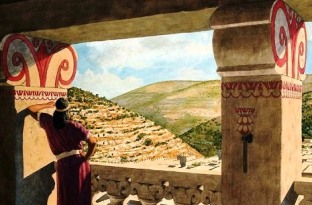
Stood on the balcony of his palace
overlooking the valley below.
The journey to this place difficult.
Anointed by God as a child.
The future king of Israel.
A youth spent avoiding the insanity of Saul.
Fighting battles with the Philistines.
Leading armies against the
Moabites and the Edomites.

Finally, after years of war,
surveyed the land he now controlled from Jerusalem’s walls
and declared peace.
Standing at last where God
called him to stand.

Yet on a day when all was right,
his heart rang hollow…empty.
He always envisioned sharing moments like this
with his best friend Jonathan.
David still mourned his death
after so many years.
Jonathan’s friendship had been a
God-given gift.

Standing on the balcony this day,
David remembered the promise Jonathan
asked of David so long ago.

“Please show to me your unfailing kindness
like the Lord’s kindness
as long as I live,
so that I may not be killed,
and do not ever cut off your kindness from my family…”
(I Samuel 20:14-15)

David intended to honor that covenant.
Calling for his advisors,
David asked,

“Is there anyone still left of the house of Saul
to whom I can show kindness for
Jonathan’s sake?”
(2 Samuel 9:1)

And the search began.

Eventually, David discovered Mephibosheth,
living under the radar,
out of sight,
in a nothing place on the
outer edge of the kingdom.

Read the rest of the story for yourself.

“When Mephibosheth, son of Jonathan, son of Saul,
came to David, he bowed down to pay him honor.

“David said, ‘Mephibosheth!’

“’Your servant,’ he replied.

“’Don’t be afraid,’ David said to him,
‘for I will surely show you kindness
for the sake of your father Jonathan.
I will restore to you all the land that
belonged to your grandfather Saul,
and you will always eat at my table.’

“Mephibosheth bowed down and said,
‘What is your servant,
that you should notice a dead dog like me?’

“So Mephibosheth ate at David’s table
like one of the king’s sons.”

(2 Samuel 9:6-8, 11)

I find in this heart-warming Bible story, a clear message of God’s desire for a relationship with a broken and self-isolated world. I find common ground with Mephibosheth. Any believer redeemed by God should relate to the experience of being granted grace undeserved by a king. The budding relationship between God and Mephibosheth is a perfect picture of God’s relationship to you and me.

Nothing in the realm of world politics required David to care for Mephibosheth. In fact, David’s advisors surely warned him against bringing Saul’s grandson into the city. For his part, Mephibosheth understood enough to know his life was not his own. He harbored no illusions that if he were ever discovered by the king, his life was forfeit. Kingdom politics at play. When he dragged his useless feet into the throne room, bowed before the king in sincere humility, he knew mercy was his only hope.

Nothing in the spiritual realm requires God to reach out to a sinful humanity. He is the Creator God. Our rebellion deserved punishment. Yet, he made a covenant of grace with his people. A promise he would eternally keep. Kingdom reality at play. While we deserved death, he found a way to give us new life. Mercy is our only hope.

For his part, David made a promise long ago to Jonathan, a man he viewed as a brother. It was a covenant rooted in love and watered by grace. Once he got wind of a living child of Jonathan, David found him in a desolate place…disabled, disheartened, defeated by the cruelty of life. But when he looked into his eyes, he saw the eyes of Jonathan and his heart leapt with joy. “Mephibosheth!”

It is the same celebration enjoyed by the Father and his angels when a sinner repents. God looks into the eyes of the sinner and sees the eyes of Jesus and his heart leaps with joy. “Kirk!” God celebrated in the same way when every believer bowed before the king. He longs to celebrate with every lost child who now lives in Lo Debar fearful of being discovered by a God whose heart he does not understand.

David did two things for Mephibosheth so illustrative of God’s compassion and grace toward us. First, he returned his dignity. Living so long in his nothing place, Mephibosheth saw himself equal to his surroundings. A bundle of self-loathing on crutches. Wretched. Crippled. Unworthy. A mirror image of every humiliating taunt the misguided attached to his name. In his own words, a “dead dog.” Dogs were detested in Jewish culture, considered unclean. A dead dog was a double whammy.

David did the unthinkable. He called him by name. No longer “crippled.” No longer “damaged goods.” No longer “lost,” “forgotten,” or “alone.” Look at it in the scripture. He was “Mephibosheth!” With an exclamation point, not a question mark or a simple period.

The first gift David gave to Mephibosheth was to return to him his dignity. The first gift God gives to us is to call us by name and declare us worthy of his love through the sacrificial death and miraculous resurrection of his son, Jesus Christ. All dignity we lost as sinners returned when he called us by name.

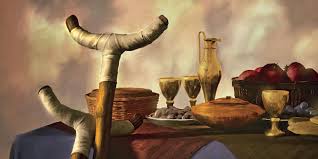
Secondly, David restored Mephibosheth all he had lost. By adopting him into his family, David restored his inheritance and gave him a seat at the king’s table. Think prodigal son. The father, watching every day, praying for his son’s return. Seeing him returning on the horizon he calls for the ring and robe and prepared a banquet in his honor. Returning him to the seat he once occupied. Far more than Mephibosheth could have hoped. Far more, he knew, than he deserved.

Is that not an amazing example of God’s grace toward us?

In his great mercy he has given us new birth into a living hope through the resurrection of Jesus Christ from the dead, and into an inheritance that can never perish, spoil or fade…kept in heaven for you…” (I Peter 1:4)

Now, if we are children, then we are heirs…heirs of God and co-heirs with Christ, if indeed we share in his sufferings in order that we may share in his glory.” Romans 1:17

Through the salvation he offers, he grants us an eternal seat at his table. Forever a child of the king. A place of belonging.

Grace is not an easy concept to grasp. We define it with two words. “Unmerited favor.” We trust it as the basis of our salvation. Though we sing it with fervor I’m not sure we understand how amazing it truly is.

God painted this beautiful picture of grace and the story of Mephibosheth was its canvas. All I know is that I was Mephibosheth and Mephibosheth was me. And today, by the good grace of God, I have a place at the king’s table.

Passion Week-Friday: Renewal

Background Passages: John 18:1-19:37, John 3:16-17, Ephesians 2:8, John 19:38-42, and John 12:32

Nine hours.

540 minutes.

32,400 seconds.

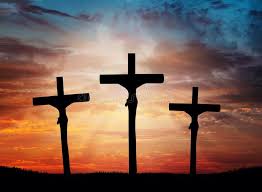
That’s all the time it took the religious leaders to arrest Jesus and to nail him on the cross. Nine hours. When Jesus whispered, “It is finished,” and breathed a sigh of release, the religious leaders patted each other on the back and breathed a sigh of relief. It was finished. They had won.

In one of the world’s best examples of a kangaroo court, Caiaphas, the high priest, and other religious officials, manufactured the evidence and brow beat a Roman governor to bend him to their will. By killing Jesus, they protected their standing among the Jewish people. Brutally efficient. Politically effective.

Little did they realize that they played right into God’s hand. Scripture tells us when the time was right, the sovereign God sent his son to live among his creation, to teach them what it means to be a part of his kingdom and to die as a substitute for the failures of a sinful world.

In those nine hours, God expressed his deepest love.

“For God so loved the world that he gave his one and only son that whoever believes in him should not perish but have eternal life. For God did not send his son into the world to condemn the world, but to save the world through him.” (John 3:16-17)

In those nine hours, we learn the very definition of grace.

“For it is by grace you are saved through faith—and this not from yourself. It is a gift from God. (Ephesians 2:8)

In those nine hours, we see the deepest love and the greatest gift of all time. In those nine hours, we see the beginning of Easter.

This will not be a typical Easter weekend. In the middle of this pandemic, our churches will be mostly empty, despite the creative ways congregations find to worship. Easter will be less public and more private. More personal. Maybe that’s not altogether bad thing.

It’s a hard truth. Most Easter Sundays find churches with their pews filled with faces who rarely enter the church doors throughout the year. Believers, for the most part, for whom the cross gets stuffed in the closet after Easter service along with their new dresses, suits and shoes. They’ll pull it out again next year, but what about the months between?

I really don’t intend for that to sound harsh or critical, though I suspect it does. I attend church almost every weekend and I know I’ve failed God more times that I care to admit. It’s not about our failures. It’s about what we do from this moment on with the cross. How do we let it change our lives?

Caiaphas and the other religious leaders rejoiced at Jesus’ death. Though they read the scriptures regularly. They clearly misunderstood the words. They projected their own interpretation of God’s word and created an image of the Messiah that Jesus did not fit. As a result, they nailed him to a cross and mocked him. “If you really are the chosen one, prove it to us once and for all by coming down from the cross.” When Jesus did nothing, they laughed, patted each other on the back and went on their way.

One thief joined the religious elite, mocking Jesus and telling him to get all of them off the cross if he was who he claimed to be. The repentant thief, on the other hand, scolded his partner in crime for his shameful words. Though he knew he deserved the death to which he had been sentenced, he recognized in the things Jesus said and did while on the cross that Jesus was innocent. He saw enough in Jesus to repent of his own sin and give his life to him, “Remember me when you come into your kingdom.”

Each of us as believers in Christ had to get to that point. Convicted of our own sin and seeing into the heart of Jesus, we gave our lives to him. Too often, we let the genuine thrill of that experience fade with time. We trust him as savior, try to live according to his word, but, whether out of embarrassment or fear, we hide our faith from others…stepping from the shadows to light only on Easter or when it is convenient for us.

What do we do with the cross? I hope we do what Joseph of Arimathea did.

Joseph was a Pharisee, a member of the ruling council. Luke describes him as a “good and upright man.” John tells us Joseph was a follower of Jesus. He had heard Jesus teach and believed in who he was. Joseph accepted Jesus as his savior, his Messiah. But, and this is still too often true today of many believers, Joseph kept his relationship to Christ private. He was afraid of what the Jewish leaders would do to him.

When Jesus died on the cross, Joseph came alive spiritually. His fear forgotten, Joseph of Arimathea approached Pilate, the man who sentenced Jesus to die, asking the governor’s permission to take Jesus from the cross and bury him properly. The cowardice and fear that kept his faith silent vanished. His bold and public request testified for Jesus in a way that everyone, including the religious leaders, could see.

Jesus had been dead less than an hour and already his words proved true.

“But if I be lifted up from the earth, I will draw all men to myself.” (John 12:32)

Joseph, who privately made his faith commitment, found himself drawn to the cross of Christ, decided it was time to make his relationship to Christ public. Time for a re-commitment.

This will not be our typical Easter. Despite creative ways to celebrate the death and resurrection of Jesus, most churches will remain closed. The pews, normally full of people, will remain empty. The word of God will be proclaimed this weekend in many ways. We will see Jesus on the cross, high and lifted up.

Be drawn to him. Wherever we have been reticent to express our faith and trust in him, let’s leave that hesitation at the foot of the cross. It’s my prayer this weekend that we all be drawn to the cross, recommitted to live and work for him each day. It’s my prayer that we all let the cross change us. May we use the incredibly sacrifice of Jesus to renew our faith commitment and boldly proclaim to the world that we are his.

For God so loved the world…

Freedom to Worship

Background Passages: John 8:31-32; Mark 12:28-31; Romans 10:13-14

The words of the Declaration of Independence, the United States Constitution and the Bill of Rights ought to inspire anyone with a pulse and a sense of history. Yet, we take these hallowed documents for granted, too often trying to bend them to match a personal perspective never envisioned by our country’s founders.

When you see the originals, written by hand on parchment and preserved behind glass in the rotunda of The National Archives, the effect is sobering. The dim, protective light made it difficult to read the 241-year-old words. Having to concentrate on the faded script only added to the power of the words written by men like Thomas Jefferson, George Mason and James Madison.

Every phrase I read spoke volumes, but one phrase kept coming to mind for hours afterward. On the original Bill of Rights, it is listed as the third amendment to the U. S. Constitution, the first two being rejected by Congress. That amendment, which subsequently became the First Amendment, said,

“Congress shall make no law respecting an establishment of religion, or prohibiting the free exercise thereof; or abridging the freedom of speech, or of the press; or the right of the people peaceably to assemble, and to petition the government for a redress of grievances.”

Any mention of religious freedom was left out of the original Constitution because most of the states had some form of state-supported religion…Maryland, New York, North Carolina, South Carolina and Virginia sanctioned the Anglican/Church of England. Connecticut, Massachusetts, New Hampshire sponsored the Puritan or Congregational Church.

James Madison of Virginia, largely credited for writing much of the Constitution, led the charge to get the document ratified in his home state. He met serious opposition from Baptist pastor, John Leland, a determined advocate for freedom of religion and freedom of speech.

Madison campaigned to be elected as a delegate to Virginia’s convention to ratify the constitution. He vocally opposed any early amendments, fearing it would derail ratification. Leland pushed back, opposing ratification without an amendment guaranteeing basic freedoms.

Recognizing Leland probably had enough votes to defeat him, Madison agreed to introduce the Bill of Rights once the constitution was ratified if Leland would not run against him. Both men honored their agreement. Madison introduced the Bill of Rights on May 4, 1789, which was ratified by the states two years later.

The idea of religious liberty is still unique in the world. The Baptist Joint Committee on Religious Liberty (BJC) says that religious liberty is the “freedom to believe and exercise or act upon religious conscience without unnecessary interference by the government.” The idea gives one the freedom to practice or not practice religion of any kind.

Religious freedom is not without boundary. Some religions involve beliefs that conflict with other laws. In those cases, the courts must decide how to accommodate sincere religious beliefs while protecting the people’s interests, including shielding those who may not share the same religious beliefs.

The BJC puts it simply. “Do not ask government to promote your religion if you don’t want government to promote someone else’s religion; and do not permit government to hinder somebody else’s religion if you don’t want government to hinder your own religion.”

Leland wrote in the 18th century, “Government should protect every man in thinking and speaking freely and see that one does not abuse another. This liberty I contend is for more that toleration. The very idea of toleration is despicable. It supposes that some have a preeminence above the rest to grant indulgence, whereas all should be equally free. Jews. Turks. Pagans and Christians.”

There is growing evidence of intolerance in government laws and regulations toward the Christian faith that seem to “prohibit the free exercise” of religion. Leland and Madison, I believe, would argue against such intrusions. They would also argue against Christian leaders’ insistence of greater government support for the Christian faith.

Staring at the original Bill of Rights in its case on display in Washington, D.C., served as a great reminder of the original intent of the First Amendment. As much as I might believe the world would be a better place if we all lived as my Christian faith says we must live, I cannot insist that the government must push my beliefs on every citizen. As it concerns religion, government must remain neutral. It’s a fine line, I admit.

For me, then, my Christian imperative is far less political than spiritual.

Neither political nor moral law provides a path to salvation in Christ. Neither political nor moral law is a path to service in Christ. Calling ourselves a Christian nation doesn’t bring a single soul to saving knowledge of Jesus Christ.

The free exercise of our faith on a political level without demonstrating the love of Christ daily with those we meet is meaningless. It is not government’s responsibility to “make disciples of all nations.” It is my responsibility. It is the role of the church.

As the Pharisees claimed a political and moral superiority over Christ, he offered one of the most profound statements in response. He said,

“If you hold to my teaching, you are really my disciples. Then you will know the truth and the truth shall set you free.” (John 8:31-32)

The truth is that Jesus came to free us from the eternal consequences of sin. To give us a path to everlasting life offered as a grace gift of God. That’s not political. It’s personal. God gave his son on a cross not that we might have a Christian prayer in schools or the right to post a copy of the Ten Commandments in a courthouse, but that we might experience life as God intended it to be lived. And that we might love and serve others in such a way as to draw them into a right relationship with Christ…to set them free as we are free.

I just get a feeling Jesus would be less worried about the political realities than he would these spiritual truths. The Pharisees were stuck in the law to exclusion of everything else. When a few of them came to Jesus to question him about paying taxes to Caesar and about their own internal arguments about religious matters, he tried to help them through their confusion. Finally, one asked him to name the paramount law or commandment.

Jesus kept it simple.

“The most important one is this: ‘Love the Lord your God with all your heart, and with all your soul and with all your mind and with all your strength.’ The second is this: ‘Love your neighbor as yourself.’ There is no commandment greater than these.”

Nothing in the current political realm can keep us from having a relationship with Christ. Nothing in this political climate keeps us from loving others and finding ways to meet their needs. That’s what was ultimately important to Jesus. It ought to be what is important to me.

I don’t need government to restrict the faith traditions of others in order to advance the Christian faith. I must use my freedom as an American and my freedom in Christ to convince others of their need for him…revealing to them his love for everyone…by living the life God intended me to live…by meeting the needs of all I encounter.

I’m grateful to live in a nation, under the protection of the Bill of Rights, that guarantees our right to worship or not worship as we please.

I am more grateful to live in relationship with Christ, under the eternal protection of God, that enables me to share his grace with those who might not believe as I do. To serve others in such a way as to draw them to Christ.

Our only hope of being a Christian nation comes when those of us who claim the name of Christ share his love by word and example in such a way as to convince one person, then another, and then another, to freely accept the grace gift of God.

“For everyone who calls upon the name of the Lord will be saved. How, then, can they call on the one they have not believed in? And how can they believe in the one of whom they have not heard? And how can they hear without someone preaching to them.”

We will never be a Christian nation by law. We will become a Christian nation when hearts are changed and people embrace the freedom that comes from knowing Jesus Christ as savior.

It seems to me that’s religious freedom as God meant it to be.

When God is Silent

Background Passage: Matthew 15:21-28; Mark 7:24-30

It had been an emotionally brutal and tiring time in Jesus’ life. Opponents within the religious hierarchy grew more brazen and belligerent in their handling of Jesus. His popularity challenged their reputations and status with the people of Israel.

Jesus’ disciples struggled with their identity and understanding of his teachings. Inconsistent in their faith. Unsure of the nature of his “kingdom of heaven.” The people who followed him seemed more interested in his miracles than his message.

As he pressed through these things, Jesus received word that John the Baptist, his cousin and the man who so beautifully set the stage for his ministry, had been beheaded at the order of the regional governor. A foreboding reminder of the inevitable outcome of his own life.

Jesus bore the weight of his responsibilities, emotionally and physically spent by the constant demands on his spirit and his time. Jesus needed to get away with his disciples to recharge his batteries and spend a little more time teaching them, opening their eyes to the needs of the Gentile world.

Perhaps that’s the reason he journeyed northwest of Galilee to Sidon and Tyre, a region he rarely traveled. Mark tells us he spent some time in the home of someone he evidently knew…a place where he hoped to find some privacy without the press of the crowd and the pernicious power plays of the Pharisees.

Along the way a Canaanite woman, a Gentile from the area, came to him with a serious problem. Her daughter was sick, suffering terribly from demon possession. The young mother pleaded with Jesus, begging for mercy from the “Son of David,” a popular, political title. She recognized him initially only as a great man of power. Her last hope.

What happens next is unexpected and unusual. The woman calls out to Jesus for mercy and healing…and he ignores her. Scripture says,

“Jesus did not answer a word.”

He continued walking to his destination while the woman continued to follow and beg. Jesus remained unmoved. The verses make us uncomfortable. This is not the Jesus about whom we want to read. The man we’ve seen touch without fear an unclean leper. The man who placed compassionate hands on the eyes of a blind man. That same sensitive and empathetic miracle worker that we know seemed to turn his back on a woman crying out in need.

Despite his silence, the woman stayed after Jesus. So persistent was her pleading that the disciples grew impatient and irritated. “Heal her or don’t,” they seemed to say to Jesus. “Just get rid of her. She’s getting on our nerves.” The implication…she’s not one of us.

Jesus finally speaks. What he tells the disciples, likely overheard by the Gentile woman, seems even more harsh than his silence.

“I was sent only to the lost sheep of Israel.”

The words imply that because the woman is not Jewish, Jesus is not responsible for her need. He has no role to play in this life episode. And, we grow more uncomfortable by his apparent disregard.

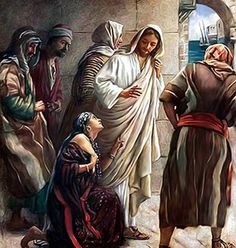
Finally, Jesus arrives at the house that was his intended destination. Despite his earlier comment, the woman followed Jesus, still asking for his intervention to save her daughter. The woman didn’t let a doorway stand as an obstacle. She came into the room with Jesus, knelt at his feet. With tears flowing down her cheeks, she cried,

“Lord, help me!”

There is a change in her address and her demeanor. Jesus’ silence and his statement of God’s purpose and plan, the conceptual became reality. “Lord,” she cried. No longer political and popular, but a clearer understanding of the true nature of God’s son. Humility took her to her knees in reverence and worship.

The lessons didn’t end there as Jesus continued to teach. He wanted her to fully embrace this new relationship by challenging her cultural perspectives…by challenging the cultural perspectives of his disciples.

“He replied, ‘It is not right to take the children’s bread and toss it to their dogs.”

No! He didn’t just say that, did he? The Jews’ hatred and prejudice toward any Gentile ran deep. To call a Gentile a “dog” was the pejorative term of the day. An insult of deepest intent. If you weren’t feeling uncomfortable yet, you probably are now.

Thankfully, the true meaning gets lost in our translation. The word Jesus used for “dog” is not the same word interpreted as “cur,” the slanderous meaning used by Jews toward most Gentiles. The term Jesus used is a word that speaks of a puppy, the beloved family pet who was fed from the family table.

I’m betting the woman’s ears picked up on the difference. I’m betting the disciples did as well. She heard his gentle, teasing tone. Saw the light dancing in his eyes. The grin on his face. A playful smile of understanding now on her face, she responded lightly in kind.

“Yes, Lord, but even the dogs eat the crumbs that fall from their master’s table.”

This woman recognized what I often fail to see. Any mercy from a loving God is good grace. She knew that a crumb of grace from Jesus would be life-changing for her daughter. She would not rest until she received even a small portion of his loving mercy.

Jesus reacted to her words with great joy.

“’Woman, you have great faith! Your request is granted.’ And her daughter was healed from that very hour.”

What I’ve come to realize over my lifetime of study is that Jesus never did anything, never went anywhere without a purpose. So in touch was he with the will of his father that nothing surprised him. For example, Jesus once ignored the normal route to Jerusalem by cutting directly south through Samaria. He did so not to save a few steps from a long journey. He did so knowing he would encounter a woman at the well in need of the living water only he could give.

I believe he went to this knowing he would encounter someone along the way who needed his touch. Maybe he didn’t know exactly who would come, but he knew someone would reach out to him. I believe he went to this place to open his disciples eyes to the possibilities of a broader ministry beyond their personal boundaries.

Nevertheless, Jesus did not react to this woman the way he reacted to others who came to him. Jesus wasn’t just having one of those bad days where he didn’t want to deal with anyone. That’s too much…well…too much like me.

We certainly aren’t to just excuse his behavior and write it off as we whisper to one another, “You know, he’s dealing with a lot in his life. We should cut him some slack.” Jesus, the perfect representative of God’s love on earth, didn’t get annoyed like that. That wasn’t who he was at any time of his life on earth.

If his response seems so out of character, there must be a reason. What could make Jesus behave this way?

Let me offer a thought.

As with most of his encounters, Jesus asked questions or led a challenging conversation, or gave a look that required people to scrutinize their own beliefs. To see their relationship to God through a different lens. This woman, and his disciples, needed that lesson.

I see Jesus’ response to the Canaanite woman in the same light. His silence was disconcerting to her. Made her uncomfortable as it would make us. Jesus needed her to look inside her heart to find a true faith. He needed her to understand who he truly was so she could get the most out of this relationship.

The woman had a choice when met with Jesus’ silence. She could have walked away angry. “He doesn’t care.” “He’s not the man I hoped he would be.” “He doesn’t love me.” It’s a natural reaction of the brokenhearted. When my prayer seems to get no response from God, I tend to sit around, impatiently drumming my fingers on my Bible, muttering under my breath, “You promised to”…”You said you would”…always wondering why he is not responding to my petition.

The delay in God’s response, his silence, is sometimes only because my faith needs to catch up to my situation, giving me time to align my will with his. I can’t do that if I walk away from the conversation.

Jesus wanted this Canaanite woman to think about her request. To think about what she was asking of him. To explore her motivation. To reflect on why her heart was calling out to him and why it was telling her this was the man to see. Jesus’ silence made her think and dig more deeply into the relationship she was seeking with him. He was giving her time to let her faith catch up to her need.

Jesus eventually broke his silence, but his response was not what she wanted or expected. Jesus reminded her and his disciples that his God-given purpose was to bring salvation to the Jews first. To fulfill God’s covenant with his people. His disciples were destined, however, to play a different role. They needed to see it modeled in front of their eyes.

Again, it would be out of character for Jesus to turn her away because she was not Jewish. It was as if he was telling her, “Think! This is who I am. What is it you really desire? What will it take for you to understand me.

The woman could have walked away in anger again at this point. “You’re not going to help because I’m not Jewish? Really? Fine, forget you!” Her growing faith and her inquisitive heart wouldn’t let her walk away. Perhaps without knowing why, she knew she had to stay engaged in conversation, trying to understand what Jesus was really telling her.

Isn’t that the way it works with us? When I grow frustrated that my prayers are not answered or my needs are left seemingly unmet, I can turn my back on God and walk away, or I can stay connected and engaged with him, trying to glean a clearer understanding of his will in my life. Rather than walk away, I ought to be saying, “What are you trying to teach me, God? What am I missing here?”

It crystalized for the woman and his disciples when Jesus talked about feeding the puppy from the table scraps. It was at this moment that Jesus seemed to know she was on the precipice of understanding. He dangled the bait one more time, hoping she would take it…hook, line and sinker.

I also think it’s at that moment that the Canaanite woman figured it out. She told Jesus she would be satisfied with just a measure of his mercy. Because of who he was even a morsel of his grace would be sufficient to satisfy her need. That’s when Jesus recognize in her the genuine faith of a true believer.

“Woman, what great faith you have!”

You see, the longer we stay in touch with Jesus…even through the silence and the confusion…we allow ourselves the opportunity to be taught by the master teacher the deeper lessons of faith. The woman’s perseverance and patience in a trying time enabled her to see more clearly what God required of her.

God wants us to have that same kind of faith. Persevering. Patient. Pushing through the silence to get to a deeper understanding of who Jesus is and what he can do in our lives.

The silence of an unanswered prayer eats away at us, especially in a world so accustomed to instant gratification. What we want, we want now. Not tomorrow. Now. When our prayers are met with silence, it is easy to walk away. We do it all the time. We struggle with life and presume God no longer cares. When circumstances take a hard turn, we stop coming to Jesus. When Christian brothers or sisters disappoint us, we criticize the hypocrites and abandon the church.

Some of the best teachers in my life were those who refused to accept my half-hearted efforts, knowing I was capable of more. They pushed, probed and prodded to get me to broaden my understanding. That’s what Jesus was doing for this Canaanite woman. His silence asked her to not give up, to keep seeking, to keep knocking until she found what she needed most.

It’s the same lesson we must learn. When we arrive at that place…when worship is real and genuine…that’s when prayers are answered in a way that matches our will to God’s will. Not the other way around.

Maybe that’s what we need to think about the next time our prayers are met with silence.

Come To Bethlehem

Background Passages: Luke 2:1-20; Matthew 2:1-12

We often get caught up in the extraordinary events of that first Christmas.

      • An angel’s visit to a chosen, teenage girl.
      • A promised and pristine conception.
      • The birth of the Christ-child.
      • A choir of angels proclaiming “peace and goodwill” to everyone.
      • The shepherds’ worship of a Messiah.
      • The wise men’s gifts to a newborn king.

Yet, the Almighty God focused all the extraordinary acts of his perfect plan for the salvation of the world on the obscure, insignificant village of Bethlehem. Chosen from the beginning of creation as the place of the Messiah’s birth, God maneuvered the events of history and enabled the lives of his obedient people to open the gate of a stall and fill its manger with the perfect image of himself.

Sure. Prophecy told us it would be Bethlehem. Israel’s favorite king was born in the little hamlet and herded his sheep in the hills surrounding it. For hundreds of years it slept a few miles from Jerusalem and its Temple Mount. Until the day when Joseph, a direct descendant of David, obediently followed the governor’s law and made a five-day journey from Nazareth to Bethlehem to fill out his census and pay his Roman required tax.

Why Bethlehem?

God could have used any number of better-known cities in Israel to call his king and send his son. Instead, he chose Bethlehem.

If you pay enough attention to God’s work in history, he seldom used the magnificent to achieve his purposes. Far more often, God chose the humble and insignificant. The ordinary and mundane. When it came time to sing the final stanza of salvation that would one day hang on a cross and be raised from the dead, God pointed the world to a tiny village using a star bright enough so all who were willing to follow would find the baby, wrapped in swaddling clothes.

God didn’t send a king. He sent a servant.

God didn’t send a conqueror. He sent a carpenter.

God didn’t choose the temple city of Jerusalem or the royal city of Tiberias. He chose Bethlehem.

Why Bethlehem?

Here’s my thought.

For most of the people of the world, the coming of Jesus to Bethlehem was, and is, a curiosity. A Nativity scene in the courthouse. A painting on a Christmas card. A phrase in a Christmas carol. A tidbit of trivia that changes nothing.

For Mary and Joseph…for the shepherds and the wise men…for me…the coming of Jesus to Bethlehem was, and is, personal and powerful. A God-purposed encounter that changed everything.

God, through his son, Jesus Christ, will never force his way into our lives. Rather, he hangs a star above a stable and invites us to come to Bethlehem. He lets his angels sing and invites us to come to Bethlehem.

We must come to Bethlehem, not for the cold glitter and gold of a palace or cathedral, but for the chance to feel the warmth of a child held in our embrace…God in human form…a child to be adored and loved and worshiped. You see, the where is not nearly as crucial as the why.

Why Bethlehem?

Because Bethlehem is a place where God becomes personal…and powerful. A place where you can find the answer to your greatest longings of heart and soul. A place to see Jesus as God’s gift to you…God’s gift to a hurting world. A chance to embrace Jesus as savior and be forever changed.

Why Bethlehem?

Perhaps its time to come to Bethlehem and see for yourself.

Lord, Teach Us To Pray

Background Passages: Matthew 6: 5-15; Luke 11:1-13

The young disciple laid on his back,
opening his eyes to a new morning.
Rubbing the stubble of his beard,
Jude propped himself up on one elbow.
Surveyed the scene unfolding around him
in the dawn of a new day.

Nathaniel.
Always an early riser,
stoked the fire.

Andrew.
Always helpful,
walked up the path from the Sea of Galilee.
A bucket of water in each hand.

Others engaged in various stages of waking.
Rolled up their sleeping mats.
Folded their blankets.
Tied their sandals.
Only John remained asleep.
Snored heavily while the world came
alive around him.

Jude stood.
Stretched and yawned.
Pressed both fists into the small of his back.
Worked the kinks out of a tired body
that slept all night on the rocky ground.
He nudged John with his toe,
eliciting a grunt and a grumpy,
“Go away,”
from the weary disciple.

“Breakfast, my friend.
You’ll be grumpier if you missed it,”
Jude chuckled.
“Rise and shine.”

Jude scanned the group looking for Jesus.
He spied him a short distance up the hillside,
sitting cross-legged.
Arms held loosely in his lap.
Leaning his head against a rock.
Engaged in his morning prayer.

“Every morning without fail,”
Jude mused,
marveling at how little sleep
their master seemed to need.

The disciples ate a quick breakfast of bread and honey
accompanied by the quiet conversation of close friends.
James wrapped some bread in a cloth,
saving it for Jesus.

The men cleaned the campsite.
Put out the fire.
Then, walked slowly and quietly up the hillside,
unwilling to disturb Jesus during his
morning prayers.
They stopped a few feet away.
Some knelt.
Some bowed their heads.
Some stood silently as their gaze settled on the
placid waters of the Sea of Galilee
far below.

Jude,
for his part,
never took his eyes off Jesus.
Watched his master with a
blend of curiosity and wonder.
No rabbi he had known spent this
kind of time in private prayer.
His whole demeanor so different from
the prayerful posturing of the Pharisees.
Eyes closed.
Arms resting in his lap.
Fingers interlaced,
dangling loosely in front of him.
Jesus was a man at peace.

After a few minutes,
Jesus breathed deeply.
Opened his eyes.
Raised his head.
Smiled at his disciples.
“Good morning.”

Stretching his legs in front of him,
Jesus caught the small loaf of bread,
James flipped his way.
Unwrapped it.
Began to eat.

The disciples probed about his plans for the day.
Tried to get a handle on what to expect.
Jude fidgeted throughout the conversation,
unsettled in heart and mind.
Unable to contain his thoughts any longer,
he blurted,
“Jesus,
I watch you like this every morning.
So deep in prayer.
Always by yourself.
It’s different from anything I’ve seen.
Different from anything we’ve seen.
The Pharisees shout from the rooftops.
You whisper in the wilderness.”

The young man’s observation took the
morning conversation in a new direction.
All eyes now on him.

Jesus nodded.
Encouraged Jude to continue.
“John taught his disciples how to pray.
Teach us to pray as John taught his disciples.”
A request from one seeking to
dip his bucket into the
deep well of faith.

Jesus looked at Jude
in the ensuing silence.
Glanced at the other disciples.
He grinned like an excited teacher
when his students asked the right question.
He leaned back against his rock.
Put his hands behind his head,
wiggled his hips as he settled for what he
hoped to be a fruitful conversation.
“You tell me.
How should we pray?”

A beautiful discussion followed
concerning one of the most
important aspects of Jesus’ life.
The disciples shared their thoughts,
each building upon the other’s understanding.
Finally, when they said all they knew to say,
they waited quietly for Jesus’ response.

Jesus explained that public prayer
should always be a part of worship.
A time to draw hearts to God in times of
reflection and praise.
But such prayer will never replace our private,
intimate conversations with the Father.

Jesus shook his head.
“When you pray,
do not be like the hypocrites.
They love to pray standing in the synagogues.
On the street corners just to be seen by others.
Truly, I tell you, they have received their reward in full.
Instead, when you pray,
go into your room.
Close the door.
Pray to your Father, who is unseen.

“Do not keep babbling like pagans.
They think they will be heard because of
their many words.
Do not be like them. Your Father knows what you need
before you ask.”

Then, he offered an example for their private prayers.
“When you pray, pray like this…

“Our Father in heaven,
hallowed by thy name,
your kingdom come,
your will be done,
on earth as it is in heaven.
Give us this day our daily bread.
And forgive us our debts
as we also have forgiven our debtors.
And lead us not into temptation,
but deliver us from the evil one. “

The disciples looked at Jesus.
Some still struggled.
Jesus elaborated.

“Suppose you have a friend…”
And the lesson continued into the morning.
Jesus challenged them to think about an
unwilling friend,
who repeatedly turned them away in
an hour of great need,
only to reluctantly open the door of his home to them
when they persisted in knocking.

Then another.
What father would give a son
a snake when he asked for a fish.
A scorpion when he asked for an egg.
“The point is this,”
Jesus said.
“If an unwilling friend will eventually help
and an earthly father responds properly to a child’s need,
how much more will your Father in heaven give
the Holy Spirit to those who ask him?”

*****

Within these two passages rest Jesus’ most comprehensive teachings on prayer. Jesus may have taught this lesson twice…once in his Sermon on the Mount and once on another distant hillside. Those scholars who believe the Sermon on the Mount to be a collection of Jesus’ teachings may see these lessons as one incident. Either way, the passages beg a great question.

How should we pray?

I recently visited with my uncle, a Lutheran pastor, about the liturgical use of The Lord’s Prayer in modern worship services. The idea troubled both of us to a degree. What is repeated often can become stale and rote. I began looking at The Lord’s Prayer in the context in which Jesus introduced it to see if it made a difference in my thinking and in my practice.

Look first at the passage in Matthew. When one of his disciples first asked Jesus to teach them to pray, he didn’t immediately launch into The Lord’s Prayer. He first shared thoughts about the attitude in which we should come before the Father. Prayer, whether public or private, is no time of grandstanding. The Pharisees…the hypocrites…who prayed on the steps of the synagogue and street corners loudly proclaimed their righteousness…spoke eloquently, careful in their choice of words…infused their speech with the appropriate number of “thees” and “thous. ”Jesus said they may impress the folks, but they are not impressing God. Their incessant babbling will not be heard by God because they pray for men and not to God. The praise they receive from their fellow Pharisees for their powerful prose is all the reward they receive.

Jesus shared a parable once about the Pharisee and the Tax Collector. The Pharisee stood on the steps of the Temple, shouting his prayer to God, extolling his virtues and thanking God that he was not like the sinners kneeling nearby. The Tax Collector, on the other hand, would not lift his eyes to heaven, but beat upon his chest in remorse for all the sin in his life. He begged God for mercy and forgiveness. One was a self-serving attempt to tell God how righteous he was. The other was a humble plea of one who recognized his failures.

Jesus led them away from such demonstrative prayers. Jesus told his disciple to make prayer a private matter. Go into your room. Close the door. Take an intimate moment with your Father in heaven. But, does that negate the need for public prayer? Does it minimize the role of liturgical prayer?

Absolutely not! Prayer will always be an essential form of worship. Nor is there anything wrong with the liturgy of spoken prayer as long as neither of those become rote or carelessly offered. Prayer is our love language to God. It can and should be expressed in many different ways.

Pate Hughes was a kindly deacon in our church who passed away a few years ago. Frequently called upon to pray, Pate would approach the pulpit with such reverence. He spoke in a whisper, barely audible to the rest of us. I can describe his prayers as “heartfelt.” The rest of us were merely eavesdropping on an incredibly intimate moment between this man and his God.

Guard your attitude in prayer. That was the first point Jesus tried to make with his disciples.

When Jesus gave them this model prayer, I’m not sure his intent was to make it liturgical. I think his intent was to provide a guide as to the content of our prayers. What a model it is!

The prayer begins with two opposing, but delightful concepts. “Our Father.” An intimate phrase that speaks to our unique, personal relationship with one who we approach with reverence, recognizing his unmatched holiness. “Hallowed.” “Holy” is his name.

The next two phrases also run in parallel. “Your kingdom come.” “Your will be done.” These are petitions for God to establish his kingdom within us, to bend us to his will and way, both in the present time and the time to come. It conveys the idea that we desire God to rule in our lives daily.

Jesus also taught his disciples and us that there is a time to ask God for the things that sustain us…”Our daily bread”…and that which will cleanse us…”Forgive our sins.” He follows with a sincere request for God’s protection from the temptations the world puts in front of us and for the strength to resist that which the world makes so appealing. Seeking God’s help in forgiving those who hurt us.

Luke records Jesus’ promise that those things we need will be provided by a willing and loving Father. His story about knocking on the door of a reluctant friend is intended to tell us we don’t need to keep nagging God until we get what we want. Rather, look at the remarkable contrast Jesus offers.

Ask and it shall be given. Seek and you will find. Knock and the door will be opened.”

Those verses stand not as a blank check for all we desire. God doesn’t simply grant all that we ask of him. I too often stopped my reading at verse 12. Look at verse 13.

“If you then, though you are evil (sinful), know how to give good gifts to your children, how much more will your Father in heaven give the Holy Spirit to those who ask him!”

The Holy Spirit is God’s greatest gift since salvation. It is the Holy Spirit that intercedes on our behalf for the deep desires of our hearts even when we have no idea what those desires might be. It is the Holy Spirit that steps between our prayers for things we don’t need and asks God to provide that which we do need. How remarkable that a gracious and loving God, through his Holy Spirit, will take our misguided prayers to give us what we need. Help us find what we seek. Open the doors that need to be opened to take us where he wants us to go.

What a promise he makes!

Prayer is an incredible opportunity to get in touch with a God who desires a close relationship with us. When we talk to God with an attitude of reverence and devotion, when we pray for God’s will to rule in our lives whatever that might mean, when we pray, confident in God’s provision, when we trust the Holy Spirit to carry our hearts to God, then prayer makes a difference.

The question of the disciple should echo in the deepest parts of our souls. “Lord, teach us to pray.”

Amen?

Amen.

Look For What’s Chasing You

Background Passages: Psalms 23:1-6

It played out almost as a modern day reality television show. God’s prophet traveled into the Judean hills near Bethlehem to find Jesse, a leading member of the community and the father of several sons. Displeased with Saul’s leadership as king, God told Samuel to anoint a new king from among Jesse’s sons.

After a lengthy sacrificial ceremony, Jesse paraded his sons in front of the prophet starting with the eldest, Eliab. One by one they came. One by one Samuel rejected them. Jesse never bothered calling his youngest from the field where he tended the sheep. Who would have considered the least of his children as the heir apparent to the throne of Israel?

Eventually, servants were dispatched to bring David to the house. As soon as he appeared, God made it clear to Samuel that David was his chosen king. Samuel poured oil upon David’s head, anointing him as the future king of his nation.

Can you even imagine that moment in David’s life? He knelt in front of Samuel more than a little bewildered at the ceremony unfolding around him. The look on his father’s face a blend of astonishment and pride. His brothers’ stood still, shocked at the unlikely turn of events. David bowed his head. Felt the warmth of the oil flow through his hair and down his cheeks. His mind racing. The prayers offered by Samuel were little more than a dull droning in David’s ears.

Then, it was over. With little preparation or fanfare, David packed a few things and followed behind God’s prophet as they returned to Samuel’s home. When they reached the crest of the hill, I suspect David looked over his shoulder at a home to which he would never return.

I wonder how long it took after that unlikely moment for David to realize how drastically his life had changed. The moment the oil streamed down his face, David’s life took a different path. His life would never be as simple. Never as sane. Never the same.

His life unfolded rapidly. Living in Saul’s palace. Slaying a giant. Alternately threatened and embraced by a mercurial king. Running for his life. Forging lasting friendships. Fighting battles. Hiding in the desert with a ragtag group of followers. Crowned as king. Ruling wisely. Making mistakes.

David’s long life passed as a mixture of spectacular achievements and dismal failures. Through his fame and his failures, his faith and his faithlessness, David always returned to his God.

I picture a time late in life as David stood on the rampart of his palace, gazing across the valley at the shepherds herding their sheep into the pen for the night. Maybe he envied the life he once had. Maybe he longed for the day when he could sleep soundly with his head on a shepherd’s rock rather than lying anxiously awake with his head on a king’s pillow.

I think it was a night like that when David wrote Psalms 23. Perhaps it was at the end of a chaotic day, that David remembered the Lord’s shepherding faithfulness throughout his life.

“…I shall not want…”
“…green pastures…quiet waters…”
“…a restored soul…”

“…a guided path…”
“…a troubled walk…”

“…no fear…”
“…you are with me…”
“…you comfort me…”

“…a table prepared…”
“…an overflowing cup…”

I read again this beloved Psalm in the middle of a frenetic and frantic week. I look back, as David did, grateful for God’s shepherding companionship. Then, I read the last verse of David’s familiar song with eyes opened to a thought I never considered.

“Surely goodness and mercy will follow me all the days of my life and I will dwell in the house of the Lord forever.”

The verse always struck me as a doxology, a closing statement meant simply to tie the psalmist’s thought together. David’s “sincerely yours” to those who might read his poem. Yet, this time I noticed so much more.

Note the confidence in his choice of words. David is convinced of God’s constant care in his life. He begins the passage,

“Surely…”

Take it as an absolute certainty…a no-question-about-it, without-a-doubt, kind of word. The psalmist is convinced of the words he speaks next because his life experiences proved its truth over and over again.

“…goodness and love (mercy)…”

David lives each day confident of God’s goodness and love.

What is God’s goodness? Think of every attribute you ascribe to God. Loving. Patient. Wise. Powerful. Truthful. Faithful. Comforting. The list goes on and on. God’s goodness is defined by his total character. All that he is, all that he will ever be, is good. There are other Psalms that express the sentiment.

“Give thanks to the Lord for he is good.”
Psalm 107:1

How great is your goodness which you have stored up for those who fear you.”
Psalm 31:19

David found God’s goodness in his provision…

“…I shall not want…”
“…a prepared table…”
“…an overflowing cup…”

David found God’s goodness in his peace…

“…green pastures…”
“…still waters…”
“…restores my soul…”

David found God’s goodness in his protection…

“…no fear of evil…”
“…rod and staff comfort me…”

The good news is that we can find what David found. God’s goodness remains the same today as it was before. He offers his children his provision, peace and protection. It is his nature. It is who he was yesterday. Who he is today. Who he will be tomorrow. God’s goodness is eternal.

What is God’s love?

David found God’s love, his mercy, in his unsurpassed gift of grace that extended his forgiveness to cover the ugliness of David’s sin. David found God’s love evidenced in his unwillingness to let David go despite his willful ways. David did some despicable things, yet God never gave up on the one who was “after his own heart.”

God’s love is what compels him to leave the 99 sheep to find the one. To turn his house upside down to find a single lost coin. To hike up his robe and sprint down the path when he sees his prodigal returning home. God’s love is found in his willingness to embrace the agony of a cross to redeem the unworthy…just like you. Just like me.

David’s song connects God’s goodness and love. Makes them inseparable. Not goodness by itself. Not love alone. Joined at the hip. Both. Together. As Max Lucado said, “Goodness to provide. Mercy to pardon.”

The picturesque imagery used by David resonates within us. Our eyes behold it and our minds take us where God wants us to go. But, there is still more. What struck me between the eyes this time was that God’s goodness and mercy, and all that it entails, will follow me.

Now, I see this in two ways. I can follow along with those with whom I agree. We walk side by side through life, content in the common things that bind us together. We follow along in step with one another.

God is chasing me in his goodness and love along the path of righteousness when I am so flush in the gifts of God that I run in exuberant joy, frolic in the refreshing shower of his blessings, and dance to the music of God’s grace. He follows me…running, frolicking and dancing… with me. He follows along…beside me…celebrating in delight that I am living in his will.

That makes me smile.

However, the Hebrew word used for “follow” also means “to pursue, to chase.” It conveys the image of a parent pursuing a runaway child. For my love of that child, I run after him to bring him back home. No matter where he goes. No matter how long it takes.

Isn’t that the way God works through my disobedience and trouble? God pursues me, holding forth his goodness and love, as I walk in the shadowed valley of death. When I take faltering steps in the darkness, feeling fearful and alone. As I struggle with my obedience. When I am mired in the mud and muck of my own creation. God hunts me down in the pits of my hell to wrap me in his goodness and love and draw me back to his side.

That makes me think.

Why would an all-powerful God do this?

God wants to ensure that, as one of his children, I will live in the abundance of his goodness and mercy all the days of my life. Because he wants to give me his manifold blessings, he will follow me through my fame and my failures, through my faith and my faithlessness, just like he pursued David.

If, like me, you find yourself standing on the rampart of your palace, longing for a shepherd’s life, know what David knew. God is a God of provision, peace and protection. He is a God that will follow you all the days of your life, no matter what you’ve done or where you go, to ensure that you will dwell in his house forever.

That, I hope, makes you smile.

Peace, Love & Joy

Background Passages: John 14:20-27; John 15:9-17

They sit in our utility room unopened. Last Christmas, we were asked to hold onto two gifts for my niece. One is a heart-shaped stool that belonged to her grandmother. The other a present for my niece’s daughter. My niece knows they are here. Life circumstances keep getting in the way. Like most of us, when she thinks about it, the time is not convenient to pick up the gifts. Then, it’s out of sight, out of mind.

So, here we are eight months later, the gifts still sit in our house, unclaimed. Hold that thought for a bit. We’ll pick this up again later.

*****

What a strong sense of melancholy Jesus must have felt as he stood in the corner of the upper room listening to the light-hearted banter, a carry-over from the excitement of his triumphant entry into the city that morning. His disciples, buoyed by the throng that met them outside the gates and the welcoming shouts of praise they heard that morning, gathered for the evening meal, exuberant and enthusiastic.

The savior knew his inevitable fate. Knew the echoes of praise now in their ears would ring hollow in the days to come. Scripture tells us the disciples, caught up in the moment, seemed clueless to the end game soon to play out on a hill outside the city. Jesus stood prayerfully in that upper room. So much to say. Would they hear? Would they understand?

Over the course of the evening, the mood grew progressively more serious. More somber.

Washing of feet.

Pronouncing betrayal.

Breaking of bread.

Sharing of wine.

This do in remembrance of me.

Gone was the fervor of the morning. In its place, confusion and concern. It was an evening filled with questions.

Peter. “Where are you going?”

Peter again. “Lord, why can’t I follow you now?”

Thomas. “Lord, we don’t know where you are going, so how can we know the way?”

Philip. “Lord, show us the father and that will be enough for us. “

Jesus spent these last moments available to him to teach again the truth of who he was. Offering comfort that only he could give to those who would, in a matter of hours, find their world flipped upside down. These questions are familiar to us…as are Jesus’ answers.

To Peter. “Where I go you cannot follow…”

To Peter again, “…I tell you the truth, before the rooster crows, you will disown me three times.”

To Thomas. “I am the way, and the truth, and the life…”

To Philip: “Anyone who has seen me has seen the father…I am in the father and the father is in me…”

In response to their growing fears, he promised they would never be alone. That he would send a comforter and counselor. In the middle of that expansive narrative, he offered words we often forget.

“On that day, you will realize that I am in my Father, and you are in me and I am in you.”

Much of my personal Bible study over the past year explored what it means to live in the image of God. How are we to live the Christ-like life we are called to live? Given our sinful nature, it feels almost impossible. Yet, verse after verse of scripture shows us how…revealed in the life of Christ. This verse offers as great a hope that I can live in God’s image as any I’ve discovered. “…I am in my Father, and you are in me and I am in you.”

Living in the image of God is as simple as allowing Jesus, who is in us, to be the boss of our lives. To take control of every aspect of it. Of course, that’s easier said than done. I know. I fail miserably at it each day, it seems. Yet, the greater possibility exists that I can respond to the challenges of this world as God would like for me to respond because his presence in my life is a constant.

Give that some thought. He is in me. He is in you.

As the narrative in John 14 and 15 continued, Jesus touched upon three attributes of his life that he gifts to us when we place our trust in him. These teachings stemmed from yet another question asked by a disciple we don’t hear from often…Judas, not Iscariot, sometimes called Thaddaeus.

“Lord, why do you intend to show yourself to us, but not to the world?”

Thaddaeus missed the point. Jesus tried explaining to him and the other disciples that he reveals himself completely to those who call upon him. Those who place their faith in him. Those who love him. People who live by the world will never understand Jesus until they open their hearts to him.

The teachable moment continued. Jesus gave us more insight into his character, offering that which he possessed to his disciples, and by extension, to us. It comes as a gift, one we will need to accept if we are to live like Christ.

“Peace I leave with you. My peace I give to you. I do not give to you as the world gives. Do not let your hearts be troubled and do not be afraid. “

The world’s idea of peace is the absence of conflict. We know from Jesus’ life that living as he lived will not end struggle, but may in fact, add to it. Jesus said, “My peace I give you.” What is the peace he gives? William Barclay says it conveys the idea that we have all we need for our “highest good.” He wrote, “The peace the world offers is the peace of escape, peace that comes from the avoidance of trouble.” The peace Jesus offers, Barclay says, is the peace which “no experience of life can take from us.” A peace that is not dependent on life’s circumstance.

Jesus lived his whole life under the shelter of this peace, woven into his spiritual DNA. It was an essential part of who he was. Despite all he was sent to do and all he had to endure, Jesus’ spirit was never threatened.

His peace is part and parcel of the gift of salvation. As he lives in us, his peace is gifted to us. Not just any peace, but his peace. The same spirit of peace that carried him through every temptation, every trial, every test exists within us as his gift to those who know him. We just have to claim it and remove it from its box, allowing it to pervade every corner of our being. Living in the image of God, in the image of Christ, means abiding in his peace.

A few verses later in Chapter 15, Jesus continued his teaching to the troubled disciples. He asked them to picture a grapevine, declaring himself the vine and urged them to see themselves as the branches who can and must bear fruit.

Buried in that familiar passage is another verse that speaks to the very nature of Jesus Christ. Jesus personified love. It motivated everything he said and everything he did. He felt the all-encompassing love of his father and passed that love on to those he encountered. Love filled his heart and soul.

“As the father has loved me so I have loved you. Now, remain in my love…love each other as I have loved you.”

He revealed the depth of his love for those who believe in him…“as the father has loved me so I have loved you.” He loved his disciples, he loves us, with all the love the Creator holds for his created. It is not that way in a world without Christ. The world loves until it is disappointed. The world’s love turns quickly to ambivalence or hate, again, based on outside circumstances.

Jesus told his disciples to remain in his love. What is Jesus’ love? He provided the illustration.

“Greater love has no man than this, but to lay down his life for a friend.”

We are called to love one another. That’s not just a call to love other Christians. We are called to extend God’s love to our fellow man. Few of us may be called to mortally sacrifice our lives for another as Jesus did. Each of us, however, is called to personally sacrifice in service to those in need. Such selfless sacrifice provides evidence of our love.

The great news is that because he abides in us, we don’t need to rely on our human capacity to love. We get to draw from the deep well of God’s all-encompassing love within us. What a gift!

We see in the scripture that God has given us his peace and his love. He didn’t stop there. He urged his disciples to remain obedient to all he had taught them; to all God called them to do. Obedience to God’s will opens his gift of joy.

“I have told you this so my joy may be in you and that your joy may be complete.”

Living as the world lives is easy. It requires little stamina. One just floats with the flow regardless of where it leads. Jesus told his disciples that his way was hard. Living in the image of God, standing firm in faith, demands we swim against the prevailing current. Yet, despite the difficulty surrounding the Christian journey, the path we follow ought to be joyous.

There is always joy in doing the right thing. Joy in living a purposeful life. Joy in letting Christ control your day to day living. In knowing you have been true to the commands of Christ.

Jesus lived his life on earth as the personification of peace, love and joy. These fruits of the spirit were embedded within his nature. They are part of the image we hold of him. A part of who he was as a man. Despite the rigors of his mission and ministry, no outward circumstance would ever strip from him that essential part of his spirit and personality.

Peace.

Love.

Joy.

Those life-sustaining characteristics he embraced are now embedded in all who believe in his name. He promised it! “You are in me and I am in you.” He gifted his peace, his love and his joy to each of us.

Here’s the thing. It’s not just that he put the capacity to experience these things into our hearts for us to develop and grow. His peace, love and joy in its fullnes reside within us already fully developed and available through the presence of the Holy Spirit. The indwelling presence of Christ in the form of the Holy Spirit gives us access to the heart of Jesus…to the all-to-often untapped potential and power of Christ in us.

To his peace.

To his love.

To his joy.

These great gifts sit in the utility room of our hearts waiting to be claimed. They will never be enjoyed and experienced until we pick them up. Take them home. Put them to good use. Our unclaimed gifts of the God’s Spirit keep us from living as the image of God.

Jesus said, “My peace, my love and my joy I give to you.”

Maybe, just maybe, it’s time we opened the package.

God Is At Work

Habakkuk 1:1-5; 2:4, 14, 20; 3:17-18; and Romans 8:28

Lately, we watch the news with a sense of morbid dread, waiting for another work of wickedness to destroy our comfortable complacency and erode the innate innocence of our children and grandchildren. I must admit God and I had a “come to Jesus” meeting over the past few days.

I shook my fist a little. Lashed out a bit. Questioned how he could sit by and watch events in Florida unfold without intervening. I finished my little fit and waited. Getting no immediate response, I huffed a bit more and went back to my worry and work.

It felt like an Old Testament week as I prepared for this devotional. I was in “an eye for an eye” mood. I scanned pages of scripture and read about Jeremiah complaining bitterly to God about the unfairness in the world around him. How evil men grow powerful and prosper. How righteous suffer. Jeremiah shook his fist at God.

Elijah hid in a cave. The prophet who had just won a major test of faith now cowered in a cave after being threatened by an angry and vengeful Jezebel. He complained balefully that he was the last godly man standing. That God had stepped aside, allowing him to be hounded and chased. Elijah shook his fist at God and wanted to die.

I read again about Job, God’s long-suffering servant. Plagued by calamities not of his making. Criticized by his friends. Struggling with the loss of those he held dear. Job lashed out critically to the Creator. “What does it profit us if we pray to him?” Job shook his fist at God.

I get it Jeremiah. I know where you’re coming from Elijah. I understand Job. That’s exactly how I feel.

Then, my eyes settled on Habakkuk. I didn’t intend to stop here. No one does a devotional on Habakkuk, right? But, this prophet joined me in shaking his fist at God so I kept reading.

In three short chapters, I discovered a God big enough to take my frustration and teach me about his presence and his purpose even in the middle of a perverse week.

Habakkuk spoke at a time when evil men ruled the day, punishing the righteous, inflicting violence upon them. “Why do you make me look at injustice?” lamented the prophet. “Why do you tolerate wrong? How long must I cry for help?”

My heart aches as Habakkuk’s aches. I see innocent children slaughtered again in a world run amuk. “Why, God, do we keep seeing this? Why do you put up with it? How long must we cry out for help?”

God’s answer to Habakkuk started a transformation in his outlook on life…an answer that lifted my own sagging spirit.

“Look at the nations and watch–and be utterly amazed. For I am going to do something in your days that you would not believe, even if you were told.” (Hab. 1:5)

All that questioning I did…this was the start of God’s rebuttal. “Look, Kirk. I didn’t cause the wickedness in the world. Human choice creates catastrophe and chaos. Your choice. Their choice. My job is to work through tragedy using people of faith to restore the broken. Redeem the lost. Rescue the troubled. I know you don’t understand. I could explain it to you, let you in on the secret, but you wouldn’t believe it.

“Know this. You are not alone. Those who are hurting most are not alone. I can carry you, carry them, through this. I will never abandon you. Despite your sorrow and struggles, I will never give up on my children. I am at work even if you can’t see it.”

Every one of us who love and trust God can look back through our lives and see the hand of God at work through the best and worst times of our lives. In those times, when we seemed to be abandoned and alone, we can now see the winding path he guided us down to emerge from the haze into a clearer understanding of his presence in our lives. I think about those times in my life and…God’s right. Had he told me how he planned to bring me through the struggle, I would not have believed it possible.

I kept reading through the book and found these declarations of eternal truth God spoke to the prophet.

“…the righteous will live by his faith…” (Hab. 2:4)

Habakkuk was blind to the work of God as he stood there and complained. God said to him, “Trust me. Have faith in my work even when you see no evidence of it.” Like an arrow, the words pierced the anxiety in my heart.

Living by faith is a hard pill to swallow when we’re sick to our stomachs over what we see happening around us. It sounds so cliché. Yet, faith is often the only answer we have…at least in the beginning. God would eventually use Habakkuk’s voice to bring about his intentional plan for redemption. When I have no answers, faith is enough. Perhaps my faith in him…my trust, my belief…can touch those troubled by tragedy.

Two other verses offered a message of hope and promise to the prophet. The strife caused by evil evaporates in the face of God’s presence. Though the bad seems to reign, its power will fade.

“For the earth will be filled with the knowledge of the glory of the Lord, as the waters cover the sea…The Lord is in his holy temple; let all the earth be silent before him.” (Hab. 2:14,20)

Our pain in the middle of tragedy cannot be denied. I cannot imagine the grief of parents and family in the aftermath of such insanity. While we seldom claim the promise of God’s eternal victory in the middle of tragedy, grief-inspired blindness doesn’t make it any less true. God will conquer. I take heart in understanding in my core the simple truth that pain and suffering around me is temporary and transient…especially when considered on an eternal scale.

God sits on his throne. Like any good ruler he knows his kingdom and his people. His anguish over our suffering is real. When we seek an audience with him to complain bitterly of that which hurts us, he listens. He is big enough to handle our confusion, our anger, our frustration, our disbelief. When our emotion is spent he reminds us that he walks among us through life’s mud and muck.

That’s why the hue and cry to put God back into our schools sits so uneasily in my bones. God never left our schools. There are people of faith teaching and serving in every public school in America. There are prayers lifted up daily on behalf of children and families. There are children and young people who lift up prayers every day in the halls and classrooms across America. Heartfelt prayers far more meaningful than a rote or recited prayer over the intercom.

Still his presence was not enough to prevent another senseless act. Why? Not because we “took God out of our schools.” Evil gets its way because we forced God out of our lives, not out of our schools. Stop making God political. Make him personal. Then, and only then, can he make an impact in and through us.

Here’s the truth I know. God is on his throne. God is present in the lives of all who believe…in school and out. Always has been. Always will be.

Without question, the senseless school shooting in Florida tested my faith this week. I struggle for words in the moment for those most touched by such devastating loss. I struggle for answers on how we might prevent such madness from ever happening again. Right now, I have no words. No answers. While I will keep searching, I have only my faith that “in all things God works for the good of those who love him who have been called according to his purpose.” (Rom. 8:28)

Make no mistake. God is at work today. I may not see it. I may not understand it, but he is at work.

The book of Habakkuk ends with the prophet’s faith renewed and restored. Despite not knowing the end game, Habakkuk rested in the strength of his faith. He accepted as I do that despite every intrusion of wickedness that creeps into our lives, whether by our own design or the horrific act of another, God will create the best plan and path through it.

“Though the fig tree does not bud and there are no grapes on the vines, though the olive crop fails and the fields produce no food, though there are no sheep in the pen and no cattle in the stalls, yet I will rejoice in the Lord, I will be joyful in God my Savior.” (Hab. 3:17-18)

Amen.