The Word Became Flesh

Focal Passages: Luke 2:1-14; John 1:1-14

There is no expectant mother traveling to a distant village.

No Bethlehem.

No inn, crowded or otherwise.

There are no shepherds tending their sheep in the fields.

No angels proclaiming good news and glad tidings.

There is no star. No wise men from the east.

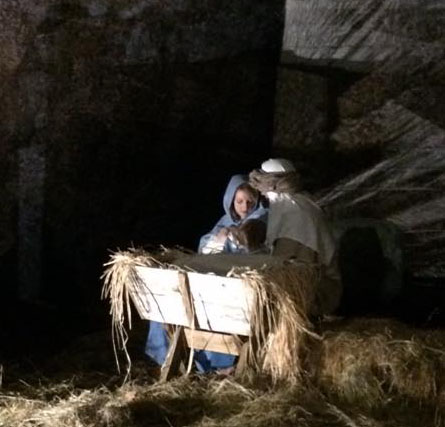
There is no baby, wrapped in swaddling clothes and asleep in a manger.

That’s Luke’s story to tell.

When he wrote his gospel, John takes the Bible’s Christmas story to a different level, focusing not on the earthly scene, but on the eternal reality it represents. The first Chapter of John tells the Christmas story from heaven’s viewpoint.

While Matthew and Luke describe how and where Jesus was born, John explains who Jesus was and is: the eternal Word…the Creator…the Light entering darkness…God becoming flesh.

John tells us about the one who came into the world to give us the right to become children of God.

If Matthew and Luke give us the method by which Jesus came to live among us, John shares the divine meaning and purpose behind the baby in a manger. He tells us why. It is no less a Christmas story than the one that will be repeated a million times in the days to come.

In the beginning was the Word, and the Word was with God, and the Word was God. He was with God in the beginning. Through him all things were made; without him nothing was made that has been made. (John 1:1-3)

It’s difficult for finite minds like ours to grasp the true nature of God. John sees the one he calls “the Word” not as an idea or thought, but as the living expression of God himself. The Word did not observe creation from a distance. The same hands that formed the stars would be wrapped in human flesh, grasping the offered forefinger of his mother. The voice that spoke with such clarity as it spoke the universe into existence, would cry in hunger in the middle of the night.

John viewed Jesus as the word of God. God’s revealed word. Present as God and with God from the time before creation.

Christmas is not merely the story of a baby being born—that happens every day. Christmas is the story of the Creator choosing to identify with you and me in every way. Choosing to draw near to his creation, not in the magnificent and extraordinary, but in the mundane and ordinary. The Word chose to come quietly and humbling, as a child.

In those days Caesar Augustus issued a decree that a census should be taken of the entire Roman world. (This was the first census that took place while Quirinius was governor of Syria.) And everyone went to his own town to register. So Joseph also went up from the town of Nazareth in Galilee to Judea, to Bethlehem, the town of David, because he belong to the house and line of David. He went there to register with Mary, who was pledged to be married to him and was expecting a child. (Luke 2:1-5)

An emperor’s powerful decree set history in motion, another phase of God’s ordained and eternal plan. The dusty roads of Galilee and Judea brought a young couple on the path of ancient prophecy. Not human administration, but divine orchestration.

Bethlehem, a small, easily overlooked village, would become the agent of God’s purpose. The Word who shaped time and space, now entered it. A heavenly throne morphed into a manger.

While they were there the time came for the baby to be born, and she gave birth to her firstborn, a son. She wrapped him in cloths and placed him in a manger, because there was no room for them in the inn. (Luke 2:6-7)

No trumpet sounded. No palace gates opened. No one rolled out the red carpet. The Son of God arrived in silent wonder. The Word rested where animals fed. Swaddled in soft and simple cloth, held by the trembling arms of a first-time mother. The world he made had no room for him. His creation failed to recognize his presence.

Heaven, however, watched closely every moment. Heard every cry that echoed with the sound of redemption. Light had entered the darkness.

In him was life, and that life was the light of all men. The light shines in the darkness, but the darkness has not understood it. The true light that gives light to every person was coming into the world. He was in the world , and though to the world was made through him, the world did not recognize him. He came to that which was his own, but his own did not receive him. (John 1:4-5,9-10)

A child was born. He arrived as light and life. Where sin cast its long shadow, he brought truth. Where fear held sway, he brought hope. Where death claimed victory, he brought life.

Shrouded in darkness, the world did not welcome him, but it could not extinguish the light. Heaven chose to amplify it.

That Light arrived not in palaces or courts…not as a gift for kings or a performance limited to the world’s elite. No. It arrived in fields beneath the open sky, announced to unassuming shepherds working in the fields.

And there were shepherds living out in the fields nearby, keeping watch over their flocks by night. An angel of the Lord appeared to them, and the glory of the Lord shone around them, and they were terrified. But the angel said to them, “Do not be afraid. I bring you good news of great joy that will be for all the people. Today in the town of David a Savior has been born to you; he is Christ the Lord. This will be a sign to you: You will find a baby wrapped in cloths and lying in a manger.” Suddenly, a great company of the heavenly hosts appeared with the angel, praising God and saying,

Glory to God in the highest,
And on earth peace to men
on whom his favor rests.”
(Luke 2:8-14)

While the world slept, heaven danced. While the earth remained deaf to the Word, the angels sang. Hear God tell you the same thing he told the shepherds. “Do not be afraid.” Celebrate the good news. Embrace the joy God offers all of us. A savior has been born…Christ the Lord. When your heart’s darkness gets driven out by the light, you can give glory to God. You can find the peace God that only comes from becoming a child of God.

Yet to all who received him, those who believed in his name, he gave the right to become children of God…The Word became flesh and made his dwelling among us. We have seen his glory, the glory of the one and only who came from the father, full of grace and truth. (John 1:11-12,14)

On that night in Bethlehem, grace lay in a manger and truth had a heartbeat. God entered our world to live as we live. To experience what we experience. To show us how to live. To be the Word and Light.

The baby with no permanent place to stay came to bring us home with him. To embrace us as his children.

The Christmas story as told by Luke and amplified by John is the penultimate chapter in what Archbishop Fulton Sheen called “the greatest story every told.” A story culminated with Jesus’ sacrificial death and resurrection. It is God’s gift to you and me.

For God so loved the world, that he gave his one and only son, that whoever believes in him shall not perish, but have eternal life. (John 3:16)

Author’s Note

The world needs Christmas. I hope you find the time to ease the frenetic pace to a slow walk with family and friends. Set aside the worry and the uncertainty and enjoy the moment. I pray that you experience those quieter moments this holiday season.

The world needs Christmas. Not the tinsel and the trees, but the peace and goodwill about which the angels sang. This year may God give you a genuine sense of his presence and his love not just on Christmas morning every day thereafter. May realizing his presence and love bring you and yours his peace and goodwill.

Merry Christmas!

Thinking Points

John presents Christmas from heaven’s perspective, less about the person of Jesus and more about his purpose. How does viewing Jesus as the eternal Word change the way you understand the meaning of Christmas in your own life?


“The world did not recognize him.” In what ordinary, quiet, or unexpected ways might Christ be present today that you are tempted to overlook or ignore?


The angels announced peace to those on whom God’s favor rests. What fears or burdens might you need to release this Christmas in order to truly find the peace Jesus came to bring?
Don’t Squander Your Inheritance

Background Passages: Genesis 25:27-34 and Romans 8:15b-17

Using some borrowed cash and his personal savings, Frank Winfield Woolworth bought some discounted merchandise to sell to the general public at reduced cost. He opened his first Woolworth’s Great Five Cent Store in Utica, NY, in 1879. Though that first store went out of business, he kept working and reopened again in Pennsylvania to greater success.

Eventually, Woolworth built his business into a retail corporation worth $25.9 billion in its heyday. Over the years, the company was handed down through the family until the last Woolworth’s closed its doors in 1997. Though the company lives on with a smaller, more targeted product line under the name of Foot Locker, Woolworth’s, as a corporation, no longer exists.

At one point, Woolworth’s granddaughter Barbara Hutton assumed leadership in the corporation. Many people point fingers at Hutton as the first of the Woolworths to start squandering her inheritance. Even though they were the biggest name in business, patriarch F. W Woolworth’s granddaughter knew nothing about making money, and instead vowed never to work a day in her life. By the time she was on her seventh husband, she had lost almost her entire fortune.

All of us would like to leave something of substantial value for our children. If we’re blessed enough to do so, we hope we’ have raised them well enough that they do not misuse the gift they have been given.

Sadly, it is not uncommon to see the second or third generation squander in a season all of the hard work, value, and wealth created by the first generation. When the sons or daughters spend away all which they’ve been given, it’s usually because they take for granted what they have, possessing a sense of entitlement.

What is true in this temporal and material world takes on even greater important in the eternal and spiritual realm. As the beneficiary of a spiritual inheritance of immense value, I know how easy it can be to squander all that God has given us. When I read the Woolworth story this week and wrapped it in spiritual terms, I had to ask myself as I’m asking you, “Are we squandering our God-gifted inheritance?”

It is, I think, a viable question.

*****

He dragged himself back home, weary and filthy after days hunting wild game. He comes empty-handed. Other than one scrawny rabbit, he killed nothing. The long trek home was nothing short of miserable. His quiver empty of arrows and his stomach roiling with hunger as he crested the ridge overlooking his father’s encampment.

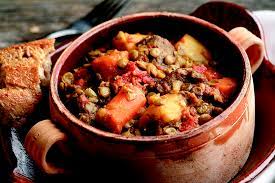
The hunter caught the aroma of a rich lentil stew carried on the smoke from the open pit near his father’s tent. Hunger drove him forward.

Young. Impetuous. Famished. Esau rushed to the tent where his brother Jacob sat stirring the pot, sampling from his ladle the tasty broth.

As Jacob sampled the stew, he saw his twin brother making a beeline for the fire pit. Normally quiet and reserved, Jacob did not enjoy confrontation, but something about Esau always set Jacob’s teeth on edge. Seeing the ravenous look on his brother’s face, Jacob’s devious streak flashed.

“Mmmmmm,” Jacob overplayed the taste of the stew, adding a pinch more salt, a look of rapture on his face. “This is soooo good,” he said to himself, knowing that Esau would hear.

Esau plopped to the ground beside the boiling pot, his mouth watering in anticipation. “Quick, let me have some of that red stew! I’m famished!”

Jacob sat back on his heels, giving Esau a sad look. “I don’t know,” he said. “I made this for Father. Maybe you can have the leftovers.”

“There were no deer anywhere,” complained Esau. “I’ve not eaten in days. Give me some stew!”

“I tell you what,” said Jacob, pouring some of the stew into a wooden bowl and wafting it under Esau’s nose. “First, sell me your birthright.”

“Look, I’m about to die,” Esau said. “What good is a birthright to me?”

“Swear to me first,” insisted Jacob. Grudgingly uttering an oath, Esau surrendered his birthright to Jacob.

“Then, Jacob gave Esau some bread and some lentil stew. He ate and drank and then got up and left. So Esau despised his birthright.”

One has to wonder how often Esau regretted his impetuous disregard of his inheritance. He was hungry, but not starving. For a morsel of food and the temporary satisfaction of a full belly, he gave up that to which he was legally entitled.

I suspect as the years passed, he forgot about it most days, perhaps thinking that Jacob would regard the transaction as a joke between brothers. I doubt either son ever told Isaac of the deal they had made. For his part, Jacob kept the oath in his robe pocket, ready to pull it out when the time was right.

Let’s talk first about this birthright. Thought it is an inheritance, there is no strong 21st century equivalent to the ancient birthright. Our culture is not wired the same way.

In the Hebrew culture, the birthright was a matter of wealth and status. Upon his death, the father’s possessions were divided equally among all the male children, except the firstborn son received a double portion. Under ordinary circumstances when Isaac died, Esau, as the oldest son, would be entitled to two-thirds of Isaac’s wealth. Jacob would receive the final one-third.

This whole situation seems deceitful and completely unfair. Jacob took advantage of his brother in a weak moment to strip him of his inheritance. It makes us cringe a little. However, God knows the heart. When Rebekah became pregnant with the twins, God revealed to Isaac and his wife that the younger son would be the prominent son.

“Two nations are in your womb, and two peoples from within you will be separated. one people will be stronger than the other and the older will serve the younger.” (Genesis 25:23)

We tend to look down on Jacob for his duplicity, but God’s plan depended on the man Jacob would become, not the man he was at the time. He knew how Esau would disregard is birthright.

It is an intriguing story, but how does it answer our initial question? Are we squandering our God-gifted inheritance? Are we doing something that would strip us of God’s blessing?

Let’s first establish our right to a godly inheritance.

In the New Testament, believers in Christ are called the “children of God.” Look at John 1:12-13.

“Yet to all who receive him, to those who believed in his name, he gave the right to become children of God—children born not of natural descent, nor or human decision or a husband’s will, but born of God.”

Being born again through our faith in Jesus Christ and the grace of God, we become his heirs, worthy of our inheritance.

“…but you received the spirit of sonship. And by Him we cry, ‘Abba. Father.’ And the Spirit himself testifies with our spirit that we are God’s children. Now if we are children, then we are heirs—-heirs of God and co-heirs with Christ.” (Romans 8:15b-17)

Clearly, scripture teaches that all believers in Christ receive an inheritance by virtue of being a child of God. It is an inheritance with benefits in the here and now as well as in the eternal. We are asked to honor that inheritance with our lives.

“Whatever you do, work at it with all your heart, as working for the Lord, not for men, since you know that you will receive an inheritance from the Lord as a reward.” (Colossians 3:23)

Hebrew culture allowed the father to strip the eldest son of his first-born rights if the father felt him unworthy.

With our spiritual inheritance guaranteed by Christ, we are still asked to live lives worthy of the gift. How might we squander that which we’ve been given? One of the keys is that almost parenthetical sentence in Genesis 25:34.

“So Esau despised his birthright.”

Culture and tradition all but guaranteed Esau a double portion of his father’s inheritance, yet we’re told he “despised his birthright.” It is not that Esau hated the whole idea of getting a double portion. In Hebrew, to despise something, to hate something, is a matter of choice. To despise your inheritance means you put other things ahead of it. To choose something else. In the heat of the moment, Esau chose a single bowl of bean soup over that to which he was entitled.

Other translations say that Esau “profaned his birthright.” That word takes on a different connotation in the 21st century, speaking primarily to crude and vulgar language. In Scripture the term suggests a broader scope. The idea conveys a lack of holiness. To take something that is righteous and good and treat it with contempt.

Esau profaned his God-given and special birthright by trading it for something cheap and ordinary…as if it meant nothing to him.

I wonder how many times I’ve approached my birthright as a child of God with the same level of disregard as Esau demonstrated. How often have I taken my spiritual inheritance for granted? How often have I treated my spiritual birthright too casually? Trading it in for something so inconsequential as a bowl of stew…satisfying in the moment, but with no lasting value.

Paul told the Colossians, “Whatever you do, work at it with all your heart, as working for the Lord…” I will not do that if I value a bowl of stew more than I value God’s provision, plan and purpose for my life.

Consider the writer of Hebrews as he posed a rhetorical question to his readers. If the world becomes more important to us that the inheritance God provides then “how shall we escape (God’s judgment) if we ignore such a great salvation?”

The world promises us that the stew is going to taste so good that everything else pales in comparison. It’s going to promise us that if we just eat the stew the hunger will never return. It’s going to promise that the stew…the wealth, the fame, the power, the position will mean more to us that anything God offers.

Here’s the deal though. Stew is not salvation. It’s just stew.

We squander our God-given inheritance when the stew is more important than the salvation. We squander our inheritance when we give too little thought to God and his purpose and will for our lives. We squander our inheritance when we fail to give God’s grace gift the value it deserves. We squander our inheritance when we fail to live as if it matters more than anything else in this world.

This is the lesson I learn from Esau. I can never forget, not for a minute, that God and his promises are holy. I am his and he is mine. When I forget that simple fact, or when I give that relationship anything less than the highest priority in my life, I squander the chance to experience the blessings he promises me.

Claim that inheritance offered through Jesus Christ. Through your witness and your work, increase its value. Frank Woolworth’s daughter squandered her inheritance. Don’t squander the inheritance God gave you no matter how tasty the stew looks.

Amen?

Amen!