It’s Just Not That Complicated–A Story

Background Passage: II Kings 5:1-15

The driver guided the gilded chariot
to the side of the valley road.
Dust from the day’s drive dulled its luster.
The Captain hopped off the back of the chariot.
Pressed his balled fists into the
small of his aching back.
Stretched the kinks from
his muscled frame.

He pulled the headpiece gingerly from his brow,
snapped his fingers.
Within seconds a servant boy
handed him a goblet of water.
Cool.
Fresh.
Soothing his parched tongue.
Slaking his deep thirst.

His caravan passed by,
continuing his journey.
Wagons bearing a king’s ransom.
Ingot and coin.
Silver and gold.
Carts hauling a king’s clothes.
Finest silk.
Softest fabric.
Gifts to the King of Israel
and his prophet.
The one his wife’s servant called
“The Healer.”

The Captain.
An imposing figure…
from a distance.
A head taller than those around him.
Shoulders broad.
Hips narrow.
Legs and arms
muscular and
mighty.
Tall in stature.
Regal in bearing.
Accustomed to the mantle of command.
Adorned with the tributes of his master…
Ben-Hadad II.
King of Aram.

An imposing figure, indeed…
until closer inspection.

His once handsome face
hidden beneath a soiled cloth.
Stained by open sores and
Ssall, weeping tumors which
consumed the skin around
his eyes and nose.
Red blemishes
circled his neck.
Gray splotches
covered his hands and arms.
Disfigured.
Discolored.

Naaman.
The Captain.
Greatest of Aram’s warriors.
Battlefield survivor.
A soldier’s soldier.
A prominent man
in search of
an improbable cure to
a dreaded disease.
A leper.

Naaman watched his entourage pass.
His men avoided looking his direction.
Partially in deference.
Partially in disgust.
Naaman noticed the slight.
He always noticed.
He roughly stroked his cheek,
angry at sensing no pain, no feeling
from the dying flesh.
More dead than alive.

An unknown prophet
his last ray of hope.
This trip a simple favor from the king
to his most trusted general.
Healing was a long shot both men willingly grasped.

Naaman gathered his strength again.
Exhaled a deep breath.
Climbed onto his chariot.
Nodded to his driver.
Followed the caravan toward the city of Samaria,
high on the distant hill.

He shook his head in weary disbelief.
He traveled this far on the word of a slave-child and
her blind trust in a holy man of Israel.

*

Naaman walked out the front door of what passed
for the king’s palace in Samaria.
Repulsed and revolted by the cowardice
he had witnessed.
He judged the Hebrew king.
A tattered bundle of nerves.
A sniveling sovereign.
A weak and whimpering ruler.

Entirely too intent upon keeping the leper at a distance,
the disdainful monarch summarily
dismissed the general from Aram.
Escaped personal accountability by
sending Naaman to
Elisha,
Israel’s prophet,
rather than ordering the prophet to the palace.
Unthinkable.

With each step along the path to Elisha’s house
Naaman grew angrier.
”What am I doing here?”
he muttered to himself.
“A fool’s errand.”

If the Israelite king’s palace was unimpressive,
the prophet’s home was little more than a hovel.
Naaman approached the door.
Hopelessness in his heart.
Contempt on his countenance.
A servant stepped onto the porch,
closing the rough-hewn door behind him.
Bowed respectfully at Naaman’s feet.

“My master bids you welcome and knows why you are here.
I tell you on his behalf to go to the Jordan River.
Dip yourself seven times into its waters.
When you rise up from the water the seventh time,
your flesh will be restored.
You will be cleansed.”

As quickly as he appeared,
the servant re-entered the home.
Closing the door in the Captain’s face.

Naaman stood stone-still in shock.
Mouth agape.
A man used to getting his way.
Now being sent along his way.
Accustomed to deference,
not dismissal.

Naaman.
Shouted indignantly at the prophet inside.
Rapped loudly at the locked door
with the hilt of his sword.
“I’ve traveled a great distance to see you.
Come outside and face me.”
Elisha did not come.
Naaman left in anger to return to his home.

Thoughts
troubled and
tumultuous.

“Not what I expected.”
“Did not stand before me and call upon his God.”
“No wave of his staff.”
“No potions.”
“No pronouncements.”
“No pretending
to do something…
anything!”

He shouted in anguish at the top of his voice,
staring at the heavens.
“Go bathe in the Jordan…Really?”
“A puny prophet!”
“An insignificant river.”
“An inconsequential country.”

“Superior rivers near Damascus…
Clearer.
Purer.
Could I not simply wash in them?
Why must I travel this far?”

He rode in silence aboard his chariot.
Returning home without a cure.
Fury slowly subsiding
into somber submission.
Resigned to his fate.

After moments of uncomfortable silence
his trusted chariot driver spoke in a meek voice,
never taking his eyes off the road ahead.

“My Captain,”
he hesitated before screwing up his courage to speak,
“if the prophet told you to do some great thing,
would you not do it?
It seems such a simple thing…
‘Wash and be cleansed.’
Is it not worth a try?”

A servant’s simplicity.

Naaman stared at the back of his driver’s head.
Then, into the distance.
Trying to find fault with his servant’s reasoning.
When he could not,
his anger evaporated.
Breathed deeply.
Exhaled slowly.
Clapped his hand upon the driver’s shoulder,
“Turn us around.
Take me to the Jordan.”

*

Naaman left the caravan a distance away,
taking only three servants with him.
Stood on the muddy bank of the Jordan.
Ankle deep in its languid flow.
Little more than 20-feet wide.
Slowly moving to the south.
A lazy current of muddy water reflecting
a greenish tint from the brush
along its slippery banks.

He stripped himself of his shirt and tunic.
Removed the soiled cloth covering his face and neck.
Hesitant.
Halting.
He waded into the water past
his hips to his chest.
With a quick glance at his servants
who had turned away to give him privacy,
Naaman submerged beneath the water…
Once.
Twice.
Six times.
Stared each time he emerged from the tepid stream
at his reflection in its wavy surface.
No change.
No transformation.

He took another breath.
Bent his knees.
Sank into the river a seventh time.
He floated beneath the surface.
Stared up through the murky water at the heavens,
filled once more with despair.

In the muddled quietness,
disturbed only by the rush of blood pulsing in his head,
he thought to himself.
“Just sink.
Open your mouth.
Drown.”
He exhaled and waited to die.
Self-preservation and aching lungs
forced him to the surface.

Water dripped from his hair.
Ran into his mouth,
Sputtering as he gasped for air,
the Captain offered a quick prayer
to a God he did not know.
Almost too afraid,
he willed his eyes open.
Looked again upon his image in the water…

Tears mingled with the
trickle of water
running down unspoiled cheeks.

The man with the smooth skin of a child
Splashed and danced in the muddy waters like a child at play.

Cleansed.
Whole.
Transformed.

With a shout that echoed through the hills of Samaria,
Naaman lifted his unblemished hands and arms to the sky…

“Now, I know there is no God in all the world
except in Israel.”

*

Naaman’s story.
An act of God leads to salvation.
Yet, he didn’t go down easily.

Look between the lines.
Arrogant by accomplishment.
Prideful of position.
Naaman almost missed out on
physical and spiritual cleansing.
We’re not so different from the
leprous warrior.

Why is it so hard for us to accept the simplicity of God’s grace?
“Believe.”
“Be saved.”
So easy to hear,
yet too hard to believe.

Whether grace unto salvation or
grace toward our need,
we pound on the Father’s door
demanding an audience.
He sends
his servant…
Pastor.
Friend.
A word of scripture.

They tell us,
“Why do you make this so hard.”
“Go wash…”
A simple act of obedience.

We fume!
He didn’t present himself to us personally.
We fuss!
He offered us nothing spectacular.
No whisper of a magic word.
No wave of a magic wand.
We demand something…anything
different than…
“Go wash.”

Far too simple for our tastes.
Not at all what we expected.

Such cleansing ought to be demanding.
A requirement through which
we can prove ourselves worthy
of His grace.

Thank God.
Naaman learned a lesson we all must learn.
God’s grace is not that complicated.
It’s a gift.

Naaman teaches one more thing.
There is no other river into which we can
plunge that offers us cleansing.
Not the rivers of our home.
Not the rivers of our family.
Not the river of our deeds.
No other river.
No other Lord.

“There is no other name under heaven given to men
by which we must be saved.” (Acts 4:12)

One last lesson.
Blessed is the one who has someone in life,
Like the chariot driver,
willing to challenge his or her stubbornness…
Someone to remind us of our illogical pride
that prevents simple obedience to God’s will.

“If He asked you to do some great thing,
would you not do it?
It seems such a simple thing.”
Go wash.”

You see.
It’s not that complicated.
The cleansing power of Jesus Christ
washes away…
Sin.
Self-importance
Smugness.
Stubbornness.
Everything that stands in the way of receiving
His grace.

Because it’s so simple,
we stare at the heavens through murky water.
Falling to its depths.
Waiting to drown.
until self-preservation pulls us to the surface.

With tentative eyes,
we stare at our own reflection…
our now unspoiled condition.
Cleansed.
Whole.
Transformed.
Shouting to the world in absolute joy…

“Now, I know there is no other God.”

Trust.
Believe.
Act.
It’s just not that complicated.

*

Publisher’s Note: You’ll find stories similar to this in each of the author’s books, Put Away Childish Things and The Chase: Our Passionate Pursuit of Life Worth Living available from Xulon Press, amazon.com, barnesandnoble.com or most online bookstores. You may subscribe to the author’s blog by entering your email in the subscription block on the right side of the page at www.drkirklewis.com.


Afraid to Let Go

Background Passages: II Samuel 11:1-17 and 12:1-13; Isa. 43:18-19; Psalm 51:19 and Heb. 12:1-2

My brother celebrated one of those milestone birthdays years ago, determined to scratch parachuting from an airplane from his bucket list. With the appropriate time in the classroom, he strap a parachute to his back, climbed into a perfectly fine airplane and took off for his first…and only…static line jump.

In my mind a static line jump fits a on an insanity scale at a level slightly less than skydiving simply because it reduces operator error. Rather than jump, fall and pull your ripcord before you die, you climb out on the wing onto a metal platform with your parachute’s ripcord attached to a static line inside the plane. When you jump, you get two or three seconds of freefall until the line pulls the cord, automatically deploying the parachute. Blind panic assisted by old school technology. Once the canopy fully inflates, you enjoy the magnificent view from above as you glide to a soft landing on the good, green earth below.

My brother found himself standing on the platform flying at 5,000 feet, clutching tightly with both hands to the strut underneath its wing. Buffeted by the wind rushing past him. He waited for his instructor to give him the thumbs up to jump. At the appropriate time, the signal was given. He executed a perfect three-point jump. His feet lifted from the platform and one hand released its death grip. His fourth point, his right hand, refused to release the strut. He flapped wildly in the slipstream underneath the wing, unable to will himself to let go of his hold on that last vestige of safety.

Let’s leave him hanging there and come back to him in a minute and see if I can draw a point from this story.

*

David, God’s chosen king of Israel, did some pretty horrible things in his life. One particular incident would have spawned a salacious investigation in today’s news cycle. An affair with a married woman left her pregnant. David attempted to manipulate the situation by recalling her husband, Uriah, from the front line of battle to create the impression that the baby was a result of her husband’s leave. Her husband unknowingly thwarted the king’s maneuvering by honorably refusing to go home while his brothers were at war. David then compounded his sin by quietly ordering Uriah and his soldiers on a suicide mission where he would most certainly die, giving David the chance to marry the hero’s widow. David did some despicable things.

When God’s prophet challenged the king’s actions, David recognized his sin, feeling the heavy burden of remorse for his actions. He fell on his face in repentance, asking God to forgive him for everything he had done. David’s felt the sting of his guilt, but he would never now release from that heavy burden until he let go of his failed past and accepted the ever=present reassurance of God’s grace and forgiveness. Only then would his relationship with the Father be reconciled and restored.

Two things happen to us who feel genuine remorse when faced with our own sin. We can seek God’s forgiveness and start anew within the grace he provides, much as David did. Too often, however, we never move past remorse to repentance, clinging to our failure with loathing and self-pity, certain that God could never forgive anyone so unworthy.

I was reminded of that fact not too long ago when I visited with a former pastor who had walked far from the path God intended. He was certain he strayed so far that God could never use him again in kingdom work. The work of Christ on the cross cleared the path for forgiveness, but this man could not bring himself to let go of the past and find a new way of serving him. It’s a journey most of us have made at some point in our lives.

When we refuse to accept the grace of God and forgive ourselves, we tend to drag the past behind us like an anchor. Instead God tells us the same thing he told the people of Israel in Isaiah 43:18-19…

“Forget (let go of) the former things; do not dwell on the past. See, I am doing a new thing. Now it springs up; do you not perceive it? I am making a way in the desert and streams in the wasteland.”

The instruction is so clear. Let go of our sin. Release it into God’s forgiving hands. He makes a way in the wasteland of our lives to restore us for a new thing. A new work.

*

Let’s not leave my brother hanging on the wing.

Though it probably seemed like an eternity bouncing around in the slipstream, my brother eventually let go of the strut. The static line pulled the ripcord. The parachute opened. He enjoyed “a new thing.” For minutes on end, he floated lazily on his descent to earth 5,000 feet below with the wondrous panorama of sky and earth laid out before him. He called it “exhilarating,” and “adrenaline rush.” Yet, he only experienced the joy when he let go.

*

There may be nothing as miserable for a Christian who desires to walk the walk than to fail to do right. Walking in that shadow of guilt is debilitating, affecting not only our relationship with God, but our relationships with others. We can fall on our knees earnestly seeking and intellectually accepting God’s forgiveness. We will never experience full release until we let go of the past and accept the next new thing God prepares for us.

David got his life back on track by asking God to “Create in me a clean heart and renew a steadfast spirit within me.” (Psalm 51:19) It is a simple prayer of a fully repentant heart that says, “God, help me set aside my past and stay focused on you.”

The writer in Hebrews puts it another way by telling us to “throw off” or let go of everything that hinders us from serving God to the best of our ability. And, he even tells us how. Look at that remarkable passage in Hebrew 12:1-2.

“…Let us throw off (let go of) everything that hinders us and the sin that so easily entangles us. Let us run with perseverance the race marked out for us. Let us fix our eyes upon Jesus, the author and perfecter of our faith.”

Guilt effectively destroys grace-filled living. Keeps us from believing God can use us in any significant way. I’m convinced when we let go of our guilt we will find life laid out before us in a wondrous panorama of God’s exceptional will for each of us. Exhilarating. An adrenaline rush of eternal proportions.

(Author’s Note: Feel free to forward this Bible study to anyone you feel might benefit from its message. Encourage your them to subscribe to the blog by going to www.drkirklewis.com and entering their email address in the box on the right side of the page. Once registered, you will receive an email announcing each new post. Thank you for sharing.)

A Mother’s Defining Moments

Background Passage: Proverbs 31:1-31

I think someone is trying to tell me something. Every Mother’s Day at my church, each mother is given a beautiful rose or some other lovely gift and a sermon extolling that Proverbs 31 woman we love and cherish. On Father’s Day, it seems, we get a self-help book on fatherhood and hear a sermon on how to be a more Godly man. Maybe we get what we deserve.

Each Mother’s Day brings to me a sense of rejoicing, remembrance and loss. My mother, Earline Lewis, passed away in 1998. Cancer claimed her but not before she shared a full life as a wonderful wife to my Dad, an amazing mother to her three children and a quiet influence to a new generation of women.

As a young woman in the 1940s, Mom studied to become an Registered Nurse. Upon graduation, she enlisted to serve as a nurse during World War II. The war ended about the same time and she was never shipped out, but she looked awfully good in her uniform. She lived a farmer’s life as a farmer’s wife, a stay-at-home mother and, for a brief time, a school nurse in our community. She ended her career as a medical director in a retirement community in Lubbock, Texas. I was always quite proud of her.

I have thought of her often over the last 18 years. If you’ll allow me a blog of personal privilege, I’d like to tell you about her on this Mother’s Day.

Mom was a woman of practical and personal faith. She experienced worship less on bended knee and more with helping hands. She lived an applied faith. Each day she demonstrated God’s love through her service to the hurting and the sick. To those whose minds outlived their bodies and whose bodies outlived their minds. She had a listening ear and a sensitive touch. Her worship often took her away from church on Sundays as she tended to the biblical “ox in the ditch.” I know God felt her worship every day.

Her faith was as personal as it was practical. She was God’s hand and heart to her elderly patients that were sometimes alone and abandoned. They were not just patients in bed three or four, they were beautiful faces, recognizable names, persons to be cared for and loved. She taught me that God calls us to care for the “least of his children.” Because he loves the least, we must also love and act in meaningful ways.

Mom was a woman of private heart. “Private,” not “remote.” When Mom loved you and engaged you, it felt like you were the only two people in the world. She was not overly demonstrative. Not one to gush. Yet, there was never a time in my life as a child or adult when I questioned her love for my Dad, her children or her grandchildren. You saw love glistening in her eyes. Felt it glowing in her smile. With a word and a touch she could connect her heart to yours.

My Grandma Mills, my mom’s mother, died in a car accident when I was young. We all felt such grief at an unexpected loss. I sat on the steps in Grandma’s house trying to play with a few toys and take my mind off of everything happening around me. I was having a hard time holding it together. Mom sat down and played with me for a time without saying a word. I cried. She cried. I hugged her. She hugged me. There were no platitudes of false comfort that I had heard from other well-meaning souls…“God just needed your Grandmas in heaven more than he needed her here.” She simply allowed me to look deeply into her hurting heart as she reached out to mine.

Mom was a woman of deep tenderness. She stood with my wife, Robin, and I in the tiny bathroom of our home the day we brought our first son home from the hospital. He was so little. Looked so fragile. So breakable. Clueless about everything, we asked her to give him his first bath while we watched. She handled a squirming and screaming sack of potatoes with such ease. She touched him, offering soothing words of comfort. She never stopped smiling and cooing at him no matter how loud he cried. Tenderness and patience.

Mom was a woman of constant love. Her relationship with her four grandchildren was nothing short of mesmerizing. The perfect grandmother. Whether it was sitting on the floor playing with dolls or trucks or joining in their conspiracy by teaching them to play poker, she was fully devoted to them. She gave them her full attention…every minute they were together. There were countless hours of intimate dialogue about dinosaurs, donuts, dolls, dreams. Shared secrets about school, sports, sororities and scholarships. Every conversation laced with a perfect blend of humor, intelligence and love. She never talked down to them. The priceless value of those encounters came less from the topic being discussed and more from the time she spent with them. Her love never wavered.

Those vignettes do not reveal everything about my Mom, but it gives you a little insight into a fabulous woman who made a difference in my life. I adored her laugh, her sense of humor, her common sense and her insight. She could cook a mean roast, suture a wound, drive a tractor, haul cotton to the gin and discuss Pauline theology. She could have done anything…been anything she wanted to be…but she was content to be my Mom. These are but a few of the things that defined her, a few of the imprints she left on my soul. She was an extraordinary influence in the lives of my brother, my sister and me. I will love her always.

I also do not think her influence stopped with us. They say that men often marry their mothers. I don’t think it is a coincidence that I married Robin 40 years ago. Though different in many ways, my Mom and Robin share identical hearts. Robin’s love for God flows through to her love for our boys. When they were children she always looked for new experiences and new opportunities for our boys to explore, sharing their interests and encouraging their curiosity. Making time for them whenever needed. Her love for them remains sacrificial and ever present. She was and is a great mother to them, helping to mold them into the amazing, Godly men they have become. I am blessed to call her my wife and the mother of our children.

Adam and Andrew, in turn, married two incredible women, Jordan and Melissa, respectively, both of whom remind me of my Mom in all the ways that matter most. I celebrate their similarities, their uniqueness, but rejoice in the mothers they have become. I admire their abiding faith and the way it governs their lives.

It may be more difficult to be a good mother in today’s world. Society tells parents to back away and let the kids find their way without undue parental influence. What a joy it is to watch Jordan with Eli and Josiah; Melissa with Lena. As mothers, these two young women are models of love, patience, discipline and devotion. I know this to be true because I’ve never seen three happier children. My grandchildren will never live a second without feeling their mothers’ love. What a gift that will be in the years to come!

I hope each of you takes the time this Mother’s Day to remember and thank that special woman who gave you life. Whether she is physically present or eternally remembered makes little difference. Her impact on your life has been immeasurable.

Happy Mother’s Day, Robin. Happy Mother’s Day, Jordan and Melissa.

Happy Mother’s Day, Mom. This verse is for you.

“Her children arise and call her blessed. Her husband also and he praises her. Many women do noble things, but you surpass them all.” Proverbs 31:28-29.

*******

(Author’s Note: Feel free to forward this Bible study to anyone you feel might benefit from its message. Encourage your them to subscribe to the blog by going to www.drkirklewis.com and entering their email address in the box on the right side of the page. Once registered, you will receive an email announcing each new post. Thank you for sharing.)

Breaking Into My Happy Dance

Background Passages: Ephesians 5:1, 15-17; Psalm 118:24, 29

I usually don’t watch the news. I spent far too much of my professional career being interviewed by reporters, hoping that the editing process would maintain the integrity of my comments. Too often full disclosure was sacrificed for a tidy sound bite. As the media grows more politically polarized, corporate bias destroys the objectivity of the press.

With little to do this week because of an empty calendar and heavy rains, I ended up watching more news that I ordinarily watch. The stories were anything but uplifting.

• Devastating earthquakes in Ecuador and Japan.
• Disastrous floods in southeast Texas.
• Deadly acts of terrorism.
• Destructive politics at home and abroad.
• Declining civility toward those whose beliefs differ from our own.

It is any wonder that polls say people are more anxious today about the quality of life than ever in recent history. I must admit to falling victim, at times, to the tone and tenor of today, anxious about tomorrow and the world our children and grandchildren will inherit. As I turned off the news, I remember thinking, “Surely there is a cave on a deserted and isolated island where I can shelter my family from the horrors of the world.”

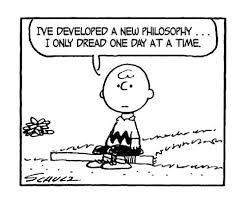
Later that day I stumbled across an old Peanuts cartoon drawn by Charles Schultz. I had grown up with Charlie Brown. I think I read most of the 17,897 comic strips Schultz penned during his 50-year career. In this particular comic strip Charlie Brown sat alone on the curb with that typical forlorn expression on his face, thwarted at every turn by life. With a hint of resigned optimism, Charlie Brown said…

dread 3

The cartoon made me smile and marvel at how God uses such ordinary things to remind us that his presence in our lives trumps every shred of doubt, disquiet and dread. As a Christian in a world in turmoil it is sometimes difficult to walk in confidence. How are we supposed to face life’s uncertainties and our own insecurities when it seems the world around us has gone mad? How do we stop being anxious about all that we see happening around us?

Sorry, Charlie. The answer does not lie in dreading only one day at a time. Paul gave us a clue in his letter to the Ephesian church as they struggled to live in a world in equal turmoil as our own. Look at Ephesians 5:1, 15-17…

“Be imitators of God, therefore, as dearly loved children, and live a life of love, just as Christ loved us…Be very careful, then, how you live—not as unwise but as wise, making the most of every opportunity, because the days are evil. Therefore, do not be foolish, but understand what the Lord’s will is.”

We come to grips with a crazy world by imitating God, living a life of love as modeled by Christ himself. We don’t fix the world’s problems by retreating from it or bemoaning its existence. We heal its sickness by loving it more. By serving it more. By sharing the alternative. Paul tells us that in the midst of evil days, we must live wisely, make right choices, follow the will of God as we understand it. And this might be the key… Our efforts can’t be uninspired or halfhearted. They can’t be judgmental and condemning. We must make the most of every opportunity God gives us to share his grace and love to a lost world.

Making the most of every opportunity allows us to see every day as a gift from God. Another chance to serve him. Another chance to love. Another day to care for those in need. Another day to rejoice. Another day to celebrate.

Charlie Brown suggested that we get the most out of the life when we are thankful for each day. When he discovers how blessed he is he goes into his happy dance…

happy dance

The Psalmist said it this way…

“This is the day that the Lord has made. Let us rejoice and be glad in it. Give thanks to the Lord, for he is good. His love endures forever.” — Psalm 118: 24, 29

God, thank you for this day and the many unmerited blessings you have showered upon us.

Maybe today, instead of watching the news, I’ll just break into my happy dance.

*****

(Author’s Note: Feel free to forward this Bible study to anyone you feel might benefit from its message by clicking on the email icon at the bottom of the page. Encourage your them to subscribe to the blog by entering their email address in the box on the right side of the page. Thank you for sharing.)

The Mountain God Forgot

Rising from the seaside in steep elevations, the barren mountains surrounding Collique, Peru, outside of Lima, reflect the hopelessness seen in the eyes of its people. Devoid of life. Buried beneath layers of grayish-brown soil. Crushed by the mass of humanity. Gridlocked in hopelessness.

Every step taken by the hundreds of thousands of people populating the hillside in lean-tos constructed of cardboard and tin, kicks up powdery earth, making it hard to determine if the haze above the sprawling squalor is pollution from Lima or dust from under foot. To the American eye Collique is both alien and alienated. A friend called it “the mountain God forgot.” No grandeur in its creation. No grace in its spirit.

*

Staring into the haze, I was reminded of God’s word in Matthew 5:16…

“Let your light so shine before men that they may see your good works and glorify your Father which is in Heaven.”

God calls us to good work. To reach out to the harmed and the hopeless with helping and healing hands, offering change to body and soul. Beyond the immediate impact. Beyond the experience of one. The kind of change that sustains from one generation to the next. Such is the power of Christ. That a single life changed for good, now possesses a soul with a burning desire to make a difference in the lives of others.
We are called to make a difference.

I had the privilege this week of serving with members of South Main Baptist Church, Pasadena, and Christians from across the country, on a mission effort in Collique, providing improved shelter and health care for those living on the steep, dusty slopes of the forgotten mountain. Sponsored by Operation San Andres, an extraordinary effort led by Houston cardiologist Dr. Luis Campos, OSA stands as an oasis of hope and help amid poverty deeper than anything you can imagine.

Our team worked quickly to build a two-room home on the side of the mountain for a family of six, little more than a backyard storage shed to us. Yet, it was a dwelling that would make a difference to 10-year-old Maria and her family.

Maria’s smile and personality captured my heart upon meeting her. She radiated intelligence, curiosity and affection. She would peek around a corner in wide-eyed wonder at the work being done only to duck way when noticed. It was not long, however, when our smiles and encouragement drew her out. The lives of Maria and her family exuded joy that only God can bring to those living in such conditions. As we showed them through their new living quarters, their expressions of delight were contagious. Through the existing language barriers, we felt their gratitude and shared a blessing we all knew came from God.

The new home will make only a little change in their current living condition, but it is a chance. A difference. Among a people who seem beaten down and battered by a brutal life existence, OSA makes a difference. We will never know the generational impact of the seed planted here and now. OSA and its many volunteers reach out with the practical expression of God’s love, renovating a lifestyle and rejuvenating the spirit of those whose lives are touched.

*

I am now certain. The mountain was not forgotten by God. Psalm 90:1 reminds me…

“Lord, you have been our dwelling place for generations. Before the mountains were born from everlasting to everlasting, you are God.”

In other words, God knew what he was creating among the mountains of Collique. Created in his wisdom and for his purpose. God does not forget his creation.

Then again in Psalm 90:17, we extend our prayer…

“May the favor of the Lord rest upon us. Prosper the work of our hands.”

God grants to us opportunities to serve. Opportunities to make a difference. He takes that simple service we offer and makes it prosper, grow, expand and extend for generations to come. What we did this week made a difference to Maria, my little sister-in-Christ. As God prospers the work, that little difference, coupled with the hope of the better life it provides, will, through Maria and her family, change the people of Collique for generations to come.

Camelot and the Cross

Background Passages: Mark 15:21-47; Phil. 2:6-8; John 3:16

The legend of King Arthur and Camelot reads as a favorite of many since it first appeared on the French literary scene in the 12th century. As a movie, released in 1967, the tale gained popular acclaim. In the movie’s climatic scene, King Arthur discovered the adulterous relationship between Queen Guinevere and Lancelot, the king’s most trusted and loved knight. Though Lancelot escaped capture, Guinevere, having broken the laws of Camelot, is tried and convicted, sentenced to burn at the stake. Arthur, deeply torn between his devotion to the laws of his beloved kingdom and his passion for Guinevere, faces an unholy predicament.

Mordred, King Arthur’s scheming, illegitimate son, dances in glee at Arthur’s “magnificent dilemma.” He says, “Let her die, your life is over. Let her live, your life’s a fraud. Which will it be, Arthur? Do you kill the queen or kill the law?” As the tragedy unfolds, Arthur stoically sacrifices his true love, “Let justice be done.”

The king watches in horror, heart shattered, as the guards lead Guinevere into the castle courtyard. The executioner chains her to the stake, waiting with his torch for the king’s signal to set the pyre ablaze. In the gripping agony of love, Arthur gives into his breaking heart. “I cannot let her die.” Mordred, relishing the downfall of the king, mutters, “Well, you are human after all, aren’t you, Arthur? Human and helpless.”

Guinevere is spared, but the dream of Camelot crumbles.

In his book, Windows of the Soul, Ken Gire compares the cross of Calvary with that climatic scene in the castle courtyard of Camelot. Think about it. God created his world and all within it and called it “good.” He loved his people so much that he made with them a covenant of relationship, a promise never broken by the Father. He loved them with all his being.

He handed them a set of principles by which they should live, asking for their obedience and commitment. Time and time again the world proved unfaithful, lost in the quagmire of its self-interest, rebellion and sin. Time and time again, the world was tried, convicted and deserving of death.

In the shadows, Satan gleefully watched as God faced his magnificent dilemma. “Let the world die, your life is over. Let the world live, your life’s a fraud. Which will it be, God? Do you kill the world or kill the law?”

Satan saw only a no-win scenario. God must turn away from his call to righteousness and ignore the sin of the world or hold to his principles and punish the world he loved. Either way. Satan wins. God loses. God, heart heavy in sorrow said, “I cannot let them die.” Satan smiled, relishing what he saw as the downfall of the Heavenly King. Helpless. But God was not finished with his redemptive act.

Filled with love for his created, the King left his throne. Took off his crown. Laid aside his scepter. Shrugged the royal robe from his shoulders. Traded his castle for a cross.

“Who, being the very nature God, did not consider equality with God something to be grasped, but made himself nothing, taking the very nature of a servant, being made in human likeness. And being found in appearance as a man, he humbled himself and became obedient to death-even death on the cross!” Phil. 2:6-8

God took the sins of the world upon himself through his “only begotten son.” A sacred, sacrificial substitute for a world that deserved to die. Today, we still find it difficult to comprehend because we are incapable of loving anything as God so loved his children. For those of us who accept by faith the grace that is the cross, we find a promise of life eternal in the arms of a living Lord who loves us as no other loves us. God’s third option remains the hope for the world.

In a story of love and justice, Camelot ends in tragedy. Gire said it best, “When love and justice collide, only the Cross offers a happy ending.”

“For God so loved the world that he gave his only son that whosoever believes in him should not perish but have everlasting life.” John 3:16

What’s In A Name?

John 11:1-16; John 14:1-7, Luke 24:1-12 and John 20:1-29

Babies make delightful noises. My seven-month-old granddaughter, Lena, babbles with the best of them. Every sound more precious than the last. I want to warn her to be careful, though. When I was her age, my innocent sounds charmed my parents and evidently baffled my uncle. My family says my prattles sounded like “gugen, gugen, gugen” as I crawled across the floor. My uncle, Dean, needed no more reason to shatter my burgeoning self-esteem than to give me my early childhood nickname, “Gugenburger.” Here we are some 61 years later and if Dean wants to pull my chain, he just calls me Gugenburger.

Nicknames have a way of sticking with us far longer than they should, rarely reflecting our more complex personalities.

Consider the label attached to Thomas, one of Jesus’ 12 disciples… “Doubting Thomas.” One incident recorded in scripture, forced a label upon him centuries ago. Like a loving uncle we latch on to it, refusing to let it go, despite the years that pass and the ministry he performed in the following years. I get it. I made the noise. I get stuck with the nickname. Thomas demands to see the nail-pierced hands and gets branded as one who cannot believe unless he sees for himself…a doubter.

Thomas was more than that single life vignette. Discarding the simple listing of disciples named in the gospels, we first encounter him in John 11. He was ministering with Jesus along the Jordan River. One day news arrived that Lazarus, a dear friend of Jesus and his disciples, was deathly ill. The message from his sisters begged Jesus to come quickly. Yet, Jesus spent two more days in ministry in and around the Jordan. On the morning of the third day, Jesus woke his disciples and said, “Let’s go to back to Judea.”

The disciples reacted in horror, reminding Jesus that the Pharisees in Jerusalem tried to kill him just a few days before. “How can you go back,” they said, “when the Jews just tried to stone you? I suspect Thomas argued vocally for an alternate plan.

Jesus would not be deterred. He told the disciples plainly that Lazarus had died. God’s timing is perfect, according to Jesus. “For now that Lazarus is dead, you can see with your own eyes the power of God through me and may believe.” When it became clear that Jesus was going to go to Bethany with or without them, Thomas rallied the disciples with fatal resignation and fierce devotion, “Let us also go, that we may die with him.”

Later in the solemnness of the upper room recorded in John 14, Jesus began preparing his disciples for the cold, hard reality of the cross. In words never more clearly spoken, Jesus told them that he would be betrayed, tried, convicted, nailed to a cross and put to death. He offered comforting words.

“Do not let your hearts be troubled. Trust in God, trust also in me…if I go to prepare a place for you, I will come back and take you to be with me that you also may be where I am. You know the way to the place where I am going.“

His words echoed around the chamber. Grave with meaning. Resting heavily on the heart. Every disciple listened, struggling with the words Jesus spoke. Thomas, searching for clarity and understanding, asked the burning question no one else dared ask. “Lord, we don’t know where you are going so how can we know the way.”

Be grateful that Thomas asked the question others failed to ask. For the response to Thomas’ question drew from Jesus salvation’s road map. “I am the Way and the truth and the life. No one comes to the Father except through me.” Yes, our friend Thomas is pessimistic at times. Devoted at others. Troubled one moment. Seeking clarity the next.

The seminal moment for Thomas’ life and ministry is that same moment that labeled him unjustly as the doubter. According to Luke 24, Mary returned from the empty tomb that first Easter morning telling the disciples the good news that Jesus had risen. No one believed her. All the disciples doubted her story. Every single one of them. They believed in the resurrected Jesus only when he appeared to them in the upper room…and remember, Thomas was absent that day.

When the disciples told Thomas what they witnessed, he responded much as they did when Mary first shared the news. “Unless I see the nail marks in his hands and put my fingers where the nails were; and put my hand into his side, I will not believe it.” And we tarnish his reputation, labeling him with a nickname…the Doubter.

Here’s the deal. A few days later, Thomas sat sullenly, his head hanging down, surrounded by the energized and enthused followers of Christ, unable to join in their revelry about their risen Lord. Can’t you see the scene unfold?

Looking down.
Lost in thought.
Thomas never heard him enter.
Never registered the rising
volume of excitement.
Never noticed the quiet the then descended like a
blanket of fresh snow as Jesus looked for the
one person he needed to see.

Thomas unconsciously processed the change in atmosphere.
Came out of his trance as a shadow fell over him.
Sandaled and nail-scarred feet stepped into view.
Thomas slowly lifted his head,
almost afraid of what he would see.

Jesus stood before him.
Nodded his head in quiet greeting.
Eyes probing the depths of Thomas’ soul.

Thomas’ mouth opened.
Forming words of surprise without sound.
Stood on shaky legs.
Speechless.
Staring at his Savior.

The reality was too much to bear.
The sound of his early disbelief shouting in his brain.
Thomas could look no longer at the one before him.
Dropped his eyes.
Bowed his head.
Adrift in shame and embarrassment.
Unable to look Jesus in the eyes.

A gentle voice called his name.
“Thomas.
Look at me.”
Arms outstretched.
A welcoming gesture.

Taking a step closer.
Jesus said with sincerity that
begged for belief.
“Put your finger here.
See my hands.”
Thomas stared at the hands of Christ.
Swallowed hard.
Made no move to touch.

“Reach out with your hand.
Put it here in my side.”
An open invitation for Thomas to prove for himself that
this was no dream.

Thomas never flinched.
Touch no longer needed.
Proof no longer required.

Thomas’ eyes.
Once riveted on those hands,
looked into the eyes of Jesus.
Tried to form the words of his heart.
Words that still would not come.
Tears flowed down his cheeks,
rolling through his beard and to the floor.

Thomas’ struggled to gain a breath.
Took a step back.
Clutched his arms across his chest,
forced his hands beneath his armpits,
squeezed as if afraid his chest would explode.
Took another deep breath.
Let it out again slowly and raggedly.

He shook his head with a rueful smile.
Dropped to his knees.
Bowed in reverence.
In a voice that grew
stronger with each word.
Thomas proclaimed
truth of profound understanding…

“My Lord and My God.”

No shred of doubt.
No a moment of pessimism.
No inkling of uncertainty.

Thomas,
the Convinced.

I like Thomas. I find his nickname unfair. Labeled for eternity for a moment of doubt and confusion common to all of Jesus’ followers at some point in life. I find compelling. Complex. And, at times, I am so much like him.

My response to Christ often fluctuates based on the circumstances in which I find myself. At times, I find myself pessimistic, perhaps even a little fatalistic about God’s plan and the troubled times in which we live. Yet, Thomas revealed the answer. My responsibility is to be with him. Simple as that. Wherever he leads I’ll go…even if that leads me to a place I don’t wish to go. Devotion drives the destination. Devoted Thomas.

There are times I find myself struggling to understand God’s will and purpose for my life. Unable to see the where he wishes me to go, what he wants me to do. I can stand immobilized by fear. Hobbled by my lack of understanding. Pretending to know what I don’t know. Or…I can be like Thomas. Asking for clarity. Digging deeper into what he desires for me at this moment in my life. Searching Thomas.

When it came down to it, Thomas left his heart open to the possibilities. “Show me his nail-pierced hands.” Less a scream of doubt as a prayer to make it so. A longing to believe when everything around him said run away. My Lord and My God. Trusting Thomas.

Thomas’ is a story of Easter at its finest. A time when I am reminded…beneath the shadow of the cross and the silhouette of my risen Savior, that he is My Lord and My God.

Call me Gugenburger if you must and we’ll both have a laugh. Would that I live each day with a different nickname…devoted….searching…trusting…convinced.

Lucado Hits the Nail on the Head

We find ourselves embroiled in the middle of the political season as Americans across the country consider whom they prefer to serve as the next President of our nation. It is a serious time for serious-minded people.

The last Republican debate left me speechless and sorrowful. The lack of civility and decorum displayed by those running for our nation’s highest office did nothing but diminish their credibility to serve as leader of the free world.

As I struggled to find the words to express my frustration at the lack of statesmanship, I came across Max Lucado’s blog, “Decency for President.” Many of you may have seen it posted on Facebook, but I thought it worthy of sharing again.

Think about the message he shares and how it applies to all who want to serve us as President, both Republican and Democrat.


Decency for President

Living Life Without Regret

Paul in prison 3Background Passages: II Timothy 4:6-7; Philippians 3:2-14; Acts 7:58-60; Acts 9:1-22

The difference between night and day.
Negligible in the grand scheme.

Night.
A visual nothingness.
The kind of darkness
where imagination resides as the only frame of reference.
Where the mind conjures its demons.

Day.
A shade of deepest black,
lightened by the faint glow
filtering around the edges of the iron plate
covering the portal in the
ceiling of his prison cell.

Days upon days.
Months upon months.
A year?
A lifetime?
Time lost its meaning.

Paul sat.
Back against the damp wall of his dungeon.
Shivering beneath frayed clothes
devoured by time and the surrounding
rot and rock.
Body ravished by sores.
Skin raw and with infection
beneath the rusty iron chains
locked around wrists and ankles.

What his eyes could not see,
his ears could hear.
His nose could smell.
His mouth could taste.

The steady drip of water seeping
through the limestone walls.
The ragged breathing in his chest.
The moans of the criminal chained to his side.
The stench of
death and disease.
The foul odor of the sewer in which he slept.
The bitter taste of the air he breathed.
Of the soiled and stale bread he ate
for his only meal of the day.

Paul knew.
Rome’s most hellish prison was his
final home on earth.

Time…
his only competition.
Memory…
his only conversation.
Faith…
his only companion.

Months passed since he last heard from Onesiphorus.
A brother in the faith who had
scoured the city to find him.
A brother in purpose
who had offered brief, but bold words of encouragement.
A brother in heart
who bribed a guard to pass along parchment
to write a final message to Paul’s dearest friend.

Paul remembered…
life before he encountered Christ.
“Circumcised on the eight day exactly as the law required.
Of the people of Israel Of the tribe of Benjamin.
A Hebrew of Hebrews.
In regard to the law, a Pharisee.
As for zeal, persecuting the church.
As for legalistic righteousness, faultless.”

Paul recalled…
standing at the edge of the crowd.
Their outer garments piled around his feet.
Watching with a gleam of pride in his eyes as they hurled
stones at Stephen.
Cold in rage at Stephen’s plea to God to
forgive those who were killing him.

Paul reminisced…
pleading before the high priest.
Begging to bring righteous justice
upon people of The Way.
Those who lived in Damascus under the banner of Jesus Christ.
Leaving with his soldiers the following morning
“breathing out murderous threats”
against the followers of Christ.

Paul reveled…
in the memory of the blinding light.
The challenging voice.
“Why do you persecute me?”
Blinded by the truth of his own guilt.
Stung by the voice of Christ.
Awakened to the unmerited forgiveness of God
graciously offered that turned his
passion for persecution into a
firestorm of faith.

Paul reflected…
on his life spent sharing the good news of Christ’s salvation
extended to Jew and Gentile alike.
On the constant reminders of the Holy Spirit’s
guidance and direction throughout his ministry.
On God’s sustaining power through times of
problem and promise.

Paul knew…
his days were numbered.
His delivery from this cell would be by
spirit alone.

In the darkness of his prison,
Paul smiled a smile seen only by God.
By the thin light of a waning candle, he
scribbled on the parchment
words of hope and joy
that would escape the
depths of a dungeon.

“For I am already being poured out like a drink offering.
The time has come for my departure.
I have fought the good fight.
I have finished the race.
I have kept the faith.
Now is in store for me
the crown of righteousness
which the Lord will reward to me on that day…”

*

Of all people,
Paul had reason to regret.
Consider his arrogant attitudes.
Lives he haunted and ruined.
People he persecuted in a planned
attack on all who would proclaim
Jesus as Lord.
Yet, he remembered his life, not for the …
misguided beliefs or misaligned purposes.
The hurtful things done or the helpful things left undone.
The bitter things said or loving things unsaid.
The hearts broken or hearts never touched.

Paul remembered his life as one forgiven;
his life forged in the crucible of his Damascus
encounter with the Living Lord.
His Lord.

Funny thing about God’s forgiveness.
A repentant heart finds every fault laid at the feet of Jesus
swept away and forgotten.
When we set aside that which God forgave,
he sets before us a new task.
A new work designed to spread the
good news of Christ to a
world desperately in need of
God’s good news.

Regret prevents us from opening ourselves to the
possibilities of God at work within us.
Leaving us feeling unworthy of his faith in us
to do what he called us to do.

Living life without regret means
surrendering all to him…
Our past.
Our now.
Our tomorrow.

Surrendering all to him…
Our bad.
Our indifference.
Our good.

Surrendering all to him allows us to try to do
what Paul tried to do each day:
“…forgetting what is past and
straining toward what is ahead.”

Paul sets before us a wonderful example of
living life without regret.
May we look back on our lives
content in the knowledge that we…
Fought the good fight,
Finished the race,
Kept the faith.

No worries.
No fears.
No regrets.

How Deep Are Your Roots

parable-sower-seedBackground Passages: Matthew 13:1-23, Mark 4:1-20, Luke 8:1-15

“Like locusts,”
Peter marveled,
“descending on a field of grain.”
The disciple commented on the crowd
gathering for the Master’s teaching.
Another day.
Another multitude.

James.
A disciple of Christ.
The son of Alphaeus.
Not the fisherman.
Raised his head.
Glanced back at the mass of humanity
spreading out across the mountain.
Muttered his agreement.
“Give them credit,” said James.
“They’ve come a long way in this heat
just to hear his words of wisdom.”

James watched Jesus working his way
among the crowd.
So full of energy.
Eager to engage each person on a personal level.

Stretching almost as far as he could see,
hundreds of men, women and children
congregated on the dusty hillside.
Turned its landscape into a
blossoming field of flowing robes.
Stretching their necks to catch a glimpse of the man who…
Worked miracles.
Fed thousands.
Healed the infirmed.
Spoke more clearly than any rabbi.

James shook his head in wonder.
Leaned hard against the prow of the boat.
He and Peter
pushed the small fishing vessel
into the warm waters of the Sea of Galilee.
Gave their Master a platform from which to speak.

The multitude settled at last to understand more about
the carpenter turned rabbi.
Many shouted out.
Sought answers to their most pressing questions.
“Who are you exactly?”
“Why are you here?”
“What must we do?”

Questions James had heard since the
Jewish leaders began their disinformation campaign
accusing Jesus of every type of heresy in the Law.

James watched.
Jesus waited
for the tide of questions to ebb.
Amid the silence of anticipation,
Jesus pointed to the distant hillside.
“See that farmer?”

The crowd turned to look.
James chuckled under his breath,
at the sound of rustling robes turning in unison.

The Farmer.
Stood straight against the weight of the
heavy seed bag tied around his waist.
Every two or three steps he stopped.
Dipped his hand bag.
With a casual and practiced flick of his wrist,
he cast seeds across his small plot of land.

“My work is much like his,” said Jesus,
“Sowing seeds of God’s truth to those who will hear.”
As the crowd turned back, he asked,
“Will you listen?”

“A farmer went out to sow his seed…”

James sat at Jesus’ feet as he always did.
Mesmerized
by every word.
Marveled
that the simplest illustration held such elaborate truth.
Awestruck that Jesus could pull a lesson of
immortal value from the
most mundane acts of life.

*

Sermon ended.
Service began.
Jesus and the disciples moved through the crowd.
Helping in any and every way they could.

James thought about the parable
throughout the day as he worked.
Unsettled.
Uncertain.
Uneasy.
He missed something.
He was sure of it.

At last,
the crowd dispersed.
Jesus sat around the campfire surrounded by
his most trusted followers.
Exhausted from the day’s ministry.
As was their habit,
they sat around the campfire…
Talking quietly.
Reflecting privately.
Discussing intimately.
Debating meaning and intent of the words they heard.

Jesus.
Sat against a fig tree.
Arms across his chest.
Head back.
Eyes closed.
Listening, but not looking.

James.
Shuffled from group to group.
Listened intently to the conversations.
Contributed little as he processed what he heard.
He found himself standing beside the tree where Jesus sat.
More nervous than usual when alone with Jesus.
Kicked the toe of his sandal against a root,
hoping that Jesus would notice his presence.

Finally, he cleared his voice.
“Jesus.
Are you awake?”

Jesus.
Didn’t move a muscle though
a rueful grin broke across his face.
One weary eye opened.
One eyebrow raised.
“I wish!” He groaned.
Glancing up at the young disciple,
“What do you need,
my friend?”
.
James looked sheepishly at the others around the fire,
feeling inside that they knew things he did not know.
“That parable you told today…
about the farmer…
What exactly did it mean?”

Jesus arched his back.
Pushed away from the trunk of the tree.
Grasp his knees and pulled them to his chest.
Speaking in a voice loud enough for all the disciples to hear,
“Among all men, you are fortunate.
The secrets of the Kingdom of God have been revealed to you.”
James chuckled again as the rustle of their robes
reminded him of the crowd on the hillside.

Closing his eyes as if thinking of the multitude,
Jesus shook his head.
“The others…the people…
I speak in parables to help them understand.
So they can see what they may not see.
Hear what they may not understand.”

He paused for a moment.
Searched their eyes.
Sensed their uncertainty.

“This is what the parable means…”

The explanation.
Lengthy and to the point.
The disciples listened.
Some nodded in agreement.
Some probed with further questions.
James sat silently.
Getting the point,
but still sensing a gap in his understanding.
Innate shyness prevented him from pushing for clarity.

Later.
Jesus leaned again,
alone against his tree.
The others congregated in small clusters around the camp.
Again in quiet conversation.

James.
Paced the edge of darkness.
Hands behind his back.
Deep in thought.
He found himself once again
standing beside the tree.
Silent.
Still.

Jesus again wearily opened one eye.
Raised one eyebrow.
Smiled slightly at the timid intrusion.
Spoke in a quiet, reassuring voice.
“Something bothering you, James?”

The young disciple
leaned against the tree.
Facing east to Jesus’ south.
Slid quietly to the ground,
letting the course bark scratch his back.
He settled in silence into a comfortable spot.

Always patient,
Jesus waited for his friend to speak.
After a moment, James said,
“I get most of it, I think.
You’re the farmer…at work in your world.
The seed…God’s truth. His word.
The different kinds of soil…hearers of His word.
Hard.
Rocky.
Thorny.
Fertile.”
James paused again,
unsure of his next thought.

James pressed Jesus for clearer understanding.
Deeper insight.
About the soil…the listeners.
“How can they hear the same word so differently?”

“What do you think?” Jesus asked.

“The hard soil.
On the surface, no pun intended,” he smiled.
“it seems to talk about the…
Determined opponent of God.
Disinterested in godly things.
Hard. Bitter. Beaten down by life.
Refusing to let any ounce of truth penetrate the surface.
Hardened to any possibility of faith.
Clearly, an unbeliever.”

“But, I think there’s more to it than that.”
Turning to Jesus he said,
“Isn’t it possible a person could be so wrapped up in doing good,
that he may no longer hear a new word from God?
So focused on his ministry that he misses other opportunities to serve?

Jesus.
Eyes still closed.
He said,
“True enough.
Look at the Pharisees.
So busy with ritual they never get to know God intimately.
So involved in “worship” they never practice what they preach.
Worship must be personal.
Must breech the hardness of our hearts
or it’s meaningless.”

Encouraged,
James pressed on.
“The soil on top of rocky ground…
Enough sustenance to sprout.
Not enough to grow.
Some listeners,
excited about the work of God,
try to live it daily.
Yet when crisis comes,
when they fall upon hard times,
they fall away.
Faith withers and dies.”

Jesus nodded.
“We must be grounded,
rooted in our faith,
if we are to withstand the difficulties
we will inevitably face.
Life is not easy.
A true life of faith even more difficult.
Setting our roots means we must be so grounded
in our study of God’s word
that we never lack for spiritual nourishment that sustains.”

James quietly quoted something Jesus said
in another time,
another place.
“If I say I love God and don’t evidence it in my life,
I’m a liar.”

Jesus laughed,
“You have been listening.”

The two men sat in silence for a while as James thought
deeply about what Jesus said.
The disciple took another deep breath.
“Let’s talk about the third soil…
Full of weeds and thorns.
Choking the life out of the good grain.
Bad attitudes and actions strangle life.
Good intentions get choked out by disbelief.”

James.
Energized.
Engaged.
Eager.
Sat cross legged facing Jesus.
Hands gesturing to punctuate his excitement.
“Lives get smothered by things that ultimately don’t matter.
We nit-pick each other over inconsequential things.
Kill our own spirit and the
spirits of those around us.”

Jesus.
Fully awake and animated
mirrored James’ posture.
Cross legged and leaning toward his friend.
He reached across the distance between them.
Slapped him on the knees.
“Now, you’re getting it!”

Jesus added,
“There is a tendency to lose the joy of salvation.
The dogs of life nip at our heels.
We let bias and prejudice get in the way of loving relationships.
Arguments over things…
great or small…
just don’t matter in the end.
It chokes our relationships.
Gets in the way of our ability to love one another.

Jesus’s eyes danced.
“Go on, James,” he urged,
“What about the good soil?”

James sat for a minute.
Stunned that he was enmeshed in this conversation.

“The good soil…
Fertile.
Rich.
Bountiful.

“Represents those of us who get it.
Those who understand what God desires of us.
Understand more clearly who you are.”
Those who take part in the harvest.
Bringing people to know you.
To accept your truth.

Jesus.
Shook his head.
“Think, James.
“It’s deeper than that. There’s more.
Keep digging.”

James found himself…
Prodded.
Probed.
Propelled beyond
convenience and conventional wisdom.
His mind raced.
Vaguely aware that others had gathered around.
Listening intently to the dialogue.

His finger punched in frustration at the ground beneath him.
“I don’t understand.
You’re not making sen…”
James stopped in mid-sentence.
Sat back.
Mouth opening and closing like a fish out of water.
His mind processing a new thought.

Quietly.
Thinking aloud.

“The farmer broadcast his seed in the field.
The field…
The field…
It’s the same field…
All of the soils.
Hard packed.
Shallow.
Thorny.
Fertile.
They’re all in the same field!”

Jesus leaned in…
Broad smile on his face…

“Sooooo…”

James looked at Jesus.
Tears of understanding welled in his eyes.
“They’re all me.
Every soil is me.
It’s not about how the multitude responds to the gospel,
it’s about how I respond.

I can be at times too hard…
too busy even in service to be of service.
I can be shallow and artificial in faith…
fainting at the first sign of adversity.
I can be overly concerned with things
that don’t matter in God’s grand scheme.
Hypercritical of others.
Or,
I can be productive, fertile…
fully responsive to the will of God in my life.

Jesus looked at James.
Eyes sympathetic and understanding.
“Knowing our capacity for failure is the
first step in avoiding the pitfalls.
Like I said before,
‘All have sinned and fallen short of the
glory of God.”

James wiped away tears with the sleeve of his tunic.
Embarrassed by his display of emotion.

Jesus.
Grasp the hand of his disciple.
Firm and reassuring.
“Don’t worry about the tears, James.
You’re in the good soil now.
You’re just watering your roots.”

*

Growing Deep Roots

I’m not sure about you.
This parable speaks to my faith…
crisply and clearly.
Identifying my life, at best, as a
spasmodic attempt to respond to the call of God.

Any honest evaluation of my life shows that I am…

Sometimes…
self-absorbed.
Busy acting good, rather than doing good.

Sometimes…
false and artificial.
Exhibiting a show of faith, without the substance of faith.

Sometimes…
Nit-picky and hypocritical.
Judging harshly the speck of sawdust in the eyes of others,
while ignoring the plank in my own.

Sometimes…
fertile and productive.
Stretching my roots into the deep, loamy soil of God’s truth.
Fully responsive to his will.

My prayer.
For me.
For you.
That we find time to listen to the voice that tells us…
We’re missing something important in God’s word.
To find the courage to sit at the tree where Jesus sits,
asking for clarity and understanding.
To dig deeper into familiar scripture.
To sink our roots into the fertile soil of truth.

May our tears of understanding
water the roots of our faith.