Focal Passage: James 1:22-25
Like many World War II veterans, Dwight Eisenhower was one of my Dad’s heroes, both as a general and a president. The more I read about Eisenhower’s leadership during the war and his time as president and his compassion for people, the more I admire the man.
Eisenhower was not a man of impulse, but rather a man who gathered information, listened to the advice of others and then acted decisively. He knew there was a time to plan and a time to do.
In his book, An Army at Dawn, Rick Atkinson related this story about Eisenhower. American troops had landed in North Africa in 1942 in an effort to liberate Europe from Hitler’s Nazi Germany. In the earliest days of that invasion, the U. S. Army struggled to gain ground. Eisenhower grew frustrated with what many of his commanders were doing…or more accurately…not doing in the field.
In his notes, Eisenhower wrote, “There is a lot of big talk and desk hammering around this place, but very few doers.”
Don’t you wonder sometimes if God feels the same way when he watches his people today. Surely, he hears a lot of “big talk and desk hammering” from those who profess a love for him, but how many of us are “doers.”
God actually warned us of that tendency when he inspired James to write a letter to the persecution-scattered Christians of the first century. Look at what he says after encouraging his fellow Christians to humbly accept the word planted in you.
Do not merely listen to the word and so deceive yourselves. Do what it says. Anyone who listens to the word but does not do what it says is like a man who looks at his face in the mirror and, after looking at himself, goes away and immediately forgets what he looks like. But the man who looks intently into the perfect law that gives freedom, and continues to do this, not forgetting what he has heard, but doing it—he will be blessed in what he does. (James 1:22-25)
James warns us against lulling ourselves into a false sense of complacency by thinking we’re getting this faith thing right for the Lord when we aren’t really doing the things he teaches us to do.
I love the illustration James uses to drive home his point when he talks about the man who, in his daily routine, sees himself in the mirror, but forgets what he looks like when he walks way. James compares the physical man with the spiritual man who “looks intently” into the “perfect law,” and not forgetting what it reveals, but rather doing what it commands.
James sees God’s word as a perfect mirror, one into which we can look to see the truth as God reveals it to us. The godly man, James says, remembers what God’s law or word says and then does what it commands him to do.
The first man observes, goes away and forgets. The second man studies, perseveres and acts. The first man goes through the motions without meaning and the second man looks with intent at the word of God, continually concentrating on its meaning.
What he learns changes his behavior and compels him to act upon it. Both men listen…which is a good place to start…only the latter ultimately acts.
In Matthew’s account of the Sermon on the Mount, Jesus makes the same point.
Therefore, anyone who hears these words of mine and puts them into practice is like the wise man who built his house on the rock. The rain came down, the streams rose, and the winds blew and beat against the house; yet it did not fall because it had its foundation on the rock. But everyone who hears these words of mine and does not put them into practice is like a foolish man who built his house upon the sand. The rain came down, the streams rose and the winds blew and beat upon the house, and it fell with a great crash. (Matthew 7: 24-27)
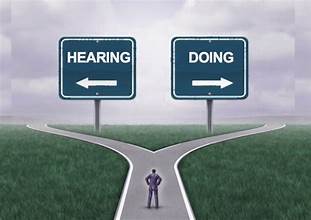
The difference between hearing and doing is huge!
Jesus’ illustration is borne out of his life experiences as a carpenter and craftsman. It is believable that he spent a portion of his life building homes, knowing the critical importance of a good foundation.
Theologian William Barclay wrote, “Only a house whose foundations are firm can withstand the storm; and only a life whose foundations are sure can stand the tests.”
Jesus tells us how to build that foundation…on hearing and on doing.
Jesus places value in the hearing. We cannot act upon what we do not know. Therefore, we must listen to God’s word. It is looking into the mirror of his word and seeing it for what it is. Again, it’s a great first step. Listening with intent takes us deeper than just hearing. The latter acknowledges God’s teaching. The former internalizes it.
Listening with intent to the word of God prepares for Jesus’ next command. Jesus wants us to be doers of his word. Knowledge only becomes relevant when we put it into action. Theory must be applied. Again, as Barclay writes, “Theology must become life.”
My cardiologist today told me to exercise more and lose weight. It does little good to go to the doctor in the first place if I’m not going to at least try to do what she instructs me to do. The same holds with my faith. It does little good to study God’s word if I don’t allow it to change my lifestyle and compel me to act.
It boils down to obedience, doesn’t it? For both my physical and spiritual health.
I have been guilty too many times of not hearing with intent. I suspect you have as well. Many people hear the word of God, but they don’t do anything with it. There are a lot of people who just enjoy listening to good preaching and teaching. That’s as far as it goes. They never really do anything with it. Call them “hearers of the word.” They listen, and listen, and listen — but it never leads them to DO what they’ve heard.
Again, hearing God’s word is a good thing, but it is not the end that God desires for us. James tells us that the one who hears with intent, never forgetting God’s word, the one will be blessed in what he does. This means the obedient person who does what God commands will find favor through a changed life. Will find blessings in the doing itself. Blessings in a life aligned with God’s will.
The blessing received by hearing and doing carries the biblical idea of shalom—being right with God and others. It is relational and spiritual. It also hints at blessings derived from an active and obedient faith that bears fruit in the life of the one who does and the lives of those he or she touches.
There’s the challenge James presents us. If all you and I are doing is hearing or reading or even studying God’s word, we might think we’re being a good follower of Christ, but we’re only deceiving ourselves, looking at ourselves in a mirror and walking away (vs. 22). Maybe it’s time we took the next step to become doers of the word!
Like Michael Jackson sang back in 1987 when he recorded Man in the Mirror:
I’m starting with the man in the mirror.
I’m asking him to change his ways.
And no message could have been any clearer.
If you want to make the world a better place
Just look at yourself then make a change.
May my life and yours be a reflection of Jesus and not a lot of “big talk and desk hammering.”
Thinking Points
When I read or hear God’s word, where do I most often stop short of actually doing what it calls me to do?
In what ways might I be mistaking familiarity with scripture for obedience to scripture?
How does Jesus’ picture of building on rock versus sand challenge the foundation upon which I’m currently building my life?
What is one concrete step I can take this week to move from “hearing” to “doing?”