Focal Passage: Genesis 12:7
I have some friends who are serious hikers. For several years, they head east to hike another leg of the Appalachian Trail. One hopes to complete the last 150 miles of his journey this year. The other still has 750 miles to go.
Robin and I are recreational hikers. Tackling such an ambitious goal is not in the cards or our legs, though we did hike about 15 feet of the Appalachian Trail when we visited the Great Smokey Mountains a couple of years ago. We have just short of 2,190 miles to go!
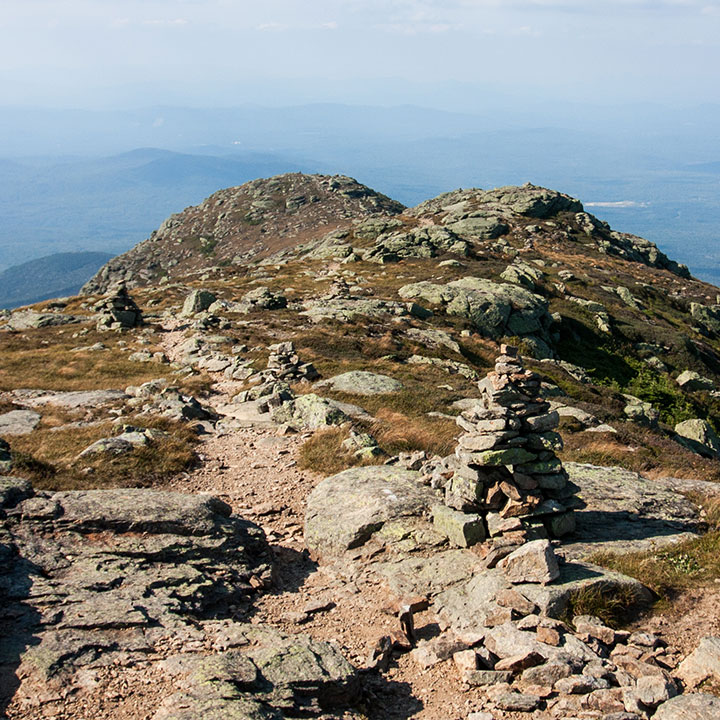
These hiker buddies tell me getting lost on the trail is a very real danger. To avoid losing the trail on rocky ground, they watch for cairns. A cairn is a pile of stones stacked carefully on top of one another, placed by rangers to guide hikers along the correct path.
We see something similar with altars. God’s people would gather stones to build an altar, not because the stones had significance, but because together they became a marker of an encounter with God—a memorial of faith, obedience or answered prayer. So, in one sense, these altars built of stone would keep them on the righteous path.
Altars are a common theme in the Old Testament, particularly in the story of Abraham’s life. God called him from a distant land, telling him to leave his country, his people and his family and go to a land that God would eventually show him and carrying a promise of blessing.
Eventually, Abraham reached a place called Shechem in Canaanite territory. When he arrived, God affirmed that this was the land he had promised to Abraham and his descendants. In Genesis 12:7 you find a small phrase showing Abraham’s response.
“…so he built an altar there…”
If you keep reading Abraham’s story, the phrase becomes a theme.
Time and time again in Genesis, Abraham builds an altar. Nothing dramatic (with one notable exception). No elaborate ritual. Just ordinary stones stacked in quiet response of God’s faithfulness. Those altars stand as markers along the trail of Abraham’s spiritual journey. In many ways, they show us how a believer grows through promise, identity, restoration, trust and obedience.
Promise
Go back to that passage in Genesis 12:7. Abraham entered Canaan, the land God promised him. Everything he owned he brought with him. The land belonged to others. God told him, “To your offspring I will give this land.”
Notice what Abraham doesn’t do. He doesn’t survey the land. He doesn’t secure its borders. He doesn’t call his men together to talk about conquest.
Instead, he worships in occupied territory. Bows before God in a place that does not yet reflect God’s reign. He stakes the ground spiritually before he ever possesses it physically. The altar at Shechem is built on promise alone. Abram has no deed. No visible guarantee. All he has is God’s word.
This is where faith begins, isn’t it? Before we see fulfillment, before we possess anything tangible, before circumstances shift in our favor, we build an altar on God’s promise alone.
Abraham’s altar is his way of saying, “God has spoken and that’s enough.”
There are seasons of life when God gives a promise, but not possession. In those moments, the question is simply this:
Will we build an altar anyway?
Identity
Afterward worshipping God in Shechem, Abraham moves his herd to a new place between Bethel and Ai. No new promise is given. No dramatic revelation follows. He is doing what a sheep herder does. He moves his flock to new grass. There, he pitches his tent and builds another altar. At this altar, scripture tells us he…
“called upon the name of the Lord.” (Genesis 12:8)
He is not worshiping this time in reaction to something new God has done. It establishes a pattern of worship for Abraham. It marks his identity. Among a people who worship pagan gods and a culture filled with competing loyalties, Abraham builds another altar establishing who he is and to whom he belongs.
You see, before faith is truly tested in the crucible of real life, it must be established, rooted in the fertile soil of God’s presence. The Bethel altar is Abraham declaring, “I belong to the Lord, not just in moments of revelation, but in daily life. It shifts the emphasis from event-driven faith to identity-driven faith.
Shechem is about what God said. Bethel is about who Abram is. There are seasons of life when we must firmly identify ourselves with God. When was the last time you built such an altar as a witness and testimony of the one to whom you belong?
Restoration
After these early steps of faith, Abraham falters. Famine sends him to Egypt where opposition feels formidable. Fear takes over. He misrepresents his relationship with Sarah. Now, the promise seems threatened by Abraham’s compromise.
When he finally returns to Canaan, he goes back to Bethel, the place where he declared his identity. I imagine the altar had fallen into disrepair during his time away. You can almost see Abraham rebuild the altar from fallen stones even as he rebuilt his identity with God. and he again…
“called upon the name of the Lord.” (Genesis 13:4)
This rebuilt altar is not about promises or identity. It is about restoration. Abraham returned to the place where faith burned brightest to rekindle what he had lost.
There is something profoundly hopeful here. The life of faith is not a straight upward climb, is it? The Father of Faith, as the writer of Hebrews describes him, stumbled just like we do. When he did, he repented. He didn’t hide in shame or construct a new path. He went back to first things. First love. First trust. First dependence. Picked up the stones and rebuilt the altar.
Abraham didn’t outgrow the altar. He returned to it. In that moment of worship Abraham found himself restored into fellowship with the God of the promise.
I don’t know about you. I’ve spent my time in Egypt—a time of fear-driven decisions or some other spiritual drift. The altar of restoration is a repentant desire to return. A desire to come back to the Lord.
The beauty of this part of Abraham’s story is there is no rebuke from God. No ending punishment. God simply receives his worship and opens his arms again to Abraham. If you need to reconnect with God today, if you need his restoration, pick up the stones. Rebuild the altar of your identity as a child of God.
Surrender
Just a few verses later, Abraham found himself at a crossroad with his nephew Lot. The land cannot sustain both families. As the elder, Abraham had the right of first choice. Instead, he let Lot decide where he wanted to settle his family and his herds.
Lot chose the lush Jordan Valley, leaving Abraham with the leftovers, land which appeared less desirable. After Lot departed, God reaffirmed his promise to Abraham and his children. Abraham then settled near Hebron and…
“…built an altar to the Lord…” (Genesis 13:18)
Maybe this altar represents surrender. Abraham had every right and reason to grasp what was his. Rather than claim his own, he yielded. He trusted that God’s promise didn’t depend on Abraham’s maneuvering or manipulation.
There is a deep spiritual maturity here. Early faith built an altar after hearing promise. Growing faith built an altar after losing its advantage.
Trust is not tested when everything aligns in our favor, but when we voluntarily relinquish control. The altar at Hebron said, “God’s blessing does not depend on my securing the best position.”
Surrendering means letting go of what looks better. Letting go of my assumed advantage to go where God has placed me. Faith means believing that what God assigns is better than what we could have chosen.
This altar was quieter than the first, but perhaps stronger. Abraham no longer needed visible superiority. He just needed to let go. Could you and I also need to let go of something we think we need in order to receive God’s fullest blessing? If so, let’s build an altar to God.
Obedience
The final altar was the most severe.
God commands Abraham to offer his son Isaac as a sacrifice—the very child through whom that original promise was to be fulfilled. This was no longer about land. It was about the promise itself.
When he arrived at Mt. Moriah, Abraham…
“…built an altar there…” (Gensis 22:9)
On Mt. Moriah, Abraham built another altar, one that would cost him everything. Earlier altars celebrated promise. This altar appeared to contradict it. Yet, Abraham obeyed. With each stone growing heavier in his hands and heart heaving in despair, Abraham’s faith grew deeper, even when he didn’t fully understand.
He didn’t argue. He didn’t delay. He built.
At the final critical moment, God provided a substitute. The altar became a place of revelation: “The Lord will provide.” Obedience revealed provision. Earlier altars revealed trust in God’s word. This one required trust in God’s character.
Faith ultimately laid everything on the altar before God, even everything that God himself had given.
When we step back and watch Abraham, we see a progression of faith.
Promise leads to worship.
Worship leads to identity.
Failure leads to restoration.
Restoration leads to surrender.
Surrender leads to obedience.
Altars mark the decisive moments in Abraham’s spiritual foundation. They are not monuments to achievement. Not even guideposts along the trail, at least not in the most important sense. They are testimonies to dependence on and connection with God.
The quiet message running beneath these passages is that faith is not defined by what we do, but by whom we worship. Abraham’s life was not secured by cleverness or control. It was shaped by repeated acts of worship. A lifestyle of worship.
We may no longer build literal altars of stone, but we need to erect our spiritual altars.
Build them in the place of promise before fulfillment.
Build them in the place where we chose to identify ourselves as children of God.
Build them where we return from wandering to a place of restoration.
Build them where we let go of our desires, surrendering to God’s control.
Build them where we obey without full understanding.
Perhaps the question for us is this simple: Where do you need to build your next altar?