Rest for the Weary

Background Passages: Mark 11:27-33: Mark 12:28-34; Matthew 11: 28-30

I wonder if Jesus ever walked into the temple in Jerusalem desiring only to offer his own prayers to the Father in the privacy of his heart. Did he ever just get to sit in the shade of the portico and listen to the well-versed teaching of the rabbi? If it happened, it did not happen often. His presence seemed always to elicit a response either from the people, begging for his words of truth, or from his persecutors, probing for a weakness in his teaching.

Hours before his arrest, Jesus might have entered the temple just to pray…to clear his mind for what was to come. Instead, he found himself surrounded by hate in a rustle of flowing and elegant robes. No pleasantries exchanged. No effort to pull him from the crowd that gathered that morning for a private talk. Jesus turned full circle studying the 15 or so men who hemmed him in…the chief priests, the most learned scholars of scripture and the temple leadership…each shouting an indignant challenge to the Galilean teacher they viewed as a substantial threat to their way of life.

“By what authority are you doing these things?” they asked. “And who gave you authority to do this?”

Those entering the temple turned on their heels not wishing to be dragged into the confrontation. Others trapped inside retreated to the walls or peaked from behind the broad columns lining the courtyard.

Jesus pursed his lips. Took a deep breath. Looked down at his sandaled feet, sensing the anger in their murmuring. He raised his head, stared intently into the face of the first one to utter the challenge. In a voice as soft as a sprinkle that threatened a downpour, Jesus said, “Let me ask you one question…” When he finished probing for a response, they huddled in confusion, knowing they had stepped into a trap of their own making.

After a minute of deliberation, the best response they came up with was, “We don’t know.”

Jesus turned again full circle with eyes that burned into their souls to see if any of the others could offer a better answer. When no one spoke, Jesus took a step forward, turned sideways and squeezed past the first row of robes as the others parted to give him room, and whispered to no one in particular, “Neither will I tell you by what authority I am doing these things.”

Delightfully cloaked in a religion of rule and regulation, the religious leaders of the day could not fathom the wonder of his miracles or the simplicity of Jesus’ teaching. It ran counter to all in which they believe. Counter to that which elevated them above the ordinary man struggling to comply with the multitude of laws the priests and teachers found so comforting.

These same men, or men just like them, constantly hovered on the fringe of the crowd as Jesus taught. One parable–about a vineyard and the workers who killed the master’s son when he came to collect what was owed–caught their attention. They gnashed their teeth when it became clear to them that Jesus viewed them as the unfaithful tenants.

As their anger grew they threw rapid fire questions at Jesus. “Should we pay taxes to Caesar?” “Will there be marriage after the resurrection?” Jesus answered and avoided their traps with a voice as strong as his accusers.

At one drawn out pause in the cancerous debate, a Pharisee stepped forward, arms stretched in front of him, palms up… a plea, a peace offering. The man looked back at the huddled Sadducees and smiled as if to say, “That was fun to watch.”

Jesus looked at him, puffed out his cheeks and exhaled audibly in relief, willing his heart to slow its beat. “Please. Sit.”

After a brief introduction, the Pharisee spoke with Jesus, intent upon understanding. “Of all the commandments in all the law, which is the most important?”

Jesus, who had spent the last three years trying to break down the wall the law had erected between God and his creation, smiled for the first time all day. Tears welled up in his eyes. At last, here was a question that merited his attention…an arrow that pierced the heart of the matter.

“The most important one,” answered Jesus, “is this: ‘Hear, O Israel, The Lord our God, the Lord is one. Love the Lord your God with all your heart and with all your soul and with all your mind and with all your strength.’ The second is this: ‘Love your neighbor as yourself.’ There is no commandment greater than these. All the Law and the Prophets hang on these two commandments.”

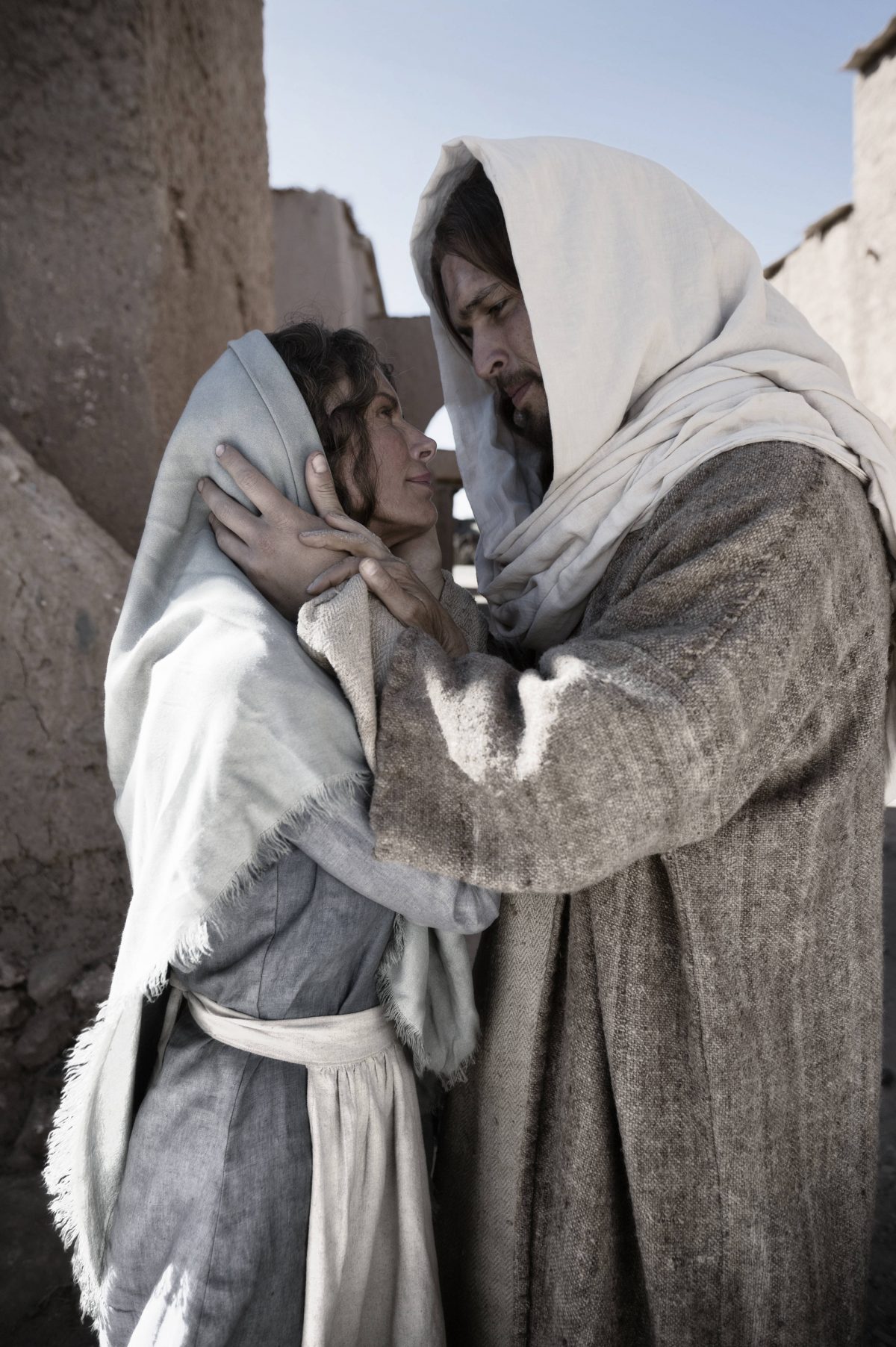
This conversation continued as Jesus and his new friend exchanged similar thoughts and ideas. It ended with a warm embrace and a word of encouragement. Jesus held the Pharisee at arms’ length and said, “You are not far from the kingdom of God.”

Life for the Sadducees and the Pharisees consisted of a set of rigorous rules and regulations no man could reasonably follow. Because their obsessive compulsive minds did it better than most, they held the ordinary man in contempt. Over time, arrogance led them to establish a hierarchy of goodness that carefully and permanently cemented them at the top of the pious pyramid, looking down upon and taking advantage of those failing to meet the stringent requirements the religious leaders imposed.

By the time Jesus arrived on earth, God’s original law and covenant lie buried under hundreds of rules of behavior almost impossible for anyone to obey. The burden of obedience drove people away from God rather than drawing them in. Jesus challenged this distortion of the law.

Noted psychologist Abraham Maslow explained the natural human tendency to be overly dependent on a narrow set of skills and resources when resolving issues in life. Maslow is generally quoted as saying, “I suppose it is tempting, if the only tool you have is a hammer, to treat everything as if it were a nail.”

Rule, ritual and regulation became religion’s hammer in an attempt to beat God’s people into submission. It was all they understood. Jesus addressed the issue as he met constant rejection from the religious leaders and people of Galilee throughout his ministry.

In a similar episode early in Jesus’ ministry, he mourned for the cities of Chorazin, Bethsaida and Capernaum saying that their absolute dependence on rule and ritual blinded them to the new truth of the good news he offered. Trying to help the people get past the legal barrier, Jesus said,

“Come to me, all you who are weary and burdened, and I will give you rest. Take my yoke upon you and learn from me, for I am gentle and humble in heart, and you will find rest for your souls. For my yoke is easy and my burden is light.”

As I read through the scripture I can see the thoughts as they developed in Jesus’ heart and mind. Trying to find a way to make his point, Jesus focused his eyes on a farmer in the distance, walking behind an ox pulling a plow through the rocky hillside. He heard the farmer shout and the animal bellow as they labored to cut through the sunbaked earth.

Jesus thought back to that carpentry shop in Nazareth. Remembered the farmer who came to him in need of a new yoke for his ox. A perfectionist in his craft, Jesus followed the farmer to his field where he sized up the animal, visualizing how he wanted this new yoke to fit upon those muscled shoulders.

He went back to his shop. Jesus took his plane from a shelf and began to shape a piece of oak to match the vision in his head. He sanded it smooth and attached the harness points in perfect balance to keep the reins from pulling the yoke to one side or the other.

I can see him as he hefted the yoke on his shoulder and took it to the farmer, carefully fitting it upon the ox, adjusting it to his shape. He gave the reins to the farmer and watched for a minute as the ox pulled the plow through the field. The yoke made the burden less onerous for both man and beast.

That memory spurred the words. “Come to me, all you who are weary and burdened…For my yoke is easy and my burden is light.”

Jesus spoke every day to people whose shoulders sagged under the remorseless pressure of compliance to a bulky set of rules. The Pharisees lived in a world of “do this…don’t do that,” of “yes to this…and no to that.” The people lived in a world, condemned by arbitrary rule, and ridiculed by the religious leaders for their personal failings.

Religion…faith…became a burden.

He faced the rebuke of the Pharisees when his disciples picked a little grain on the Sabbath to satisfy their hunger. He faced the challenge of religious leaders who chastised him for healing a man with a crippled hand on the Sabbath. Ultimately, in those last days, he battled with an entrenched enemy whose questions never addressed the heart of the matter.

Jesus tried time and time again to tell them. “It doesn’t have to be this hard. Love your God with your whole being. Love those around you as you love yourself.”

I read again this week of a man who said that being a Christian was just a bunch of rules designed to “suck the fun right out of life.” That statement always troubles me. Do we as Christians act like the religious leaders of the day forcing compliance to a set of “laws” we created to separate ourselves from others?

The joy of life is not conditioned by rules and regulations that tell you what you can or cannot do. Joy comes through relationships…first and foremost with God and then with others. If those two things fall into place, that which “sucks the joy out of life” disappears.

Walking with God need not be complicated. It need not be burdensome. When the master carpenter carves out your yoke and places it upon your shoulders, it fits like a glove, the burdens so much lighter.

Jesus countered the prevailing burden with a simple invitation to accept the salvation he offered…the life he offered. “Come to me…” It’s that simple. “…all who are wearied and burdened…” It’s that inclusive. “…I will give you rest…” It’s that rewarding.

Jesus extends a personal invitation to the lost who have not found him and to the found who have lost their way. Come to him. Erase the weariness from your heart. Then, love your God with all your being. Love your neighbor with the love God extends to you. Once done, life becomes joy.

A Righteous Woman of Influence

Background Passages: Luke 1: 26-38; Luke 1:46-55; Luke 2:22-40; John 2:1-12; and John 19:25-27

Mother’s Day lies just around the corner. I’m reminded of words spoken by the late Dr. Billy Graham speaking to the unique opportunity God gives women to influene and impact the lives of others in ways that few men can.

“There is nothing in this world more personal, as nurturing or as life-changing as the influence of a righteous woman.”

Don’t get me wrong, I’m not minimizing the man’s role in God’s world. When men allow God to rule their lives and women live out their call to righteous living there is a divine balance that makes the world a better place.

However, as most of us blessed with wonderful mothers can testify, Dr. Graham’s statement rings with the peal of abiding truth. I have felt it in my own life. The righteous influence of godly women…a wife, a mother, aunts, Sunday School teachers, public school teachers and countless friends…absolutely shaped and molded who I am, spiritually, professionally and personally. A new generation of women, led by my two amazing daughters-in-law, continue to teach me the things I need to know about being the man God needs me to be every day.

As I think of the women who influenced my life, I realized how blessed I am to have known so many women who believed in me. Women who supported me. Women who propped me up when I stood on the edge of failure. I think of the women who lifted me up at some point in my life with their presence…their words…their friendship…their touch…just when I needed to hear or feel it. Their influence is a tremendous gift in my life!

I’m convinced God placed these women in my life for a reason. Their influence in my life shifted from the piddling to the powerful because they live each day as righteous women.

So what does it mean to be a righteous woman of influence?

Of all the women of influence in the Bible I point you to Mary, the mother of Jesus. We, Baptists, fail to give Mary the credit she deserves for her unrecognized impact on Jesus’ life. Mary wasn’t perfect. She didn’t walk around with a halo above her head. She was certainly more than a simple vessel God used to carry his Son. To better understand Mary’s role, embrace the humanity of Jesus.

Let me explain. We tend to think of Jesus in the divine. We casually recognize his humanity, but we want to color it heavily with his godliness. We like to think Jesus was pulled from the womb without crying, speaking King James English and turning water into milk.

We don’t think of him as a baby with colic, crying through the night. A toddler who fell and bumped his head on the table Joseph built. A three-year-old disciplined for taking a toy from his little brother. We don’t think of him as a little boy scraping his knee while chasing a friend. As a teenager who thought that little Jewish girl down the street was pretty. We never consider that as a young, apprentice carpenter he one day bashed his thumb with a hammer, biting back the ugly word you and I might say.

If he came into the world to be like us, we have to embrace his human side…acknowledging the perfect way he dealt with all those very human situations. If we can fully accept Jesus’ humanity, that part of his personhood had a very human mother…one amazingly normal, human mother. The mother who lost it at times because she was up three nights in a row with a squalling baby. The mother who swatted the hand of a three-year-old for taking his brother’s toy. The mother who looked at that pretty little Jewish girl as a threat to her son. The mother who kissed the scraped knees and laughed at her son when he swallowed that ugly word after bashing his thumb.

If Mary was an ordinary, very human woman, why did God choose Mary to be the mother of his only begotten son? Why was she so “highly favored?”

I think God chose Mary because he knew the person she was. Knew the kind of mother she would be. God chose Mary because he knew she would love Jesus unconditionally. Knew she would teach him about life and model everything good in it. God chose Mary because she would stand beside him in the darkest hours of his life. He chose Mary above all others because she possessed the mother’s instinct to raise Jesus with the spiritual and moral integrity to tackle the mission God planned for him as the savior of the world.

God chose Mary because she lived as a righteous woman of influence.

Mary’s story begins in bizarre fashion. Not every woman could handle the news she heard. Mary possessed the spiritual depth to believe an implausible message.

It is one thing to accept the unlikely future while the angel speaks. It’s another thing to stay faithful when the angel disappears in the darkness. The rational side of Mary knew her pregnancy would bring a host of life-altering issues…ridicule and disgrace…embarrassment to her family…Joseph’s anger. What strikes me most about Mary’s response to the unexpected visit from the angel is that, in the end, she submits to the will of God with such obedience and trust. She said in response to all she heard,

”May it be to me as you have said.”

What an amazing moment of faith and obedience! Despite knowing the difficulties this decision posed in her life, she allowed God to work his will. How often do you think Jesus heard this story as he was growing up? Imagine the lesson of obedience and faith it taught him.

Still, like the disciples and like us, Mary struggled to understand God’s way of working out his redemptive plan. Her understanding of “Messiah” did not contemplate a tragic death. Though she heard it in the temple when Jesus was born, she did not anticipated a “sword would pierce her soul.” Even though she didn’t have Jesus all figured out, she grappled with the unknown, trusted God, and remained faithful to his call on her life.

More than once we see where Mary “pondered in her heart” all that happened around her. She did more than simply deliberate the meaning of a word or event. Rather, she watched, listened and thought about all that happened around her and her son in light of the message from the angel that night, in light of the words from the rabbi and prophetess in the temple. She constantly made the connections, determining how she could help make God’s plan come to pass in the life of her son. Not content to just let life happen, she laid the groundwork needed to bring it to pass.

At some point in Jesus’ life, Mary’s faith, obedience and trust, stood out as an encouragement to Jesus when he was struggling to follow God’s plan. Can’t you almost hear Mary’s words whispered in the Garden of Gethsemane as Jesus agonized over his impending death on the cross? I believe at such a time, Jesus recalled the words of his mother when she told the angel, “May it be to me as you said.” His prayer says, “Not my will, but yours…” the essence of obedience and trust…Mary’s model of faith that carried him through his most difficult times.

To be a woman of influence requires obedience to God and trust in his plan for your life.

GROUNDED IN AND GUIDED BY SCRIPTURE—MARY’S SONG
We encounter Mary again in scripture when she visits her aunt, Elizabeth. After they share each other’s miraculous stories of God’s blessing, Mary sings a song from her heart. Find in the words of Mary’s song the boldness to call for God’s justice in an oppressive, unjust world. Find in Mary’s song, the words and deeds of Jesus. She sings from Old Testament scripture, the traits of a living God:

“…you are mindful of me in my humble state…” Look at Jesus’ own humility before God.
“…scatters the proud…” Look at Jesus’ challenge to ritualistic faith of the Pharisees.
“…lifts up the humble.”… Look at how Jesus work so fervently for the poor and needy.
“…fills the hungry…” Look how Jesus fed the multitudes both physically and spiritually.
“…he is merciful…” Look how Jesus offered mercy to those who did not deserve it.

This was the image of God that Mary carried in her heart. Things she learned from scripture before the culture really allowed women to study God’s word. She internalized scripture she read or heard to the point where it shaped her life and ultimately the life of Jesus. That was the God she knew. That was the character of God she taught God’s son. I can imagine Mary singing her song to Jesus every night as she laid him in bed as a child, a poignant lullaby…embedding those godly virtues into his very being. Modeling it for him every day. In the end, her influence contributed to his role as the servant Messiah.

To be a righteous woman of influence ground yourself in scripture. Let it guide your actions. Share its meaning with those you love. Live out its lessons as you tend to the needs of others.

ENCOURAGING THE READY…THE WEDDING
We see Mary at the wedding in Cana. Mary tried to work through a potentially embarrassing situation when the host family ran out of wine. She brought the problem to Jesus.

Why would she do that? Jesus even asked her, “Why are you bothering me with this? My time has not come.” My mind sees Mary looking deeply in the eyes of Jesus without saying a word. Never taking her eyes off his, she spoke to the servant beside her, “Do whatever he says to do.” The twinkle in her eye and the crooked smile on her face signaled her belief that Jesus would do the right thing…every time. Her trust in him full and complete. That one look gave Jesus permission to be who he was intended to be. It is as if she were saying, “Now is as good a time as any, my son. I don’t need you as much as the world needs you. What are you waiting for?”

A woman becomes a righteous woman of influence by playing the role she plays…recognizing when it’s time to push the bird from the nest. Knowing when a simple word of encouragement to someone convinces them it is time to get started doing what God called them to do…time to take that leap of faith. Letting them know, “This is your time.”

DEEPLY LOVING AND BEING DEEPLY LOVED
The most endearing and enduring passage concerning Mary takes place at the foot of the cross. Scripture paints a vivid picture of a mother watching the son she raised and loved dying an agonizing death on the cross. A death she could not comprehend. Only a mother who lost a child can begin to fathom the emotional suffering Mary experiences as she hears his ragged breathing. Sees the pain etched on his features. Watches his life flow out with every drop of blood spilled on that rocky soil.

The words of Jesus from the cross whispered to John and Mary tell us everything about Mary’s influence on Jesus. “Behold your Mother.” “Behold your son.”

Jesus’ loved his mother so deeply he could not let death take him without ensuring that Mary would never be alone. Jesus recognized through his own pain the deep sorrow of one who loved him. Surely, while on that cross, there were flashbacks to every embrace, every kiss, every smile. Jesus hung on that cross, feeling like God had abandoned him, looking down on a mother who never could. A mother whose love was endless.

You become a righteous woman of influence when you love others so deeply that you are deeply loved in return.

My mom passed away 20 years ago. I cannot explain the magnitude of her impact on my life…my understanding of who I am…how I relate to others…the focus and purpose of my life.

I learned from her delightfully sarcastic sense of humor. Never mean-spirited, but always catching you off guard. Life needs laughter and it is always easiest to laugh at yourself if for no other reason but to avoid taking yourself too seriously.

She taught me to deeply respect the ability of women to be accomplished in any field, reminding me to keep capable, intelligent and independent women in my life. I loved it when she convinced my sister to leave the nursing field and become a medical doctor because she was smarter than most men with the degree.

She instilled in me an understanding that marriage was a partnership, promising to break my arm if she ever heard that I did not help with the housework.

She taught me about being a beloved grandparent. I loved how every minute she spent with our kids was personal and filled with joy. She was, after all, the one who sat on the floor with my boys and my brother’s girls and taught them to play poker.

Like Mary, my mom was obedient to her God, trusting him in all of life. Demonstrating her faith in the most difficult of times. She was able to do so because she was grounded in and guided by scripture, knowing just how to apply Christ’s teaching in the most practical of ways. Mom encouraged each of her children to pursue our dream and passion, instilling in us the belief that we could do anything. There were times when she pushed us with an impeccable sense of timing to start down the path God intended for us. In the end, Mom was loved deeply because she deeply loved.

Without a doubt, like Mary, my mom was one of those righteous women of influence.

I recently saw a posting on Facebook that said, “The fact that you are a woman doesn’t make you a different kind of Christian, but the fact that you are a Christian ought to make you a different kind of woman.”

Being a righteous woman of influence is a choice. Make it.

Living as a righteous woman of influence is a commitment. Live it.

The responsibility of being a righteous woman of influence is a gift from God. Claim it.


Wherever He Leads

Background Passages: Mark 8:27-36; Luke 9:18-25

Jesus slipped to the grass from the flat rock upon which he sat as he spent the last hour in prayer. The canopy of trees under which he now reclined with his back against the rock sheltered him from the late afternoon sun. Jesus glanced at his disciples gathered in a loose cluster about 40 feet further down the hill. As they finished their prayers one by one, they talked quietly among themselves, breaking out a small loaf of bread and passing it around, satisfying their hunger.

Jesus looked from his disciples down into the town of Caesarea Philippi, a bustling city 30 miles north of the region of Galilee. He watched the frenetic pace of the people as they finished the work of the day and headed home. He lifted his eyes toward the sheer cliff on the north side of the city. It rose 150 feet above the lush, green valley below. He knew the streamlet gushing from the massive grotto on the western edge of the cliff were the headwaters of the Jordan River as it flowed south to the Sea of Galilee.

The cavern was said to be the birthplace of Pan, the Greek god of nature. Worshippers still brought their offerings of fruit and grain, laying them at the altar.

His vision shifted to the gleaming temple of white marble which Philip, the region’s ruler, dedicated to Caesar Augustus, the Roman emperor whom the people considered a god. Before these temples and altars were built, Jesus knew his history well enough to know the whole area stood as a center dedicated to the worship of Baal, the ancient Canaanite god.

It was a deeply reflective moment. Jesus contemplated the scene spread across the valley below. Considered all he had done during his ministry. Felt his gut tighten when he thought about the cross to come. Had anything he said and done made a difference? Before he began his final journey to the cross Jesus needed to know. Did anyone really know who he was?

He turned to his disciples quietly talking and laughing in the ease of friendships forged by common experiences. His words cut through the comfortable conversation. “Who do the crowds say I am?”

They turned toward Jesus in a rustle of robes and shuffling feet. They were used to his probing. Knew an answer was required. “John the Baptist,” one blurted. “One of the old prophets brought back to life,” announced another. “Elijah,” another proclaimed.

Jesus glanced again at the city below, lost in thought for a moment. Then, he turned back to his disciples. “But what about you? Who do you say I am?”

Jesus held his breath, looking into the eyes of each of his closest friends. Their answers would make all the difference. Would he see blank stares of incomprehension? Would he catch so much as a spark of understanding that meant he had at least lit a torch in their hearts. He waited. Felt his heart thump anxiously in his chest.

How his soul must have soared when Peter stood among them, looked at his friends, then to Jesus, knowing that he answered for all of them. “You are the Messiah. The Anointed One of God.”

That moment sealed the deal for Jesus. He then taught them intently about the events to come. Suffering. Rejection. Death. Resurrection. Prophecies that left them frightened and confused. Then, he challenged them with words that echo still in the ears of every believer today.

“If anyone would come after me, he must deny himself and take up his cross daily and follow me. For whoever wants to save his life will lose it, but whoever loses his life for me will save it. What does it profit a man to gain the whole world and yet lose or forfeit his very soul?”

The call of Christ demands that we deny self. It’s not a matter of dismissing our lives as unworthy or inconsequential in the grand scheme of God’s plan. Denying ourselves means to set aside our egos. Deliberately subordinating our will to the will of God. Opening our lives to the possibility that his plan for us is greater and more meaningful than the one we planned for ourselves. It means turning from where we wish to go to follow the path he lays before us.

The call of Christ demands that we take up his cross. Not just any cross…his cross. Jesus knew the horror of what lay before him. When Jesus was a boy, a Jewish rebellion in Sepphoris, just four miles from Nazareth, ended badly for those who fought against the Roman empire. Historians tell us more than 2,000 rebels were crucified, set in lines along the roadside as a frightful reminder of the power of Rome.

To face the cross was a vicious reality burned into the back of his mind. He, as well as anyone, knew what it meant to take up the cross. It stood as the inevitable certainty he faced by declaring a kingdom of God that rocked the boats of the pious and the political.

Today, taking up the cross of Christ means to live our life with the same focused commitment to God’s purpose that Jesus did. It means preparing for rejection in a world that does not understand. Letting nothing… no thought of ridicule, persecution, or embarrassment…prevent us from doing that which we know God desires us to do. It means looking at a world that dismisses Jesus as irrelevant and proclaiming in word and deed, “I belong to Christ!”

Denying ourselves. Taking up his cross. These are steps in the right direction. If we stop there, however, we miss that which matters most. The call of Christ demands we follow. It means spending our lives, not hoarding it. It means giving of ourselves, not taking from others. It means not playing it safe, but doing the right thing at all times and in all situations. It means not getting by with as little as we can for the cause of Christ, but investing ourselves completely in his ministry.

The way of the world always seeks to gain advantage over another. The goal of the world is to amass more wealth, power and glory than the guy next door. Jesus would answer that unbridled ambition with this question. Where is the eternal profit in that way of life? Jesus said one saves his life when he loses it in service to others.

As believers in Christ we have been called to follow the lead of Christ, not always knowing where it will take us. Doors open and doors close. Following his lead is not always easy, but it is always best.

I’m reminded of the old invitational hymn, Wherever He Leads, I’ll Go, written in 1936 by Baylus Benjamin McKinney. He penned the words to his poem after meeting with the Rev. R.S. Jones, a South American missionary who had been pulled from service. Because of a serious illness, he would not be allowed to return.

“What will you do?” McKinney asked his friend.

“I don’t know, but wherever he leads, I’ll go.”

From a simple conversation between two old friends poured the words that challenge us…challenge me…today.

“Take up thy cross and follow me,”
I heard my master say;
“I gave my life to ransom thee,
Surrender your all today.”

He drew me closer to his side,
I sought his will to know,
And in that will I now abide,
Wherever he leads I’ll go.

It may be through shadows dim,
Or o’er the stormy sea,
I take my cross and follow him
Wherever he leadeth me.

My heart, my life, my all I bring,
To Christ who loves me so;
He is my master, Lord and king.
Wherever he leads I’ll go.

The chorus of the song declares, “I’ll follow my Christ who loves me so.”

Wherever he leads, let’s go.


Living as the Image of God

Background Passages: Genesis 1:27; John 14:9; Matthew 5:1-12

I pored through a number of old 35mm slides, pictures taken by my parents when my siblings and I were small. I enjoyed sharing those captured memories with my children and grandchildren. Fascination grew as we recognized family resemblances across generations…the power of genetics, I suppose. If I heard it once, I heard it several times, “I see your Dad in his eyes.” “You look so much like your uncle at that age.” “She is the spitting image of your mother.”

There is some measure of joy in knowing that we physically resemble those most dear to us. Then, I wonder, when others look at us, do they see how closely we resemble Christ in spirit and deed. Can the world see Jesus…see God…in us?

“So God created man in his own image,
in the image of God he created him;
male and female he created them.”

On the surface, being created in the image of God seems such a complex theological concept requiring a deeper understanding of the nature and spirit of the Creator himself. But, it’s really not that hard. Jesus told his disciples, “If you have seen me, you have seen the Father.” In other words, we find in the character of Jesus Christ, the very nature and spirit of God. The image of God reflected in the life of Christ. To be the image of God in our world, as we were created to be, simply requires us to be like Jesus.

So, how are we to know what that looks like?

Every gospel story reveals the character of Christ. We can identify in Jesus God’s compassion, love, faith, humility and honesty. We find in his teachings keys to living as the image of God.

People flocked to Jesus early in his ministry in Galilee, drawn by the candor and consistency of his teaching and the power of his healing. As he left Capernaum one day, the crowd pressed around him to hear his words and feel his touch. Eventually, somewhere on the northeastern shore of the Sea of Galilee, he sat himself down on a rocky hillside and began to teach. Matthew records this event as the Sermon on the Mount.

Rather than being a single event, the Sermon on the Mount may be a collection of ideas that Jesus taught over and over again throughout his ministry captured by Matthew as a summary of his teaching themes. William Barclay, in his commentaries, suggests as much.

One of the most beloved segments of this passage is known as The Beatitudes, a passage that unveils the character demanded of those who desire to be a part of the kingdom of God. When you look at the passage and look at the life of Christ, you’ll find that Jesus modeled each characteristic in his daily walk.

Blessed are the poor in spirit, for theirs is the kingdom of God.
Blessed are those who mourn, for they will be comforted.
Blessed are the meek, for they will inherit the earth.
Blessed are those who hunger and thirst after righteousness,
for they will be filled.
Blessed are the merciful, for they shall be shown mercy.
Blessed are the pure in heart, for they will see God.
Blessed are the peacemakers, for they will be called the sons of God.
Blessed are those who are persecuted because of righteousness,
for theirs is the kingdom of heaven.

Jesus teaches about kingdom living. Think of them as proverbs or declarations. Assuring us that we will feel blessed as a result of our actions or attitudes that align with the expectations of the Father. That demonstrating these character traits leads to promised rewards.

Consider the word “blessed.” Some translations substitute the word “happy” rather than “blessed.” But, “happy” feels too frivolous. Too superficial. Think, rather, in terms of the contentment, joy and peace that comes from being in right relationship with God. It cannot be dampened by external circumstances. Happiness may be a part of the equation, but take it deeper into the heart of our relationship with the Father. One commentary called being blessed “a pledge of divine reward for the inner spiritual character of the righteous.” I like that. Jesus promises that if we live in such a way as to reflect the character of Christ, we will be filled with inner peace and joy.

Let’s discuss the specific character demanded of those who would be a part of the kingdom of God and the promise that follows. Blessed are…

…poor in spirit.
To be poor in a financial sense is to be destitute. To be poor in a physical sense is to be oppressed. To be poor in the spirit is to be humbled, to live without arrogance or self-sufficiency. It speaks to the person who recognizes his or her sinful nature; who comes to God each day with a contrite heart; knowing that God’s grace is an unmerited gift that promises a life within the kingdom of God.

…those who mourn.
Everyone in this life will experience sadness and grief. Such mourning is a natural part of the ebb and flow of life. Here, Jesus speaks of those who mourn for a lost world; for the sinfulness that serves as a barrier separating us from God…from the relationship he desired with us when he created us. If we don’t grieve for the lost we will never feel compelled to share the love of Christ with a ruined world. God will provide comfort for those whose hearts break when confronted by sin and disbelief. Comfort which allows us to continue the hard work of reconciling a lost world to the one who loves them so much.

…the meek.
Think of meekness not as passivity or weakness. That is the world’s definition. Its first century meaning carries an idea of self-control…gentleness…kindness…all fruits of the spirit identified by Paul. The meek control their instincts and impulses, harnessing the passion and power within them to build and edify, to lift up rather than tear down. They see all things through the eyes of empathy, hearts free of evil intent and purpose. These are people who treat everyone with respect and dignity regardless of their station in life.

…those who hunger and thirst after righteousness.
Hunger and thirst represent our most primal needs. When truly hungry and thirsty, a body will do almost anything to secure food or drink. Little else seems to matter. To hunger and thirst for righteousness is to demonstrate that strongest spiritual desire to understand and act upon the will of God. Our passion to live for him takes precedence over anything else. Therein lies the promise. The one who seeks after God will have those needs satisfied. His or her life filled with the joy of knowing who walks beside you.

…the merciful.
Mercy is an act of grace. Despite our sinful ways, God offers his forgiveness, requiring only a contrite heart. It is pure, unmerited grace. Mercy is not a quality limited to God alone. As believers in Christ discover his forgiveness, mercy toward others ought to be a natural outgrowth of our hearts. People hurt us. Ignore us. Sin against us. Hate us. Persecute us. We face a choice: retaliate or redeem. Mercy finds expression in the kindness and compassion we extend even to those who hurt us. It is a quality borne out of the mercy God extended toward us even when we hurt him. As we forgive, so are we forgiven. That is the promise of God.

…pure in heart.
When the Bible speaks of the heart, it speaks to the center of will, the choices we make. Pure in heart means the decisions we make, the desires we hold, the intent of our thoughts and deeds must be unblemished with sin, wholly pleasing to God. The purity of our hearts lies at the center of every characteristic proclaimed in the beatitudes…our mercy, our quest for righteousness, our meekness and humility. Jesus told Nicodemus, “You must be born again” to suggest a spiritual change in his heart. To take that which was unclean and purify it from all self-interests and desires.

Jesus promises those who would listen that the pure in heart would see God. There is certainly within this statement a promise of our life eternal in the presence of the father. It might also suggest that the pure in heart have within them the capacity to see God in every circumstance…seeing his presence in life’s heartbreaks and horrors as well as its blessings and bounty.

…the peacemakers.
The kingdom of God is a kingdom of peace and yet we are too often at war with one another. The broken relationships, the societal divisions, the political acrimony, the racial bigotry drive a wedge between God’s people. Joy comes to those who find ways of bringing people together in the love of Christ, reconciling others to God and to one another. This statement promises the peacemakers will be called Sons of God.” The Old Testament called angels the Sons of God. Angel may be an apt description of those who act as God’s peacemakers.

…the persecuted.
Living a lifestyle exemplified by the characteristics listed in the beatitudes puts one in a precarious place. The life God demands of his children is a life the world opposes and rejects. All who identify with Christ face a hostile world that tolerates in the best of times and terrorizes in its worst. God offers a promise to those who face such opposition. Hold on. Run the race. Keep the faith. God’s kingdom is yours forever.

I go back to the beginning. We are to live as the image of God. That’s how he created us. We discover how to do that by looking at the life of Christ and paying attention to his teachings. Throughout his ministry Jesus taught us how to live and modeled those choices every day of his life. He lived and breathed every action and attitude he taught in the beatitudes. If we are to live like him, as the image of God, we ought to do the same.

The promise of the beatitudes is not a pie-in-the-sky, wait-for-it, kind of promise. Barclay writes, “…the beatitudes are not pious hopes of what shall be; they are not glowing but nebulous prophecies of some future bliss; they are congratulations on what is…It is a blessedness (a joy and peace) which exists here and now.”

Blessed are those who live as the image of God. Live it and claim the promise.


Whose Neighbor Can I Be

Background Passages: Luke 10:25-37; Mark 12:28-34; Matthew 7:12

“What must I do to inherit eternal life?”

The question, shouted by an expert in the law, quieted the intimate conversation Jesus was having with the small crowd that gathered around the Galilean teacher. Heads turned toward the booming voice coming from the edge of the crowd. The man hiked up his flowing robe, pushed himself away from the large rock he leaned against, moving forward until he towered over Jesus who was sitting on a cedar log.

Jesus had noticed him skirting the periphery of the crowd for the past three days. Listening without hearing. Rolling his eyes. Biting his tongue. Biding his time. He was among a small group of Pharisees tracking Jesus from Jericho on his way to Jerusalem. They weren’t there to understand Jesus and his teaching. They were there to find fault in his words in an effort to discredit him in the eyes of the people.

Though the scribe asked a good question, it lacked in sincerity. Uttered by one who loved to hear his own voice. Seeking a specific answer. Hoping for something heretical. Jesus looked at the man for a moment and smiled. “What does the law say? How do you read it?” giving the man his moment in the spotlight.

The scribe turned to the crowd and confidently proclaimed, “Love the Lord your God with all your heart and with all your soul and with all your strength and with all your mind; and ‘love your neighbor as yourself.’” With a self-satisfied grin, he turned back to face Jesus, challenging him to disagree.

“You’re absolutely right,” Jesus answered. “Do this and you will have eternal life.” Jesus sat silently, his eyes never wavering from the eyes of the Pharisee. As the silence deepened, the scribe shuffled his feet. He did not get the answer he was expecting from the teacher. His eyes flashed as he fell back on his legal training, focusing his attack from a different angle. “Ahh, and just who is my neighbor?”

Jesus’ lips tightened and he let out a slow breath through his nostrils. For all he understood of God’s greatest commandments to his people, the lawyer limited its universal truth by qualify its spirit.

What Jesus speaks next is perhaps one of the most well-known parables he ever shared. The parable of the Good Samaritan transcends religious conversation, working its way into a secular context. Good Samaritan laws protect those who lend assistance in life-threatening situations. Those who go out of their way to help another are called good Samaritans.”

Here’s the gist of the story Jesus told.

A man traveling alone from Jerusalem to Jericho was attacked by robbers who beat him senseless and took his clothes and his money. They threw him in the ditch next to the road, bleeding , broken and near death. At separate times, a Jewish priest and a temple administrator happened upon the scene of the crime. They pretended not to see the man lying in the ditch. They averted their eyes, shuffled to the other side of the road and quickened their pace, ignoring the man in distress. Out of sight. Out of mind.

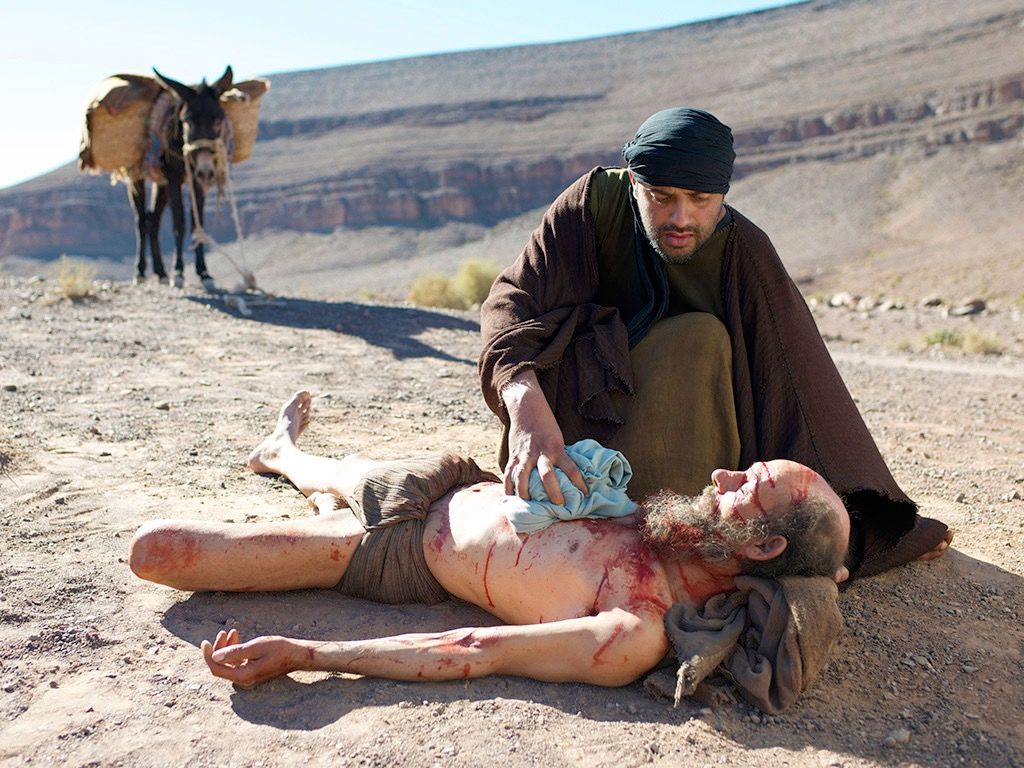
Later, a Samaritan on his way to Jericho came across the bleeding man. Compassion ruled the moment and the Samaritan jumped into the ditch to render aid. He cleaned the man’s cuts and bruises with his oil and wine and tore the hem of his garment to bandage the man’s wounds. He lifted the injured man onto his own donkey and walked him miles into the city. He took the man to an inn, nursing his needs throughout the night. The next morning, the Samaritan paid the innkeeper to watch over the man, promising to cover any additional costs the innkeeper incurred when the Samaritan returned.

Jesus told the story to the crowd gathered around him. He looked into the faces of every person around him. Finally, his eyes bore into the eyes of the scribe still standing in the middle. Jesus’ eyes narrowed and his voice lowered an octave. His next question landed like a heavy weight upon the man’s chest, crushing the breath from his lungs. “Which of these three do you think was a neighbor to the man who fell in to the hands of the robbers?”

I picture the man opening and closing his mouth like a fish out of water, fully aware that he had been outfoxed by the master teacher. His brain flashed in overdrive as he tried to think of a snappy comeback. Unable to give credit to a hated Samaritan, he answered in little more than a grudging whisper. “The one who showed mercy on him.”

The lengthy conversation between Jesus and the scribe must have inspired those who sat around and watched it unfold. The parable shared by Jesus subtly suggesting that faith is best demonstrated, not by grand theological arguments, but by the things we do for others. And, it is a message that echoes loudly today. A lesson I still need to learn at times.

Here’s the thing. The scribe asked a great question in the beginning. It is the fundamental question all of us who long for meaning in life should ask. “How do I find eternal life?” Ironically, he gave the same answer that Jesus gave to another group of Pharisees who questioned him about God’s greatest commandments (Mark 12:28-34). Had the man stopped to consider the meaning and spirit of the words he spoke, the whole conversation might have taken a different and better turn.

His second question, however, reveals an exclusionary faith. “Who is my neighbor?” is a question that seeks to limit our compassion…creating boundaries that give us an out. “Who is my neighbor?” suggests that some groups or some individuals are unworthy of my time and effort.

The scribe practiced a ritualized religion based on man-made rules that identified peoples that the law considered unclean and unworthy of God’s love. The Pharisees and scribes knew Jesus frequently associated with tax collectors, Samaritans, Gentiles, lepers, outcasts and outlaws. When the scribe asked his question, I suspect he hoped Jesus might identify as a neighbor one among this group of the unclean which Jewish law excluded from fellowship.

We often fall into the same trap as the scribe. Surely my “neighbor” only includes those people with whom I have a relationship…those who look like me…those who live in my social circle…my own racial subset, those for whom I can give money, but not get my hands dirty…those whose needs do not inconvenience me.

Jesus rejects that view. In Jesus’ parable, the Samaritan showed compassion and mercy to the injured man even though society considered the Samaritan an outcast and unworthy of God’s love. So, from Jesus’ standpoint, the question is not “Who is my neighbor,” but rather, “Whose neighbor can I be?”

It’s not a matter of identifying the person I wish to help. It’s a matter of looking for the unfolding opportunities God places before me where I can serve my God and my fellow man. Determining whose neighbor I can be demands that I step outside my comfort zone…insists that I engage with those whose backgrounds and cultures differ significantly from mine…mandates that I move past the safety of simple charitable giving to immerse myself in the gritty world of need in which others live.

Jesus defined our “neighbor” when he addressed the Pharisees in Mark. “Love your neighbor as you love yourself.” Find the definition also encompassed in the Golden Rule. “Do unto others (your neighbor) as you would have others do unto you.” Both verses suggest an empathy that allows us to see ourselves in the circumstances experienced by someone else. Except for the grace of God we could find ourselves in similar circumstances. That realization should compel us to provide the help and assistance to another in need that we desire in our most desperate times.

In essence Jesus asked the scribe to abandon the smooth road ritualized religion and live in the dirty ditch of practical and powerful faith. Forget about qualifying those we choose to help. Look instead for the chance to change the course of another’s life.

It’s a good question.

Whose neighbor can you be?


From the Author: If you would like to receive these devotional thoughts via email, simply subscribe to “The Searcher” by registering your email on the “Subscription” link on the right side of this page.

Peace on Earth

Background Passages: Luke 2:1-14; John 14:27

The young man leaned against a boulder, resting his head upon his arms as his calloused hands gripped the shepherd’s staff held in front of him. The quiet of the night interrupted by the soft bleating of a ewe calling for his lamb. The nearby campfires set around the hillside illuminated the measured steps of his friends standing watch around the flock. He found comfort in their presence.

Without warning, an angel in radiant garments, appeared among them, night’s shadows chased away by the brilliance of God’s glory. Stricken with fear, the shepherds dropped to the ground. “Do not be afraid,” the angel said with a voice calm and clear. “I bring you tidings of great joy for all the people. Today, in the city of David, a Savior is born to you. He is the Messiah, the Lord.”

As soon as he made his announcement, a great host of angels surrounded them, singing praises to God of his unsurpassed greatness and declaring “peace to all on earth on whom God’s favor rests.”

From the moment the angel declared the birth of God’s own Son, we have longed for the promised peace. When we look past the tinsel and trappings of the season into the world around us, the angel’s words of good cheer and peace seem elusive at best. The fault lies not with the angel’s pronouncement, nor with God’s promise. Rather, the failure lies in our definition of peace.

Jesus’ birth did not usher in a time of peace. The savior was born in a region consumed by strife for hundreds of years. The Roman conquerors, just the latest in a long line of foreign rulers, kept a heavy hand upon Judea. Herod, the appointed king of Judea, feared any and every rival, eventually calling for the death of every child under the age of two. Jesus’ parents fled to Egypt. No, Jesus’ world was hardly a place of peace.

Throughout his life and ministry Jesus encountered suspicion and hatred, ultimately leading to his death on a cross and the persecution of his followers. Upon hearing of the declaration to the shepherds, the casual observer might ask, “Where is the promised peace?”

Nineteen centuries later, the world watched as the United States of America tore itself apart in a ugly Civil War, fought to end the enslavement of one people by another. During this brutal time, the eldest son of Henry Wadsworth Longfellow, the famed American poet, enlisted in the Union army without his father’s permission. Young Wadsworth suffered a severe wound at a battle in Virginia.

As a result, our poet wrote Christmas Bells, a poem later put to music and renamed, I Heard the Bells on Christmas Day. It begins with a declaration of the popular seasonal sentiment of peace on earth before decrying the reality of war and violence. The sullen lyrics proclaim, “And in despair, I bowed my head; ‘There is no peace on earth,’ I said; ‘For hate is strong, and mocks the song of peace on earth, good will to men.’” The casual reader might hear the song and ask, “Where is the promised peace?”

Understand clearly, Jesus’ birth remains one of earth’s most amazing events and marks the beginning of the final expression of God’s plan for bringing salvation to the world. It did not then, and does not now, end the disharmony among men. Turn on the television and listen to the divisive conversations. See the reports of warfare and violence across the globe. The casual observer might ask, “Where is the promised peace?”

God calls us to live in harmony today with one another, to love our neighbors and our enemies, but this is not the peace of Christmas. God’s promised peace is not found in our external relationships. God’s perfect peace is internal…in the heart of every believer…and it is eternal…in the life everlasting he promised through his son, Jesus Christ.

As he prepared for his death on the cross, Jesus comforted his disciples. “Peace I leave with you; my peace I give you. I do not give to you as the world gives.” Then, he echoed the words of the angels to the shepherds, “Do not let your hearts be troubled and do not be afraid.”

While the world’s discord ought to concern us and our lives ought to be about bridging those damaged and fragile relationships, we tend to live in fear of the anger that exists among us. God reminds us often in scripture, “Do not be afraid.” Fear is overcome by living as God desires us to live.

God loves it when we live obedient to his will. It pleases him. We find the peace and contentment he promised while here on earth only when living in the light of his will for our lives. It is not the absence of conflict as the best peace given by the world. It is the peace he gives us as his spirit lives within our hearts in the here and now.

The baby God sent to lie in the manger in Bethlehem, the one the angels proclaimed as the Messiah, brought God’s gift of grace and salvation to a hateful world so that those who would place faith and trust in him would find true peace…not just in the present day, but for all eternity.

In the end, Wordsworth’s expressed pessimism yielded to the promise of the baby in the manger. His last stanza declares our greatest hope. Where is the peace? It is found in these words.

Then rang the bells more loud and deep.
God is not dead, nor doth He sleep.
The wrong shall fail, the right prevail,
With peace on earth, good will to men.

Then ringing, singing on its way,
The world revolved from night to day.
A voice, a chime, a chant sublime
Of peace on earth, good will to men.

Listen to my favorite rendition of this Christmas classic by Casting Crowns.

God is still in control and his victory over all that is wrong is assured. In Christmas we catch a glimpse of what we can be. In Christmas we bury that which divides us to find a brief respite from the rancor that rules the year. In Christmas we find peace that only a life committed to Christ can find. Because of Christmas we rest in God’s promise of eternal peace.

This is my prayer for you this Christmas.

Prayer Warriors

Background Passages: Colossians 1:7-8; 4:12-13; Philemon 23; James 2:14-16

The great Protestant reformer, Martin Luther learned the need for deep spiritual concentration in prayer from his dog, Klutz. Luther said, “If I could only pray the way this dog watches meat …(beyond that one thing) he has no thought, wish or hope.” Effective prayer requires a singular focus.

One such prayer warrior, casually mentioned in scripture, poured his every thought, wish and hope into his passionate prayers for the believers in Colossae. Consider the example of Epaphras.

I suspect the long journey to Rome gave him time to reflect on the troubles plaguing the Colossian church as it resisted the heretical attacks of those who misunderstood and misapplied the gospel of Christ. After his conversion experience in Ephesus experienced at the feet of Paul, Epaphras took his missionary zeal 100 miles west to the cities of Colossae, Laodicea and Hierapolis.

As it was in other areas, the spread of Christianity faced a host of problems caused by those who wished to assimilate Christ’s teachings into the prevailing religions or philosophies of the day. Some Jewish leaders embraced the teachings of Christ to a point, but insisted that Jewish laws, rituals and traditions be embraced as a condition of salvation. Some Gentiles attempted to blend Greco/Roman philosophies with Christian teaching, but proclaiming a “secret knowledge” that made them more in tune with God. Other philosophers tried to meld Christian humility and servanthood with the joyless stoicism of self-denial.

Faced with all of these pressures upon the churches he served, Epaphras boarded a boat to Rome intent upon sharing his concerns with Paul, his spiritual mentor and guide. When Paul heard of the difficulties in the church, he penned a letter addressed to the churches providing instruction from the apostle to the believers. In the book of Colossians, Paul encouraging them to set aside the false teachings and focus instead on the teachings of Christ.

As he closed his letter to the Colossian church, Paul spoke highly of Epaphras, one of only three times this dedicated pastor was mentioned in the Bible. In the brief biblical references to Epaphras, he is called “servant of Christ Jesus,” “our beloved fellow servant,” “faithful minister” and “my fellow prisoner.”

Paul held this man of faith in high esteem, considering him a valuable member of the ministry team and a personal encouragement in his life. However, Paul’s reference to his friend reveals a great deal about Epaphras that I find instructive. He wrote,

“Epaphras, who is one of you and a servant of Christ Jesus, sends greetings. He is always wrestling in prayer for you, that you may stand firm in all the will of God, mature and fully assured. I vouch for him that he is working hard for you and for those in Laodicea and Hierapolis.”

Epaphras understood what we tend to forget. Our prayers tend to be incident specific, offered during times of personal need or want. Our prayers tend to be generic as we intercede for “them,” those whose struggles we see, but never really touch. Epaphras prayed differently.

Paul said, “He is always wrestling in prayer for you…” He offered prayers of intercession, lifting his congregation to the throne of God, laying their needs at the feet of Christ. Knowing what they faced…knowing that great was their need for the Spirit’s presence at a time when false teachers were pulling them in all directions…Epaphras prayed.

I suspect he did more than pray for the generic spiritual health of his church. He knew his people, his friends. He knew the unique struggles each individual faced. He knew their personal hurts, their unique desires, their individual weakness. He knew their joy, their devotion, their strengths. He prayed for each member of his congregation that God’s presence might be felt. God’s voice heard. God’s will obeyed.

How much more effective would our prayer life be if our first thought was not for our own needs or for a faceless crowd, but for the specific needs of the one? Praying not just for the universal needs of the Christian community, but for specific friends and family we know caught between the loving arms of God and the selfish pull of the world. Praying for friends and family that God’s joy might be made complete in them.

We learn another truth from this passage. “He is always wrestling in prayer for you,” Paul wrote. Epaphras prayed persistently and continuously for his people, lifting them up constantly to the Father. So great was his love for his congregation, their situation remained at the forefront of his heart. Though miles separated Rome from Colossae, Epaphras could not take his mind off their struggles. When you know those you care for are under spiritual attack and you cannot stand physically by their side, prayer provides a connection one to the other, linking your heart to theirs.

Thessalonians reminds us to “pray without ceasing,” not so a forgetful God will be reminded of our requests, but that we remain connected to those we love through a spiritual life line. Persistent and continuous prayer for another never allows the needs of another to get buried beneath the bustle of daily life.

Epaphras knew that effective prayer is labor intensive. Paul said, “He is always wrestling in prayer for you.” This servant of Jesus Christ agonized over the souls of those for whom he was responsible. They were that important to him. He carried their burdens as his own and that heavy responsibility left him seeking answers day in and day out, desperate to discover what he could say or do to bolster their faith and give them strength.

The word “wrestle” found in this text comes from a Greek word meaning “to agonize.” In a real sense, it paints a picture of competing for a prize. Figuratively, it suggests fighting an adversary. Both concepts ring true. The false teachers threatened the work of God’s grace, eternity’s highest prize, in the daily life of the Colossians. Those Epaphras opposed stood as enemies of the faith. True adversaries. He would fight them with every spiritual weapon at his disposal. Praying for the Colossians brought heartbreak and pain. The danger to their faith was never more real.

Epaphras labored in prayer over Colossae, Laodicea, and Hierapolis. Stretching his mind, his heart, his spirit and his soul, Epaphras’ prayers consumed his time, drew upon his strength and challenged his commitment.

Prayer that fails to burden the soul echoes as a hollow sound. Epaphras teaches us that prayer should compel us to go to the mat for those in need and should define who we are and that for which we stand.

Epaphras prayed specifically and intelligently for the people. He prayed that in the face of all that opposed them, they might “stand firm” in the will of God. That their faith might be “mature” and “fully assured” as they withstand the assault on their beliefs. We might have prayed for God’s blessing upon them, or God’s peace and presence… and God would hear that prayer. However, Epaphras prayed for specific manifestations of their faith in a troubled time. His prayer came with a stated purpose for personal spiritual growth and confidence that they did not walk alone.

The most effective prayers we utter are those that are backed by our own hard work. Paul reminded the Colossians of their pastor’s tireless effort on their behalf. “I vouch for him that he is working hard for you and those in Laodicea and Hierapolis.” It wasn’t enough to lay his concerns before God, Epaphras set out to make those prayers a reality in the lives of those he loved. He worked. He worked hard as God’s hands and feet to make his prayers a reality.

James tells us of the link between faith and works. “Suppose a brother or sister is without clothes and daily food. If one of you says, ‘Go, I wish you well; keep warm and well fed,’ but does nothing about his physical needs, what good is it?”

I suspect the same is true of our prayers. Casual prayers of blessing for those we know who are struggling sound like we simply wish them well. We need to back our prayers with our actions. In this way we serve as God’s conduit for the answers he provides.

Every day we encounter someone who lives life in turmoil. Will we wrestle constantly in prayer for the heart that is broken? Will we put ourselves to work to ensure that our prayers actually touch a life of another? Can we go to God with such fervor and focus there exists no greater thought, wish or hope beyond that for which we pray?

The lesson taught by this obscure Christian giant is a good one. Whose Epaphras will you be?

*****

Author’s Note: This devotional thought is the third in a series of posts about some of the unsung heroes of the New Testament. These men and women, in many ways, carried the responsibility of the spread of the gospel in first 50 years after the ministry of Christ. By putting together the limited biblical references to their work and filling in the gaps with a little imagination, we find ways in which we, as ordinary Christians, can find in the examples they set our own heart for ministry.

If you read this blog through my feeds on Facebook, Linked In or Twitter, you can subscribe to my blog and receive my blog twice a month via your email. Your email is not shared with anyone. Scroll up the right side of this page to the Subscriber link. Type in your email address and click on the “Subscribe” button. It’s as simple as that. You will then receive an email link every time I post something new. Thanks for reading.


‘Little Faith’

Background Passages: Matthew 14:22-36; Mark 6:45-52; John 6:15-21

As I write today from the safety of my home in Pasadena, Texas, Hurricane Harvey slammed into the central Texas coast as a Category 4 storm. Our prayers go out to those most impacted by the storm. Here, the heavy rains began to fall last night and continue off and on this morning.

I’m reminded of friends who have children serving in the United States Coast Guard. Their search and rescue teams prepare themselves for moments like this. As the storm rages, there is all too often a boat unable to outrun the storm, putting lives of those aboard in jeopardy.

I’m amazed at the men and women who fly out in helicopters or battle the breaking waves in Coast Guard vessels to put their lives on the line for those trapped in the storm. I can’t begin to imagine the bravery required to drop into those rough waters to rescue a stranger in despair. Those heroes will tell you that their work is less a matter of bravery as it is focus and training.

The Bible tells us a story of a raging storm that threatened a small boat and its crew of 12 men. I heard it first as a child and it remains one of my favorite Bible stories today. It happened at a time when there was no Coast Guard to offer assistance. The full account of the dramatic event can be found in three of the four gospels.

Hours before this story actually began, Jesus fed more than five thousand people with a prayer and a small basket of bread and fish. The crowd saw his miracles, but missed the meaning of his message. John tells us they wanted to make him king on the spot. Jesus considered such talk a distraction and determined to avoid the temptation to abandon his Father’s purpose. Dismissing the multitude, Jesus sent his disciples across the Sea of Galilee while he went up on the mountain to get away from the distraction and pray. To focus again on what God called him to do.

That night as the disciples headed toward Capernaum on the northwest shore of the sea, a strong wind blew, turning the placid water into an untamed tempest. For hours the 12 disciples fought the storm, water-soaked and weary. They made little headway. Still miles from the safety of the shore, battered by wave and water, tired to the bone, a ghostly apparition approached their vessel. The disciples cried out in terror, certain the figure was an omen of doom.

Above the roar of the storm, they heard a voice, “Take courage! It is I. Do not fear.”

Peter, recognizing the voice of Jesus, asked his master’s permission to join him on the water. Jesus called out to him, “Come.” I cannot imagine the thoughts running through his head as he threw himself overboard into the teeth of the storm. With a hand on the wale of the boat, Peter leaped into the roiling sea at the invitation of Jesus and began to walk on the waves.

Peter sloshed through the waves toward Jesus. Waves crashed around his ankles with every step. The warning cries of his friends turned into stunned silence as Peter walked determinedly through the storm. In one devastating moment, a breaking wave splashed across his face or a flash of lightning and a cascade of thunder drew his attention to the storm swirling around him. Peter took his eyes off his Lord. As he sank into the sea, sputtering in fear as each wave crashed over his head, Peter called out for Jesus to save him.

Matthew says that no sooner had Peter voiced his plea, Jesus stretched out his hand, raising Peter once again to the surface of the waves. Peter clung to Jesus’ arm. He coughed and sputtered, spewing salty seawater from his lungs. Jesus’ words as he lifted Peter into the safety of his arms seemed to condemn the disciple. “You of little faith.” A reprimand. A put down.

According to one commentary, those four little words that seem to convey disappointment in English, are rendered in two words in the original Greek. “Little Faith.” Almost a term of endearment. A lighthearted teasing among great friends. “Why do you doubt?”

Then, Peter, arm and arm with Christ, walked again on water as Jesus took him back to the boat…while the waves continued to crash and the wind continued to blow. It wasn’t until they climbed back aboard that the storm ceased.

This wonderful story reminds me of three things.

Think about it. At that stormy moment when Jesus said, “Come,” the water, to Peter, seemed a safer place to be than the boat. With his eyes locked on Jesus, the wind and waves were less daunting. In fact, with his eyes on Jesus, Peter no longer noticed the storm raging around him.

As Peter jumped from the boat and began walking toward Jesus, the storm kept blowing. The tempest didn’t stop when his feet touched the sea. Rather, Peter quit looking at the obvious and turned his eyes on Jesus. For those few seconds, his faith blocked out the howling wind and the crashing waves.

Following Christ requires a measure of courage. A leap of faith if you will. Heller Keller said, “Life is either a daring adventure, or it is nothing at all.” Born without sight, hearing or speech, Keller overcame every obstacle to inspire millions to live a courageous life.

Peter, like the rest of the disciple band, feared for his life in the worst of the storm. Yet, when his eyes locked on Jesus and he heard his call to “Come,” Peter’s fear evaporated and he threw himself upon the waves without hesitation, another step in a daring adventure. The rest of the disciples continued to cling to the boat under a cloud of dread and despair. Peter’s first step was a courageous act of faith.

Life is a risky endeavor. God calls us to act on faith. Taking steps into the dark waters. Not settling for less. Not accepting the status quo. When we hear the spirit’s call to “Come,” we must jump out of the boat. If God calls, the boat is no longer the safest place for us to be. Those of us who are unwilling to take risks, will never discover the exhilaration of walking on water…of discovering what living in faith is all about. We will never have all the answers before we make our decisions. Faith remains a mystery if we wait until we have all the answers. There is power for us in that first lesson.

There is more this story can teach us.

Whether the water splashed against his cheek or the wind picked up its intensity, Peter lost his focus. When he looked away from Jesus and into the teeth of the storm, he lost his courage. He feared for his life. He sank into the sea. How easy it is to become distracted, especially when the storm around us is raging. Our concentration on Christ breaks. We focus instead on the problems we face.

Life is filled with turmoil. Issues that distract us from that which God wants us to do. In those times, our natural impulse is to allow our fear to trump our faith. We must resist those distractions. If the Coast Guardsman focused on the strength of the waves, he might never jump into the water.

Jesus and Peter provide two ways of dealing with distractions. When, the multitude wished to make Jesus their king, Jesus sent them away. He removed himself from that which might distract him and went up to the mountain to pray. There are certainly times when we can leave the distraction behind and spend time in prayer to the Father.

Like Peter, however, there are times when the distractions press so hard on our hearts that we begin to falter in our faith. The problems are beyond our control and tend to overwhelm our senses. Peter made it through the storm as long as he kept his eyes on Jesus. When the storm intruded into the peace in his heart, Peter lost it. Lost his focus. Lost his connection to Christ. As hard as it may be at times, we must always keep our eyes on our Lord, especially when we’re in the middle of one of life’s many storms.

There is one final message that shines like a beacon in the stormy night. When Peter found himself treading water, he called to Jesus for rescue. In his deepest fear, he knew to whom he must call. With an outstretched arm, Jesus lifted Peter from the water and…here’s a point we often miss…Peter and Jesus walked together, back through the storm, and climbed into the boat. It was only then, that the winds stopped blowing and the waves stopped crashing.

Faith does not dissipate the storm. Just because our fear grips us as the ill wind blows, Jesus does not take the storm away or remove us from its impact. Rather, he lifts us from our deepest despair and walks with us through the waves that would engulf us.

Christ does not abandon his followers to the storm. When needed, he reaches out for us. Challenging us rather than chiding us, he calls us, “Little Faith.” He probes our hearts, “Why do you doubt?” And, to prove his point, he walks with us on top of the water until the winds no longer blow.

So, here are the questions I must ask myself.

When he says to me, “Come,” will I jump from the boat? Will I walk on water?

As I live my life of faith, will I keep my eyes on Jesus or will I let the storms that come distract me from the life he has called me to lead?

When I falter, and I will falter, will I call upon his name and allow him to walk with me through the storm, or will I sink into a new wave of despair, struggling to keep my head afloat?

Those are good questions for all of us. Upon what are you focused today? The storm or the savior?

Come, Let Us Reason Together

Background Passage Isaiah 1:11-18

He was the coolest guy in town, wearing his jeans, a white t-shirt and leather jacket. A snap of his fingers called six attractive girls to his side. A tap of his fist or a quick kick turned on the jukebox. If a kid from another high school was threatening his friends, his mere presence sent the bully running for the exit of the malt shop.

Arthur Fonzarelli. He was the Fonz. As a leading character of the popular 1970s sitcom Happy Days, the Fonz, played by Henry Winkler, dispensed his brand of street wisdom to his group of wide-eye followers, Richie Cunningham, Ralph, “the Mouth”, and Potsie. In their eyes, Fonzie could do no wrong.

The Fonz rarely made a mistake so sitcom writers gave him an endearing quirk. He had a hard time admitting he was wrong. He would start to confess his mistake to Richie or Ralph and invariably stumble over the word. “I was wwwrr…” After a pause to collect himself, he would again stutter, “I was wroonn…” Trying again and again to communicate his mistake, he would change his approach and finally admit, “I wasn’t exactly right.”

Nothing stings as much as the sudden realization that we are wrong. I suspect it happens in our lives more often than we’d like to admit. I know it does in mine. Like the Fonz, we struggle to admit we are wrong. The words catch in our throats.

At no time is that fault more evident than when we sin against God. In our attempts to live our lives in our own strength, we fail miserably at times to live up to the standard of Jesus Christ, making a mess of our days. Even when confronted with our sin, we use every excuse, every reason to justify our behavior. Only when the earth gives way beneath us and our world starts to crumble, do we admit that we were “wwwrr…,” “,,,Wroonn.” “…Not exactly right.”

God knows this struggle within us and stands ready to talk it out.

The people of Israel in the days of Isaiah gave lip service to worship of the One God. They went through the motions of honoring their God. Offering their sacrifices. Singing their praises. Conducting their religious festivals. Spreading out their arms in prayer. Because God knew the insincerity of their hearts, he called them to task for their sin.

“The multitude of your sacrifices, what are they to me?” says the Lord. “I have more than enough of burnt offerings.” God called their offerings “meaningless” and their assemblies “unbearable.” He said, “I will hide my eyes from you. I will not listen to your prayers.” God, their Father, challenged them. “ Stop doing wrong, learn to do right! Seek justice, encourage the oppressed. Defend the cause of the fatherless, plead the case for the widow.”

Then, he offered something that only a loving Father would offer. An offer he still makes to us today. He said,

“Come, let us reason together.”

Imagine that. Our God, our Creator, the Almighty, wants to sit down with us to talk it out. Another translation of this passage says, “Come, let us argue it out.” God’s word here is not an offer to negotiate our decisions and choices. It is so much more. God extends an invitation to us to talk about our lives, the things with which we struggle, the things that break our hearts, the things we do to try and control our lives on our own. He calls us to engage in thoughtful and honest conversation.

Why would a sovereign Lord seek time with us about the things we do that run counter to his teaching and his will for our lives? When we make an argument before God in an attempt to justify our sin, and when we sincerely listen to his counter arguments, God knows that at some point in that conversation we’re going to open our eyes and our hearts and realize he was right and we were wrong. In an honest dialogue with God, that outcome is inevitable.

Within that debate, if we’re honest with ourselves, God’s logic, his evidence, his arguments against our chosen lifestyle will simply be too convincing and compelling. We will have no choice but to admit our guilt. Oh, we’ll struggle to say it out loud. We will pussyfoot around it. We’ll admit, “I wasn’t quite right,” before we finally bow down before him and say it. “I was wrong.” “I have sinned.”

God doesn’t just want us to admit our mistakes, he wants us to turn away from them. To repent and reclaim his promises. And, he offered restoration. He told the people of Israel,

“Though your sins are as scarlet, they shall be as white as snow. Though they are red like crimson, they shall be like wool.”

The conversation God invites us to enter with him, the dialogue that ensues, doesn’t leave us begging for forgiveness that will never come. It always leads to redemption and restoration. Admitting our guilt is step one. Turning from our ways to full obedience and trust sets us back on the proper path of God’s will for our lives. And, it all starts with the conversation. “Come, let us reason together,” says the Lord.

Understand clearly, in the balance between our God-given freedom and his divine sovereignty, our obedience does not force God to forgive. If it did, we would control his forgiveness. God forgives, not because our obedience requires him to, but because he wants to forgive. It is the desire of his heart. Just ask David or Jonah or a host of others throughout the Bible. God is the God of do overs and second chances.

I saw a poster recently. Paraphrased, it said, “Nothing stinks more than that moment during an argument when you realize you’re wrong.”

There may be an element of truth in that statement as it pertains to our worldly relationships. We just don’t like to be wrong. But, in our relationship to God, there is nothing sweeter than that moment when our conversation with the Father convinces us of our mistakes and draws us back under his will and way.

“Come, let us reason together.” What a life changing conversation that can be!

***

Dr. Kirk Lewis is author of two unique devotional books–Put Away Childish Things and The Chase: Our Passionate Pursuit of Life Worth Living. Learn more about author and his books at www.drkirklewis.com. 

What Would Our Lives Be

Background Passage: I Samuel 16:7

Dallan Forgaill, a sixth century Christian poet from Ireland, penned the words to Rob Tú Mo Baile in Old Irish. The poem proclaims a message that has endured for more than a millennium. Legend says that Dallan, a nickname which literally means “little blind one,” lost his sight as a young man because he studied so long and so intensely.

Through the years, monks used his poem as part of the liturgy of the church, it’s words deeply meaningful. More than 1,100 years later in 1905, the poem was finally translated for the first time into English by noted linguist Mary Elizabeth Byrne and adapted as a hymn seven years later by Eleanor Hull. We know the song as Be Thou My Vision.

I came across this version of a song I’ve heard all my life and was reminded again of how often deep spiritual truth is conveyed through words and melody. Too often we see those around us…value them…based upon how they live and what they look like. The lyrics of this song speak to the way Christ sees past the outward circumstances and external appearance straight into the heart. I Samuel 16:7 spells it out with supreme clarity.

Samuel stood confused as God rejected all the brothers of David as king and instructed the priest to anoint David instead, the youngest and smallest among them. “But the Lord said to Samuel, ‘Do not look on his appearance or on the height of his stature, because I have rejected him. For the Lord sees not as man sees: man looks on the outward appearance, but the Lord looks on the heart.”

This rendition of Be Thou My Vision, performed by Eden’s Bridge, a Christian band whose harmonies align well with elements of Celtic music, expresses the profound faith of one whose heart’s desire longs to life unfold through the eyes of Christ. As you listen to the melody, take note also of the lyrics:

“Be thou my vision.” What would it mean to our lives if we looked at the world around us with the eyes of Christ? How would it change the way we treat each other? The love of Christ is unconditional. Love that looks beneath a sometimes ugly surface and sees the heart’s deepest need. A love that sees the deepest need of our fellow man and acts redemptively in that person’s life. The song reminds us when the Lord of our hearts opens our eyes and becomes our best thought of the day his presence can light up the dark places that hide the inner hearts of those around us. Imagine how differently we might think and act.

“Be thou my wisdom.” What would it mean to our lives if we let our thoughts be God’s thoughts? His wisdom our wisdom? How would it change our actions and deeds if we allowed the Holy Spirit to dwell with us every hour of every day? Imagine the struggle we could avoid and the hurt we might no longer cause ourselves and others if we relied on his wisdom instead of our own.

“Be thou my armor.” Amid the onslaught of the world’s temptations, what would it mean to our lives if we stood in the strength of God, allowing his presence in our lives to shield us from the traps into which we stumble and fall? To protect us from the evil we too readily accept in our lives? Imagine what it would mean to us and those we love if we rested daily in the power of Christ?

“Be thou my treasure.” What would it mean to our lives if we spent less time worried about gathering the riches of the world or the praise of others and banked instead on the heavenly inheritance of grace that comes when we accepted Christ as savior? How different would our lives be if we stored up the treasures of heaven rather than the riches of the world? Imagine the freedom that comes from the absence of worry about material things that really don’t matter.

“Be thou my victory.” If we saw the world through the eyes of Christ, victory in life is ours. The joy and contentment only he provides is ours. The eternity he promises is ours. And, nothing that happens in this world, nothing anyone does to you, changes any of that.

“Be thou my vision.” I know. Allowing Christ the kind of access into our hearts to enable us to see the world through his eyes is easier said than done. We fight it so. But, what would our lives be and how would our lives change if we made this song our prayer as we wake each morning?

“Be thou my vision, O Lord of my heart.”