Here’s Mud In Your Eye

Background Passage: John 9:1-41

God created us with intelligence and natural curiosity. He created us to reason and think. To learn something new every day we live. That’s why I love being around children. In a quest of new discovery, they are willing to ask a thousand questions just to understand one thing more. Learning is a God-given gift.

That’s why I love to study scripture. There is so much of God’s plan and purpose I do not understand, I always feel like a child on the verge of discovery. Seeking new insight. Tossing away old paradigms. I believe there is always something new God can teach me about his nature…about the life he has given me.

That’s probably why I struggle with those who live in such certainty that their faith gets set in concrete leaving them unable and unwilling to test what they know. Dogma is the death of discovery. When it comes to my faith, my certainty rests in my personal experiences, everything else is discovery. Maybe that’s why the blind man in John 9 is one of my favorite Bible characters.

Deep blue skies.
No cloud in sight.
By daily measure…ordinary.
To those walking the streets of Jerusalem…unnoticed.
To the man born blind…remarkable.

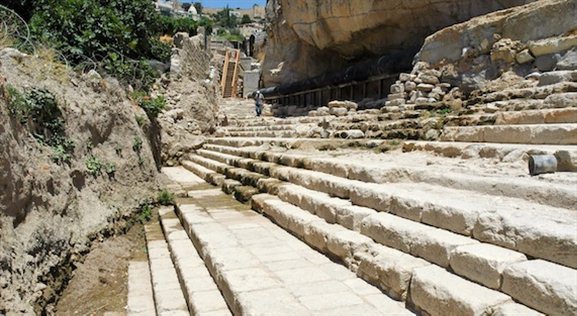
He sat on the stone-lined edge of the Pool of Siloam.
Feet dangling into the water.
Cool.
Clear.
Staring in wonder at his reflection
Framed by the blue heavens above.
His first time to see his own image.
His first time to see anything.
His trembling fingers traced the hollow of his eyes.
Touched the rise of his cheeks
The contour of his nose.
Brushed through his coarse beard.
Ran his fingertips along his sun-baked lips.

Heart racing.
Breath,
a series of ragged gasps.
He lifted his eyes to the world around him
and immediately raised his hands.
Shielded his eyes from the harsh glare
of the mid-morning sun.
He blinked.
Tears running down a face
he had never known.

A world of touch and texture,
brought to life in a
confusion of form and color,
now coalesced around him.

For the first time he saw…
the ripple of wind on water.
The elegance of the portico-covered pool.
The dance of sunlight and shadow.
The beauty of the surrounding hills.
The people…oh, the people.

Slowly, his mind adjusted to this new reality.
Standing awkwardly like a new colt,
steadied by the joyful friend who guided him here from the temple,
the man gradually found his balance…
not an easy task for one blind since birth.

In time,
they danced.
Sang.
Laughed.
Cried.
On his way home…
throughout the streets of Jerusalem…
he shouted to anyone and everyone,
“I can see!
I was blind, but now I see!”

John tells this poignant story in a series of scenes set between two major confrontations between Jesus and the Pharisees. We find Jesus and his disciples leaving their time of worship through the south gate of the Temple. As they walked down the steps, his disciples posed a question steeped in Jewish tradition. Pointing to a man begging on the bottom of the Temple steps, they asked,

“Jesus, who sinned, this man or his parents that he was born blind?”

According to the prevailing belief of the day sin was responsible for all illness and disability. A child sick or disabled since birth either sinned somehow in the womb or the parents’ disobedience caused this infirmity. Jesus often fought this kind of misguided thinking. Seizing this teachable moment, Jesus explained to his disciples.

“Neither this man nor his parents sinned. This happened so the work of God might be displayed in his life…While I am in the world, I am the light of the world.”

Neither God nor man caused this unfortunate circumstance, but God would use this man’s condition as a living metaphor of his ability to turn darkness and despair into light and life.

With that declaration, Jesus approached the man. Sat next to him on the steps. Engaged him in quiet conversation. Sensing the man’s open heart, Jesus spat on the ground and worked his saliva and the light gray limestone soil into a muddy paste that he spread across the man’s eyes. Taking his hands in his own, Jesus stood, lifting the man to his feet.

Now, go,” he said, “wash in the Pool of Siloam.”

With the help of a friend, the man made his way down the slope of the Temple Mount, about a quarter of a mile southward toward the large, terraced pool, fed by the Gihon Spring. The man must have received odd looks as he made his way through the crowd with mud covering his eyes.

He sat on the edge of the water and did has he was instructed. Splashing the cool water on his face, the man wiped the mud from his eyes. I can see him taking a deep breath as he wipe away the water and grim with the sleeve of his robe. Slowly, he opened his eyes to a brand new world.

Over the next few hours and days, the man faced disbelief and disparagement. Some friends thought him an impostor. The Pharisees called him before the council, not to celebrate his healing, but badger him in hopes of accusing Jesus of violating the Sabbath. They sapped the joy of his healing.

Fearing for their own reputation, his own parents refused to stand by him. Ultimately, the Pharisees condemned him as a sinner, eventually excommunicating the man from the synagogue because he refused to deny that Jesus was the one who restored his sight.

In the end, John tells us that Jesus sought out the man whom he healed after learning about the Pharisees’ actions. Face to face with Jesus, the man made a heart-felt confession of faith. At the Pool of Siloam, in the blink of an eye, his physical blindness became 20/20 vision. Over the course of the next 48 hours, he went from being entombed in spiritual darkness to being embraced by the Light of the world.

The power of Jesus echoes throughout this amazing story. But, I also marvel at the authoritative testimony of the man born blind. Standing before a hostile panel of powerful religious leaders who called him a fraud, grilled him mercilessly, challenged his every word, the man never faltered. Never failed to speak the truth.

The Pharisees clamored for him to deny Jesus’ power. Pushed him to denounce his healer. “We know this man is a sinner!” they shouted, challenging him to confirm their accusation. With uncommon strength of character, the man, so unlearned in theology, said simply,

“Whether he is a sinner or not, I don’t know. One thing I do know. I was blind, but now I see.”

What an extraordinary confession of faith!

Imagine the man’s first few moments at the pool. Sights never seen began to fall into context in new ways. Not only were his eyes changed, but God transformed his mind to allow him to interpret and make a sense of what he was seeing for the first time. The miracle changed his heart. A life of resigned despair became a life of renewed hope and endless possibilities.

So what is the take away from this man’s experiences?

There is so much about God’s creation I do not understand. So much about his plan and purpose I cannot comprehend. So much about his nature which remains unknown to me. So much he still must teach me. I don’t know about you, but like the Pharisees, I tend to build a false world around me filled with my plans, my truth and my finite understanding of God and his world based on what I think I know. What I’ve discovered in my life is that that viewpoint is almost always limited. To an extent, that’s okay.

Look at this man’s example. He could not explain what happened. How his eyes were opened remained a mystery to him. He didn’t claim to understand. Nor did he back down in the face of mounting pressure. He merely spoke out with a growing faith borne of powerful, personal experience.

“This one thing I do know. I was blind, but now I see.”

What an extraordinary confession of faith! This man born blind from birth would find ahead of him a life of discovery, not just in the physical world he could now see, but in his budding faith. Knowing what he did not know, he started his new life on what he had experienced with Jesus. That’s a fine place to start.

When I don’t have answers to every question that comes my way, this one thing I do know. I was blind, but now I see.

So, my prayer today is simple. “God, cover my eyes in mud. Let me wash in the Pool of Siloam. Let me understand more clearly, God, who you are and what you need from me. Let me see the world from your perspective. Open my heart and my mind to the discovery of this life you’ve given me. At the end of the day, when the world challenges that which I do not fully know, let me share my personal experiences with you.”

Maybe that’s a prayer that works for you as well.

Here’s mud in your eye.

Come Sit at the Big Table

Background Passages: Luke 2:41-52; Philippians 2:6-7; I Corinthians 3:1-3

I don’t know if your family gatherings were like mine growing up. Typically, everyone brought a pot luck casserole or vegetable while someone provided the ham. Everyone would meet at Grandma’s house after church on Sunday.

The cousins would play…loudly…while the food was placed on the dining room table, extended to its full length. Card tables sat in the “formal” living room, surrounded by those folding chairs that pinched more than one finger at some point during the day. After a prayer, the adults sat around the dining room table, banishing the kids with their paper plates to the card tables in the next room.

I remember listening from the other to the conversation around the big table. Sometimes it was filled with love and laughter. Sometimes it was serious and somber.

For each of the cousins, we longed for the day when Grandma would point you to a chair at the big table. What a glorious rite of passage! No longer a child. Now, an adult.

I wonder if Jesus felt that way when he entered the temple in Jerusalem when he was 12-years-old. Picture it.

*

Every year of his memory, the boy traveled with his family from Galilee to Jerusalem to celebrate the Passover. His father, devote and upright, would walk with his son into the temple, his hand resting lightly on his son’s shoulder. Each year, the father let his son experience the awe and majesty of the towering white-washed temple stone, glistening in the morning sun.

Then, he would drop to a knee, take the young boy by the shoulders and remind him of his place. Standing with the other children against the wall—to look, listen and learn. Being seen, but never heard. With a smile and a gentle push, Joseph sent Jesus to join the other boys, all who longed for the day when they would be invited among the men to learn at the feet of Jerusalem’s most noted rabbis.

What a difference this year made! Jesus, on the verge of Jewish adulthood, entered his final year of study prior to becoming a “son of the covenant.” This would be his first year to sit among the men in the temple in Jerusalem, a moment about which Jesus dreamed for years.

On this special day, Jesus stood a little straighter beside his father just inside the gates of the inner courtyard. Joseph marveled at the lad who stood nearly as tall as he, the young man’s eyes fixed straight ahead, the slight smile on his face filled with anticipation and yearning. Jesus watched with fond recollection as his father again took a knee, hands resting on the shoulders of his younger brothers…a quiet word and gentle push sending them to stand with the other boys.

As Joseph watched them walk away he brushed the dust from his robe. When all was in order, the father gazed down at his oldest son and grinned. He knew the importance of the day for Jesus. It was all he spoke about for the last six months. With a nod of his head the two walked into the gathering crowd of men. No longer a child. Now, an adult.

The day ended. The thrill of the conversation not lost on Jesus. Throughout the teaching and questioning of the rabbi, Jesus listen. Never uttered a word. Never asked a question. Respectful of the moment. Taking it all in. That night he visited with family, excited by the day, full of questions left unasked at the temple.

The group of family and friends rose bright and early the next morning setting out on a long journey home…all except Jesus. He had every intention of returning home, but in the hustle of the morning, the burning questions in his heart consumed him. Almost without thinking he found himself again inside the temple, sitting on the steps among the men, listening with rapt attention to the words of the rabbi.

No longer overwhelmed by the moment, Jesus could no longer contain himself. He listened. He commented. He sought clarification. He probed with questions of his own that startled the rabbi. When the rabbi turned the tables and asked questions in return, Jesus did not shy away. He thought. He recited passages of scripture to support his thoughts. The dialogue intrigued the rabbis, drawing a larger crowd to hear the dynamic exchange of ideas.

Night fell and Jesus remained again in Jerusalem, finding a family to let him sleep by their fire. The next morning he went again to the temple, finding his place among the rabbi’s disciples. The dialogue deep, rich and instructive.

You know the rest of the story. The next day Jesus sat in the temple astounding everyone with his understanding and his insight. Amazing the learned ones with his questions. Drawing them deeper and deeper into the scripture they often took for granted. Making them think with him. Learning more with each passing hour.

At some point, Jesus felt a heavy hand on his shoulder. Looking behind him he saw the face of his father, a look of relieved anger etched in his eyes. Joseph said nothing. He just crooked his finger, beckoning Jesus to follow. Follow he did. They left the inner courtyard and came face to face with Mary, his mother.

The swirl of robes engulfed him with a mother’s relief of a lost child found. Then, she pushed him away and the anger flashed. Jesus didn’t often see his mother in such a state, but he was smart enough to know to let her speak first.

“Son, why have you treated us so? Your father and I have been looking for you anxiously.”

I suspect there was more to the conversation than Luke records in his gospel. Suffice it to say, Jesus got an earful.

I also suspect there was a more sympathetic and apologetic response from Jesus than scripture records. “I am sorry. I should have asked to stay. I have never felt anything like this. I should have asked to stay. Please don’t be mad. Don’t you know? I must be about my Father’s business.”

In the hugs that followed and the sincere sorrow at the distress he caused, Mary and Joseph both recalled all those things they treasured in their hearts since the angel first visited. With a heavy sigh of forgiveness, Mary embraced her son again, “Please, next time, just let us know what you’re doing.” I can see Jesus reaching out, touching his hand to her check, a gesture of love and affection, “I’m so sorry, Mother. I promise.”

As they began again their journey home, Jesus filled each moment with excited conversation about all he had learned about God’s love, God’s will and God’s purpose.

*

I think we live with the assumption that Jesus was born with the full knowledge of his God-ness. I’m not sure that’s true. The day may come when I understand the duality of Jesus Christ as he lived among us as God and man. That day is not today by any means. I reason it out as best I can, trying to rationalize the omniscient and omnipotent Father encased in human form.

We tend to see Jesus as a four-year-old boy, capable of miracles, knowing completely his purpose and role as God’s Messiah. Yet, scripture tells us Jesus grew in wisdom and stature in the eyes of men and God. Growing in stature comes easily enough. The child became a man. Growing in wisdom complicates things. If he were God in all complete power and knowledge from the moment of birth, how could he grow in wisdom?

I believe Jesus understood to whom he belong. He knew who is Father was. His response to Mary and Joseph was honest. “I must be about my Father’s business.” I just don’t think he had full knowledge of what that meant for him and how it would play out in his life…at least not when he was twelve.
Scholars far more learned than I speak to God imposing personal limits to his own power and knowledge when he took human form so he could be “like us.” Paul said as much in Philippians:

“Though he was in the form of God, he did not count equality with God a thing to be grasped, but he emptied himself, taking the form of a servant.”

Perhaps Jesus emptied himself of the omniscience of the Father. There were some things he did not know. He admitted that some things were hidden from him when he told the disciples in Matthew that he did not know the day of his return:

“Of that day and hour no one knows, not even the angels in heaven, nor the Son, but the Father only. “

If we can buy that idea, we see Jesus’ time in the temple in a new light. Not as God speaking from the mouth of a 12-year-old, enlightening the blindness of the rabbis. Rather, we see the inquisitive nature of a student of God. One who desires to know all there is to know about the nature and work of God. One craving righteousness.

That’s the point of the narrative in my eyes. Jesus preached to the multitude on the mountainside and tells them, “Blessed are those who hunger and thirst for righteousness…” He understood that nature of that blessing because he experienced it himself as an eager boy in the temple. He recalled that longing to know God that compelled him with passion to seek answers to questions to which he had no ready answers. The quest for righteousness drove him to study…to grow in spiritual wisdom…in preparation for the moment when God would release him for ministry.

If we are to live in the image of God we must also hunger and thirst for righteousness as if our lives depended upon its sustenance.

What does that mean for us?

Too many Christians are not eager to understand more about God than they already know. We grow complacent and comfortable in our knowledge. As Paul said, to the Corinthians, “I gave you milk not solid food for you were not ready for it. Indeed, you are still not ready for you are worldly.”

It is a message echoed by the writer of Hebrews. “Although by this time you ought to be teachers, you need someone to teach you the elementary truths of God’s word all over again…Everyone who lives on milk is still an infant, inexperienced in the message of righteousness.”

When we ought to be hungering for righteousness, we often grow too comfortable sitting at the kid’s table, afraid of the conversations that take place in the other room. Hoping we will never be asked to sit at the big table.

Yet, Jesus, as a boy, understood that obedience to God required him to open God’s word. To probe and dig more deeply into its treasure. To be responsive to God’s call today requires us to sink our teeth into God’s scripture. Asking questions. Looking for answers. Reading scripture each day as if it were new. Praying that the Spirit might breathe new truth into an open heart and mind.

I am grateful for the pastors and mentors in my life. I’m grateful for parents and Sunday School teachers who challenged my thinking. Friends who encouraged me to ask questions and to keep asking until the pieces of life’s puzzle began to fit together. I’m grateful to God who shows me sometimes that the puzzle pieces can fit together in a new way, taking me more deeply down the path he needs me to travel.

I am grateful that God invites us daily to sit with him at the big table.

Pull up a chair.