Their Father’s Eyes

Background Passage: I Corinthians 13:4-8a

I’m certain there were a great many times during my sons’ teenage years when they agreed with Mark Twain when he said, “When I was fourteen, my father was so ignorant I could hardly stand to have the old man around.” Hopefully, now that both of them are in their 30s, they might agree with Twain’s finished thought. “But, when I got to be 21, I was astonished at how much the old man had learned.”

We celebrate Father’s Day this weekend. Last year I wrote about my Dad and the genuineness and integrity he brings to life each day. This weekend, he is in a rehab hospital recovering from hip replacement surgery at the age of 91. He is a good, good man.

I think back on all I learned from Dad and hope I put the best of those things into practice during my 38 years as the father of two sons. Adam and Andrew witnessed my response through the ups and downs…through life’s turmoil and trauma and its beauty and blessings. They saw me struggle when the fog of life shrouded my sense of direction. Hopefully, they also saw me press on until the mist lifted and the sun shone brightly again. Hopefully, they learned during all those days what not to do as easily as they learned what to do.

I have watched my two sons grow and mature into amazing husbands and fathers. Granted, neither of them has walked yet in the furnace of fire that will surely engulf them during the teenage years to come. Based on what I have seen so far, I think they’ll do fine.

So, on this Father’s Day, while I am eternally grateful for the example of my own father, I am equally blessed by the example of my sons.

I rejoice also knowing that both of my sons know first-hand the love of Christ and live each day in faith and commitment to him. Their relationship to Christ guides their relationships with their wives, their children and all those they encounter. They live as a witness to their faith by telling their kids about Jesus and his love for them and by bringing their children to church. As a result, the seed of grace and faith have already been planted in the lives of grandchildren. This testimony of faith is the greatest gift my sons will give their children through all the days of their lives.

Both my sons married well. God led them to two women who complement them in every way. Adam’s wife, Jordan, and Andrew’s wife, Melissa, are delightful additions to our family. It is obvious to me that Adam and Andrew adore them. Love is evident at its deepest level. Visible in meaningful ways. I’m grateful that they listened as God put those two women into their lives. They are stronger men and better fathers because of these exceptional young women.

Adam and Jordan have two sons, Eli, 6, and Josiah, 4. Andrew and Melissa have two daughters, Lena, 2, and Amelia, 6 months. These children recognize at some level the love their parents have for one another, even if they may be too young to fully understand it. It is another beautiful gift my sons give their children.

The two families joined us at our house today to celebrate my Father’s Day. It was good to have them here. The house was noisy, busy with the echoes of childish laughter and the stomp of running feet throughout the house. Sublime perfection.

Because I had this thought in mind for this devotional, I watched more closely the way my sons covered my grandkids in love. The passage of scripture that came to mind was not one of those traditional Father’s Day scriptures. Paul’s words in I Corinthians 13 jumped into my heart.

“Love is patient, love is kind. It does not envy, it does not boast, it is not proud. It is not rude, it is not self-seeking, it is not easily angered, it keeps no record of wrongs. Love does not delight in evil, but rejoices with the truth. It always protects, always trusts, always hopes, always perseveres. Love never fails.”

I watch my sons playing with their children, spending quality time with them, and this is what I see. A love that is both patient and kind, expressed in arms that enfold them. Words of encouragement that build a child’s self-worth. A love that disciplines when necessary…not in a hateful or reactive manner, but in an instructive way. The fatherly guidance children need to understand the nature of right and wrong. Lessons that teach acceptable behavior and how God wants them to live. It is a love that guides and seeks the best for the child. The love I see in their eyes as they live life as a parent is protective, trusting, hopeful and constant. It is, I know, a love that never fails.

So, I watch them and think, “Maybe I didn’t screw them up after all.”

We like to talk about children who look like their parents. We say, “He has his father’s eyes.” Gary Chapmen wrote a song in 1979 that shows he understands that phrase in a different way. He saw in his own father a man who found the good in everyone and every circumstance. A man whose eyes reflected compassion and empathy. Chapman’s hope expressed in the first verse is that others will see in his own eyes what he saw in his father’s eyes. He then takes the last verse to a deeper level, reminding us that the world ought to see the loving eyes of our heavenly father reflected in our own.

https://youtu.be/sfRNXuc6eCk

I truly don’t know what others might see of me when they look into the eyes of my sons. I hope my influence has been a positive one. What is most important to me is that others see the eyes of Christ in the eyes of my sons because that’s what I see. For in their eyes, I see…

“Eyes that find the good in things,

When good is not around;

Eyes that find the source of help,

When help just can’t be found;

Eyes full of compassion,

Seeing every pain;

Knowing what you’re going through

And feeling it the same.”

In my mind, Adam and Andrew have their heavenly Father’s eyes that shine with compassion and empathy in their relationship to their wives, their children and the world around them. An earthly father cannot hope for more.

As I watched the frenetic activity around me today, I prayed that my grandchildren someday realize what a blessing it is to be wrapped in their father’s love. I pray they have their fathers’ eyes…as well as Father’s eyes.

Dip Your Toes in the Jordan

Background Passage: Joshua 1:1-9

I walked on stage this year again as a part of yet another high school graduation. After a 30-year career in public education, I’ve participated in one form or another in more than 120 commencement exercises and watched roughly 65,000 young people end their high school careers. That means I’ve seen my share of beach balls. Heard my share of air horns. Watched my share of impromptu dances across the stage.

The faces of these graduates as they received that cherished piece of parchment paper reflected a mixture of joy and excitement, tinged with an underlying sense of dread. Each of them undoubtedly realized in the hours after they walked the stage that they faced a future that remained largely unknown despite all their plans and dreams.

As I watched the evenings unfold each year, the ceremony always reminded me of my own graduation from high school. The scope and venue were certainly different. NRG Stadium in Houston compared to my high school auditorium in Ropesville. Standing among classes ranging in size from 450 to 900 students compared to my class of 33.

The graduation ceremonies, regardless of time, place and size, mean the same today as they did in our yesterday. Each graduate ends that which is familiar to begin a future that will unfold before them in unexpected ways, taking them down paths beyond anything they can truly imagine. It will be confusing and chaotic. Exciting and exhilarating. Filled with joy and pain. Some will thrive amid the challenges of life. Others will wither under its pressure.

So, we watch these young people graduate from high school with a prayer on our lips and hope in our hearts that God will lead, guide and protect them through each day of their lives. I am certain, whether they know it or not, they will need his presence every step of the way.

Our culture calls it commencement. A beginning. I like to think of it as a commissioning. A challenge set before them to be all God needs them to be in whatever call of life he sets before them.

He faithfully served his God under the leadership of Moses. Chosen among the leaders of his tribe to sit among Moses’ council of advisors, Joshua played a significant role in leading the Hebrew people into the promised land. As a spy, Joshua refused to see the land of Canaan as a place of unconquerable giants and impenetrable fortress cities as others did. Rather, Joshua saw the land God promised as a land of milk and honey.

Because of his trust and faith in God, Joshua was given the task originally assigned to Moses. I picture him standing ankle deep in the slow current of the River Jordan, staring across the valley in the direction of Jericho. It is three days before he would give the command to his people to cross the river and enter the land of promise.

If he was anything like most of us, and I suspect he was, he fought an internal battle with his doubts and fears, voicing a prayer for strength and wisdom he did not feel. Joshua surely understood his future would be at times confusing and chaotic. Exciting and exhilarating. Filled with joy and pain. A future in which he could thrive amid the challenges and stumble under the pressure. Like our graduates today, I suspect the butterflies in Joshua’s stomach seemed as large as eagles.

God chose that moment as his commencement. His commissioning. The Old Testament tells us that God gave his charge to the leader of his people as he stood with his toes in the Jordan. As a commission to those he calls to serve it can encourage our graduates equally well as they prepare to encounter life after high school. And, it is good news indeed.

God said to Joshua…

“Be strong and very courageous. Obey the laws Moses gave you. Do not turn away from them and you will be successful in everything you do. Study this book of the Law continually. Meditate on it day and night so you may be sure to obey all that is written in it. Only then will you succeed. I command you…be strong and courageous! Do not be afraid or discouraged. For the Lord you God is with you wherever you go.” (Joshua 1:7-9)

To our graduates know that God has a purpose for your life, just as he did when he told Joshua, “You will lead my people to possess all the land I promised to give their ancestors.” His plan is unique to you, to the heart he has given you, the skill sets you have learned and the talents you acquire along the way. I can almost guarantee you the plan will take you places you never thought you’d go. Watch for the doors that open and don’t hesitate to walk through them.

Following God’s path will not always be easy. Life will hit with cold reality that will lead to disappointment and discouragement. Yet it will also bless in glorious ways. God encouraged Joshua to “be strong and very courageous.” The door he opens may not be the threshold you wanted to cross. Step through it anyway with courage, conviction and confidence in the Father. The door may appear to be blocked. Overcome. Persevere and rest on the promises of God.

God reminds us in this passage that success is contingent on our understanding of and obedience to the word of God. We leave high school and home desiring to exert our personal independence, to make our own choices and chart our own course in life. That’s the whole point of growing up.

Free of someone who wakes you on Sunday morning for church, it will be easy to sleep in…to set aside your faith. A word of caution. Now is not the time to express your independence from God. As you enter college or head into the work force to establish a home of your own, you will choose whether to abandon the relationship you have with Christ or to draw more deeply upon it. You have that choice.

God reminded Joshua not to stray from the teachings of God. To hold the word of God close to his heart. To meditate upon it. To study it. To draw from scripture the wisdom of God that enables us to deal with both the good and difficult times of life. This is the key to success.

Be careful also to recognize success through the eyes of God and not the eyes of the world. Success hinges upon your ability to stay focused and obedient to the plan God has for you. When we walk in his steps we walk on firm ground, able to experience joy and contentment in a life of service to the Father and to others.

As you can imagine and as the scripture tells us, Joshua and his people had to fight for all that God promised. The path God chose for Joshua was not easy. The hardships and heartaches were real. The difficulties must have seemed insurmountable at times where Joshua struggled with which way to turn and what he should do. He must have felt terribly alone at times.

You will almost certainly face hardships and heartaches throughout your life, hopefully in the measured grace of God’s blessings. You will face some of life’s hardest decisions, uncertain about which way to turn and what you should do.

Know this. God promised his presence. “…the Lord your God is with you wherever you go.” It is a promise as true today as it was when Joshua stood with his toes in the Jordan River. Trust the promise. Trust in the one who made it. God will be with you wherever you go.

So the message of Joshua speaks these four things as clearly to me today as it should to you as a high school graduate.

God has a plan and purpose for each of us…in every phase of life.

He calls us to walk with strength and courage in obedience to his plan and purpose regardless of where it leads us.

We find that strength and courage and discover his will and wisdom only when we seek him and immerse ourselves in his word.

Despite the difficulties that will most assuredly come, we can rest each day knowing that he will be with us wherever we go.

Here’s the thing I’ve learned and the one of which I am reminded with every graduation I attend. The challenge of graduation isn’t a one-time event. After you’ve tossed the cap and hung the tassel from the mirror of your car, you will take the next step in the life God has planned for you. You will dip your toes in the Jordan and step into the land he has promised. From that day forward, you will find another Jordan to cross. And another. And another. And another.

To every graduate out there, whether with the Class of 2017 or any class back through time, celebrate this special day. When it is over, dip your toes in the Jordan. You can’t imagine what God has planned for you!

Walk a Mile in Their Shoes

Author’s Note: I originally published this devotional two weeks ago, but my blog site developed some issues. While it posted on my personal webpage, www.drkirklewis.com, it did not get sent to my subscribers or shared on my social media pages. We’ve managed to repair our social media access (I think), but the subscriber links are still down. We’re working on it and hope to have things back in order soon. I sincerely apologize.

Background Passages: Hebrews 13:3; Luke 6:31-36; Philippians 2:5-8

Cecil Rhodes, the British statesman and financier who used his wealth to endow the famous Rhodes Scholarship, had a reputation for his elegant fashion sense and impeccable dress. One year, Rhodes invited one of his scholarship recipients to his home to dine with him and a number of England’s well-to-do.

The young man came from a poor family. He wore his best suit to dinner, though stained and a little too small. He was embarrassed upon his arrival to find all the other guests in full evening dress. Rhodes, dressed in his tuxedo, was about to enter the dining room when he saw the young man and his discomfort. He went back upstairs, appearing at the dining table a few minutes later in a shabby, old blue suit.

Rhodes understood the distress the young man felt. Rather than add to the misery of another, he set aside his personal preference to connect with this young man of promise.

Empathy.

Empathy feels what another feels. Sees the world from another’s perspective. Understands as fully as possible what another experiences. It is one thing to feel, see and understand the life of another. It’s a great first step. But, it seems to me, true empathy compels us to act…to walk an extra mile.

We can imagine horror experienced by the family whose home is wiped out by flood or fire. We have difficulty at times imaging the struggles of learning disabled when learning comes easily to us. We struggle in our response to those who are depressed if we ourselves have never experienced hopelessness. Empathy is difficult.

Empathy is also inconvenient, especially when life is going our way. I can see the plight of the poor and the afflicted, but do not wish to sully my hands in the work it would take to help them work through their own difficulties. We rationalize the distance we keep by blaming them for their own predicament.

As he closed out his letter, the writer of Hebrews exhorted believers to “Remember those in prison as if you were their fellow prisoners and those who are mistreated as if you yourselves were suffering.”

Those encouragements go far beyond simply feeling sorrow or sympathy for those who are troubled. It calls upon us to feel with them as if the suffering were our own. To put ourselves in their shoes. To see the world…and ourselves…through their eyes.

Jesus, the personification of God’s empathy toward a lost world, shows us the full expression of empathy as he introduces to us his concept we know as the Golden Rule. He taught that one could sum up the entire content of the Old Testament law and prophets by “doing to others what you would have them do to you.” To act in ways toward others as you wish others to act toward you.

The concept Jesus introduced was not a new concept. Many other religions and philosophies offer a similar message, though often presented in negative form. In ancient Egypt, the statement read, “That which you hate to be done to you, do not do to another.” In ancient Greece, “Do not do to others that which angers you when they do it to you.” Self-preservation is not empathy.

When Jesus asks us to treat others as we want to be treated, he is not saying: “I’ll scratch your back if you’ll scratch mine.” It’s so much more than that. It is a proactive directive. Empathy takes pre-emptive action to meet the needs of others because we feel the distress as if it were our own. So, we act, treating others as we would hope others would treat us if we found ourselves in similar circumstances.

We’re not simply to avoid doing things that hurt others because we don’t want to be hurt in the same way. Instead, every action toward others should be expressed in the love of Christ. He’s saying: Take the risk of giving your time, your energy, your resources…in essence, giving yourself… to ease the pain of another whether that person is a friend or stranger.

Jesus followed this command by telling us how to live an empathetic life. He explained, “If you love those who love you, what credit is that to you? And if you do good to those who are good to you, what credit is that to you? Even ‘sinners’ do that…Love your enemies, do good to them, and lend to them without expecting to get anything in back…Be merciful (other translations use the words ‘compassionate,’ ’empathetic’), just as your Father is merciful.”

Living a Christ-like life teaches us that religion and faith are not a just set of beliefs. It is not the dogma of the day. Christianity, if it is to be viable and real in our lives, is about what we do for the poor with too little to eat, too little to wear and little or no shelter over their heads. It is about what we do for the sick and the elderly, in desperate need of our touch. It is about what we do for the disenfranchised of society who find themselves distanced from the opportunities we enjoy.

Jesus teaches us that empathy, as difficult and inconvenient as it can be at times, ought to compel us to act differently when we encounter human need. To understand the needs of others as if they were our own.

We have the perfect example in the life of Christ. Paul said as much to the Philippian church.

“Your attitude should be the same as Christ Jesus: Who, being in very nature God, did not consider equality with God something to be grasped, but made himself nothing, taking the very nature of a servant being made in human likeness.” Leaving the throne of God to become man is the ultimate in empathy. A deliberate, purposeful, life-giving act of empathy that led straight to the cross.

Today, it seems most people walk the world blind to the feelings and needs of others. If they disagree with us, if they live differently than us, if they respond to the challenges they face in ways we would not, we chastise them for not reacting as we assume we would react in similar circumstances. I’m not sure we will ever impact the world for Christ until we can walk a mile in their shoes.

I hope God challenges all of us this week to embrace the empathy of Christ as we encounter the needs of the world around.

When All We Hear Is Silence

Background Passages: John 9:31; Jeremiah 29:11; Hebrews 11:1, and 2 Timothy 3:14-17

President Franklin Roosevelt hosted many state receptions, locking his polio-weakened legs into braces, and greeting the hundreds of men and women who came to his events to see and be seen. He complained to an aide one day that no one paid real attention to what he said as they passed through the receiving line.

During one particular reception, Roosevelt smiled at each person who came through the line, shaking his or her hand. Amid his words of greeting, he murmured to each one, “I murdered my grandmother this morning.” The guests responded to his greetings with inane comments: “Marvelous party, Mr. President.” “Keep up the good work, Mr. President.” “God, bless you, Mr. President.” They truly were not listening.

Toward the end of the evening while greeting the ambassador from Boliva, the president muttered his mock confession of his grandmother’s demise. Without missing a beat, the ambassador, who understood the importance of listening, leaned in and whispered, “I’m sure she had it coming, Mr. President.”

We’ve all felt like no one was listening to us from time to time, but when we talked to God, we want him to respond appropriately. We want answers to our prayers. “God, please change…” “God, please fix…” “God, only you can heal…” “God, please protect…”

We utter those prayers with the expectation that the God who loves us will answer. Instead, we hear the unnerving and uncomfortable sound of silence. No immediate change of life circumstance. No quick resolution to the problems we face. No miraculous healing.

Therein lies an uneasy truth for those of us who place our trust in God. His mercy and his power cannot be summoned like a genie in a bottle, rising in a puff of smoke to make our wishes come true. It seems faith, by definition, must remain firm even when the answers don’t come and circumstances don’t change. The writer of Hebrews said, “Now faith is being sure of what we hope for and certain of what we do not see.”

What do we do when our prayers of anguish and despair are met with silence?

Just because God remains silent doesn’t mean he isn’t listening. God’s silence is purposeful. It is not malicious. Perhaps the silence is meant to remind us he has already provided an answer that we chose to ignore in the past. Perhaps we need time to process what is happening and what comes next. Perhaps the silence galvanizes our God-given strength amid the difficult times of life.

Regardless of how lost and alone we may feel, God listens to his children. The promise of John 9 is that God stands ready to “listen to those who worship him and do his will.” Such is the nature of faith and trust.

When your prayers and pleas to God find only silence, hang in there. I believe everything God does or does not do unfolds by plan and purpose. Your request didn’t catch him off guard. It didn’t confound him. He doesn’t need to think about it and get back to us later. God knows the desires of our hearts. When we can’t hear him, we must hold tightly to our faith knowing his plan for our lives is better than anything we can devise on our own. So, hang in there. Hold on. Stay true and trust.

“For I know the plans I have for you,” declares the Lord, “plans to prosper you and not to harm you, plans to give you hope and a future.” Jer. 29:11

When you get right down to it, the silence we hear from God is often self-imposed. We want the manna from heaven. We want to hear that the cup will pass before us. In truth, we don’t need a voice from a burning bush when he has provided an answer for every concern we face, inspired into the hearts of men and written in his word. It is his voice we hear from mouth of Jeremiah. His voice that echoes off the shores of Galilee. His voice that whispers from Gethsemane.

One finds in the Bible answers to every aspect of life. We crave the supernatural when it comes to our prayers. When the cancer continues to grow or the child continues to rebel or the troubles continue to mount, we feel as though God isn’t listening and doesn’t care. We agonize in the silence, thinking God has nothing to say to us.

God speaks to us through words he spoke to men and women just like us through his prophets and recorded in the Old Testament. He speaks to us through the life and ministry of Jesus and those who learned at his feet. He speaks to us in the inspired, written word that is the Bible.

God’s silence is not because he isn’t speaking. It is because we aren’t spending time in his word–reading, studying, learning and listening–and allowing the Holy Spirit to move our hearts as we read, “There it is, Kirk. That’s the answer you’ve been seeking.”

Paul shared as much with Timothy as he reminded him of what the young pastor had learned since childhood.

“All scripture is God-breathed and is useful for teaching, rebuking, correcting and training in righteousness, so that the man of God may be thoroughly equipped for every good work.”

When all we hear is silence, maybe that’s the best time to read.

How Can I Keep From Singing

Background Passage: Psalm 59:16-17

The hectic nature of life the week brings about a short post. I’m currently with a small group of people from my church this week on a mission trip to Collique, Peru, to build more permanent shelters for some of the families in this impoverished community tucked in the hills northeast of Lima. These are not houses as you and I understand them, but they are homes for families with little more than a roof above their heads.

This is just my second year to participate. Like the others in my group, most of whom have made this trip multiple times, I end each day amazed at how little these wonderful people have and great their joy in comparison.

Their smiles and their constant expressions of gratitude transcend the language barriers and cultural differences between us, serving as a dynamic testimony to the power of Christ to fill a heart with joy. Theirs is a faith that truly sustains through every circumstance.

For me, and I’m certain for others in our group, it is a teachable moment. These people with whom we’ve been blessed to work this week have so little. We have so much. They endure though faced with a life we can scarcely imagine. We need to remember…no, I need to remember…that despite the turmoil I feel at times, God gives me voice to declare my love for him. Our relationship with God should enable us to sing when others…lost without him…can’t hear a note.

British vocalist James Loynes recently recorded a beautiful song written by Robert Lowry, a 19th century Baptist minister and composer. The melody and words resonate on every level. The final stanza offers this word.

The peace of Christ makes fresh my heart,
A fountain ever springing.
All things are mine since I am his,
How can I keep from singing?

Listen to the video. Hear the gentle reminder. How can you keep from singing?


Time To Be a Monkey Fist

Background Passages: Psalm 107:23-30; 2 Corinthians 8:8-9; 16-17

I don’t know if you caught the YouTube video recently of cruise ship passengers riding out a storm in the North Atlantic where 30-40 foot waves regularly crashed against the window of their cabin. It’s one of those unnerving images of pending disaster that haunts a lot of travelers whether they travel by sea or by air. I’ve never cruised in waters that rough, but, in almost every port, I remember the gratifying feeling of being docked securely in the harbor. It’s a feeling similar to when your plane lands safety at its destination. Being back on solid ground offers great comfort.

As we arrived in that safe harbor on our last cruise, I watched from the deck of the ship as the captain used his starboard thrusters to ease the vessel toward the pier. He stopped the thrusters, leaving the ship 30 feet from the dock. The crew scurried to moor the ship by sending hawsers—thick ropes three inches in diameter–across the void from the ship to the bollards on shore. I remember thinking how hard it would be to toss the heavy ropes that distance to the pier.

Instead, the crew attached a 60-foot, thin rope to a rope ball about six inches in diameter, tying the ball to the hawser. They swung the ball around on the end of the rope like David’s slingshot and sent it flying across the emptiness between the ship and pier, carrying the thin line behind it. The workers on the dock picked it up, pulled the rope across the water, eventually dragging the hawser with it. They tightened the hawser, drawing and securing the ship close enough to the pier for passengers to disembark. It was a slick operation that allowed us once again to step upon firm ground.

I’m told the thick ball at the end of the thin rope was called a “monkey fist.” In the maritime world, the monkey fist, which dates back to the early 17th century, is a specialized knot wrapped around a stone, an iron ball or other heavy weight to make it easier to toss the heavy hawser onto the dock.

It’s this monkey fist that stirred my thoughts today.

Over the past several weeks, several friends and family members have found themselves at sea, struggling in the midst of life’s storms, most of which are not of their making. These difficulties, like waves on the ocean, crash against our lives threatening to sink even the strongest among us into depression and despair.

The psalmist used the poetic language of ancient mariners to indicate the difficulties we sometimes face.

“They mounted up to the heavens and went down to the depths;
In their peril their courage melted away.
They reeled and staggered like drunkards;
They were at wits end.”

Yet, the psalmist knew that God provided a safe harbor for those who trust him and call upon his name.

“Then they cried out to the Lord in their trouble,
And he brought them out of their distress.
He stilled the storm to a whisper;
The waves of the sea were hushed.
They were glad when it grew calm,
And he guided them to their desired harbor.”

There is good news for those of us who commit our lives to Christ and know how precious it is to have him as our safe harbor. When the storms of life batter us, we know we can tie ourselves securely to him, confident that once we wrap our hawser around his bollard, nothing will separate us from his safe keeping. We know within the trouble and distress, he can calm the storm to a hushed whisper.

I have been in that position. The difficulty comes when my strength fails. When my courage melts away. When I am at my wits end. I can’t draw close enough to the Father on my own to toss him my mooring line. My burden too heavy. The distance between me and the Father too great. The line itself much too short.

In times like that, I need someone to hurl the monkey fist. Someone to make it easier to drag my hawser to the dock and tie it off to the bollard, safe within the arms of God’s love, care and protection. Invariably, I find a pastor, a spouse, a friend, and at times, a stranger, willing to tie all things together through word or deed that allows me to reconnect with God in the way I need it most.

We will all need that connection from time to time. Paul knew what it meant to find comfort in Christ. He wrote in 2 Corinthians 8:8-9, 16-17:

“We are pressed on every side, yet not crushed; perplexed, but not in despair; persecuted, but not abandoned; struck down, but not destroyed…Therefore, we do not lose heart. Though outwardly we are wasting away, yet inwardly we are being renewed day by day. For our light and momentary troubles are achieving for us an eternal glory that far outweighs them all.”

When our batteries need recharging or when we need time out of the wind and wave to gather ourselves again for ministry and service, it’s comforting to know that we have a haven in Christ. I am grateful in my life for those who gripped and tossed the monkey fist on my behalf when the safe harbor seemed so far away.

This week many individuals will cross our path with lives torn apart by broken relationships, lost jobs, illness, injury and death. Those who struggle to make ends meet. Those with little hope for the future. Their seas are high and frightening.

We must look for opportunities to toss the monkey fist for those in need of the peace and comfort that only God can provide. May we be the ones that draw their storm-tossed vessel to the safety of the harbor and allow them to set their feet again on solid ground.

The Elephant in the Room

Background Passages: John 10:30-34; John 14:1-11

Given our difficulty as Christians in handling some of the social issues of the day, it seems we have a hard time understanding the true character and nature of God. We make attempts to classify him by putting God in a box of our own creation. We define him on our terms and, too often, in our image. If we need God to be anti-immigrant, we find a way to make him so. If we need God to take a stance on health care for the poor, we make it for him. If we need God to smite a specific nation, we find a way to justify the smiting.

It has been that way since the beginning. Mankind has always sought to define God. It’s why the ancients worshipped idols. Why they invented a god for every act of nature. Throughout history mankind has defined God within the limits of his understanding. God knew it would happen when he created us, knowing one day he would reveal himself to his creation in a special way.

I remember my third grade teacher, Ms. Wallace, reading a specific poem in class. It made me laugh. John Godfrey Saxe, a 19th century American satirist and poet, penned his poem The Blind Men and the Elephant in 1874, his take on an old Hindu story. Though entertaining, I did not find it particularly provocative until it was read again in my university philosophy class. The poem, as interpreted by a number of West Texas philosophers, became emblematic of the search for moral truth and necessity of religious tolerance.

I stumbled across the poem again this week in my study. Allow me to set aside the extended philosophical and theological debate with apologies to the original Hindu storyteller and to Saxe.

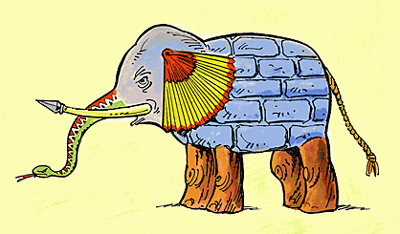
The poem, based on an old Hindu text, tells the story of six blind men who had never encountered an elephant. When given the chance to get up close and personal with the massive beast, they each touched a different part of the animal. One the elephant’s side. Another its tail. One its trunk. Another its ear. And, so on. When asked, then, to describe the elephant, each responded within his only frame of reference. Why, certainly, the elephant was like a wall…a rope…a snake…a fan…

Take a look at the last two stanzas.

And so these men of Indostan
Disputed loud and long,
Each in his own opinion
Exceeding stiff and strong,
Though each was partly in the right,
And all were in the wrong.

So, oft in theologic wars
The disputants, I ween,
Rail on in utter ignorance
Of what each other mean
And prate on about the Elephant
Not one of them has seen!

Work with me here and forgive the metaphor. God wants a relationship with us. He wants us to know him. We were unable to fully grasp his character and nature as long as God stayed in his heaven. So, he became the elephant in the room, introducing himself to the world through his son Jesus Christ. He sent his son into the world to walk among us, to reveal the nature and character to God to us in the words he spoke and the ministry he performed.

Still we struggled to understand. As Jesus prepared his disciples for his death on the cross and the inevitable time when they would carrying on his work without his physical presence among them, the disciples had a hard time putting Jesus and God together.

Jesus offered comfort amid their confusion. “Do not let your hearts be troubled. You believe in God; believe also in me.” He told them he would prepare a place for them in his father’s house and that they knew how to get there. Thomas, ever confused, confessed his lack of understanding. Jesus said, “I am the way, the truth, the life…If you really know me, you will know my Father as well.” In the haze of uncertainty, Phillip asked Jesus to “show us the father. That will be enough.”

Jesus’ sad response to Phillip explains to us how we can begin to know the character and nature of God. “Phillip,” Jesus said, “don’t you know me, even after I have been among you for such a long time? Anyone who has seen me has seen the father…Believe me when I say that I am in the Father and he is in me or at least believe in the evidence of the works themselves.”

So if we have trouble understanding the character and nature of God, we need look no further than the life and ministry of Jesus Christ. Our understanding of him, grows the more we touch him. The more we experience him. So, like the blind men with the elephant, if we limit our experiences with Christ we will never know all we can about who he is…who God is.

You see, God is not passive and silent, forcing us to guess about his nature and what he expects of us. He tells us what he likes and what he expects. God, in Jesus Christ, gave us a standard by which to measure our actions and our thoughts.

We don’t have to grope in the darkness to understand God from a limited perspective. Our understanding comes through the direct revelation of God through Jesus Christ. No other religion makes a similar claim. Jesus declared it clearly and succinctly. “I and my Father are one.” He declared to his disciples, “If you have seen me, you have seen the Father.”

How much more would we learn of God if, unlike the blind men, we didn’t stop with that first touch? God calls us to look beyond the nail-scared hands, as important as that experience might be. Watch, listen, and learn from the one God sent into the world to show us how to live.

Through God’s Eyes

Background Passage: Ephesians 1:18-19

As the story goes, Cambridge University hosted a debate between a learned science professor, a self-declared atheist, and a Christian pastor. The professor offered his reasoning for asserting God “existed” only as a figment of human imagination. Grounded in rationale thought and scientific understanding, the professor offered that no rationale human being could look at the universe and believe in a Creator God, much less one active in the world.

The Christian pastor countered with a quick argument. Getting the professor to acknowledge that there is still much in the world that science and rationale thought cannot explain, the pastor suggested that it might be possible that God exists within that body of knowledge yet unknown. That someday man might discover through rationale thought and scientific understanding that God does indeed exist. The Christian pastor claimed victory when the scientist agreed to that possibility.

It makes a good story, I suppose, but a God that can be explained by some unknown data set, seems somehow less…Almighty or Sovereign. To prove God’s existence using some aspect of human understanding seems to me to thwart the purpose and power of faith.

Noted theologian C. S. Lewis, sadly no relation, offered a statement in his work entitled, Is Theology Poetry? that hit the nail on the head. He wrote, “I believe in Christianity as I believe that the sun has risen; not only because I see it, but because by it I see everything else.”

Lewis embraced faith over fact because his belief transformed the way he saw the world. Faith internalized and deeply held allows us to see the world around us, and the people within it, through God’s eyes. And that, I feel, is a significantly different world view that seen by those who live without a personal faith in Christ.

Given the chaotic and confused condition of life in the 21st century, we need our faith, our Christianity, our ability to see the world through the eyes of God, to make sense of things. How is a child of God to react when the world around us chooses to confront rather than console? To argue rather than understand? To divide rather than embrace? To hate rather than love?

If we see the world and all within it are, through the lens of the true faith, we accept that we carry an incredible responsibility to live as Christ lived. Instead of taking part in the divisive dialogue, we should encourage one, through our witness and walk, to console. To understand. To embrace. To love as Christ loved us.

The sun’s light illuminates all that we see. Because it does, we know it is real. The Son’s light reveals the world to us in its splendor and its ugliness. We can share its splendor, unleashing its beauty so it can shine in the face of ugliness. If we choose to live in him, we can see the world as he does—using the extraordinary vision with which he blessed us to bridge the distance between the Lord who loves and lost and lonely among us.

I have to admit the world I see today is a shadowy place, filled with uncertainty and chaos. Though I try to see through my Father’s eyes, I have a hard time wrapping my head around hatefulness. Lewis said it is his faith in Christ that opens his eyes. Paul took it a step further when he prayed for the believers in Ephesus.

“I pray that the eyes of your heart may be enlightened in order that you may know the hope to which he has called you, the riches of his glorious inheritance in his holy people, and his incomparably great power for us who believe.” Ephesians 1:18-19.

Without God’s corrective vision, I look at the world and feel…hopeless. Paul tells me it can be different if I let God adjust or enlighten the eyes of my heart. When I can see the world through his eyes, I find hope and purpose.

Scotty Smith, pastor of Christ Community Church in Franklin, TN, writes a blog for The Gospel Coalition. He summed it up better than I ever could in this prayer to God.

“…this text makes a ton of sense to me. Apart from the work of your Spirit and the corrective lens of the gospel, it will be impossible for me to see what you intend for me to see with awe-producing clarity. So, indeed, Lord, open the eyes of my heart. Heal my shortsightedness, my far sightedness and the astigmatism of my soul. I want to see all things from your perspective, including the hope to which you have called us. To see with the eyes of hope means that I will be able to discern your heart and hand at work everywhere.”

I particularly like that last sentence. When we see through the eyes of our Christian faith, the eyes of hope, we can see God at work in all things. We see with awe-producing clarity our place in his redemptive work. Understanding that, I no longer see this world as an ugly place. It is a field ripe for the harvest.

The Parable of the Vanilla Milk Shake

Background Passages: Proverbs 119:18, I Cor. 3:1-3, I Cor. 13:11, and 2 Tim. 3:16

Sometimes the most ironic humor comes from that which we observe or fail to observe around us. I find the best comedians to be those who extract humor from ordinary life events. Though not a part of the mainstream entertainment world, comedian Jeanne Robertson is a master at sharing life as it unfolds around her. She tells a story of stopping for a drink of water and talking herself into a vanilla milk shake. Listen to her describe her experience in the following video.

I chuckle at this story because I relate so completely at times with the clerk whose mind consistently overlooks the obvious. Because the circumstance doesn’t mesh with the preconceived possibilities staring at her from the cash register, she cannot find a way to address the customer’s request.

The story made me wonder how often I fail to see the truth revealed to me because of my preconceived notions of the truth as I know…and want…it to be. It is a trap easily tripped as we live in the social, emotional and political world around us. It’s also a snare that prevents us from freely grasping the truth of God’s teachings and its application in our lives.

Absent a bolt of lightning or burning bush, most of us uncover the will of God in our lives through a deeper and more meaningful understanding of his Word as revealed to us by the Holy Spirit. If that’s true, then this Parable of the Vanilla Milk Shake serves as an apt reminder of how we should approach our study of the Bible–with eyes wide open and searching to understanding that lies buried within the words printed in scripture.

Paul reminded the church in Corinth (I Cor. 3:1-3)that the evidence of their lives made him think of them still as spiritual infants, able only to drink milk rather than solid food he offered them. Despite their years in the faith, they had not grown to understand its full meaning and application of what it means to be a follower of Christ. Paul also reminded us (I Cor. 13:11)that if we’re still seeing things through the eyes of a child we are not growing in our understanding of the life God would have us lead.

Like the clerk in Robertson’s story, I lock myself onto that which I learned years ago, content that the “truth” I learned as a teenager remains permanently valid for my life today. That what I learned as a child and reasoned as a child, should not be put away. In truth, God teaches me new things almost every time I open myself to his Word. I can read a passage of scripture today that I’ve read and studied for years only to wake up in wide-eyed wonder at a new thought God’s spirit has revealed…to understand how that verse applies in my life–not yesterday, but today. Not then, but this moment in my life. Much like the clerk behind the counter, I read that familiar passage and the light in my heart and my eyes turns on. I find a new way to think about and apply what was right in front of me all the time.

I’ve read Psalms 119 several times over the years. I even taught this portion of the chapter in my Sunday School class a few weeks ago. Yet, this week as I scanned across it again, several new thoughts occurred to me.

There are wonderful things in the Bible just waiting for God to show them to us. I like to think I am a reasonably bright man, yet I am unable to comprehend the complexity of God’s word on my own without his inspiration. His truth must be revealed in our lives at a time and place of God’s choosing. They are words that enable us to get the most out of our relationships with God and others.

Paul once told Timothy, “All scripture is God-breathed and is useful for teaching, rebuking, correcting and training in righteousness, so that the man of God may be thoroughly equipped for every good work.” (2 Tim. 3:16) Those wonderful things in scripture change us in ways we can only imagine and empower us in ways we never dreamed to do the work God asks of us.

The passage teaches us that we are incapable of discovering all these wonderful things unless God first opens our eyes. Reading through his word without seeking the revelation of the spirit is like the blind man who after first experiencing Jesus’ healing touch saw a world in which men looked like trees walking around. We might, on our own, find a nugget of truth lying on the surface of scripture and see God’s word vaguely. We will never see his word with the kind of clarity that profoundly changes our hearts and our lives unless he opens our eyes to the possibilities.

Since we cannot explore the depths of God’s word on our own, we must pray that he shines light upon his word every time we turn the page. Helpless to see the beauty and wonder of God’s teachings through my myopic lens, I must ask him to “Open my eyes, Lord, and let me see the wonderful things in your law.”

I liked Jeanne Robertson’s description of the young clerk as she realized could not offer the family their desired chocolate milk shakes. With a gleam in her eyes, the young woman offered instead four vanilla shakes that, until that day, she never knew she had. It was a delightful revelation.

The Parable of the Vanilla Milk Shake teaches a wonderful lesson. The Christian walk evolves and grows as we allow God to teach us…the ultimate in life-long learning. Some of the best things in life have been there all the time. Our eyes just failed to see them. I am grateful to love a God who shows me what I need to know when I need to know it through the inspiration of his active and indwelling spirit. Open my eyes, Lord. There are so many more wonderful things to learn. It is a delightful revelation.

Don’t Look Back

Background Passages: Luke 9:57-62 and Philippians 3:12-14

The big day had finally come. To a young boy growing up in the 1960s on a cotton farm, each day brought a series of chores to be done. Most were routine and boring. Those I deemed “exciting,” like jumping on the tractor and plowing the field, were the privileges of age and responsibility. When deemed old enough and responsible enough, my Dad entrusted me with an old, yellow Case 400 tractor and a plow called the “lister.” We used the lister to prepare the fields for planting. By tilling the soil in this way, we cleared the field of weeds and old stalks and built the furrows and ridges, or “beds,” necessary for planting.

Hoeing the field, slopping the hogs, moving the irrigation pipe were mind-numbing work. Driving the tractor stood as a rite of passage…at least it was to this 12-year-old boy. Listing was one of the first “real jobs” my Dad assigned me as I was growing up. “Real” being defined as anything involving a tractor and plow. I remember burying my excitement in a cover of feigned indifference, but inside, I was pumped.

As I drove the tractor to my assigned field, Dad followed in his dusty Dodge pick-up. When we arrived, he jumped from the truck and showed me where he wanted me to begin. He explained the hydraulics and showed me how to drop the disk to mark the next row. Dad set the disk and drove the first few rows, straight as an arrow, with me riding along watching…a “do as I do” moment.

Listing was one of the first steps in the annual farming process. The planter followed the rows created by the lister. The cultivator followed the planter as the cotton grew to remove weeds and mix and incorporate the soil to ensure the growing crop had enough water and nutrients to grow well. So, if the rows created by the lister were not straight, it made the field difficult to work.

I should note that the rows my Dad plowed as my template looked as if they were drawn by a ruler. Straight as an arrow stretching a quarter mile across our West Texas farm. He had a knack for it.

The task appeared simple to me. Align the front wheel of the tractor with the line drawn by the disk and my rows would be as straight as Dad’s. As he climbed off the tractor and bounded toward his truck before leaving me alone to my work, he told me to concentrate on the line ahead of me and “don’t look back.”

Looking behind you as you plowed was the surest way of getting off line. I scoffed inwardly at Dad’s advice. How hard could it be to drive in a straight line?

It turns out that laying that perfect row requires concentration a 12-year-old boy finds difficult to maintain. I remember spending a great deal of time looking behind me, checking on my progress. Every wiggle I saw heightened my anxiety about the quality of work, compelling me to look time and time again where I had travelled.

The more I worried with it, the worse it looked. My quarter mile rows meandered through that red soil like a copperhead snake. Dad laughed when he saw it. I eventually learned the lesson he taught though I was never quite as good as he was.

God reminded me of that moment in my childhood as I read a passage in the Gospel of Luke. It seems Dad’s lesson about farming was as old as the Bible and applies just as neatly to life.

The crowd that followed Jesus generally included his closest disciples and others whose hearts were captured by Jesus message and ministry. They professed a faith in him and a desire to follow wherever he led them. As the 12 disciples discovered, the requirements of discipleship must be wholeheartedly embraced if we are to live to the fullest the life he wills for us.

One day as Jesus journeyed down the road followed by an interested crowd. A man came to Jesus pledging to follow him. Jesus needed him to think seriously about the commitment he was making. Jesus had “no home, no place to lay his head.” Following him meant a life of sacrifice and uncertainty. Jesus wanted more from the man than an ill-considered impulse decision that circumstance made hard to sustain. Count the cost, Jesus suggested, before you make a snap decision.

Jesus called out to a second man in whom he saw great promise. “Follow me.” Though willing, the man felt torn by the needs of his family and the responsibilities of discipleship. Jesus told him to get his priorities straight. God’s call required complete devotion to God.

The third man provoked a harsher response from Jesus. The man promised to follow Jesus but asked for time to say goodbye to those he loved, his heart divided between his desire to do as God asked and his love for his family and friends. He said, “No one who puts his hand to the plow and looks back is fit for service in the kingdom of God.”

The Greek words translated for “looks back” paint a picture of one constantly and continuously looking back at what he left behind. A picture of someone reluctant to let go of the things of the world rather than to fully commit life to God. The more we look back, the more likely we are to walk a wavering line of faith life that constantly strays from the path God intends for us.

The lesson for those of us who follow Christ emerges clearly in the conversation Jesus had with the three would-be followers. We must give ourselves completely to the call of Christ by counting and embracing the cost of discipleship and making God’s work the most important thing in our life. Following Christ has never been easy, but doing so in a fractured world that demeans and diminishes faith grows even more difficult. It is made harder when important things of life pull and tug at us from every direction. We must follow Christ despite the hardships, heavy hearts and home ties that block us from giving ourselves completely to him.

God calls us to put our hands on the plow and get on with the work of faith, creating a straight row that makes it easier for him to accomplish his future work. Human nature and the subtle work of a tempter compel us to look back upon the mistakes we’ve made, those sins in our lives that seek to convince us that God cannot possibly use such a flawed vessel?

Certainly, it may be good to glance behind us on occasion, to revisit our mistakes, as a reminder of how easy it is to fail God. Yet, to dwell in the misery of our past failures inhibits our ability to be useful in service ministry, makes us feel unworthy of the purpose to which we have been called.

Just as troubling are those times when we think wistfully of the “good ol’ days” when life and faith were easier. Today is the time we have been given. Looking back and wishing the world were different prohibits us from seeing in front of us the God-directed opportunities that allow us to demonstrated his love for a world that can no longer plow a straight row.

Don’t look back, Christ says. Give yourself wholly to your call and count the cost. Christ cannot accept our conditional or half-hearted service. Nor can we spend more time looking back at our past, reveling in a simpler time or lamenting our failures. He asks us instead to look forward; to press on. To open ourselves to the possibilities of service and ministry.

Paul captured the same message in his letter to the Philippian church as he declared that he could not fully grasp all that God called him to be. “Brothers, I do not consider myself to have embraced it yet. But this one thing I do: Forgetting what lies behind and straining forward to what lies ahead, I press on…”

*

Experience is a great teacher. I eventually learned to rely upon that handy, pivoting disk on the plow that I raised and lowered as I traversed the field. If I kept my eyes fixed on the line as it ran into the distance, put my tractor wheel in its furrow and followed it to the end, my rows rarely wavered.

For those committed to Christ, Jesus drew the line in the sand with his life as the perfect example to follow. Most of us recognize that our line drifts away from the line Jesus walked. Our mistakes compound when we spend too much time looking behind us. Let’s keep our eyes focused constantly on him and the path of righteousness he walked as an example to all of us.

I promise, it will make the rest of life that much easier to plow.