Wonderfully Made…For a Purpose

Background Passage: Psalm 139

The brightest minds in Greek and Roman worlds for centuries before and after the time of Christ believed human wisdom, emotion, memory and thought centered in the heart, not the brain. Ancient ideas of physiology and psychology told them that God spoke through the heart; that within the heart lived the essence of man’s soul. They believed the brain was an internal radiator that simply cooled the blood as it circulated through the body.

Influenced by these cultures, the ancient Hebrews understood that the core of who and what they were was centered in the heart. In other words, like the ancient Greeks, they believed the heart was the focus of all rational thought and emotion. So unimportant was the brain in Hebrew thinking that the word is never recorded in scripture…not once.

Scientifically, we know the ancients were wrong. We continue to learn more about the brain as the depth of scientific research grows into the complex role it plays in our how we think, feel and learn. Though we know better, we still speak of “feeling” and “thinking” with our hearts, a metaphorical echo of scientific error relegated to the pages of history.

The human brain functions as one of God’s most marvelous creations, yet only in the past 150 years have scientists and physicians made serious efforts to understand how it works. In 1861, French physician Pierre Paul Broca discovered that small region of the left frontal lobe of the brain controls our ability to speak. In subsequent studies since that time, scientists have identified 83 specific areas of the brain that activate when we recognize a face, read a book, think about a specific memory or do certain types of physical work.

Neuroscientists at the University of Washington recently published a new map of the brain, revealing more than 97 previously unknown regions of the brain to add to the 83 areas already familiar to today’s scientists.

A Stanford University study recently used a new imaging technique called array tomography to look more closely at the brain’s neurons and synapses. The data collected produced a three-dimensional picture of these tiny cell connections. The images indicate that the number of synapses in the brain exceed the number of estimated stars in 1,500 Milky Way galaxies combined, making the brain far more complex that previously understood.

These new discoveries caused a few of my own synapses to make a few new connections. I thought of Psalms 139. The Psalmist, in his praise of God, wrote beautiful lyrics about his creative work.

“For you created my inmost being;
you knit me together in my mother’s womb.
I praise you because I am fearfully and wonderfully made;
Your works are wonderful,
I know that full well.”

We are God’s creation. Whether we developed through an evolutionary process or appeared in a molding of clay and bone is really immaterial to me. Neither view changes my understanding of God as Creator. To focus on that debate misses the point of my personal relationship to him. That he gave me this marvelous brain that thinks, acts, reasons, chooses, understands and loves is an amazing gift that governs my relationships to my God and to others. That he gave me the ability to grasp the concept of faith in him is grace in full measure.

That thought led to another. My son and his wife, Melissa, are expecting their second child in December. They have named her Amelia Diane. We saw another ultrasound of her yesterday. Even now as her body is developing inside the womb, God knows her and all she will become. The Psalmist explored that idea, also.

“Your eyes saw my unformed body;
all the days ordained for me were written in your book
before one of them came to be.”

I think of these things not to get into a debate on abortion and the definition of when life starts. Rather, I stand amazed that God already knows my granddaughter. That a God-ordained, perfect plan already exists for her life. That the only things standing in the way of that life are the choices she makes and the positive influence brought to bear through the unconditional love of her Christian parents and all of those who enter her life.

Her intricate and incomparable brain will be imprinted with her God-given uniqueness etched throughout its gray matter. The life he plans for her will unfold as it is imparted by her parents, instructed by gifted teachers at church and at school, and inspired by the love of family and friends that desire only the best for her.

One final thought occurred to me as I read again this familiar scripture. Intellectually, I know our brains, not our hearts, make us who we are. Yet, we must continue to lean upon the understanding of the ancients, like the Psalmist, to express our desire to be all that God wants us to be.

He planted a seed in all of us that longs for a Father. As we allow that seed to grow, God guides our lives through every trial, test and temptation. The seed, that free-will choice of heart and head–creates purpose. We uncover our purpose in God when we honestly seek him and genuinely desire to walk the path he sets out for us. As the Psalmist sang,

“Search me, God and know my heart;
test me and know my anxious thoughts.
See if there is any offensive way in me.
Lead me in the way everlasting.”

Afraid to Let Go

Background Passages: II Samuel 11:1-17 and 12:1-13; Isa. 43:18-19; Psalm 51:19 and Heb. 12:1-2

My brother celebrated one of those milestone birthdays years ago, determined to scratch parachuting from an airplane from his bucket list. With the appropriate time in the classroom, he strap a parachute to his back, climbed into a perfectly fine airplane and took off for his first…and only…static line jump.

In my mind a static line jump fits a on an insanity scale at a level slightly less than skydiving simply because it reduces operator error. Rather than jump, fall and pull your ripcord before you die, you climb out on the wing onto a metal platform with your parachute’s ripcord attached to a static line inside the plane. When you jump, you get two or three seconds of freefall until the line pulls the cord, automatically deploying the parachute. Blind panic assisted by old school technology. Once the canopy fully inflates, you enjoy the magnificent view from above as you glide to a soft landing on the good, green earth below.

My brother found himself standing on the platform flying at 5,000 feet, clutching tightly with both hands to the strut underneath its wing. Buffeted by the wind rushing past him. He waited for his instructor to give him the thumbs up to jump. At the appropriate time, the signal was given. He executed a perfect three-point jump. His feet lifted from the platform and one hand released its death grip. His fourth point, his right hand, refused to release the strut. He flapped wildly in the slipstream underneath the wing, unable to will himself to let go of his hold on that last vestige of safety.

Let’s leave him hanging there and come back to him in a minute and see if I can draw a point from this story.

*

David, God’s chosen king of Israel, did some pretty horrible things in his life. One particular incident would have spawned a salacious investigation in today’s news cycle. An affair with a married woman left her pregnant. David attempted to manipulate the situation by recalling her husband, Uriah, from the front line of battle to create the impression that the baby was a result of her husband’s leave. Her husband unknowingly thwarted the king’s maneuvering by honorably refusing to go home while his brothers were at war. David then compounded his sin by quietly ordering Uriah and his soldiers on a suicide mission where he would most certainly die, giving David the chance to marry the hero’s widow. David did some despicable things.

When God’s prophet challenged the king’s actions, David recognized his sin, feeling the heavy burden of remorse for his actions. He fell on his face in repentance, asking God to forgive him for everything he had done. David’s felt the sting of his guilt, but he would never now release from that heavy burden until he let go of his failed past and accepted the ever=present reassurance of God’s grace and forgiveness. Only then would his relationship with the Father be reconciled and restored.

Two things happen to us who feel genuine remorse when faced with our own sin. We can seek God’s forgiveness and start anew within the grace he provides, much as David did. Too often, however, we never move past remorse to repentance, clinging to our failure with loathing and self-pity, certain that God could never forgive anyone so unworthy.

I was reminded of that fact not too long ago when I visited with a former pastor who had walked far from the path God intended. He was certain he strayed so far that God could never use him again in kingdom work. The work of Christ on the cross cleared the path for forgiveness, but this man could not bring himself to let go of the past and find a new way of serving him. It’s a journey most of us have made at some point in our lives.

When we refuse to accept the grace of God and forgive ourselves, we tend to drag the past behind us like an anchor. Instead God tells us the same thing he told the people of Israel in Isaiah 43:18-19…

“Forget (let go of) the former things; do not dwell on the past. See, I am doing a new thing. Now it springs up; do you not perceive it? I am making a way in the desert and streams in the wasteland.”

The instruction is so clear. Let go of our sin. Release it into God’s forgiving hands. He makes a way in the wasteland of our lives to restore us for a new thing. A new work.

*

Let’s not leave my brother hanging on the wing.

Though it probably seemed like an eternity bouncing around in the slipstream, my brother eventually let go of the strut. The static line pulled the ripcord. The parachute opened. He enjoyed “a new thing.” For minutes on end, he floated lazily on his descent to earth 5,000 feet below with the wondrous panorama of sky and earth laid out before him. He called it “exhilarating,” and “adrenaline rush.” Yet, he only experienced the joy when he let go.

*

There may be nothing as miserable for a Christian who desires to walk the walk than to fail to do right. Walking in that shadow of guilt is debilitating, affecting not only our relationship with God, but our relationships with others. We can fall on our knees earnestly seeking and intellectually accepting God’s forgiveness. We will never experience full release until we let go of the past and accept the next new thing God prepares for us.

David got his life back on track by asking God to “Create in me a clean heart and renew a steadfast spirit within me.” (Psalm 51:19) It is a simple prayer of a fully repentant heart that says, “God, help me set aside my past and stay focused on you.”

The writer in Hebrews puts it another way by telling us to “throw off” or let go of everything that hinders us from serving God to the best of our ability. And, he even tells us how. Look at that remarkable passage in Hebrew 12:1-2.

“…Let us throw off (let go of) everything that hinders us and the sin that so easily entangles us. Let us run with perseverance the race marked out for us. Let us fix our eyes upon Jesus, the author and perfecter of our faith.”

Guilt effectively destroys grace-filled living. Keeps us from believing God can use us in any significant way. I’m convinced when we let go of our guilt we will find life laid out before us in a wondrous panorama of God’s exceptional will for each of us. Exhilarating. An adrenaline rush of eternal proportions.

(Author’s Note: Feel free to forward this Bible study to anyone you feel might benefit from its message. Encourage your them to subscribe to the blog by going to www.drkirklewis.com and entering their email address in the box on the right side of the page. Once registered, you will receive an email announcing each new post. Thank you for sharing.)

Breaking Into My Happy Dance

Background Passages: Ephesians 5:1, 15-17; Psalm 118:24, 29

I usually don’t watch the news. I spent far too much of my professional career being interviewed by reporters, hoping that the editing process would maintain the integrity of my comments. Too often full disclosure was sacrificed for a tidy sound bite. As the media grows more politically polarized, corporate bias destroys the objectivity of the press.

With little to do this week because of an empty calendar and heavy rains, I ended up watching more news that I ordinarily watch. The stories were anything but uplifting.

• Devastating earthquakes in Ecuador and Japan.
• Disastrous floods in southeast Texas.
• Deadly acts of terrorism.
• Destructive politics at home and abroad.
• Declining civility toward those whose beliefs differ from our own.

It is any wonder that polls say people are more anxious today about the quality of life than ever in recent history. I must admit to falling victim, at times, to the tone and tenor of today, anxious about tomorrow and the world our children and grandchildren will inherit. As I turned off the news, I remember thinking, “Surely there is a cave on a deserted and isolated island where I can shelter my family from the horrors of the world.”

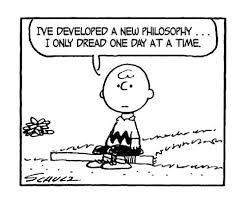
Later that day I stumbled across an old Peanuts cartoon drawn by Charles Schultz. I had grown up with Charlie Brown. I think I read most of the 17,897 comic strips Schultz penned during his 50-year career. In this particular comic strip Charlie Brown sat alone on the curb with that typical forlorn expression on his face, thwarted at every turn by life. With a hint of resigned optimism, Charlie Brown said…

dread 3

The cartoon made me smile and marvel at how God uses such ordinary things to remind us that his presence in our lives trumps every shred of doubt, disquiet and dread. As a Christian in a world in turmoil it is sometimes difficult to walk in confidence. How are we supposed to face life’s uncertainties and our own insecurities when it seems the world around us has gone mad? How do we stop being anxious about all that we see happening around us?

Sorry, Charlie. The answer does not lie in dreading only one day at a time. Paul gave us a clue in his letter to the Ephesian church as they struggled to live in a world in equal turmoil as our own. Look at Ephesians 5:1, 15-17…

“Be imitators of God, therefore, as dearly loved children, and live a life of love, just as Christ loved us…Be very careful, then, how you live—not as unwise but as wise, making the most of every opportunity, because the days are evil. Therefore, do not be foolish, but understand what the Lord’s will is.”

We come to grips with a crazy world by imitating God, living a life of love as modeled by Christ himself. We don’t fix the world’s problems by retreating from it or bemoaning its existence. We heal its sickness by loving it more. By serving it more. By sharing the alternative. Paul tells us that in the midst of evil days, we must live wisely, make right choices, follow the will of God as we understand it. And this might be the key… Our efforts can’t be uninspired or halfhearted. They can’t be judgmental and condemning. We must make the most of every opportunity God gives us to share his grace and love to a lost world.

Making the most of every opportunity allows us to see every day as a gift from God. Another chance to serve him. Another chance to love. Another day to care for those in need. Another day to rejoice. Another day to celebrate.

Charlie Brown suggested that we get the most out of the life when we are thankful for each day. When he discovers how blessed he is he goes into his happy dance…

happy dance

The Psalmist said it this way…

“This is the day that the Lord has made. Let us rejoice and be glad in it. Give thanks to the Lord, for he is good. His love endures forever.” — Psalm 118: 24, 29

God, thank you for this day and the many unmerited blessings you have showered upon us.

Maybe today, instead of watching the news, I’ll just break into my happy dance.

*****

(Author’s Note: Feel free to forward this Bible study to anyone you feel might benefit from its message by clicking on the email icon at the bottom of the page. Encourage your them to subscribe to the blog by entering their email address in the box on the right side of the page. Thank you for sharing.)

A Unsung Prayer Warrior

Background Verses: Colossians 1:7-8 and 4:12-13

All of us struggle with weighty decisions from time to time. Those issues that tend to keep you awake at night. Whether matters of the heart, matters of health or matters of the soul, we find comfort when we know there are friends and family praying for us. I cannot tell you how many times in my life I have found an element of peace after being told by a friend that they have lifted me up in prayer.

Last night I found myself reading through Colossians within that frame of reference. Here is a first-century church, a group of people from diverse backgrounds, Greek and Jew, master and slave, rich and poor, gathering regularly in someone’s home to hear the gospel proclaimed and to be taught how they should live as followers of Christ in a world that follows a very different moral compass…a church struggling to stay on the right path when those among them are preaching and teaching a tarnished truth blending convenient portions of pagan, Jewish and Christian teaching into a hybrid belief system lacking substance.

Yet, there are good people in the church, trying desperately to hang on to what they have been taught and what they believe. They’re hanging on while their faithful pastor Epaphras serves in Rome offering love and support to an imprisoned Paul, Christianity’s foremost missionary.

Imagine the Christians in Colossae, gathering quickly at a friend’s home. They’ve just been told that Tychius and Mark, two men well-known in the region for their association with Paul and their pastor, have arrived in town bearing a letter from Paul. Men and women of faith gathering in anticipation.

Erastus ducked his head through the door,

out of breath from his dash across town.

Eyes darted from face to face,

Slapping a back in greeting.

Clasping hands with those

not seen since they last gathered for worship.

Many others already sat in boisterous conversation

around the walls of the tidy villa.

Permeating the room was an air of

Energy.

Excitement.

Expectation.

Across the crowded room,

quietly visiting with the man of the house…

Two men he had never met.

Known only by reputation.

Associates of

The Missionary.

Though they looked tired from their journey,

they laughed easily.

Comfortable in their companionship .

Bound together

with those in the room by the

fellowship of faith.

Introductions are made.

Greetings exchanged.

Tychicus,

the elder of the two men took a step back,

yielding to Mark,

 the younger of the two messengers.

Erastus liked him immediately.

No haughtiness.

No pretense.

A calm tone and quiet voice.

A warm smile that spoke volumes

and revealed his heart.

“I have a letter from Paul,” he said,

“and a word from your pastor.”

Mark began to read.

“We always thank God, the Father of our Lord Jesus Christ,

when we pray for you because

we have heard of your faith in Christ Jesus…

the love you have for all God’s people–

the faith and love that springs from the hope stored up for you in heaven…

The gospel is bearing fruit and growing throughout the whole world–

just as it has been doing among you

since the day you heard it and truly understood God’s grace.

You learned it from Epaphras,

our dear fellow servant,

who is a faithful minister of Christ on our behalf,

and who also told us of your love in the Spirit.”

Erastus felt…

Edification.

Encouragement.

Erastus heard…

Warnings about the false doctrines that

wage war against their souls.

Words that inspired him to stand fast.

Hold true to what he had been taught.

 I have to believe Paul’s message met its intended purpose. False teachers had peppered them for months with a new doctrine that sounded right, but felt terribly wrong. Yet, the boldness of their arguments tempted them to abandon what they had been taught by their beloved pastor.

Those individuals who listened to the words read to them by Mark had to find reinforcement and reassurance in their fledgling faith.

Yet, as powerful as Paul’s words might have been, I can’t help but feel there was an unsung hero buried in the text of Paul’s letter. A name that captured their attention and strengthened their resolve by the simply sound of his name and the reminder of his love for them.

 The tone of Mark’s voice changed.

Clearly, the letter was drawing to a close.

Erastus had been lost in thought,

Staring at the floor.

His mind hearing,

but not locking on to the closing words

until the sound of a familiar name

jolted him from this thoughts.

“Epaphras, who is one of you and

a servant of Christ Jesus,

sends greetings.”

The men seated around him,

looked at each other and grinned.

The salutation was like balm on a sunburned back.

“Epahpras is always wrestling in prayer…

for you…

praying that you will stand firm in all the will of God,

mature and fully assured.

He is working hard for you.”

Erastus squared his shoulders.

Leaned back against the wall.

Closed his eyes.

Prayed for the kind of strength for which his pastor prayed.

Faith’s great turning point in his life.

Epaphras was a man of faith who loved his congregation. He saw them not simply as sheep to feed, but friends to love. A man who felt the burden of responsibility to develop their immature belief into a deep abiding faith that sustains. So, every day…every day…he lifted them up to the Father. Notice the words Paul used. “Always wrestling in prayer.” He never failed to remember his people in Colossae. The prayer was never casual, but deep and heartfelt.  Praying as if God might not hear unless his prayer sprung from his gut…fearful that if he did not intercede, God would not know how desperate their situation might be. Incessant. Insistent. Impassioned.

Not only did he pray frequently and deeply, but his prayer was specific. Not given to pious platitudes. The prayers were pointed…that they might “stand firm in all the will of God.” Continuing in their belief, finding in Him righteousness as a model for life; finding in Him strength as a mechanism to cope with any disinformation they might hear. Asking that they be…unwavering in their faith and their understanding of God’s grace and what he desires of them. That their faith might discern his perfect wisdom and desire for their lives. Instilling in them…the truth of what they believe and how that belief is translated into practice. Inspiring them to…demonstrate the courage of their conviction even in the midst of abuse and persecution.

I find value in the life of Epaphras, this unsung bible hero, who cared so deeply for the spiritual security of his friends and neighbors that his spirit groaned in passionate petition for his people. May I be blessed with that kind of prayer warrior lifting me up as I deal with life that God has laid before me. May I be that kind of prayer warrior for those I love and those I serve.

Source: The Searcher